加息预期

Search documents
长江期货市场交易指引-20260401
Chang Jiang Qi Huo· 2026-04-01 01:24
1. Report Industry Investment Ratings - **Macro Finance**: Bullish on stock indices in the medium to long term, suggesting buying on dips; expecting government bonds to move in a sideways pattern [1][5] - **Black Building Materials**: Short - term trading for coking coal; range trading for rebar; shorting on rebounds for glass [1][8][10] - **Non - ferrous Metals**: Holding short positions moderately on rallies for copper; strengthening observation for aluminum; suggesting waiting and seeing for nickel; range trading for tin; expecting gold, silver and lithium carbonate to move in a sideways pattern [1][14][20][24] - **Energy Chemicals**: Bullish - biased sideways movement for PVC, caustic soda, styrene, polyolefin, and rubber; shorting on rallies for soda ash; range trading for urea and methanol [1][25][27][32] - **Cotton Textile Industry Chain**: Bullish - biased sideways movement for cotton and cotton yarn; expecting apples and jujubes to move in a sideways pattern [1][38][39] - **Agricultural and Livestock**: Rolling short positions at high levels for the 05 and 07 contracts of live pigs; shorting cautiously on weak rebounds of near - month contracts for eggs; hedging cautiously on weak rebounds of near - month contracts for corn; paying attention to the support performance at 2900 - 2950 for the 05 contract of soybean meal; bullish - biased sideways movement and rolling long strategy for oils and fats [1][43][45][47] 2. Core Views of the Report The report provides trading suggestions and market outlooks for various futures products based on comprehensive analysis of macro - economic factors, geopolitical situations, supply - demand relationships, and cost - profit conditions. It emphasizes the impact of factors such as the Middle East conflict on global markets, and suggests corresponding trading strategies according to the different characteristics of each product [1][5][15] 3. Summaries by Relevant Catalogs Macro Finance - **Stock Indices**: Expected to move in a bullish - biased sideways pattern. The willingness of the US and Iran to end the Middle East conflict has led to a sharp rise in US stocks, and stock indices may be bullish - biased [5] - **Government Bonds**: Expected to move in a sideways pattern. After the end of the quarter, the proportion of bonds in asset allocation may gradually increase [6] Black Building Materials - **Coking Coal and Coke**: Expected to move in a sideways pattern. The total inventory of coking coal has slightly increased, and the inventory transfer of coking coal and coke is smooth [8][9] - **Rebar**: Expected to move in a sideways pattern. The futures price is below the electric - furnace valley - electricity cost, and the demand is still recovering [10] - **Glass**: Expected to be weak. The hype of coal cost has weakened, and the demand in the peak season is not good [11] Non - ferrous Metals - **Copper**: High - level sideways movement. Affected by macro - factors, there is a downward risk, but domestic inventory reduction and the consumption peak season will provide support [14][15] - **Aluminum**: High - level sideways movement. Supply concerns may boost the price, and attention should be paid to the development of the situation [17] - **Nickel**: Sideways movement. The support at the ore end is strong, but the lack of demand and macro - disturbances limit the upward drive [18][19] - **Tin**: Sideways movement. The supply of tin ore is tight, and the downstream demand is in a state of rigid procurement [20] - **Silver and Gold**: Sideways movement. Affected by the Middle East situation and economic data, the medium - term price center has moved up [21][22][23] - **Lithium Carbonate**: Range - bound sideways movement. Supply and demand are both increasing, and attention should be paid to supply disturbances [24] Energy Chemicals - **PVC**: Bullish - biased sideways movement. Although the current supply - demand situation is weak, there are opportunities for short - term rebound and long - term industrial upgrading [25] - **Caustic Soda**: Bullish - biased sideways movement. Supported by spring maintenance and downstream replenishment, exports may increase [27] - **Styrene**: Bullish - biased sideways movement. Supported by cost and with low inventory pressure, it is expected to maintain de - stocking [28] - **Polyolefin**: Bullish - biased sideways movement. Supported by cost and with marginal improvement in supply - demand [29][30] - **Rubber**: Bullish - biased sideways movement. In the short term, it is in a game between synthetic rubber support and inventory pressure [31] - **Urea**: Bullish - biased sideways movement. Supply is at a high level, and demand is supported by agricultural and compound fertilizer needs, with smooth de - stocking [32][33] - **Methanol**: Bullish - biased sideways movement. The supply - demand situation is relatively stable, and inventory has decreased [34] - **Soda Ash**: Shorting on rallies. Supply is in excess, and the price may continue to be under pressure [35][36] Cotton Textile Industry Chain - **Cotton and Cotton Yarn**: Bullish - biased sideways movement. Global cotton supply is increasing, but domestic consumption is strong, and the price of chemical fiber has a positive impact [38] - **Apples**: Sideways movement. The market is polarized, with good - quality goods being in high demand [39] - **Jujubes**: Sideways movement. The raw material acquisition in the production area is based on quality, and the enthusiasm of merchants to restock is not high [41] Agricultural and Livestock - **Live Pigs**: Bottom - building sideways movement. In the short term, the supply exceeds the demand, and in the long term, the price may rise after the supply tightens [43] - **Eggs**: Bearish - biased sideways movement. In the short term, the price increase is weak, and in the long term, it is in a state of bottom - building [45] - **Corn**: Range - bound sideways movement. The supply - demand situation is relatively balanced, and the near - month contract can be hedged on weak rebounds [47] - **Soybean Meal**: High - level sideways movement. The 05 contract should pay attention to the support at around 2900 [47] - **Oils and Fats**: Bullish - biased sideways movement. Supported by palm oil de - stocking and the B50 plan in Indonesia, but the supply will be relatively loose in the second quarter [53]
海外地缘冲突持续,关注中国3月官方PMI
Hua Tai Qi Huo· 2026-03-31 07:02
Report Summary 1. Report Industry Investment Rating - Not provided in the given content. 2. Core Viewpoints - Overseas geopolitical conflicts, especially in the Middle East, are having a significant impact on the global market, with the Iran - Israel conflict affecting energy prices and related industries. - Global interest rate hike expectations are rising, which, combined with the impact of the Middle East conflict on the economy, has led to a "recession" pricing scenario in the market. - China's domestic policies are taking the lead, and the economic structure shows differentiation, with different performance in various economic indicators. - The short - term fluctuations of commodities are mainly dominated by the Iran situation and oil prices, and different commodity sectors have different investment opportunities and risks. [1][2][3] 3. Summary by Related Catalogs Market Analysis - **Iran Situation**: The Iran - Israel conflict has escalated, with attacks on key energy facilities. The US proposed a one - month cease - fire, and Iran responded to the 15 - point cease - fire plan. The situation mainly affects crude oil, LPG, and the shipping sector, and has a far - reaching impact on the energy and agricultural product markets. [1] - **Global Interest Rate**: The Fed, the Bank of England, and the European Central Bank have different stances on interest rates. Global interest rate hike expectations are rising, and the market is in a "recession" pricing situation due to factors such as rising oil prices and supply chain disruptions. [2] - **Domestic Economy**: China's February economic data shows that exports and imports have increased significantly. The consumer and industrial sectors are growing, while the real estate sector is in decline. Different commodity sectors have different performance and influencing factors. [3] Strategy - For commodities and stock index futures, investors can buy on dips in stocks, precious metals, and some chemical products. [4] To - do List - The US Senate Banking Committee plans to hold a hearing on Kevin Warsh, the nominee for the Fed Chair, starting in the week of April 13. - The EU Energy Minister will discuss the EU's energy coordination plan for the Middle East situation on Tuesday. [2][6]
大越期货贵金属早报-20260331
Da Yue Qi Huo· 2026-03-31 02:05
Report Industry Investment Rating No information provided in the report regarding the industry investment rating. Core Viewpoints - The dovish stance of Federal Reserve Chairman Powell and the escalating Middle - East situation led to the fluctuating upward trend of gold and silver prices. The expected improvement in US - Iran peace talks and the cooling of interest - rate hike expectations made the prices of gold and silver fluctuate strongly [4][5]. - The continuous escalation of the US - Iran conflict, high oil prices, and the increasing expectation of interest - rate hikes caused gold prices to continue to give back gains in recent years. However, with the approaching mid - term elections, there was still macro - level support [9][12]. Summary by Directory 1. Previous Day Review - **Gold**: The dovish statement of Federal Reserve Chairman Powell and the escalation of the Middle - East situation made the gold price fluctuate upward. The US three major stock indexes had mixed closing results, European three major stock indexes all rose, US bond yields fell across the board, the 10 - year US bond yield dropped 7.76 basis points to 4.350%, the US dollar index rose 0.32% to 100.51, the offshore RMB against the US dollar appreciated slightly to 6.9164, and COMEX gold futures rose 0.36% to $4540.40 per ounce [4]. - **Silver**: Similar to gold, the silver price also fluctuated upward. COMEX silver futures rose 0.55% to $70.18 per ounce [5]. 2. Daily Tips - **Gold**: The basis was - 4.6, with the spot at a discount to the futures, which was neutral. The gold futures warehouse receipts remained unchanged at 106,644 kilograms, which was bearish. The 20 - day moving average was downward, and the K - line was below the 20 - day moving average, which was bearish. The main net long position increased, which was bullish [4]. - **Silver**: The basis was - 34, with the spot at a discount to the futures, which was neutral. The Shanghai silver futures warehouse receipts increased by 2,628 kilograms to 374,427 kilograms, which was bullish. The 20 - day moving average was downward, and the K - line was below the 20 - day moving average, which was bearish. The main net long position decreased, which was bullish [5]. 3. Today's Focus - Multiple events were to be focused on, including French President Macron's visit to Japan, Japan's February unemployment rate and March Tokyo CPI, Australia's March monetary policy meeting minutes, China's March official manufacturing, non - manufacturing, and comprehensive PMI, and many more speeches by central bank officials and economic data releases [15]. 4. Fundamental Data - **Gold**: The fundamental situation was affected by factors such as the Federal Reserve's attitude, the Middle - East situation, and the US stock and bond markets. The basis, inventory, and technical indicators all had an impact on the gold price [4]. - **Silver**: Similar to gold, the silver price was affected by multiple factors including the Federal Reserve's attitude, the Middle - East situation, and the US stock and bond markets. The basis, inventory, and technical indicators also influenced the silver price [5]. 5. Position Data - **Gold**: The long - position volume of the top 20 holders in Shanghai gold decreased by 1,974 to 147,144, a decrease of 1.32%. The short - position volume increased by 2,307 to 44,494, an increase of 5.47%. The net position decreased by 4,281 to 102,650, a decrease of 4.00% [38]. - **Silver**: The long - position volume of the top 20 holders in Shanghai silver increased by 238 to 240,033, an increase of 0.10%. The short - position volume increased by 1,561 to 214,706, an increase of 0.73%. The net position decreased by 1,323 to 25,327, a decrease of 4.96% [41].
研究所晨会观点精萃-20260330
Dong Hai Qi Huo· 2026-03-30 03:33
Report Summary 1. Industry Investment Ratings No industry investment ratings are provided in the report. 2. Core Views - The market is worried about the escalation of the tense situation between the US and Iran, leading to a continued decline in global risk appetite. In the short term, the domestic stock index oscillates weakly with increased volatility, and the domestic stock index market cools down again. - The overall economic and inflation situation in China from January to February is better than expected, but the overall goals and policy intensity in 2026 are lower than those in 2025. - Different asset classes have different trends: stocks oscillate weakly in the short term; bonds oscillate in the short term; black commodities oscillate weakly; non - ferrous metals oscillate weakly; energy and chemical products oscillate strongly; precious metals oscillate significantly and rebound in the short term [2][3]. 3. Summary by Categories 3.1 Macro - finance - Overseas: Iran claims to have closed the Strait of Hormuz, and other energy supply interruption news has hit risk sentiment. International oil prices have risen unilaterally, and the US dollar index and US bond yields have increased. - Domestic: The Chinese economy rebounded unexpectedly from January to February, exports far exceeded expectations, and inflation continued to recover. The overall economic and inflation situation is better than expected. The government work report sets the main expected development goals and fiscal and monetary policies for 2026, with overall goals and policy intensity lower than in 2025. - Asset trends: Stocks oscillate weakly and with increased volatility in the short term; bonds oscillate in the short term; black commodities oscillate weakly; non - ferrous metals oscillate weakly; energy and chemical products oscillate strongly; precious metals oscillate significantly and rebound in the short term. It is recommended to observe cautiously in the short term [2]. 3.2 Stock Index - Driven by sectors such as energy metals, biomedicine, and small metals, the domestic stock market rebounded. - The economic and inflation situation from January to February is better than expected, but the overall goals and policy intensity in 2026 are lower than in 2025. - The market trading logic focuses on Middle - East geopolitical risks. In the short term, the stock index oscillates weakly and with increased volatility due to the mixed geopolitical news. It is recommended to observe cautiously in the short term [3]. 3.3 Precious Metals - The precious metals market rose on Friday night. The Shanghai gold main contract closed at 1009.44 yuan/gram, up 1.73%; the Shanghai silver main contract closed at 17763 yuan/kg, up 3.12%. - Spot gold rose significantly in the US session, breaking through the $4550 mark, and finally closed up 2.58% at $4492.99/ounce; spot silver closed up 2.55% at $69.78/ounce. - Precious metals oscillate significantly and rebound in the short term. It is recommended to observe cautiously in the short term [4]. 3.4 Black Metals - **Steel**: The steel futures and spot markets continued to oscillate on Friday, and the trading volume was low. The escalation of the Middle - East situation over the weekend may further increase steel costs. The real demand has improved marginally, and the inventory decline has continued to expand. The apparent consumption of five major steel products has decreased slightly this week, but the hot - metal output has increased slightly. The steel market will follow the cost in the short term [7]. - **Iron Ore**: The spot price of iron ore dropped significantly on Friday, and the futures price oscillated at a high level, mainly affected by rumors of iron - ore negotiation setbacks. The demand for iron ore remains resilient, and the supply and demand misalignment problem is gradually being alleviated. The room for further price increase is limited, and attention should be paid to the risk of phased adjustment after the energy price weakens [7]. - **Silicon Manganese/Silicon Iron**: The spot prices of silicon iron and silicon manganese were flat on Friday, and the futures trends were divergent, with silicon manganese showing a stronger trend. The rebound in oil prices supports the alloy prices. The silicon - manganese market has stable supply, and the profit margin is acceptable. The silicon - iron market is waiting for the entry situation in April. It is recommended to view the futures prices of silicon iron and silicon manganese with an oscillating - strong mindset [8]. 3.5 Non - ferrous Metals and New Energy - **Copper**: The copper price dropped significantly, and downstream enterprises replenished their inventories at low prices, resulting in a significant decrease in social copper inventories. The supply of the copper market remains loose, and the downstream terminal demand is affected by the overdraft effect of last year. The core contradiction lies in the mining end, and the probability of extreme shortage is not high [9]. - **Aluminum**: The attack on the UAE Global Aluminum Company may affect electrolytic - aluminum production in the short term, providing some support for the aluminum price. The domestic aluminum - ingot social inventory is at a high level and is being depleted slowly due to high domestic supply [9]. - **Zinc**: The domestic zinc - ingot inventory continued to decline last week but is still at a high level in recent years. The zinc - ore processing fees in the south have rebounded, and the domestic smelting output remains relatively high. The overseas smelting output will increase in 2026. The demand is not optimistic [10][11]. - **Lead**: The imports of refined lead and crude lead in the first two months increased significantly. The domestic production of primary lead and secondary lead has increased seasonally. The demand is entering the off - season, and the social inventory of primary lead has decreased. The LME lead inventory is at a high level [11]. - **Nickel**: The Indonesian policy is unstable. The RKAB quota in 2026 has decreased significantly, and the MHP supply may decline. The nickel price has support at the bottom, but the upside space is limited by high inventories at home and abroad [12]. - **Tin**: The imports of tin ore from Myanmar have increased significantly, and the import sources are more diversified. The demand is mixed, with the semiconductor industry performing well but other industries underperforming. The tin price has rebounded due to the return of risk appetite and inventory depletion. Attention should be paid to the emotional fluctuations caused by the repeated Middle - East situation [13]. - **Lithium Carbonate**: The weekly production of lithium carbonate has increased, and the social inventory has decreased slightly. The supply and demand are both strong, and the inventory of smelters remains low. There is still no progress in the negotiation of the Zimbabwean export ban, and the lithium carbonate price has a large upward potential. It is recommended to lay out at low prices or hold long positions cautiously [14]. - **Industrial Silicon**: The weekly production has decreased slightly, and the social inventory is at a high level and stable. The supply and demand are weak, and the production capacity is in surplus. The price is close to the cost, and it is expected to oscillate strongly due to the increase in coking - coal prices [15]. - **Polysilicon**: The prices of silicon wafers and battery cells have continued to decline, and the inventory has increased slightly. The medium - and long - term policy is negative for the market, and the price is close to the full - cost range. Attention should be paid to the inventory depletion situation after April. It is recommended to hold short positions cautiously or take partial profits [16]. 3.6 Energy and Chemicals - **Crude Oil**: The US preparation for landing operations has kept the market's expectation of the Strait's safety low. The attack on the Russian terminal has restricted oil exports, and the oil price has exceeded $100. The oil price will remain strong in the short term [17]. - **Asphalt**: The oil - price support continues, the refinery production schedule in April is expected to decline significantly, and the seasonal demand will increase. The total inventory will be depleted, and the short - term price will follow the oil price and fluctuate significantly [17]. - **PX**: The price of naphtha is strong, and the PX price has rebounded. The PX will remain strong in the short term due to the decrease in upstream reforming operations and the increase in overseas demand for aromatic materials [17]. - **PTA**: The PTA price has increased following the decline of the reforming device, but the increase is limited by the negative feedback from the downstream. The core logic lies in the aromatic raw materials, and the PTA is likely to be strong [18]. - **Ethylene Glycol**: The overseas supply of ethylene glycol is expected to decrease significantly, and the price has remained strong. Attention should be paid to the negative feedback from the terminal [18]. - **Short - fiber**: The increase in the oil price has driven the polyester sector to strengthen. The finished - product inventory is low, and the production and sales have declined. The short - fiber will continue to oscillate strongly in the short term [19]. - **Methanol**: The import reduction due to the geopolitical conflict has led to a reduction in port inventory and an increase in inland demand. The methanol market has support, but attention should be paid to the marginal changes caused by geopolitical relaxation and downstream negative feedback [19]. - **PP**: The upstream supply has decreased, and the downstream demand has increased. The spot market is tight, and the price is expected to remain strong. The key variable is the navigation situation in the Strait of Hormuz [19]. - **LLDPE**: The upstream supply has continued to decrease, and the demand has been supported by the traditional peak season. The inventory has been depleted rapidly, and the polyethylene is expected to continue to operate strongly. Geopolitical factors are the key variables [19]. - **Urea**: The policy of ensuring supply and stabilizing prices continues to put pressure on the market, but the industrial demand provides support. The price will oscillate narrowly in the short term [20]. 3.7 Agricultural Products - **US Soybeans**: The US biodiesel policy has been finalized, and the policy benefits are exhausted. The uncertainty of Sino - US soybean trade has increased. The increase in the CBOT soybean price is limited by profit - taking [21]. - **Soybean and Rapeseed Meal**: The arrival of imported soybeans at oil mills has decreased seasonally, and the inventory has been depleted rapidly. The basis remains high. The supply of rapeseed meal is expected to increase, and the price will oscillate with the soybean meal [21]. - **Oils and Fats**: The crude - oil price is the main driving factor for international oils and fats. The vegetable - oil price has the potential to rise, but it is restricted by recession expectations and the expected high - yield. The domestic soybean - oil inventory is being depleted, and the price difference between soybean oil and palm oil may rebound. The supply of rapeseed oil may increase, and it will fluctuate with soybean oil and palm oil [22]. - **Corn**: The bargaining power of the trading end has increased, but the downstream demand is weak. The possible rice auction in early April may have a negative impact on the corn price [23]. - **Hogs**: The weight of hogs in stock is increasing, and farmers are reluctant to sell. The short - term spot price may continue to weaken, but the long - term expectation is improving. The futures market has risks in the near - term contracts and support in the far - term contracts [23].
期货研究报告:战争再度升级,能化仍应偏强
Dong Zheng Qi Huo· 2026-03-30 03:17
1. Report Industry Investment Rating No relevant content provided. 2. Core View of the Report - The performance of commodities next week is expected to be in the order of energy and chemicals > ferrous metals > agricultural products > non - ferrous metals > precious metals. It is necessary to be vigilant against the risk of continuous reversal of market sentiment due to the erratic stance of the Trump administration [2][18][105] 3. Summary According to Relevant Catalogs 3.1 One - week Review and Views 3.1.1 One - week Review - From March 16th to March 22nd, war expectations reversed continuously, and the trends of various commodities were differentiated. In terms of sectors, the order was oil chemical > non - ferrous metals > coal chemical > black > agricultural products > precious metals > energy. On Monday, the US - Iran conflict intensified, energy and chemical prices rose, driving the black sector stronger, while precious metals and non - ferrous metals weakened, and agricultural products fluctuated narrowly. On Tuesday, Trump started TACO, energy and chemical sectors weakened rapidly, and the increase in the black sector was also reduced. Subsequently, the market was mainly trading in the TACO mode. Near the weekend, the risk of war escalation reappeared, the decline in energy prices narrowed, and chemical products turned up. The market's interest - rate hike expectation decreased, and precious metals and non - ferrous metals rebounded [1][12] 3.1.2 Next - week Outlook - War situation and economic indicators will jointly affect the market next week. There are signs that the war is escalating again. Important economic indicators such as the March PMI of major economies and the US March non - farm payrolls will be released. It is expected that China's March PMI will rise, and the US March S&P manufacturing PMI will recover. War escalation is beneficial to energy and chemicals, and the price increase of energy products will spill over to the black and some agricultural products. Although the rise in oil prices has made the market price in the Fed's interest - rate hike this year, the risk of stagflation is also rising. The overall performance of commodities next week is expected to be energy and chemicals > ferrous metals > agricultural products > non - ferrous metals > precious metals [2][17][18] 3.2 Exchange Rate and Interest Rate Data Tracking - The US dollar index strengthened, and the yield of the 10Y US Treasury bond increased. As of the close on March 27th, the US dollar index rose 0.67% to 100.1745 compared with the close of last weekend; the yield of the 10Y US Treasury bond was reported at 4.44%, up 5BP from last weekend, and the interest - rate spread between the 10Y Chinese and US Treasury bonds was inverted by 262.1BP. The war rhythm still affects the market. The RMB fluctuated narrowly [26] 3.3 Upstream Raw Material Prices - The war rhythm was tortuous, oil prices fluctuated at a high level, and the price of coking coal was supported by energy - end disturbances [29] 3.4 Production - end High - frequency Data - This week, the production - end data of most commodities improved. Only the PE operating rate dropped to a recent low due to many maintenance devices. The supply and demand of soda ash and glass were both weak [33] 3.5 Inventory - end High - frequency Data - The inventories of gold and silver continued to decline slightly. The inventories of most industrial products showed the characteristic of de - stocking at a high level. The release of "Golden March" demand was an important reason for inventory de - stocking. However, the inventories of copper, aluminum, iron ore, methanol, PVC and other varieties were still at a relatively high level in the same period of history, and the de - stocking rhythm needed to be continuously observed. The slaughter weight of pigs continued to rise, and the inventory pressure was still high [47] 3.6 Demand - end High - frequency Data - This week, real - estate data was generally positive. The sales areas of commercial housing in 30 large and medium - sized cities and first - tier cities were both rising. The listing index of second - hand housing for sale in national cities declined slightly, and the transaction area of second - hand housing in 16 cities also declined slightly but remained at a seasonally high level. The net financing scale of government bonds was slightly low this week, and the cumulative net financing amount of government bonds this year was lower than that of the same period last year. The passenger volume of the subway and the flight execution rate were both rising seasonally. The apparent consumption of rebar increased, and project construction accelerated. The freight rate index was still rising [71][72] 3.7 Key Commodity Basis - The report provides data on the basis of key commodities such as gold, copper, aluminum, rebar, iron ore, coking coal, crude oil, methanol, PTA, PVC, pigs and soybean meal, but no specific analysis content is given [84] 3.8 Commodity Price Ratios - The report provides data on commodity price ratios such as the gold - silver ratio, gold - copper ratio, gold - oil ratio, copper - oil ratio, copper - aluminum ratio, steel - ore ratio, agricultural - industrial ratio and pig - grain ratio, but no specific analysis content is given [97] 3.9 Summary and Outlook - The performance of commodities is expected to be energy and chemicals > ferrous metals > agricultural products > non - ferrous metals > precious metals. It is necessary to be vigilant against the risk of continuous reversal of market sentiment [3][105]
宁证期货今日早评-20260330
Ning Zheng Qi Huo· 2026-03-30 02:59
Report Summary 1. Report Industry Investment Rating No information provided. 2. Core Views - The report provides short - term evaluations and outlooks for multiple commodities including coal, methanol, precious metals, industrial metals, energy, and agricultural products, considering factors such as supply - demand, geopolitical conflicts, and policy changes [1][2][4]. 3. Summary by Commodity Coal and Related Products - **Coking Coal**: After most domestic coal mines resumed production, they maintained normal production, but some mines in Inner Mongolia and Shanxi had production limitations, resulting in a slight decline in output. The overall customs clearance of Mongolian coal remained high, and in the short - term, prices were likely to rise and difficult to fall. Attention should be paid to geopolitical conflicts [1]. - **Methanol**: Domestic methanol production was at a high level, downstream demand recovered, port inventories continued to decline, and imports decreased significantly. The market was expected to be slightly stronger in the short - term [2]. Precious Metals - **Silver**: There were uncertainties in the market's interest - rate hike expectations and the appointment of the Fed chairman. Silver passively followed the movement of gold and was expected to fluctuate within a range in the medium - term [4]. - **Gold**: The war situation seemed to have escalated, and the risk - aversion sentiment rose. Gold had a short - term rebound demand and was expected to have a wide - range fluctuation pattern in the medium - term [4]. Industrial Metals - **Iron Ore**: Geopolitical conflicts affected the shipping rhythm of overseas mines, and the high oil price increased shipping costs. The overall supply - demand of iron ore was in a state where the pressure was difficult to be traded. Market sentiment was affected by conflicts, and the liquidity of some varieties was a key factor affecting prices [5]. - **Steel (Rebar)**: The peak - season demand for rebar was expected to be limited, the supply pressure increased with the resumption of blast furnaces, and the inventory was relatively high. The futures price faced the pressure of a high - level decline [5]. - **Aluminum**: Two major aluminum companies in the Middle East were attacked, increasing the market's concern about supply interruption. Although the domestic supply was relatively stable, aluminum prices were expected to be slightly stronger in the short - term [11]. - **Copper**: The long - term cooperation plan pointed to an increase in supply, but it had limited impact on the current market. The supply was still tight, and the demand was picking up. Copper prices were expected to fluctuate in the short - term [8]. - **Nickel**: The postponement of the windfall tax implementation provided short - term support. The supply tightening expectation was alleviated, and the demand was expected to release further. Nickel prices were expected to fluctuate [12]. - **Alkali (Soda Ash)**: The domestic soda ash market was stable with a slight decline. The demand was general, and the inventory was high. Prices were expected to be slightly weaker in the short - term [14]. Energy - **Crude Oil**: The short - term operation should be cautious. In the medium - term, the longer the war lasted, the stronger the upward driving force for oil prices [10]. - **Asphalt**: The supply shortage was not effectively alleviated. If the terminal consumption recovered, the inventory was expected to decline, and it was advisable to take long positions at low levels [10]. - **Fuel Oil**: High - sulfur fuel oil supply might be tightened due to geopolitical conflicts, and low - sulfur fuel oil production declined. It was advisable to take long positions at low levels [12]. Agricultural Products - **Palm Oil**: The market's attention to the US biodiesel policy increased, and the export of Malaysian palm oil was strong. The domestic high - inventory situation suppressed prices. Palm oil was expected to fluctuate at a high level in the short - term [7]. - **Rapeseed Meal**: The future supply of rapeseed was expected to increase, and the market was bearish. Rapeseed meal prices were expected to decline in the short - term [8]. - **Pig**: The pig price was weak and stable, with limited demand growth. The futures price of the far - month contract was stable, and attention should be paid to the slaughter volume and the reduction of sows [6]. Others - **Five - year Treasury Bond**: The industrial enterprise profit data was better than expected, which was negative for the bond market. The bond market was expected to fluctuate and wait for policy guidance [7]. - **Plastic**: The supply pressure of LLDPE was expected to be alleviated, the downstream demand was rising, but the high price suppressed the purchasing enthusiasm. Plastic prices were expected to fluctuate in the short - term [15].
大越期货贵金属早报-20260327
Da Yue Qi Huo· 2026-03-27 02:24
1. Report Industry Investment Rating - No information provided 2. Core Viewpoints of the Report - Due to the deadlock in the cease - fire negotiations between the US and Iran and Trump's statement of delaying the strike on Iranian energy facilities for ten days, the prices of gold and silver have fallen. However, due to the high uncertainty of the US - Iran peace talks and the easing of emotions, the prices of gold and silver will fluctuate. The conflict between the US and Iran continues to escalate, oil prices are high, and the expectation of interest rate hikes is rising, causing gold prices to continue to give back gains in recent years. With the approaching mid - term elections, there is still support at the macro - level [4][5][9][12] 3. Summary According to the Directory 3.1. Previous Day's Review - **Gold**: COMEX gold futures fell 3.85% to $4376.90 per ounce. The US three major stock indexes and European three major stock indexes all closed down. The US bond yields rose collectively, with the 10 - year US bond yield rising 8.34 basis points to 4.414%. The US dollar index rose 0.3% to 99.93, and the offshore RMB depreciated against the US dollar to 6.9206 [4] - **Silver**: COMEX silver futures fell 6.22% to $68.12 per ounce. Other market conditions are similar to those of gold [5] 3.2. Daily Tips - **Gold**: The basis is - 3.48, with the spot at a discount to the futures, which is neutral. The inventory of gold futures warehouse receipts is 1067463 kilograms, unchanged, which is bearish. The 20 - day moving average is downward, and the K - line is below the 20 - day moving average, which is bearish. The main net position is long, and the main long position is decreasing, which is bullish [4] - **Silver**: The basis is - 13, with the spot at a discount to the futures, which is neutral. The inventory of Shanghai silver futures warehouse receipts is 370299 kilograms, a decrease of 5795 kilograms, which is bullish. The 20 - day moving average is downward, and the K - line is below the 20 - day moving average, which is bearish. The main net position is long, and the main long position is increasing, which is bullish [5] 3.3. Today's Focus - 07:00, Fed Vice - Chairman Jefferson will talk about the US economy; 07:10, Fed Governor Barr will speak; Time TBD, the 2026 Global Developers Pioneer Conference will open, and the Brain - Computer Interface Innovation and Development Forum of the Zhongguancun Forum will be held; 09:30, China's industrial enterprise profits from January to February; 15:00, UK's retail sales in February; 22:00, the final value of the University of Michigan Consumer Confidence Index in the US in March; 23:00, Richmond Fed President Barkin (2027 FOMC voter) will talk about the economic outlook; 23:30, Philadelphia Fed President Anna Paulson (2026 FOMC voter) will talk about macro - economy and monetary policy, and San Francisco Fed President Daly (2027 FOMC voter) will give an opening speech at a monetary policy seminar; At 00:00 the next day, ECB Executive Board member Schnabel will speak; On Sunday, many European countries will start daylight saving time, and the market trading time will be advanced by one hour [15] 3.4. Fundamental Data - **Gold**: The conflict between the US and Iran continues to escalate, oil prices are high, and the expectation of interest rate hikes is rising, causing gold prices to continue to give back gains in recent years. With the approaching mid - term elections, there is still support at the macro - level. The factors that are bullish for gold include global turmoil, tense Middle - East situation, the influence of the shadow Fed, the upcoming appointment of a new Fed chairman, Trump's tariff disputes, etc. The bearish factors include high oil prices leading to capital transfer to crude oil and related commodities, the rising expectation of Fed interest rate hikes, the optimistic expectation of Russia - Ukraine peace talks, and the ineffectiveness of reciprocal tariffs [9] - **Silver**: The logic is similar to that of gold. In addition, the photovoltaic and technology sectors support the silver price, and the low spot inventory and the hot supply - shortage game are also bullish factors. The bearish factors also include the deterioration of risk appetite [12][14] 3.5. Position Data - **Gold**: The long position of the top 20 in Shanghai gold decreased by 1.32% to 147,144, the short position increased by 5.47% to 44,494, and the net position decreased by 4.00% to 102,650. The SPDR gold ETF position remained unchanged [38][43] - **Silver**: The long position of the top 20 in Shanghai silver increased by 0.10% to 240,033, the short position increased by 0.73% to 214,706, and the net position decreased by 4.96% to 25,327. The silver ETF position decreased slightly [41][45]
格林大华期货早盘提示:贵金属-20260327
Ge Lin Qi Huo· 2026-03-27 01:44
Report Industry Investment Rating - Not provided Core Viewpoints -受地缘政治影响,市场短期不确定性较大,投资者需注意控制仓位、防控风险 [2] Summary by Relevant Catalogs Market Quotes - COMEX黄金期货跌3.85%,报4376.90美元/盎司;COMEX白银期货跌6.22%,报68.12美元/盎司;沪金主力合约下跌2.83%,报980.08元/克;沪银主力合约下跌5.66%,报16841元/千克 [1] Important Information - 3月26日,全球最大黄金ETF--SPDR Gold Trust持仓较上日增加0.286吨,当前持仓量为1052.705吨;全球最大白银ETF--iShares Silver Trust持仓较上日减少104.21吨,当前持仓量为15409.46吨 [1] - 据CME“美联储观察”,美联储4月加息25个基点的概率为6.2%,维持利率不变的概率为93.8%;到6月累计加息25个基点的概率为19.9%,累计加息50个基点的概率为1.0%,维持利率不变的概率为79.2% [1] - 美国上周首次申领失业救济人数为21万人,预估为21万人,前值为20.5万人 [1] - 截至3月20日当周,土耳其央行黄金储备从820.8吨降至771.8吨,抛售约22吨黄金,还进行了约31吨的黄金互换交易 [1] - 特朗普称应伊朗政府要求将打击伊能源设施时间推后10天至4月6日,双方谈判进展顺利;伊朗官员称未就美国潜在袭击提出请求,已正式回应“15点计划”,认定美国谈判声明为“第三次欺骗”,目前无谈判安排 [1] Market Logic - 周四美伊紧张局势持续,美国延长对伊能源设施打击暂停期,伊朗回应无谈判安排;国际原油价格小幅上涨,美股下跌,2年期美债收益率上升约10个基点收报3.98%,美元指数上涨0.29%至99.92;叠加土耳其央行出售黄金消息,COMEX黄金和COMEX白银均回落;美伊双方立场差别大需调和,未来演变需持续关注 [1][2] Trading Strategy - 受地缘政治影响,市场短期不确定性较大,投资者注意控制仓位,防控风险 [2]
纳指深夜跌超500点,科技股重挫,闪迪跌超11%,小马智行跌超14%
Sou Hu Cai Jing· 2026-03-26 23:46
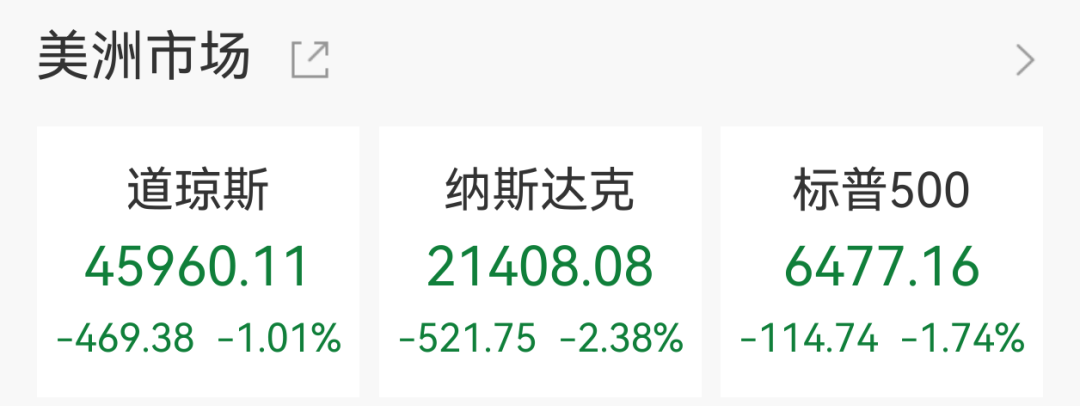
Market Overview - Major stock markets in Europe and the US experienced collective declines, with the Nasdaq dropping over 2% and the S&P 500 falling more than 1.7%, breaking below 6500 points, marking a new low since early September of the previous year [1] - The tech sector faced significant losses, with the US Tech Giants Index falling nearly 3%, led by Meta's nearly 8% drop and Google's over 3% decline [1] Company Performance - Nvidia fell over 4%, Tesla dropped more than 3%, Amazon decreased nearly 2%, and Microsoft declined over 1%, while Apple saw a slight increase of 0.11% [1] - Semiconductor stocks suffered a collective downturn, with the Philadelphia Semiconductor Index dropping nearly 5%. Notable declines included SanDisk down over 11%, Lam Research and Applied Materials down over 8%, and Micron Technology down nearly 7%, marking a 23% retreat from its historical high since March 18 [1][2] Chinese Stocks - Chinese stocks listed in the US also saw widespread declines, with the Nasdaq Golden Dragon China Index falling over 2.5%. Individual stocks such as Pony.ai dropped over 14%, XPeng fell over 6%, and Baidu and Bilibili decreased nearly 5% [2] Commodity Market - In the commodities market, international precious metals saw gains, with spot gold rising 0.51% to recover to $4400 per ounce, and silver increasing 0.82% to $68.49 per ounce [3] Cryptocurrency Market - The cryptocurrency market experienced a significant downturn, with Bitcoin dropping 3.38% below the $70,000 mark and Ethereum declining nearly 5%. Over 100,000 individuals faced liquidation, totaling $331 million in losses [4] Economic Context - The geopolitical situation between the US and Iran remains tense, with President Trump asserting that Iran is seeking negotiations. He announced a delay in airstrikes on Iranian energy facilities until April 6 [4] - Hawkish comments from Federal Reserve officials have strengthened expectations for a delay in interest rate cuts, with indications that the reduction of the Fed's balance sheet may take several years [4]

纳指深夜跌超500点,科技股重挫,闪迪跌超11%,小马智行跌超14%
21世纪经济报道· 2026-03-26 23:38
Market Overview - The US and European stock markets experienced a collective decline, with the Nasdaq dropping over 2% and the S&P 500 falling more than 1.7%, breaking below 6500 points, marking a new low since early September of the previous year [1] - Major technology stocks saw significant declines, with the "Big Seven" tech index falling nearly 3%, led by Meta which dropped nearly 8% following a ruling in a social media addiction lawsuit [2][3] Technology Sector - Nvidia fell over 4%, Tesla dropped more than 3%, and Amazon decreased nearly 2%, while only Apple saw a slight increase of 0.11% [3] - The Philadelphia Semiconductor Index plummeted nearly 5%, with notable declines in companies such as SanDisk (down over 11%) and Micron Technology (down nearly 7%) [3][4] Chinese Stocks - The Nasdaq Golden Dragon China Index fell over 2.5%, with significant drops in individual stocks such as Xiaoma Zhixing (down over 14%) and XPeng Motors (down over 6%) [5] Commodity Market - Following a previous day of significant declines, international precious metals saw a rise, with spot gold increasing by 0.51% to recover to $4400 per ounce, while spot silver rose by 0.82% [5] - International oil prices fell sharply, with WTI crude oil opening down over 1% and ICE Brent crude down over 1.7%, currently reported at $100.1 per barrel [5] Cryptocurrency Market - The cryptocurrency market experienced a significant downturn, with Bitcoin dropping 3.38% below the $70,000 mark and Ethereum declining nearly 5% [6] - Over 100,000 individuals faced liquidation in the past 24 hours, with a total liquidation amount of $331 million [6] Geopolitical Context - The ongoing tensions between the US and Iran continue to impact market sentiment, with President Trump asserting that Iran is seeking negotiations and delaying airstrikes on Iranian energy facilities [6] - Hawkish comments from Federal Reserve officials have reinforced expectations for a delay in interest rate cuts, with a growing belief among traders that the likelihood of rate hikes this year exceeds 50% [6]