
激光芯片

Search documents
光芯片,重磅进展
半导体行业观察· 2026-03-12 01:39
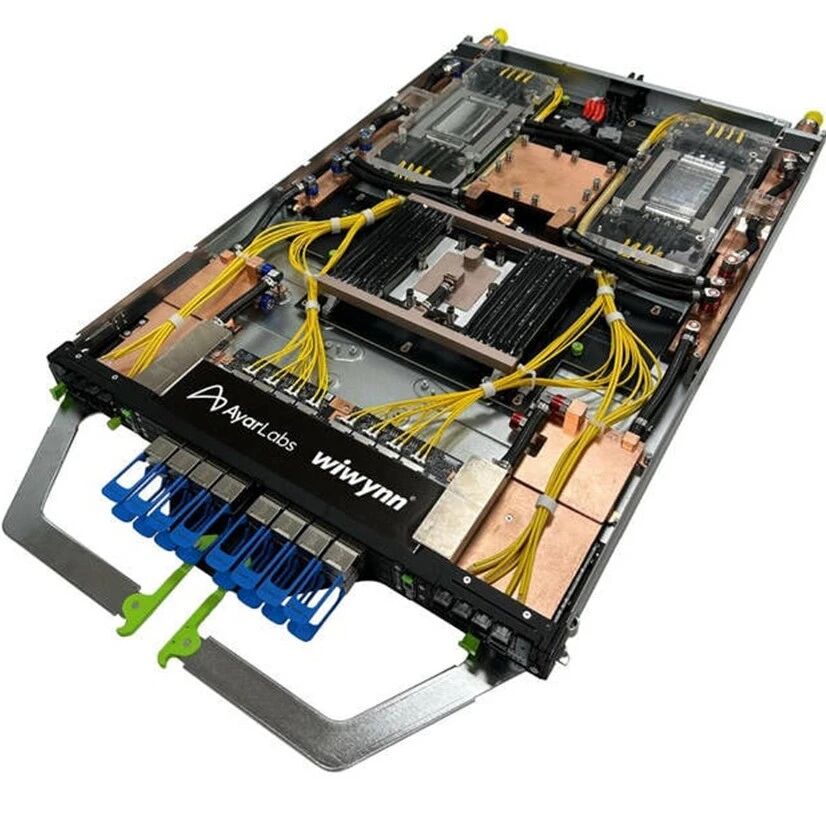
Core Viewpoint - Scintil Photonics, supported by Nvidia, has begun providing laser chips for testing, aiming to utilize optical pulses for data transmission in AI servers, which could simplify the connection of multiple chips into large computing systems [2][3]. Group 1: Company Developments - Scintil is in discussions with "six or seven companies" interested in using its technology by 2028, with a goal to produce hundreds of thousands of chips monthly [3]. - The company received $58 million in funding from Nvidia last year and has developed a method to package indium phosphide lasers with other components into a single chip [2][3]. - Scintil's LEAF Light is the first single-chip DWDM laser for AI infrastructure, with an evaluation kit (EVK) allowing customers to validate the technology in their environments [3][5]. Group 2: Technology and Product Features - LEAF Light aims to reduce power consumption by 50% compared to single-wavelength CPO, offering lower latency and higher bandwidth density [4][5]. - The EVK is expected to launch in Q2 2026, featuring two laser photon components and supporting 8 and 16 wavelength configurations [5][6]. - The technology includes on-chip digital control and monitoring capabilities, ensuring wavelength precision and power uniformity without manual intervention [6][7]. Group 3: Market Context and Competitors - The shift from copper interconnects to optical architectures is necessary as AI systems expand from single-rack to multi-rack configurations, with copper reaching its limits in speed and density [3][4]. - Other companies like Ayar Labs and Lightmatter are also advancing optical technologies, with Ayar developing a system integrating over 1024 GPUs and Lightmatter introducing a new optical engine that can halve fiber usage in data centers [8][15]. - Lightmatter's Passage L20 optical module is designed for high-performance switches and GPUs, aiming to reduce fiber costs and improve efficiency without requiring co-packaging [15][16].


长光华芯:公司持续关注新应用带来的市场机遇
Zheng Quan Ri Bao Zhi Sheng· 2026-02-25 12:46
Group 1 - The company is continuously monitoring market opportunities brought by new applications and will assess the development and layout of related products based on industry technology trends, market demand, and its own R&D progress [1] - The company has invested in Shangguang Communication through the Taihu Photonic Industry Fund and is closely tracking developments in this application field [1] - The company plans to leverage its platform advantages in laser chip technology to timely launch related products as needed [1]

长光华芯:公司将持续跟踪航空航天与新能源领域技术趋势与市场需求
Zheng Quan Ri Bao Zhi Sheng· 2026-02-25 12:45
Core Viewpoint - The company, Changguang Huaxin, is committed to tracking technological trends and market demands in two major fields, leveraging its existing expertise in laser chip technology for research and development [1] Group 1: Technology Development - The company will conduct preliminary technical exploration and feasibility studies tailored to applicable scenarios [1] - Future product development directions and timelines will be assessed cautiously based on the company's R&D progress, industry maturity, and market demand release pace [1] Group 2: Strategic Planning - The company aims to steadily advance its exploration of cutting-edge technologies and industrial research while aligning with its development plans [1] - The focus is on seizing potential opportunities arising from industry developments [1]
Lumentum Holdings Inc. (NASDAQ:LITE) Earnings Preview: A Look into the Future
Financial Modeling Prep· 2026-02-02 12:00
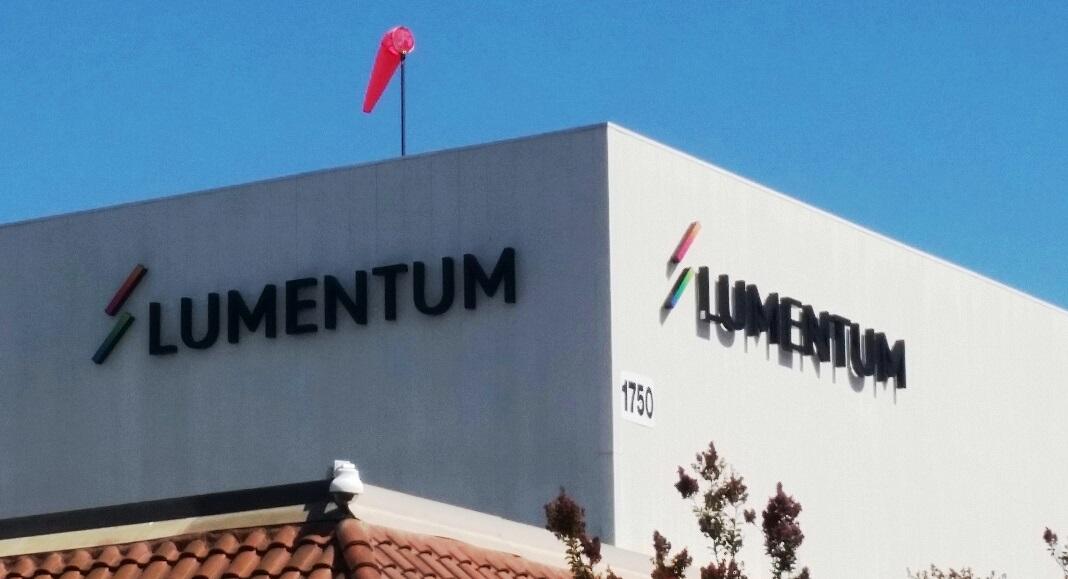
Core Insights - Lumentum Holdings Inc. is set to release its quarterly earnings on February 3, 2026, with analysts expecting an EPS of $1.40 and revenue of approximately $646.7 million [1][6] - The company is experiencing significant growth driven by increased demand for AI and cloud technologies, projecting revenues between $630 million and $670 million and non-GAAP EPS ranging from $1.30 to $1.50 [2][6] - Over 60% of Lumentum's revenue comes from AI and cloud demand, primarily from hyperscaler customers, with a Zacks Consensus Estimate for revenues at $652.4 million, reflecting a 62.2% increase from the previous year [3] Revenue and Growth Projections - Lumentum's optics business is thriving due to the adoption of AI technologies, with expectations to surpass its revenue guidance of $650 million sooner than anticipated [4] - The company's components for cloud and data center applications are crucial for data center operations, contributing to half of the expected growth in the second quarter [3][4] Market Impact - The upcoming earnings report could significantly impact Lumentum's stock price, with potential for a rise if expectations are exceeded, or a decline if results fall short [5]

可控核聚变技术跃进 多只概念股研发强度高(附名单)
Zheng Quan Shi Bao Wang· 2026-01-08 00:09
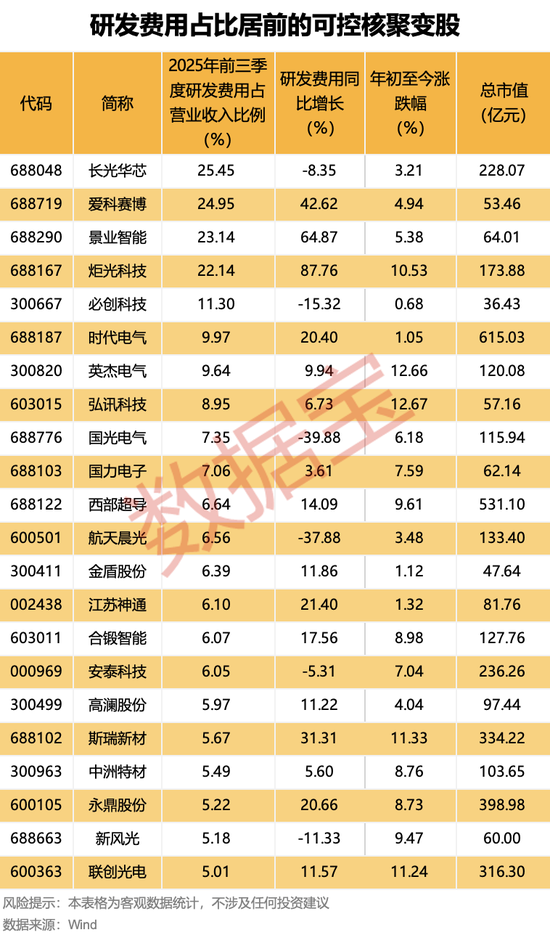
Core Insights - China's controllable nuclear fusion technology has achieved a new breakthrough, with significant advancements in the experimental device known as EAST, which has confirmed the existence of a density-free zone, providing important physical evidence for high-density operation in magnetic confinement fusion devices [3][4]. Industry Overview - The global fusion industry has experienced explosive growth over the past five years, with total investment soaring from $1.9 billion in 2021 to $9.7 billion, and an additional $2.6 billion expected in 2024 alone [4]. - Predictions from the International Energy Agency and the International Atomic Energy Agency suggest that the global nuclear fusion market could reach $496.55 billion by 2030 and potentially exceed $1 trillion by 2050 [4]. Company Developments - In the A-share market, 59 companies are involved in controllable nuclear fusion, with 22 companies reporting R&D expenses accounting for over 5% of their revenue before the third quarter of 2025 [5]. - Notable companies leading in R&D intensity include Changguang Huaxin, Aikesaibo, and Jingye Intelligent, with R&D expenses exceeding 20% of their revenue [5][7]. - Among these, Yujing Technology, Jingye Intelligent, and Aikesaibo reported significant year-on-year increases in R&D expenses of 87.76%, 64.87%, and 42.62%, respectively [6]. Financial Performance - Zhongtai Co. has forecasted a net profit of between 420 million to 480 million yuan for 2025, marking a turnaround from losses, driven by overseas orders in its manufacturing segment [6]. - The company has successfully implemented its helium refrigeration technology in fusion research facilities, indicating its relevance to the controllable nuclear fusion sector [6].
最可控核聚变技术跃进,多只概念股研发强度高
Xin Lang Cai Jing· 2026-01-07 23:51
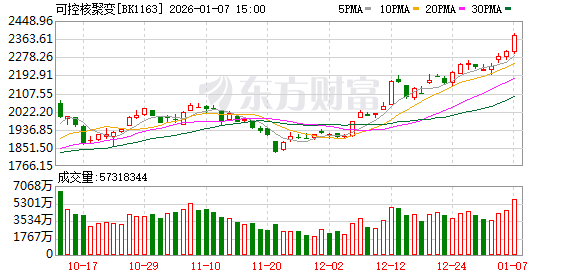
Group 1 - The concept of controlled nuclear fusion has gained momentum, with several stocks such as China Nuclear Engineering, Snowman Group, and others hitting the daily limit up, while stocks like Yingjie Electric and Zhongtai Co. have seen increases of over 6% [1][6] - The Chinese Academy of Sciences has announced a breakthrough in controlled nuclear fusion technology, confirming the existence of a density-free zone in the EAST experimental device, which provides important physical evidence for high-density operation of magnetic confinement fusion devices [1][6] - Controlled nuclear fusion is considered the ultimate solution for the energy revolution due to its abundant resources, environmental friendliness, and zero-carbon safety [1][6] Group 2 - The global fusion industry has experienced explosive growth, with total investment rising from $1.9 billion in 2021 to $9.7 billion, and an additional $2.6 billion expected in 2024 [2][7] - The global nuclear fusion market is projected to reach $496.55 billion by 2030 and exceed $1 trillion by 2050, driven by breakthroughs in high-temperature superconductors and artificial intelligence [2][7] - The focus of the controlled nuclear fusion industry is on technological engineering and commercial feasibility, with significant investment opportunities concentrated in the upstream sector [2][7] Group 3 - There are 59 stocks in the A-share market related to controlled nuclear fusion, with 22 companies reporting R&D expenses exceeding 5% of their revenue for the first three quarters of 2025 [3][8] - Companies like Changguang Huaxin and Aikesaibo have high R&D intensity, with R&D expenses as a percentage of revenue exceeding 20% [3][8] - Among the 22 companies, 16 reported year-on-year growth in R&D expenses, with notable increases from Juguang Technology (87.76%), Jingye Intelligent (64.87%), and Aikesaibo (42.62%) [3][8]


可控核聚变迎新突破 多只概念股研发强度高
Zheng Quan Shi Bao· 2026-01-07 17:59
Group 1 - The concept of controlled nuclear fusion is gaining momentum in the market, with several stocks experiencing significant gains, including China Nuclear Engineering (601611) and Snowman Group (002639), among others [1] - The Chinese Academy of Sciences has made a breakthrough in controlled nuclear fusion technology, confirming the existence of a density-free zone in the Tokamak, which is crucial for high-density operation of magnetic confinement fusion devices [1] - Controlled nuclear fusion is viewed as a solution to the energy revolution due to its abundant resources, environmental friendliness, and zero-carbon safety [1] Group 2 - The global fusion industry has seen explosive growth, with total investments rising from $1.9 billion in 2021 to $9.7 billion, and an additional $2.6 billion expected in 2024 [2] - The global nuclear fusion market is projected to reach $496.55 billion by 2030 and exceed $1 trillion by 2050, driven by advancements in high-temperature superconductors and artificial intelligence [2] - There are currently 59 stocks in the A-share market related to controlled nuclear fusion, with 22 companies allocating over 5% of their revenue to R&D, including Changguang Huaxin and Aikesaibo, which have R&D expenses exceeding 20% [2] Group 3 - Changguang Huaxin is developing high-efficiency laser chips and array modules for controlled laser nuclear fusion, focusing on low cost, high power, and efficiency [3] - Among the 22 companies, 16 reported an increase in R&D expenses, with Yujing Technology, Jingye Intelligent, and Aikesaibo showing the highest growth rates of 87.76%, 64.87%, and 42.62% respectively [3] - Zhongtai Co. has forecasted a net profit of 420 million to 480 million yuan for 2025, driven by overseas orders and successful application of its helium refrigeration technology in fusion research [3]



永鼎股份20251222
2025-12-22 15:47
Summary of the Conference Call for Yongding Co., Ltd. Industry Overview - **Global Fiber Demand**: Significant growth in global fiber demand is expected in 2025, with domestic non-operator market prices for ordinary fiber rising from 15-16 RMB at the beginning of the year to 20-22 RMB by year-end, driven mainly by data center and trunk fiber network construction in mainland China [2][4]. - **Impact of the Russia-Ukraine War**: The war has greatly increased demand for fiber drones, which is expected to remain high even if hostilities cease, as military stockpiles will likely retain a certain number of these drones, leading to stable long-term demand [2][6][10]. Company Performance - **Yongding's Revenue and Profit**: In 2025, Yongding Co., Ltd. exceeded expectations in revenue and profit within the rod and cable sector, increasing production capacity from 300 tons at the beginning of the year to approximately 450 tons by December, with plans for further increases in 2026 [2][7]. - **Product Development**: Multi-mode fiber has been successfully developed and is in small-scale commercial use, while hollow fiber and 654B fiber are expected to undergo testing in Q1 2026 [2][7]. Price and Supply Forecast - **Price Predictions**: Ordinary non-operator fiber prices are expected to increase by 10%-20% in 2026, potentially reaching 23-25 RMB. Other product types, including A2 fiber, are also anticipated to see price increases [2][8][21]. - **Supply Chain Recovery**: The recovery of supply chains is cautiously optimistic, with slow recovery of production capacity from competitors like Futong and European brands seeking OEM partnerships in China [2][8]. Product Capacity and Competition - **Capacity Utilization**: Different types of fibers impact overall capacity differently. For instance, producing 654B fiber consumes more raw materials, leading to actual usable capacity being less than theoretical values. The demand for drone-related products has created competitive pressure on existing systems [2][9]. - **Tight Supply Conditions**: The supply of 657A2 and multi-mode fibers is under pressure due to competition from data centers and drones, with factory orders currently extending to 45 days [3][11][17]. Technological Developments - **Laser Chip Expansion**: Yongding has established a presence in the optoelectronics sector with laser chips and plans to expand production capacity significantly, with expectations of reaching tens of millions of effective chips supplied in 2026 [3][22][29]. - **Future Trends in Optical Communication**: The optical communication industry is experiencing rapid growth driven by AI, with increasing demand for optical modules and tight supply of optical chips. New technologies are expected to further propel market growth [28]. Challenges and Market Dynamics - **International Market Entry**: Domestic companies face challenges entering overseas markets, particularly in North America, where demand is surging. Some companies are using indirect trade routes to access these markets [19]. - **Price Differences**: There are significant price differences between domestic and international brands, with international brands like Corning charging substantially more for their products [13][14]. Conclusion Yongding Co., Ltd. is well-positioned for growth in the optical fiber and laser chip markets, with strong demand driven by technological advancements and geopolitical factors. The company’s strategic plans for capacity expansion and product development indicate a positive outlook for the coming years.

Lumentum Stock Pops. Is More Upside Ahead?
Yahoo Finance· 2025-11-25 15:17
Core Insights - Lumentum Holding (LITE) stock has increased by 240% this year, driven by AI-driven demand, transforming it into a leading cloud infrastructure company [1] - The company achieved record revenue in Q1 of fiscal 2026, with expectations for continued growth [1][2] Financial Performance - In Q1, Lumentum recorded $533 million in revenue, a 58% year-over-year increase, marking the highest revenue in its 10-year history [2] - Adjusted earnings per share rose to $1.10 from $0.18 in the prior year quarter [2] - The company has revised its growth targets, now expecting to reach a quarterly revenue midpoint of approximately $650 million in Q2, ahead of its previous timeline [2] Revenue Composition and Growth Drivers - Over 60% of total revenue is derived from cloud and AI infrastructure, indicating strong demand from hyperscale customers and related sectors [3] - The transition from a telecom subsystem provider to a primary supplier of AI-scale optics is progressing well [3] - Gross margin improved to 39.4% due to better manufacturing utilization and increased volumes of data center laser chips [3] - Management anticipates that cloud transceivers, optical circuit switches, and co-packaged optics will be the main growth drivers in the coming years [3]
从“物理叠加”到“化学反应” 数字经济重塑产业基因
Zhong Guo Fa Zhan Wang· 2025-11-18 04:30
Core Insights - Fujian Quanzhou is leveraging digital transformation to reshape its traditional manufacturing industry, focusing on smart manufacturing and data-driven innovation [1][2][8] - The city has established itself as a national pilot for digital transformation and is home to several key digital economy clusters [1][6] Group 1: Digital Transformation in Quanzhou - Quanzhou is recognized as a national pilot city for new manufacturing technology transformation and digital transformation for SMEs, with a focus on building digital infrastructure [1][3] - The city has successfully cultivated three provincial-level digital economy core industry clusters, including Jinjiang Economic Development Zone, Fengze District, and Shishi City [1][3] - The digital transformation has led to significant improvements in production efficiency and reduced defect rates in various industries [2][3] Group 2: Jinjiang's Smart Manufacturing - Jinjiang's smart factories utilize automation and AI technologies, achieving production efficiency increases of 35% and defect rate reductions of 60% [2][3] - The district has implemented a comprehensive service system for digital transformation, supporting companies like Anta and 361° in their smart upgrades [2][3] - The revenue of Jinjiang's leading industries surged from 1379.46 billion to 2949.09 billion from 2022 to 2024, with an average annual growth rate of 45.9% [3] Group 3: Shishi's Optical Chip Industry - Shishi has developed a complete domestic supply chain for optical chips, breaking foreign technology monopolies and achieving a monthly production capacity of over 1.5 million chips [4][5] - The optical information industry cluster in Shishi has attracted over 30 leading enterprises, forming a comprehensive ecosystem covering various optical technologies [4][5] Group 4: Fengze's Data Empowerment - Fengze District has established a robust digital infrastructure, including over 1.8 billion data assets and more than 3000 5G base stations [6][7] - The district's digital economy is projected to reach 624 billion by 2024, accounting for 63.7% of its GDP, with a significant annual growth rate [7][8] - Fengze's initiatives in data application have led to substantial improvements in government services and industrial efficiency [6][7] Group 5: Future Outlook - Quanzhou aims to integrate digital and physical economies, promoting a synergistic relationship between traditional and digital industries [8] - The city is set to continue leading the province in digital transformation, with a projected digital economy scale exceeding 740 billion by 2024 [7][8]