现货比特币ETF

Search documents
高盛Q4“挑拣投资”科技板块:科技巨头中青睐苹果与谷歌减仓两大数字代币ETF
美股IPO· 2026-02-11 13:03
Core Viewpoint - Goldman Sachs (GS.US) reported a total market value of $810 billion in its Q4 2025 13F filing, reflecting a decrease of approximately 1.22% from the previous quarter's $820 billion [3][4]. Holdings Summary - In Q4 2025, Goldman Sachs added 671 new stocks, increased holdings in 3027 stocks, and sold out of 555 stocks. The top ten holdings accounted for 22.11% of the total market value [3][4]. - The turnover rate for the portfolio was 17.6%, with the top 20 holdings held for an average of 17.35 quarters and the top 10 for 24.4 quarters [4]. Top Holdings - The top five holdings included: 1. Nvidia (NVDA.US) with approximately 166.66 million shares valued at about $31.08 billion, representing 3.83% of the portfolio, a decrease of 0.82% from the previous quarter [5][6]. 2. Apple (AAPL.US) with approximately 90.99 million shares valued at about $26.94 billion, representing 3.32% of the portfolio, an increase of 2.60% [5][6]. 3. Microsoft (MSFT.US) with approximately 51.36 million shares valued at about $24.84 billion, representing 3.06% of the portfolio, a decrease of 5.86% [5][6]. 4. SPDR S&P 500 ETF (SPY.US) with approximately 32.92 million shares valued at about $22.45 billion, representing 2.77% of the portfolio, a decrease of 9.01% [5][6]. 5. Alphabet - A (GOOGL.US) with approximately 52.19 million shares valued at about $16.34 billion, representing 2.01% of the portfolio, an increase of 1.47% [5][6]. Trading Activity - The top five purchases by percentage change in the portfolio were GOOGL, AAPL, AAPL Call options, DIA, and TSLA Call options [8]. - The top five sales included SPY Put options, QQQ Call options, SPY Call options, MSFT, and IWM Put options [7]. Cryptocurrency Exposure - Goldman Sachs disclosed a significant exposure to cryptocurrencies, holding over $2.36 billion in digital assets, which accounted for 0.33% of its reported investment portfolio [9]. - The bank held approximately 21.2 million shares of various spot Bitcoin ETFs valued at $1.06 billion, a decrease of 39.4% from the previous quarter [11]. - The bank also held approximately 40.7 million shares of spot Ethereum ETFs valued at about $1 billion, a decrease of 27.2% [11]. - Notably, Goldman Sachs increased its holdings in newly launched spot XRP and Solana ETFs, with values of $152.2 million and $108.9 million, respectively [11].





高盛Q4“挑拣投资”科技板块:科技巨头中青睐苹果(AAPL.US)与谷歌(GOOGL.US) ...
Xin Lang Cai Jing· 2026-02-11 11:32
Summary of Key Points Core Viewpoint Goldman Sachs (GS.US) reported a total market value of $810 billion in its fourth-quarter holdings as of December 31, 2025, reflecting a decrease of approximately 1.22% from the previous quarter's $820 billion [1][2]. Holdings Overview - Goldman Sachs added 671 new stocks, increased holdings in 3,027 stocks, and sold out of 555 stocks during the fourth quarter [1][2]. - The top ten holdings accounted for 22.11% of the total market value [1][2]. Major Holdings - Nvidia (NVDA.US) was the largest holding with approximately 166.66 million shares valued at about $31.08 billion, representing 3.83% of the portfolio, a decrease of 0.82% from the previous quarter [2][4]. - Apple (AAPL.US) ranked second with around 90.92 million shares valued at approximately $26.94 billion, making up 3.32% of the portfolio, an increase of 2.60% [3][4]. - Microsoft (MSFT.US) was third with about 51.36 million shares valued at approximately $24.84 billion, accounting for 3.06% of the portfolio, a decrease of 5.86% [3][4]. - The SPDR S&P 500 ETF (SPY.US) was fourth with around 32.92 million shares valued at approximately $22.45 billion, representing 2.77% of the portfolio, a decrease of 9.01% [3][4]. - Alphabet Inc. (GOOGL.US) was fifth with approximately 52.19 million shares valued at about $16.34 billion, making up 2.01% of the portfolio, an increase of 1.47% [3][4]. Trading Activity - The top five purchases included GOOGL, AAPL, AAPL call options, DIA, and TSLA call options [5][6]. - The top five sales included SPY put options, QQQ call options, SPY call options, MSFT, and IWM put options [5][6]. Cryptocurrency Exposure - Goldman Sachs disclosed a significant cryptocurrency exposure, holding over $2.36 billion in digital assets, which constitutes 0.33% of its reported investment portfolio [6][7]. - The firm held approximately 21.2 million shares of various spot Bitcoin ETFs valued at $1.06 billion, a decrease of 39.4% from the previous quarter [8]. - The firm also held about 40.7 million shares of spot Ethereum ETFs valued at approximately $1 billion, down 27.2% from the previous quarter [8]. - Notably, Goldman Sachs increased its holdings in newly launched spot XRP and Solana ETFs, valued at $152.2 million and $108.9 million, respectively [8].



高盛Q4“挑拣投资”科技板块:科技巨头中青睐苹果(AAPL.US)与谷歌(GOOGL.US) 减仓两大数字代币ETF
智通财经网· 2026-02-11 11:26
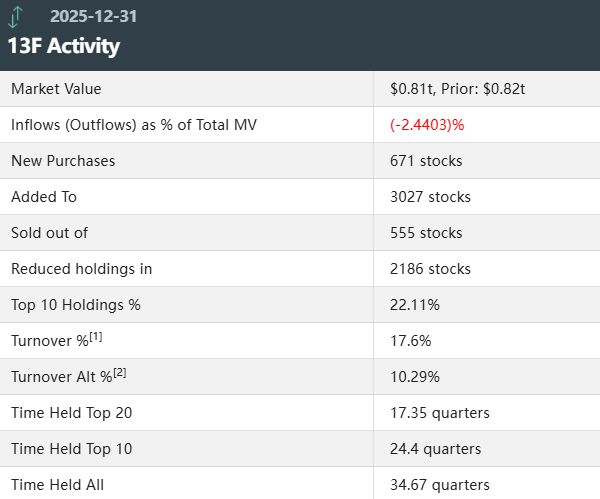
Core Viewpoint - Goldman Sachs (GS.US) reported a total market value of $810 billion in its Q4 2025 13F filing, reflecting a decrease of approximately 1.22% from the previous quarter's $820 billion [1][2]. Holdings Summary - The total number of new stock purchases in Q4 was 671, with 3,027 stocks added to existing positions and 555 stocks sold out [1][2]. - The top ten holdings accounted for 22.11% of the total market value [2]. Top Holdings - Nvidia (NVDA.US) was the largest holding with approximately 166.66 million shares valued at about $31.08 billion, representing 3.83% of the portfolio, a decrease of 0.82% from the previous quarter [3][4]. - Apple (AAPL.US) ranked second with around 90.99 million shares valued at approximately $26.94 billion, increasing its portfolio percentage by 2.60% to 3.32% [3][4]. - Microsoft (MSFT.US) was third with about 51.36 million shares valued at approximately $24.84 billion, a decrease of 5.86% to 3.06% of the portfolio [3][4]. - The SPDR S&P 500 ETF (SPY.US) was fourth with around 32.92 million shares valued at approximately $22.45 billion, down 9.01% to 2.77% of the portfolio [3][4]. - Alphabet Inc. (GOOGL.US) was fifth with approximately 52.19 million shares valued at about $16.34 billion, increasing its portfolio percentage by 1.47% to 2.01% [3][4]. Trading Activity - The turnover rate for the portfolio was 17.6%, with a lower alternative turnover rate of 10.29% [2]. - The average holding period for the top 20 stocks was 17.35 quarters, while the top 10 stocks had an average holding period of 24.4 quarters [2]. Cryptocurrency Exposure - Goldman Sachs disclosed a significant exposure to cryptocurrencies, holding over $2.36 billion in digital assets, which accounted for 0.33% of its reported investment portfolio [6][7]. - The bank held approximately 21.2 million shares of various spot Bitcoin ETFs valued at $1.06 billion, a decrease of 39.4% from the previous quarter [10]. - The bank also held about 40.7 million shares of spot Ethereum ETFs valued at approximately $1 billion, down 27.2% from the previous quarter [10].
adexMarkets瑞德克斯:比特币触底6万关口 高杠杆出清后布局
Xin Lang Cai Jing· 2026-02-06 13:05
Core Insights - Bitcoin demonstrated resilience after testing the critical psychological level of $60,000, indicating a potential end to the extreme market deleveraging process in the short term [1][3] - The market has seen a significant evaporation of value, with approximately $2 trillion lost since the peak of $4.379 trillion in October, including over $1 trillion in the past month alone [1][3] - The recent volatility in precious metals and the sharp decline in tech stocks contribute to a macro-level liquidity stress test [1][3] Market Dynamics - The recent deep correction is viewed as a "cleansing" of crowded positions and excessive speculation, particularly as Bitcoin has closely followed tech stock trends driven by AI themes [2][4] - The price drop to $60,000 is seen not as a loss of market confidence but as a necessary correction of prior irrational exuberance [2][4] - Major digital assets like Ethereum have started to recover from near 10-month lows as selling pressure eased [2][4] Institutional Behavior - The Bitcoin ETF has recorded continuous net outflows since the beginning of 2026, with January alone seeing outflows exceeding $3 billion, reflecting a cautious strategy among institutional investors in a complex macro environment [1][3]
从8万美元跌至6万美元,比特币为何“跌跌不休”?
Guo Ji Jin Rong Bao· 2026-02-06 12:33
Core Viewpoint - The cryptocurrency market, particularly Bitcoin, is experiencing a significant downturn, with prices dropping sharply due to macroeconomic constraints and structural funding issues [1][6]. Market Performance - Bitcoin fell below $80,000 on February 1, dropped below $70,000 on February 5, and reached a low of approximately $60,000 on February 6, with a 24-hour decline of 10.19% and a 30-day decline of 31.17% [1][5]. - The total market capitalization of Bitcoin is approximately $1.29 trillion, with a trading volume of $208.05 billion in contracts and $27.50 billion in spot trading [2]. Market Dynamics - The decline in Bitcoin's price is attributed to macroeconomic factors, including the nomination of Kevin Warsh as the next Federal Reserve Chairman, which has led to expectations of tighter monetary policy and a stronger dollar, reducing risk appetite for volatile assets [6][8]. - There has been a notable decrease in the inflow of funds into Bitcoin ETFs, leading to widespread deleveraging and asset rebalancing, which exacerbates the downward pressure on prices [6][7]. Liquidation Events - In the past 24 hours, over 579,000 traders were liquidated, with a total liquidation amount of $2.59 billion, highlighting the volatility and risk in the current market environment [3][4]. Future Outlook - Analysts predict an 82% probability that Bitcoin will fall below $65,000 this year, with a 60% chance of dropping below $55,000, indicating a challenging market ahead [7]. - The future trajectory of Bitcoin will depend on two main variables: the completion of the global deleveraging process and the potential return of ETF and arbitrage funds to the market [8].

比特币失守6.5万美元,去杠杆与市场动荡放大抛压,特朗普行情涨幅悉数回吐
Di Yi Cai Jing· 2026-02-05 23:46
Group 1 - The core viewpoint of the articles highlights a significant decline in cryptocurrency prices, particularly Bitcoin, which has dropped below $65,000, erasing gains made after Trump's election victory [1][2] - The forced liquidation of leveraged positions and a general decline in market risk appetite have exacerbated the sell-off in the cryptocurrency market [1][2] - The MarketVector Digital Assets 100 Small Cap Index has experienced a decline of approximately 70% over the past year, indicating severe losses among smaller speculative tokens [1] Group 2 - The recent downturn in Bitcoin prices is attributed to multiple factors, including a sell-off triggered by redemption pressures and forced liquidations of high-leverage positions [2][3] - Market analysts note that Bitcoin's performance has shifted closer to high-risk assets rather than serving as an inflation hedge, especially amid volatility in tech stocks and precious metals [3] - Concerns over potential changes in monetary policy, particularly regarding the nomination of Kevin Walsh as the next Fed Chair, have led to fears of a reduction in the Fed's balance sheet, which is perceived as unfavorable for cryptocurrencies [4]
FXGT:金银狂飙后显疲态 比特币震荡僵局
Xin Lang Cai Jing· 2026-01-27 12:42
Group 1 - The current global safe-haven assets are experiencing extreme differentiation, with Bitcoin showing stagnation around the $88,000 mark while gold and silver have shown signs of fatigue after a significant surge [1][2] - The market capitalization of precious metals has seen a remarkable increase, with some analyses suggesting that the daily market cap growth could cover the entire market share of Bitcoin, indicating temporary concerns about the liquidity of digital assets [1][2] - The U.S. dollar index (DXY) is in a weak range since September last year, and despite the dollar's weakness typically benefiting safe-haven assets, Bitcoin has not surged as expected, reflecting a shift in investor preference towards physical precious metals [3] Group 2 - There are significant signs of capital outflows in the cryptocurrency market, with over $1.3 billion in net outflows from spot Bitcoin ETFs last week, indicating a cooling of institutional investor risk appetite [4] - The market volatility is primarily a defensive reaction to the potential government shutdown on January 31, and if Bitcoin cannot stabilize above the key support level of $84,500, it may face a risk of a deeper correction to $74,000 [4] - Future developments in legal and regulatory frameworks will be crucial in breaking the current deadlock, with the potential delay of the "Clarity Act" due to the threat of a government shutdown [4]

CWG Markets外汇:韩国拟解禁企业加密投资
Xin Lang Cai Jing· 2026-01-12 11:36
Group 1 - The South Korean Financial Services Commission (FSC) has decided to allow listed companies to allocate 5% of their capital to mainstream cryptocurrencies, marking a significant shift in East Asian financial history [1][3] - This decision addresses years of capital outflow pressure due to domestic restrictions on overseas crypto investments, and aims to position South Korea favorably in the global digital asset landscape by 2026 [1][3] - The strategy limits investments to the top 20 cryptocurrencies by market capitalization and a 5% capital allocation cap, reflecting a cautious regulatory approach of "compliance first, then expansion" [1][3] Group 2 - The introduction of a stablecoin licensing system with a 100% reserve requirement is central to building a domestic digital currency ecosystem [2][4] - The expected launch of a spot Bitcoin ETF in 2026 will create a three-part structure in the South Korean market, consisting of direct holdings, financial products, and stablecoin payments, potentially attracting around 3,500 institutional entities and bringing trillions of Korean won in liquidity [2][4] - South Korea's plan to deeply integrate Central Bank Digital Currency (CBDC) into treasury management aims to challenge the traditional SWIFT payment dominance, with a goal of digitizing 25% of treasury funds by 2030 [2][4]
华尔街对加密货币的投入主导了2025年,但2026年的需求前景如何?
Sou Hu Cai Jing· 2025-12-30 01:32
Group 1 - 2025 is expected to be a remarkable year for Bitcoin (BTC) and the broader cryptocurrency market, driven by supportive legislation and Wall Street's acceptance of cryptocurrencies as legitimate asset classes [2] - The total net inflow into spot Bitcoin ETFs reached $57 billion, with total net assets amounting to $114.8 billion [2] - The performance of the cryptocurrency market in early 2026 will depend on the sustainability of adoption by institutions, corporations, and governments [4] Group 2 - Since October, the strong inflow into spot Bitcoin ETFs has noticeably slowed, with some periods experiencing a shift to a sell-side market, leading to a 30% drop in Bitcoin prices and a 50% drop in Ethereum prices [4] - Investor sentiment towards the AI industry and the performance of tech-heavy S&P 500 index are expected to directly impact the cryptocurrency market [4] - The rapid expansion of balance sheets is identified as a key strategy providing strong momentum for tech-related stocks in 2025, with significant investments in data centers and computing capabilities [5] Group 3 - The potential passage of the CLARITY Act is a significant bullish event to watch in early 2026, as it aims to provide clearer regulations for fintech innovators and may encourage more overseas cryptocurrency firms to relocate to the U.S. [5][6] - The CLARITY Act will clarify the jurisdiction of regulatory bodies (SEC and CFTC) over various types of crypto assets and emphasize consumer protection [6] - Expectations of a shift towards a more accommodative monetary policy by the Federal Reserve, including potential rate cuts of up to 100 basis points, could be bullish for risk assets [6] Group 4 - The softening job market and rising costs of goods and services due to tariffs may lead to decreased consumer confidence among retail investors [8] - Investors face a dilemma in early 2026 regarding whether signals of the Federal Reserve's accommodative policy have been priced in or if evolving policies will extend the bullish market from 2025 into the cryptocurrency space [8] - The overall outlook for 2026 appears bullish, influenced by Trump's economic agenda, Federal Reserve policies, and crypto-friendly regulations, but uncertainties surrounding AI developments and the actual impact of rate cuts on consumers and the economy will determine market direction [8]

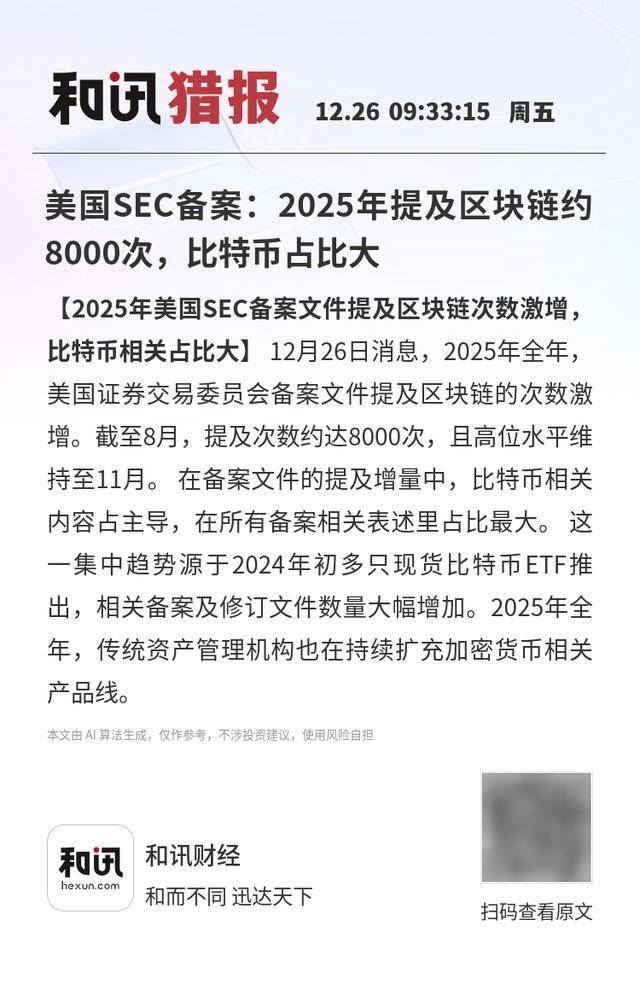
美国SEC备案:2025年提及区块链约8000次,比特币占比大
Sou Hu Cai Jing· 2025-12-26 02:21
Group 1 - The number of mentions of blockchain in SEC filings in the US surged in 2025, reaching approximately 8000 mentions by August, maintaining high levels until November [1][2] - Bitcoin-related content dominated the mentions, representing the largest share of all related statements in SEC filings [1][2] - This trend is attributed to the launch of multiple spot Bitcoin ETFs in early 2024, which significantly increased the number of related filings and amendments [1][2] - Traditional asset management firms continued to expand their cryptocurrency product lines throughout 2025 [1][2]