生猪产品

Search documents
山东省畜牧兽医局发布公告:5家厂(场)通过生猪屠宰质量管理规范首次检查
Feng Huang Wang Cai Jing· 2026-02-13 08:55
Core Viewpoint - The Shandong Provincial Animal Husbandry and Veterinary Bureau announced the first inspection results of the quality management standards for pig slaughtering, with five facilities passing the initial checks [1] Group 1: Announcement Details - The announcement was made on February 12, detailing the first batch of facilities that passed the quality management standards for pig slaughtering [1] - The announcement includes the names of five facilities, including Jiajing County Zhifang Livestock and Poultry Breeding Purchase and Sales Co., Ltd., that have successfully passed the inspection [1] Group 2: Regulatory Framework - The inspection aligns with the requirements set forth by the Ministry of Agriculture and Rural Affairs and the Shandong Provincial implementation plan for the quality management standards [1] - The provincial bureau emphasized the need for local governments to report the results of the inspections and to strengthen supervision of the facilities that passed [1] Group 3: Future Actions - The bureau will continue to guide the facilities that did not pass the inspection to ensure compliance with the quality management standards [1] - The overall goal is to enhance the safety and quality of pig products in the region [1]
农业农村部:1月第4周全国生猪产品、鸡蛋价格环比上涨
Xin Hua Cai Jing· 2026-01-27 06:31
Group 1 - The Ministry of Agriculture and Rural Affairs reported an increase in prices for various livestock products, including live pigs, eggs, and chicken, while the price of broiler chicks decreased [1] - The average price of piglets reached 25.96 yuan/kg, up 4.5% week-on-week but down 25.2% year-on-year; the average price of live pigs was 13.39 yuan/kg, up 2.5% week-on-week and down 18.8% year-on-year; the average pork price was 23.57 yuan/kg, up 1.6% week-on-week and down 15.3% year-on-year [1] - The average price of eggs was 9.03 yuan/kg, up 2.7% week-on-week but down 17.9% year-on-year; the average chicken price was 22.47 yuan/kg, up 0.4% week-on-week and down 5.1% year-on-year [1] Group 2 - The average price of corn remained stable at 2.44 yuan/kg, with a year-on-year increase of 7.5%; in the Northeast, the price was 2.28 yuan/kg, and in Guangdong, it was 2.51 yuan/kg, both unchanged from the previous week [2] - The average price of soybean meal was 3.33 yuan/kg, stable week-on-week and up 0.9% year-on-year; the average price of fattening pig feed was 3.37 yuan/kg, up 0.3% week-on-week and up 0.9% year-on-year [2] - The average prices for meat chicken feed and egg chicken feed were 3.51 yuan/kg and 3.23 yuan/kg respectively, both stable week-on-week, with year-on-year increases of 1.4% and 1.9% [2]
农业农村部:12月第2周鸡蛋价格环比上涨 生猪产品、豆粕价格环比下跌
Xin Hua Cai Jing· 2025-12-17 01:16
Core Viewpoint - The agricultural market is experiencing mixed price trends for various livestock and feed products, with some prices rising while others are declining, indicating fluctuations in supply and demand dynamics across different regions [1][2][3][4][5][6]. Livestock Product Prices - The average price of piglets nationwide is 23.43 yuan/kg, down 1.2% week-on-week and down 29.7% year-on-year [2] - The average price of live pigs is 12.13 yuan/kg, down 0.7% week-on-week and down 27.1% year-on-year [2] - The average price of pork is 22.59 yuan/kg, down 0.7% week-on-week and down 19.3% year-on-year [2] - The average price of eggs is 8.60 yuan/kg, down 0.1% week-on-week and down 22.7% year-on-year [3] - The average price of chicken is 22.25 yuan/kg, down 0.2% week-on-week and down 5.2% year-on-year [3] - The average price of beef is 71.33 yuan/kg, unchanged week-on-week and up 7.3% year-on-year [4] - The average price of lamb is 71.59 yuan/kg, up 0.1% week-on-week and up 2.4% year-on-year [4] Feed Prices - The average price of corn is 2.43 yuan/kg, unchanged week-on-week and up 4.7% year-on-year [6] - The average price of soybean meal is 3.29 yuan/kg, down 0.3% week-on-week and up 0.3% year-on-year [6] - The average price of fattening pig feed is 3.36 yuan/kg, unchanged week-on-week and down 0.3% year-on-year [6] - The average price of broiler feed is 3.50 yuan/kg, up 0.3% week-on-week and unchanged year-on-year [6] - The average price of layer feed is 3.22 yuan/kg, unchanged week-on-week and up 0.9% year-on-year [6]
浙江:进一步加强生猪及生猪产品调运管理
Mei Ri Jing Ji Xin Wen· 2025-12-13 01:56
Core Viewpoint - The Zhejiang Provincial Department of Agriculture and Rural Affairs has issued a notice to strengthen the management of the transportation of live pigs and pig products, with specific regulations on inter-regional transport and importation of pigs and pig products from outside the province [1] Group 1: Transportation Regulations - For slaughter pigs transported across major regions, a "point-to-point" transport method will be implemented, with transport distances generally limited to within 1,000 kilometers, subject to adjustments based on the risk of major animal diseases [1] - The notice allows pig farming enterprises outside the province that hold a "Breeding Livestock Production and Operation License" to transport breeding pigs and piglets (weighing under 30 kilograms and intended for feeding) into Zhejiang [1] Group 2: Importation Requirements - Imported pig products from outside the province must undergo quarantine and quality inspection, and are required to be registered and reported through designated channels before being transported into Zhejiang [1] - The new regulations will take effect on January 10, 2026 [1]
山东经营主体数量突破1457万户
Da Zhong Ri Bao· 2025-12-12 01:01
Group 1 - Shandong has implemented a quality-driven strategy during the 14th Five-Year Plan, leading to a significant increase in high-value invention patents to 11.6 per 10,000 people, up by 7.26 from the end of the 13th Five-Year Plan [1] - The province has registered 304.8 million effective trademarks, representing an increase of 89.3% compared to the end of the 13th Five-Year Plan [1] - The total number of operating entities in Shandong has reached 14.5778 million, ranking third in the country, indicating enhanced market vitality [1] Group 2 - Shandong has established a fair competition review system and has cleared policies that hinder the development of private enterprises, resulting in over 3,400 cases of antitrust and unfair competition being investigated [2] - The province has implemented a "one-stop" reform for business registration, achieving a high online processing rate and eliminating paper business licenses, which has improved administrative efficiency and reduced burdens on enterprises [2] - Comprehensive regulatory effectiveness has been enhanced, with the completion of revisions to 8 laws and regulations, and the establishment of a "reduction list" for minor violations [2] Group 3 - Shandong has been approved as a pilot for the national reform of drug supplementary application review and approval procedures, reducing review times from 200 to 60 working days, with a high volume of processed items [3] - The province has approved 10 Class 1 innovative drugs during the 14th Five-Year Plan, which is ten times the number approved during the 13th Five-Year Plan, and has seen a nearly 40% compound annual growth rate in new drug approvals [3] - Patent commercialization has been emphasized, with 66,507 patent transfers and 17,332 patent licenses recorded this year, reflecting increases of 36.3% and 317.4% respectively [3] Group 4 - Shandong is a major food production and consumption province, focusing on food safety through the implementation of information traceability for livestock products, with 337 slaughter enterprises connected to over 14,000 wholesale meat vendors [4] - Risk classification management has been fully implemented across food production, sales, and catering units, with initiatives like "Internet + Bright Kitchen" covering key sectors such as school canteens [4] - The province has appointed 1,890 food safety monitors among delivery riders and launched a "Snap and Report" app to encourage public participation in food safety efforts [4]
农业农村部:12月第1周全国生猪产品价格环比下跌
Xin Hua Cai Jing· 2025-12-09 13:53
Core Insights - The agricultural market in China shows mixed trends in prices for various livestock and feed products, with some experiencing increases while others decline [1][2]. Price Trends - **Pork Products**: The average price of piglets is 23.71 yuan/kg, down 0.7% week-on-week and down 29.6% year-on-year. The average price of live pigs is 12.21 yuan/kg, down 1.0% week-on-week and down 27.8% year-on-year. The average price of pork is 22.74 yuan/kg, down 0.5% week-on-week and down 19.3% year-on-year [1]. - **Poultry Products**: The average price of eggs is 8.61 yuan/kg, up 0.2% week-on-week but down 22.4% year-on-year. The average price of chicken is 22.30 yuan/kg, down 0.1% week-on-week and down 5.1% year-on-year. The average price of broiler chicks is 3.49 yuan each, unchanged week-on-week and down 12.8% year-on-year [1]. - **Beef and Lamb Products**: The average price of beef is 71.32 yuan/kg, unchanged week-on-week and up 7.1% year-on-year. The average price of lamb is 71.51 yuan/kg, up 0.2% week-on-week and up 2.3% year-on-year [2]. Feed Prices - **Corn**: The average price of corn is 2.43 yuan/kg, unchanged week-on-week and up 3.8% year-on-year. In Northeast China, the price is 2.24 yuan/kg, up 0.4% week-on-week, while in Guangdong, it is 2.48 yuan/kg, up 0.8% week-on-week [2]. - **Soybean Meal**: The average price of soybean meal is 3.30 yuan/kg, up 0.3% week-on-week and down 0.3% year-on-year [2]. - **Feed for Pigs and Chickens**: The average price of fattening pig feed is 3.36 yuan/kg, up 0.3% week-on-week and down 0.6% year-on-year. The average price of meat chicken feed is 3.49 yuan/kg, unchanged week-on-week and down 0.3% year-on-year. The average price of egg-laying hen feed is 3.22 yuan/kg, up 0.3% week-on-week and up 0.6% year-on-year [2].
食品生产抽检合格率连续3年全省最高!烟台食药安全形势稳定向好
Qi Lu Wan Bao· 2025-12-09 06:17
Core Insights - Yantai City has strengthened food and drug safety supervision and enforcement since the start of the 14th Five-Year Plan, achieving the highest product sampling pass rate in the province for three consecutive years [1][2] - The city has been recognized as an advanced collective in national food safety work by the State Council Food Safety Committee in 2021 [1] Group 1: Regulatory Enhancements - The municipal government has integrated food and drug safety into key work reports and performance assessments, establishing a comprehensive regulatory system [1] - The Food and Drug Safety Committee plays a leading role in improving mechanisms for administrative and criminal coordination [1] Group 2: Collaborative Supervision - A mechanism for connecting the production and market entry of agricultural products has been established, involving multiple departments to enhance food safety [2] - Collaboration with various departments, including education and health, has been intensified to monitor centralized dining units like school and nursing home cafeterias [2] Group 3: Risk Management - The city has conducted nearly 230,000 food and drug inspections during the 14th Five-Year Plan, focusing on early detection and resolution of issues [2] - Emergency response plans for food, drug, and vaccine safety have been developed, along with regular emergency drills to improve response capabilities [2]
农业农村部:11月第3周生猪产品、鸡蛋、蛋鸡配合饲料价格环比下跌
Xin Hua Cai Jing· 2025-11-24 09:27
Core Insights - The agricultural market shows mixed trends in livestock and poultry prices, with some products experiencing price increases while others decline [1][2][3][4][5][6] Livestock Prices - The average price of piglets nationwide is 24.14 yuan/kg, down 1.0% week-on-week and 29.2% year-on-year [2] - The average price of live pigs is 12.50 yuan/kg, down 1.1% week-on-week and 26.6% year-on-year [2] - The average price of pork is 23.02 yuan/kg, down 0.5% week-on-week and 19.1% year-on-year [2] - In contrast, the average price of beef is stable at 71.37 yuan/kg, with a year-on-year increase of 6.7% [4] - The average price of lamb is 71.32 yuan/kg, up 0.3% week-on-week and 2.0% year-on-year [4] Poultry Prices - The average price of eggs is 8.61 yuan/kg, down 0.6% week-on-week and 22.4% year-on-year [3] - The average price of chicken is 22.34 yuan/kg, down 0.1% week-on-week and 5.2% year-on-year [3] - The average price of broiler chicks is 3.50 yuan each, down 0.8% week-on-week and 11.8% year-on-year [3] Feed Prices - The average price of corn is 2.43 yuan/kg, stable week-on-week and up 3.4% year-on-year [6] - The average price of soybean meal is 3.29 yuan/kg, stable week-on-week and down 1.8% year-on-year [6] - The average price of feed for fattening pigs is 3.36 yuan/kg, stable week-on-week and down 0.9% year-on-year [6]
周期之困中,“清远鸡王”天农食品能靠赴港破局?
Zhi Tong Cai Jing· 2025-11-06 13:27
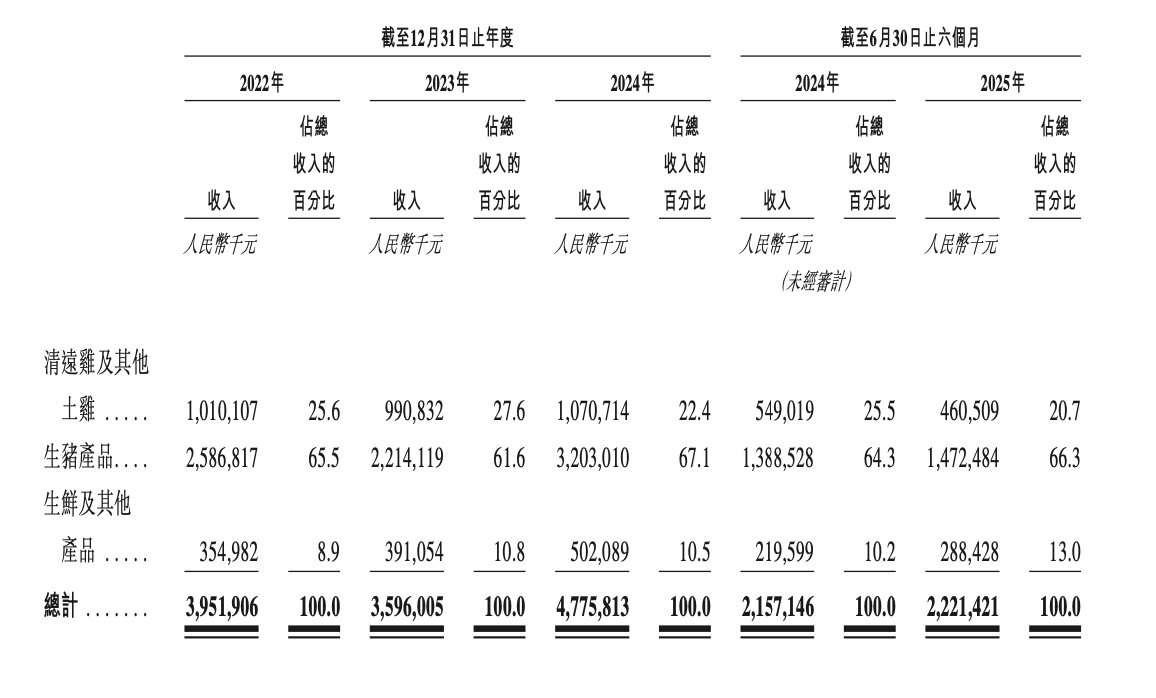
Core Viewpoint - Guangdong Tianong Group Co., Ltd. (Tianong Foods), a leading supplier of Qingyuan chicken, is preparing for an IPO on the Hong Kong Stock Exchange, aiming to enhance its capital reserves amid the cyclical pressures of the poultry and pig markets [1][9]. Company Overview - Established in 2003, Tianong Foods has evolved from a regional poultry farming enterprise to one of China's leading high-quality meat and meat product providers, with a vertically integrated operation covering breeding, ecological farming, feed production, slaughtering, food processing, and brand marketing [2][3]. - The company holds a dominant position in the Qingyuan chicken market, with a projected market share of approximately 59.3% in 2024, significantly surpassing its competitors [2][3]. Financial Performance - Tianong Foods reported fluctuating revenues over the years, with revenues of approximately 39.52 billion RMB in 2022, 35.96 billion RMB in 2023, 47.76 billion RMB in 2024, and 22.21 billion RMB in the first half of 2025 [2][4]. - The company's gross profit margins have also shown instability, with margins of 16.3%, 1.6%, 18.8%, and 15.5% during the same period, reflecting the volatility in its earnings [4]. Product Segmentation - The company offers a comprehensive product range, including Qingyuan chicken, other native chickens, and pig products. The revenue from pig products has shown an upward trend, while revenue from Qingyuan chicken has been more volatile [3][4]. - Revenue from pig products was 25.87 billion RMB in 2022, 22.14 billion RMB in 2023, 32.03 billion RMB in 2024, and 14.72 billion RMB in the first half of 2025, indicating a growing share of this segment [3][4]. Market Dynamics - The company faces challenges from the "chicken cycle" and "pig cycle," which have led to significant price fluctuations in the market. The average price of Qingyuan chicken has dropped by 21% in the first half of 2025 compared to the previous year [7][8]. - The pig market is currently in a prolonged downturn, with high supply and low prices, impacting the company's profitability. The average price of pigs fell from nearly 2,700 RMB per head in 2022 to 1,989.8 RMB in 2023, reflecting the ongoing challenges in the sector [8][9]. Strategic Implications - The IPO is seen as a strategic move for Tianong Foods to bolster its financial position and enhance its resilience against market fluctuations. The company's established brand and integrated supply chain are viewed as key advantages, but the volatility in its performance raises concerns about its business model's robustness [9].

新股前瞻 | 周期之困中,“清远鸡王”天农食品能靠赴港破局?
智通财经网· 2025-11-06 13:23
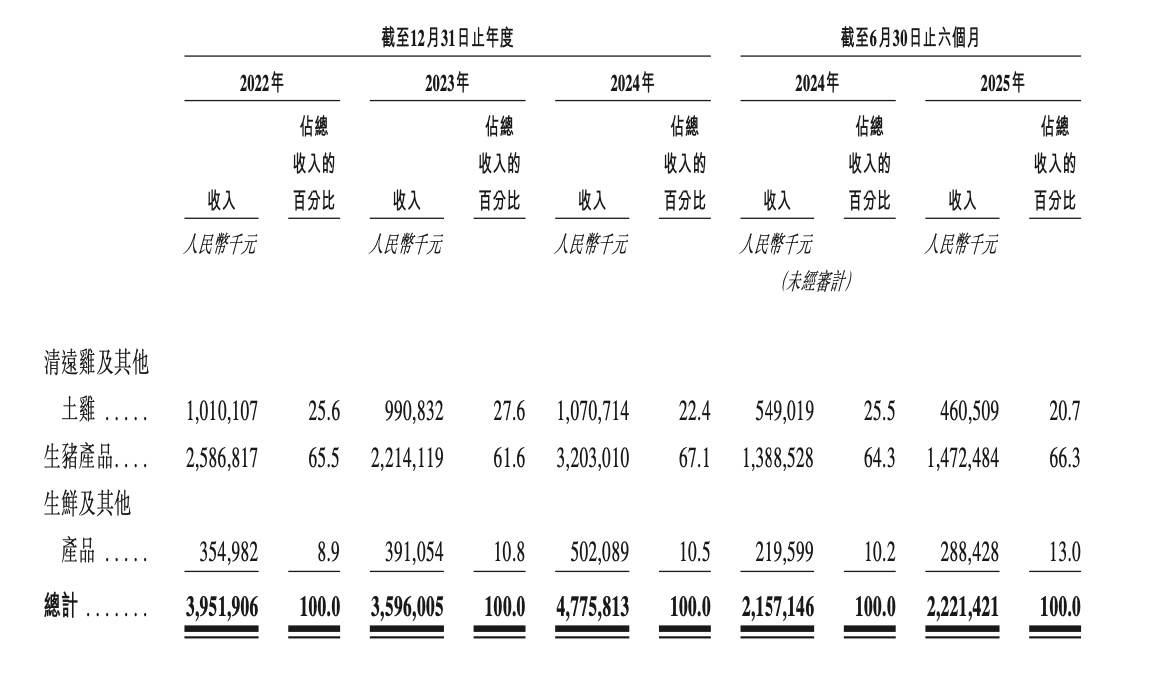
Core Viewpoint - Guangdong Tianong Group Co., Ltd. (Tianong Foods), a leading supplier of Qingyuan chicken, is seeking to list on the Hong Kong Stock Exchange, marking a significant move in the capital market amid the challenges posed by the cyclical nature of the poultry and pig industries [1][9]. Company Overview - Established in 2003, Tianong Foods has evolved from a regional poultry farming enterprise to one of China's leading high-quality meat and meat product suppliers, focusing on a vertically integrated operation covering breeding, ecological farming, feed production, slaughtering, food processing, and brand marketing [2]. - The company holds a dominant position in the Qingyuan chicken market, with a projected market share of approximately 59.3% in 2024, significantly surpassing competitors [2][3]. Financial Performance - Tianong Foods reported fluctuating revenues over the years, with revenues of approximately RMB 39.52 billion in 2022, RMB 35.96 billion in 2023, RMB 47.76 billion in 2024, and RMB 22.21 billion in the first half of 2025 [2][4]. - The company's gross profit margins have also shown instability, with margins of 16.3%, 1.6%, 18.8%, and 15.5% during the same period, reflecting the volatility in profitability [4]. Product Segmentation - The company offers a comprehensive product range, including Qingyuan chicken, other native chickens, and pork products. The revenue from pork products has shown an upward trend, while revenue from Qingyuan chicken has been more volatile [3][4]. - Revenue from pork products was RMB 25.87 billion, RMB 22.14 billion, RMB 32.03 billion, and RMB 14.72 billion over the reporting period, indicating a growing share of the overall revenue [3]. Market Dynamics - The company faces challenges from the "chicken cycle" and "pig cycle," which have led to significant price fluctuations in the market. The average price of Qingyuan chicken has dropped by 21% in the first half of 2025 compared to the previous year [6][7]. - The pig market is also under pressure, with the average price of pigs declining from nearly RMB 2,700 in 2022 to RMB 1,989.8 in 2023, reflecting ongoing challenges in the industry [8]. Strategic Implications - The IPO is seen as a strategic move to enhance capital reserves and improve risk resilience amid the dual pressures of cyclical downturns in the poultry and pig markets. The company's established brand position and integrated supply chain are viewed as core advantages [9].