
电感磁珠

Search documents
中金 | MLCC周期复盘与展望:算力增长重构供需,结构性提价渐行渐近
中金点睛· 2026-03-10 23:35
Core Viewpoint - The report indicates that the MLCC (Multi-Layer Ceramic Capacitor) market is currently in a structural price increase window, driven by cost pressures and high demand for high-end products, particularly in the AI server segment [3][10]. Demand Analysis - The demand for MLCCs is expected to grow significantly, particularly in AI servers, with predictions of an 87% and 88% increase in demand for 2026 and 2027, respectively [26][30]. - The general server MLCC demand is projected to increase by 49% and 61% in the same years [30]. - The overall MLCC market is anticipated to see a modest growth of 2% and 8% in 2026 and 2027, respectively, with notable differentiation in demand across sectors [34]. Historical Price Trends - Historical price increases for MLCCs have been observed in cycles lasting 1.5 to 2 years, with significant profit margin expansions for manufacturers during these periods [6][17]. - Previous cycles saw price increases of 70% and 20% in 2017/2018 and 2020/2021, respectively, driven by supply-demand mismatches and cost pass-throughs [3][10]. Supply Dynamics - The supply of high-end MLCCs is currently tight, with major players like Murata and Samsung Electro-Mechanics operating at high capacity utilization rates of 90% or more [42][40]. - The competitive landscape is highly concentrated, with Japanese and Korean manufacturers dominating the high-end MLCC market, accounting for approximately 85% of the market share [40][41]. Price Increase Drivers - The current price increase is primarily driven by rising metal costs, particularly silver, which has seen price increases of over 100% [10][14]. - High-end MLCCs are experiencing demand-driven price increases due to robust orders from AI infrastructure and ASIC chip manufacturers [10][11]. Future Outlook - The report suggests that the current market is more likely to experience localized price increases rather than systemic ones, with domestic manufacturers potentially benefiting from cost pass-throughs [11][12]. - The expansion plans of major manufacturers focus on high-end MLCCs for AI servers and automotive applications, indicating a strategic shift towards high-value segments [43][44].


涨!涨!涨!半导体行业掀涨价风暴
Xin Lang Cai Jing· 2026-02-11 10:16
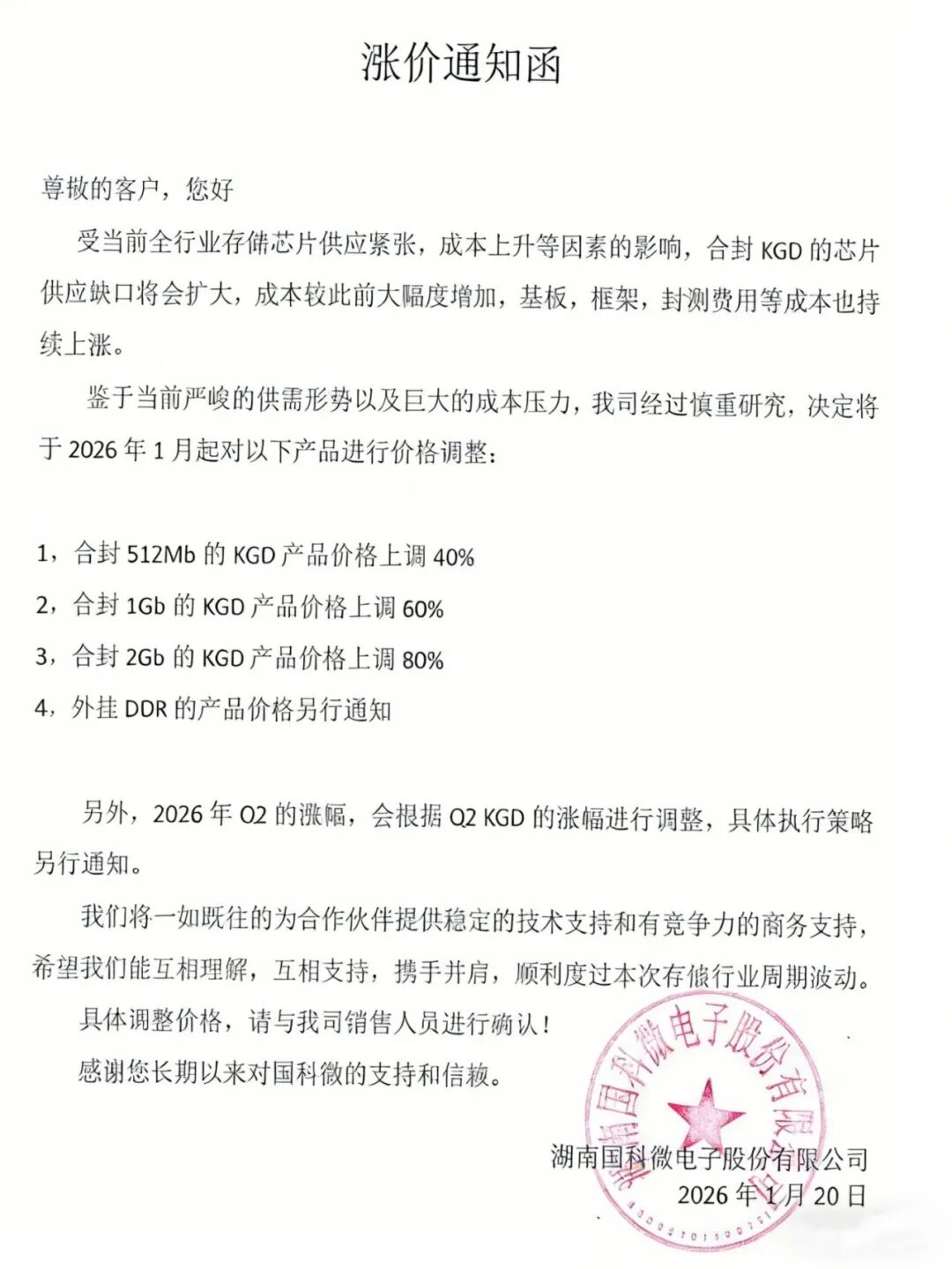
Core Viewpoint - The global semiconductor industry is experiencing a new wave of price increases across the entire supply chain, driven by surging AI demand and rising raw material costs [1][3][61]. Group 1: Price Increases in Domestic Semiconductor Companies - Over 20 semiconductor companies have officially announced price increases [2][62]. - Domestic chip manufacturers are significantly raising prices, with increases as high as 80% for certain products [4][63]. - Guokewai announced price hikes for its KGD storage products, with increases of 40% to 80% [6][66]. - Zhongwei Semiconductor is raising prices for MCU and NOR Flash products by 15% to 50% due to supply chain pressures [9][73]. - Biyiwei has also announced price increases across its entire product line, citing rising raw material costs [17][76]. Group 2: Price Increases in International Semiconductor Companies - International semiconductor giants are also raising prices, with ADI increasing prices by 15% to 30% starting February 1, 2026 [21][81]. - Infineon plans to raise prices for power switches and IC products due to increased demand from AI data centers [24][83]. - Texas Instruments is expected to raise prices by over 30% across nearly all categories due to rising costs [21][81]. Group 3: Price Increases in Wafer Foundry and Packaging - Wafer foundries are increasing prices, with TSMC raising advanced process prices by 3% to 10% [25][85]. - Packaging and testing services are seeing price increases of up to 30%, driven by high demand and capacity constraints [27][86]. Group 4: Impact of Raw Material Costs - The prices of precious metals like gold, silver, and copper are rising, significantly impacting chip manufacturing costs [57][116]. - The increase in raw material costs is leading to a ripple effect across the semiconductor supply chain, prompting many companies to raise their product prices [57][116]. Group 5: Effects on End Markets - The price increases in storage chips are affecting end markets, with PC manufacturers like Dell and Lenovo planning price hikes of 10% to 30% [59][118]. - In the smartphone sector, rising storage costs are pressuring new product pricing, particularly for low-end models [59][118]. - The automotive electronics sector is also feeling the impact, with companies like Xiaomi and NIO reporting cost pressures due to rising semiconductor prices [59][119].


被动元件,涨涨涨!
半导体行业观察· 2026-02-08 03:29
Core Viewpoint - The recent price hikes in passive components, driven by supply-demand imbalances and rising raw material costs, indicate a significant transformation in the market dynamics of the passive components industry [6][9][12]. Price Adjustments - Yageo announced a price increase of 15%-20% for certain resistor products starting February 1, reflecting its position as a market leader with an 18% global market share [2]. - Other companies, including Walsin Technology and Panasonic, have also announced price hikes for various passive components, with increases ranging from 15% to 30% [2][3]. - The price adjustments are widespread, with many small and medium-sized manufacturers in China also raising prices by 5%-20% across multiple product categories [3]. Supply Chain Dynamics - The price increases are primarily driven by rising costs of raw materials such as silver, copper, and aluminum, which have seen significant price surges, with silver prices increasing over 140% in 2025 [7][9]. - The production costs for passive components have risen by 20%-30% due to these raw material price increases, prompting manufacturers to pass on costs to customers [7][9]. - Capacity constraints are exacerbating the situation, as many Japanese manufacturers have shifted focus to high-end products, reducing supply in the mid-to-low-end market [8][9]. Demand Drivers - The demand for passive components is being driven by the rapid growth of AI and electric vehicle markets, with AI server motherboards requiring significantly more MLCCs than traditional servers [10][11]. - The demand for passive components in electric vehicles is also increasing, with the number of MLCCs used per vehicle rising dramatically compared to traditional vehicles [10][11]. - The overall market for passive components in China is projected to grow from 1237.65 billion yuan in 2023 to 2583.59 billion yuan by 2030, with a compound annual growth rate of 11.09% [12]. Market Structure Changes - The current price hikes reflect a structural change in the passive components market, with high-end products for AI servers and electric vehicles experiencing significant demand while traditional consumer electronics face challenges [14][17]. - Domestic manufacturers are beginning to capture more market share, with companies like Walsin Technology and Sunlord Electronics seeing increased orders and expanding their production capabilities [18][19]. - The shift towards high-end products presents opportunities for domestic manufacturers to enter the supply chains of larger companies, especially as global manufacturers face capacity and delivery challenges [22][23].


开源证券:成本端驱动涨价潮 被动元件高端需求开启新周期
Zhi Tong Cai Jing· 2026-01-26 05:55
Core Viewpoint - The global passive component market is entering a new upcycle driven by price increases announced by leading companies since 2025, primarily due to rising upstream metal raw material prices and increased labor/power costs, with inflation being a dominant factor [1] Price Increase Situation - Major companies such as Yageo, Walsin, Panasonic, Fenghua, and Sunlord have announced price hikes, with Yageo starting from the second half of 2025, increasing prices for various capacitor and resistor products by 10%-30% [2] - Panasonic has notified dealers of price increases for 30-40 models of tantalum capacitors by 15%-30%, effective February 1, 2026 [2] - Fenghua announced price increases for inductor products by 5%-25% and for various capacitor products by 10%-30% starting November 2025 [2] - Walsin plans to adjust prices for resistor products due to rising costs, effective February 1, 2026 [2] Supply Side - The continuous rise in upstream metal raw material prices, including silver, palladium, ruthenium, tin, and copper, is a major driver of the price increases in passive components [4] - The production costs have significantly increased due to the rise in metal prices, which is being passed down through the supply chain [4] - The operating rates of major manufacturers have remained high since 2025, with a trend of further improvement [4] Demand Side - Demand from emerging sectors such as AI servers, new energy vehicles, and industrial control is strong, which may lead to a longer upcycle for the passive component industry compared to previous cycles [5] - For instance, each AI server is equipped with approximately 15,000 to 25,000 MLCCs, with the market for MLCCs in AI servers expected to grow at an annual rate of 30%, reaching 3.3 times the 2025 level by 2030 [5] Target Companies - Companies to watch include SanHuan Group, Sunlord Electronics, JiangHai Co., and Fala Electronics [6] - Beneficiary companies include Fenghua, Placo New Materials, Jiemai Technology, and Maijie Technology [6]
行业点评报告:被动元件:成本端驱动涨价潮,高端需求开启新周期
KAIYUAN SECURITIES· 2026-01-26 03:14
Investment Rating - The industry investment rating is "Overweight" (maintained) [1] Core Insights - The current price increase in passive components is driven by rising upstream metal raw material prices and increased costs related to labor and electricity, with inflation being a dominant factor [8] - Demand from emerging sectors such as AI servers, new energy vehicles, and industrial control is robust, suggesting that the current upcycle in the passive components industry may last longer than previous cycles [7][8] Summary by Sections Price Increase Situation - Major passive component manufacturers like Yageo, Panasonic, and Walsin have announced price increases for various products, with increases ranging from 5% to 30% starting from early 2026 [5] - Yageo has raised prices for multiple capacitor and resistor products by 10%-30% since the second half of 2025, citing significant increases in wafer costs [5] - Other manufacturers, including Walsin and Huazhong, have also issued price hikes due to rising costs of labor, electricity, and materials [5] Supply Side - The prices of upstream metal raw materials such as silver, palladium, ruthenium, tin, and copper continue to rise, significantly impacting production costs for passive component manufacturers [6] - The operating rates of major manufacturers have remained high since 2025, with an upward trend expected [6] Demand Side - Traditional demand from consumer electronics remains stable, while new sectors like AI servers and new energy vehicles are experiencing strong growth, indicating a potentially longer upcycle for the passive components industry [7] - For instance, each AI server is estimated to require 15,000 to 25,000 MLCCs, with the market for MLCCs in AI servers expected to grow at an annual rate of 30%, reaching 3.3 times the 2025 market size by 2030 [7] Investment Recommendations - The report suggests focusing on companies such as Sanhua Group, Sunlord Electronics, Jianghai Co., and Farah Electronics, with beneficiaries including Walsin, Placo New Materials, Jiemai Technology, and Maijie Technology [8]
最高上调30%!被动原件大厂二月再涨价,AI服务器带来需求数倍增长
Xuan Gu Bao· 2026-01-05 08:18
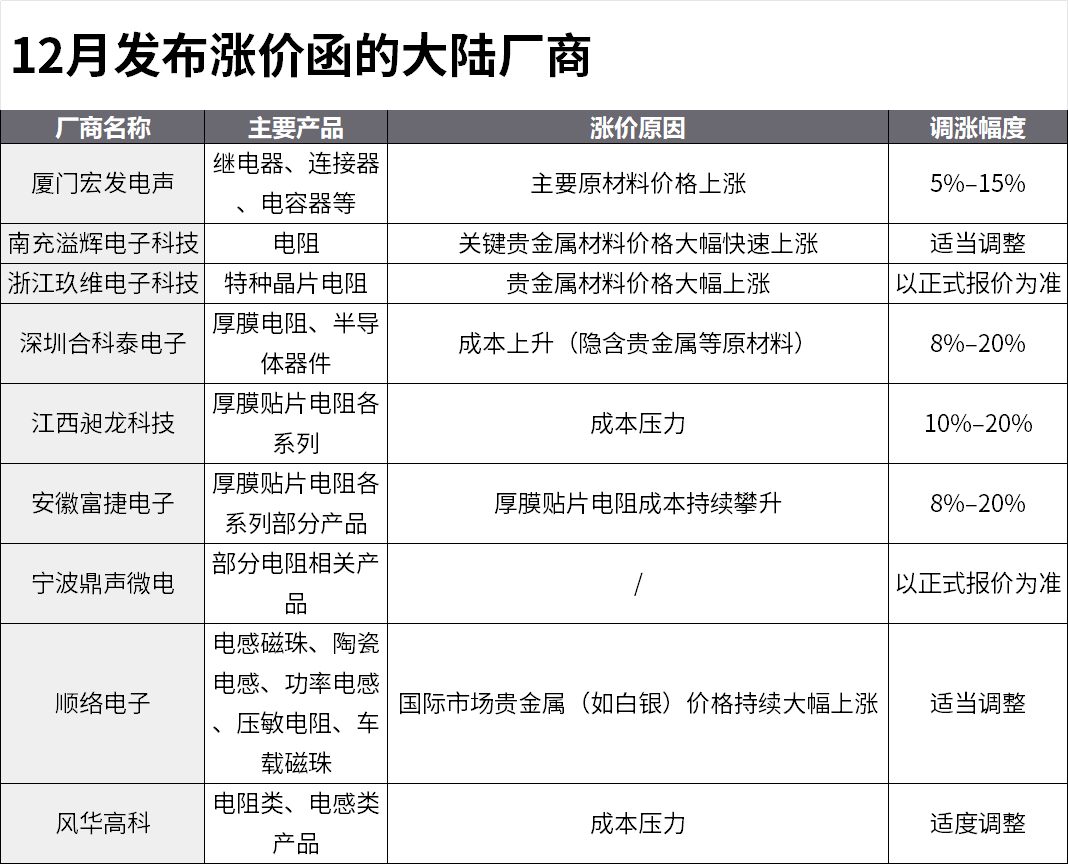
Group 1 - Panasonic has announced a price increase for certain tantalum capacitor models by 15-30%, effective from February 1, 2026, covering 30-40 types of tantalum polymer capacitors [1] - Multiple passive component manufacturers in China have also issued price increase notices, with adjustments ranging from 5% to 20% due to rising raw material costs [1] - The passive component industry is entering a new round of price increases, driven by both raw material cost pressures and surging demand from AI applications [2][3] Group 2 - The primary reasons for the price increases in passive components are the rising costs of raw materials such as silver, tin, copper, and other metals, alongside increased demand driven by AI technology [3] - The price of silver has surged approximately 143% in 2025, contributing to the overall increase in production costs for passive component manufacturers [3] - AI servers require significantly more passive components compared to traditional electronics, with one AI server using an average of 30,000 MLCCs, which is 30 times more than a smartphone [3] Group 3 - Guosen Securities projects that the tantalum capacitor market will reach $21.7 billion by 2026, a 45% increase from 2024, with an anticipated supply-demand gap due to limited production expansion by leading companies [4] - Yageo Corporation announced a price increase for polymer tantalum capacitors starting November 1, 2025, in response to the surge in demand from AI applications [5] - Companies like Winhao Technology and Sunlord Electronics are also adjusting prices for various electronic components due to rising precious metal costs [7]
三环集团(300408):MLCC和SOFC双轮驱动
Orient Securities· 2025-12-02 15:20
Investment Rating - The report maintains a "Buy" rating for the company, with a target price of 54.23 CNY based on a 29x PE valuation for 2026 [4][10]. Core Insights - The company is expected to achieve net profits of 2.79 billion, 3.59 billion, and 4.39 billion CNY for the years 2025, 2026, and 2027 respectively, reflecting a downward adjustment in revenue and gross margin forecasts for its electronic components and communication parts businesses [4][10]. - The report highlights the positive impact of AI on the passive components industry, with increased demand for MLCCs driven by AI server requirements, which are significantly higher than traditional servers [9]. - The company is positioned well in the MLCC market with a comprehensive product matrix that caters to various sectors, including mobile communication and new energy [9]. Financial Summary - The company's projected revenue for 2025 is 9.39 billion CNY, with a year-on-year growth of 27.3%. By 2027, revenue is expected to reach 13.55 billion CNY, growing at 19.2% [6]. - The gross margin is forecasted to improve from 39.8% in 2023 to 46.7% in 2027, while the net profit margin is expected to rise from 27.6% to 32.4% over the same period [6]. - The earnings per share (EPS) is projected to increase from 0.82 CNY in 2023 to 2.29 CNY in 2027 [6].