
移动医保保

Search documents
移动营业厅也卖保险?通信运营商正在切入保险分销新场景
2 1 Shi Ji Jing Ji Bao Dao· 2026-02-10 03:26
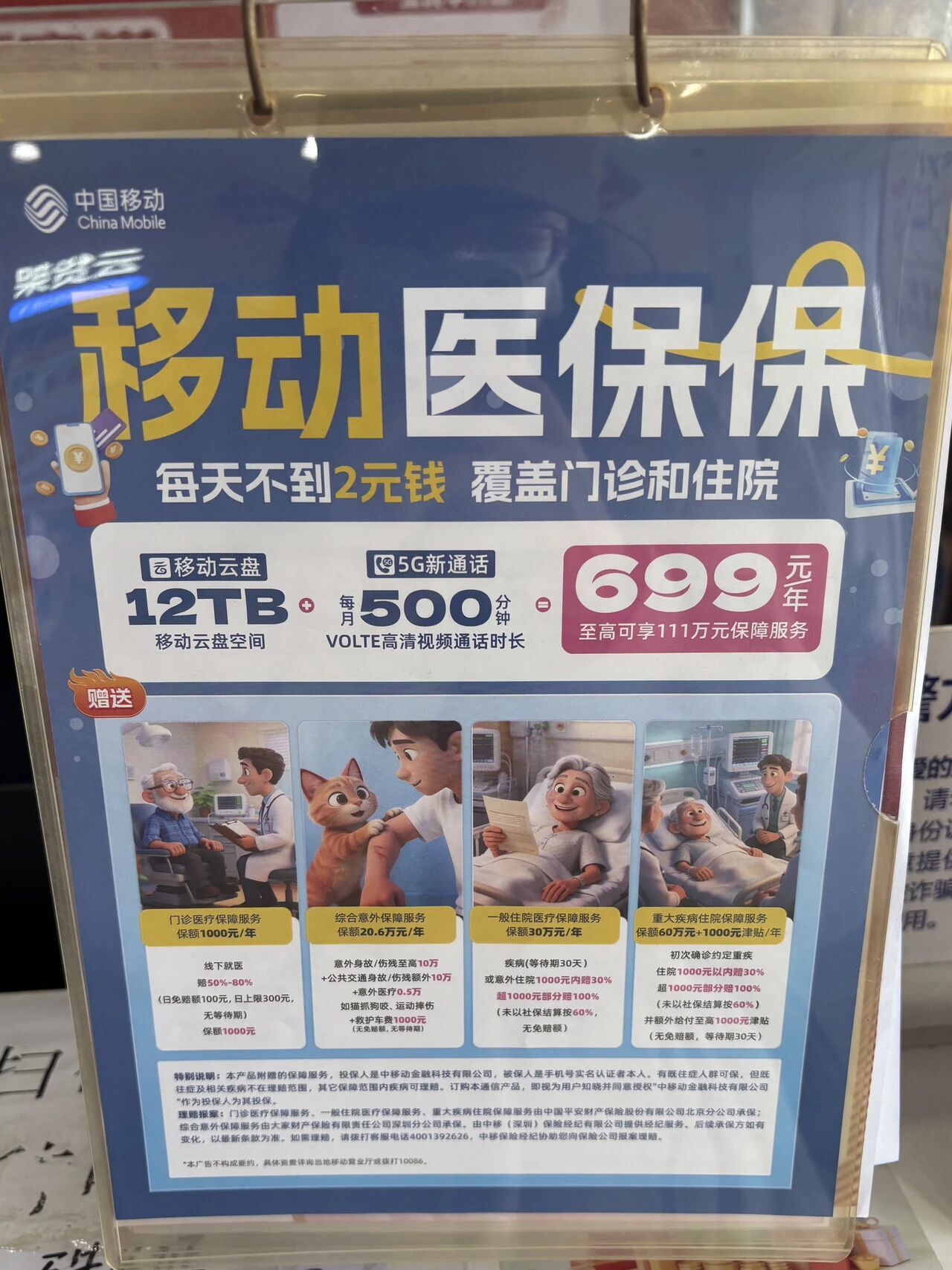
Core Insights - China Mobile has launched two insurance products, "Mobile Medical Insurance" and "Mobile Family Insurance," in select offline service centers, marking a significant move towards integrating insurance into its service offerings [1][2] - The insurance products are designed to leverage China Mobile's extensive customer base and service frequency, aiming to create a "communication + finance + life services" ecosystem [1][4] Product Overview - "Mobile Medical Insurance" focuses on basic medical coverage and cost reimbursement, with annual fees ranging from 199 yuan to 699 yuan [2] - "Mobile Family Insurance" targets comprehensive family protection and daily risk management, with annual fees between 69 yuan and 199 yuan [2] Strategic Positioning - China Mobile's entry into the insurance sector is supported by its long-standing involvement in insurance brokerage since 2001, establishing a foundation for its current offerings [2][3] - The company has developed a product matrix that includes personal accident, health, and family property insurance, differentiating its offerings by closely aligning them with communication and daily life scenarios [3][4] Channel Advantages - China Mobile utilizes its insurance brokerage license to implement its insurance business, allowing it to embed insurance into its core operations without assuming underwriting risks [4] - The company benefits from a vast user base, stable app engagement, and extensive offline service center coverage, enabling low-cost access to underserved markets [4][5] Technological Integration - Advanced technologies such as 5G, big data, and AI support precise pricing, intelligent underwriting, and fraud prevention, facilitating a seamless integration of insurance into communication services and other digital platforms [5] Market Context - The insurance market in China is rapidly evolving, with significant growth potential, particularly in internet insurance, which aligns well with China Mobile's strategic objectives [3][9] - The telecommunications industry is facing challenges such as user growth slowdown and increased competition, prompting operators like China Mobile to explore insurance as a new growth avenue [9] Competitive Landscape - Other major telecom operators in China, including China Unicom and China Telecom, are also entering the insurance market, albeit with different strategies and levels of engagement [7][8] - China Mobile's approach appears more integrated and robust compared to its competitors, maintaining a strong presence in the insurance sector without showing signs of decline [8]

证券账户能买分红险 办手机卡推销健康险 跨界玩家密集进场卖保险
Nan Fang Du Shi Bao· 2026-02-03 23:16
Core Viewpoint - The insurance industry is experiencing an innovative trend of "cross-industry collaboration," with various sectors such as securities firms and telecommunications companies entering the insurance market, leading to a multi-channel integration of insurance sales [2][3][10]. Industry Trends - Multiple securities firms have quietly launched "insurance sections" in their official apps, with one leading firm offering 18 insurance products, including 13 dividend-type products [3]. - China Mobile has opted for a "offline trial sales" model, starting in January 2026, selling insurance products directly in its service outlets [3]. - Other capital players, such as Guangzhou Yuexiu Group and Midea Group, are also making significant investments in the insurance sector through acquisitions [3][4]. Market Impact - The entry of cross-industry players is reshaping traditional insurance sales channels, with a notable shift in market dynamics. The insurance sales market may evolve into a layered structure, where cross-industry platforms focus on standardized products while traditional agents emphasize complex risk management [6][10]. - The insurance sales channels are undergoing a profound transformation, with the bancassurance channel surpassing individual insurance channels in new premium scale for the first time in 14 years [5]. Opportunities - The current scale of insurance sales through cross-industry channels remains relatively small, with securities firms' insurance sales accounting for less than 5% of their total sales revenue [9]. - The integration of insurance into daily life through cross-industry platforms is seen as a strategic move to enhance user engagement and create new revenue streams for companies facing growth pressures in their core businesses [9][10]. Challenges - While cross-industry collaboration makes purchasing insurance easier, it also complicates the process of selecting the right insurance, as consumers may overlook their actual needs due to the convenience of embedded insurance offerings [10][11]. - There are concerns regarding the potential dilution of sales professionalism and service responsibilities, which could undermine consumer trust in the insurance industry [11][12].



券商、运营商密集跨界卖保险,消费者选择困难症来了?
Nan Fang Du Shi Bao· 2026-01-29 06:33
Core Viewpoint - The insurance industry is experiencing an innovative trend of "cross-industry collaboration," with various sectors such as securities firms and telecommunications companies entering the insurance market, leading to a multi-channel integration of insurance sales [2][5][10]. Group 1: Cross-Industry Participation - Major securities firms have launched "insurance sections" in their official apps, with one leading firm offering 18 insurance products, including 13 dividend-type products [3]. - China Mobile has begun selling insurance products in its offline stores, integrating insurance sales with telecommunications services [3][10]. - Other capital players, such as Yuexiu Group and Midea Group, are also making significant investments in the insurance sector through acquisitions [3][5]. Group 2: Market Dynamics and Consumer Behavior - The entry of cross-industry players is reshaping traditional insurance sales channels, which have historically relied on individual agents, bank insurance, and brokerage channels [6][7]. - The insurance market is witnessing a shift, with the bank insurance channel surpassing individual insurance channels in new premium scale for the first time in 14 years, while individual channels have seen a 16.6% decline [6]. - Consumers are finding it easier to purchase insurance but are increasingly concerned about making the right choices, as the integration of insurance into daily life may lead to oversimplified decision-making [11][12]. Group 3: Implications for Traditional Channels - The emergence of cross-industry channels is expected to challenge traditional agents and brokers, particularly in the distribution of standardized insurance products [7][10]. - Experts suggest that while cross-industry platforms may dominate simple insurance products, the value of professional agents will become more pronounced in complex risk management and long-term service [7][13]. - The market may evolve into a structure where cross-industry channels focus on lower-end products for younger demographics, while traditional channels cater to high-net-worth clients with complex needs [7][10]. Group 4: Regulatory and Strategic Considerations - The regulatory environment is evolving to support the expansion of insurance sales by securities firms, with new guidelines set to take effect in February 2026 [9]. - The push for cross-industry collaboration is driven by the need for traditional firms to diversify revenue streams amid declining income, with insurance sales seen as a key strategy for wealth management [9][10]. - The integration of insurance into telecommunications and financial services is viewed as a strategic move to create new growth avenues in a saturated market [10][13].

太平2025年业绩预增215%至225%;人身险预定利率研究值降至1.89%;顾越当选华泰保险集团董事|13精周报
13个精算师· 2026-01-24 03:04
Regulatory Dynamics - Nine departments support insurance institutions to develop commercial health insurance products suitable for drug retail scenarios and encourage the development of drone delivery liability insurance [6][7] - The Ministry of Finance announced that the central government will allocate approximately 1.2 trillion yuan for basic pension insurance subsidies in 2025 [9] - The Ministry of Finance stated that agricultural insurance premiums are expected to exceed 155 billion yuan in 2025, with nearly 80% coming from government subsidies [11] - The People's Bank of China maintained the 1-year and 5-year Loan Prime Rate (LPR) at 3.0% and 3.5% respectively [14] - The National Bureau of Statistics projected a GDP growth of 5% for 2025, with industrial added value growth of 5.9% [15] Company Dynamics - China Life plans to invest 4 billion yuan to establish a partnership focusing on technology innovation in the Yangtze River Delta region [26] - China Life's overseas total assets exceeded 452.8 billion HKD, participating in multiple star innovation enterprises' equity investments [27] - China Life's overseas company subscribed to approximately 2.4 billion HKD in Hong Kong's multi-currency digital green bonds [28] - China Pacific Insurance's cumulative original insurance premium income for 2025 is projected to be 258.115 billion yuan, an increase of 8.1% year-on-year [34] - China Taiping expects a 215% to 225% increase in annual profit attributable to shareholders for 2025 compared to the previous year [33] Industry Dynamics - Seven Chinese insurance companies ranked in the "2026 Global Brand Value 500" list, with Ping An at 32nd and China Life at 104th [55] - The insurance asset management sector registered 314 plans in 2025, with a total scale of 510.443 billion yuan, showing a decrease in both quantity and scale year-on-year [58] - The insurance industry is expected to see a "double increase" in premiums and profits in 2025, benefiting from a rising equity market [56][57] - The cumulative payout for Zhong An Insurance in 2025 reached 17.9 billion yuan, with AI integrated into the entire claims process [38][39]





中国移动跨界保险市场挑战:保险业务面临专业与合规考验?
Nan Fang Du Shi Bao· 2026-01-22 23:11
Core Viewpoint - China Mobile has launched innovative insurance products, marking its entry into the insurance business and sparking discussions on the "telecom + insurance" integration model [1][2]. Group 1: Product Launch and Details - China Mobile, through its subsidiary Zhongyi Insurance Brokerage, has introduced "Mobile Medical Insurance" and "Mobile Home Insurance," initially available in Shandong [1]. - The insurance products cover hospitalization, family property, and comprehensive accidents, with annual fees set at 199 yuan for "Mobile Home Insurance" and 699 yuan for "Mobile Medical Insurance" [1]. - The target audience includes local mobile users with a monthly consumption of 50 yuan or more, with plans for nationwide rollout in the future [1][2]. Group 2: Historical Context and Strategic Moves - China Mobile's foray into insurance is not new; it dates back over 20 years, with the establishment of its predecessor, Haida Insurance Brokerage, in 2001 [1]. - In 2016, China Mobile invested 2 billion yuan to acquire a 20% stake in China Merchants Jinhe Life Insurance, becoming its second-largest shareholder, thus transitioning from a sales channel to a capital player in the insurance sector [2]. Group 3: Industry Context and Motivations - The primary motivation for telecom operators to enter the insurance market is the pressure on traditional business growth, with challenges such as user saturation and slowing ARPU growth [3]. - The insurance sector is seen as a viable "second growth curve" due to its large scale, stable cash flow, and rigid demand [3]. - Other telecom operators, such as China Unicom and China Telecom, are also exploring insurance, albeit through different strategies [3][4]. Group 4: Challenges and Considerations - The integration of insurance with telecom services presents challenges, including unclear profit models and the need for professional capabilities to handle complex insurance processes [5][6]. - Compliance risks are significant, particularly regarding user data usage and potential sales misguidance [6]. - The current pilot phase of the insurance products raises questions about future rollout strategies and service optimizations [6].
中国移动跨界卖保险?上海、山东等地营业厅已上新
Guo Ji Jin Rong Bao· 2026-01-22 11:57
Core Viewpoint - Telecom operators are expanding into the insurance sector to diversify their business and create new growth opportunities in response to market saturation in traditional communication services [4][10]. Group 1: Product Launch and Features - China Mobile has launched two insurance products, "Mobile Medical Insurance" and "Mobile Home Insurance," in regions such as Shanghai and Shandong [5]. - "Mobile Medical Insurance" offers various coverage options, including outpatient medical services (CNY 1,000/year), general hospitalization (CNY 300,000/year), and critical illness hospitalization (CNY 600,000 + CNY 1,000 allowance/year), with premiums ranging from CNY 199 to CNY 699 depending on customer categories [5][6]. - "Mobile Home Insurance" provides coverage for home safety, health benefits, family services, and protection against telecom fraud, with a maximum coverage of CNY 1.342 million and annual premiums ranging from CNY 0 to CNY 199 based on user card levels [6]. Group 2: Strategic Rationale - The move into insurance allows telecom operators to leverage their large user base and offline channels, transforming into "ecological operators" and enhancing user engagement through value-added services [4][7]. - The integration of insurance services into telecom offerings addresses the "last mile" issue in traditional insurance distribution, particularly benefiting underserved markets with lower entry barriers and more convenient processes [4][10]. Group 3: Industry Landscape and Differentiation - China Mobile has a history in the insurance sector, holding a 20% stake in China Merchants Jinhe Life Insurance and possessing an insurance brokerage license [8]. - In contrast, China Unicom has engaged in strategic partnerships with major insurance companies but does not hold direct insurance licenses, while China Telecom is retracting from the insurance market by divesting its insurance agency [9]. - The differing strategies among the three major telecom operators stem from their strategic positioning, resource allocation, and synergy with core business operations [9][10]. Group 4: Challenges and Recommendations - Common challenges faced by telecom operators entering the insurance market include a lack of expertise in insurance product design, unclear profit models, and compliance risks related to user data [10]. - To succeed, operators should focus on technology and channel integration, collaborate closely with insurance companies to develop scenario-based products, and enhance their service systems to build user trust [10][11].
明日题材前瞻:黄金挑战美元霸权,中国移动跨界引爆保险暗线
Sou Hu Cai Jing· 2026-01-21 13:27
Group 1 - The proportion of gold in global reserve assets is continuously rising, with central banks showing no signs of slowing down their gold purchases. Morgan Stanley indicates that gold's share in central bank assets has increased from approximately 14% to 25%-28%, and this upward trend shows no signs of abating. Risk premiums and hedging behaviors will continue to exert pressure on the US dollar while supporting gold demand. Additionally, policy factors driving "de-dollarization" are currently in a "neutral to slightly accelerating" state, and the evolution of these policies in the short term will determine the extent of the de-dollarization trend [1] Group 2 - China Mobile has launched insurance products through its subsidiary, signaling a rapid expansion of telecom operators into the financial sector. The products, "Mobile Health Insurance" and "Mobile Home Insurance," are currently being trialed in select regions like Shandong and can be purchased at offline service centers. This move highlights the telecom operator's strategy to leverage its extensive offline channel network and customer resources to penetrate the financial insurance services market [2] Group 3 - The Ministry of Housing and Urban-Rural Development in China is advancing a new model for real estate development, emphasizing the implementation of a current housing sales system. This approach aims to ensure that buyers receive what they see, fundamentally mitigating delivery risks. The ministry will continue to support reasonable financing needs of real estate companies and maintain the rights of homebuyers through regulated pre-sale fund supervision [3] Group 4 - The upcoming Spring Festival travel period is expected to witness unprecedented levels of cross-regional personnel movement, with both railway and civil aviation passenger volumes projected to reach historical highs. The emphasis will be on self-driving travel, prompting local authorities to enhance road management and service guarantees. This indicates a peak demand period for industries related to energy supply, road services, and vehicle maintenance [4]