窄基ETF

Search documents
A股尾盘,突然异动!宽基ETF成交再度放量
券商中国· 2026-01-28 08:41
Core Viewpoint - The A-share market is experiencing significant net outflows from broad-based ETFs, despite strong overall market performance and high trading volumes [2][4][6]. Group 1: ETF Market Dynamics - On January 28, the trading volume of multiple broad-based ETFs surged, with total ETF trading reaching a record high of 762.8 billion yuan [3]. - As of January 27, 11 broad-based stock ETFs had net outflows exceeding 10 billion yuan each, totaling over 720 billion yuan in outflows [4]. - Major ETFs such as Huatai-PB CSI 300 ETF and E Fund CSI 300 ETF faced net outflows exceeding 100 billion yuan each [4][6]. Group 2: Sector Performance - Despite the outflows from broad-based ETFs, sectors like non-ferrous metals, chemicals, electric grid equipment, semiconductors, and satellites have shown strong performance [4]. - Specific ETFs in these sectors, such as Southern CSI Nonferrous Metals ETF and Huaxia CSI Electric Grid Equipment ETF, have attracted over 10 billion yuan in net inflows [4]. Group 3: Market Trends and Investor Behavior - The A-share market is characterized by a clear divergence in performance, with indices like Sci-Tech 200 and Sci-Tech 100 performing well, while large-cap indices like CSI 300 and SSE 50 lag behind [6][7]. - The current market environment is marked by a strong "opening red" expectation, which supports investor confidence, despite significant net redemptions in broad-based ETFs [7]. - The growth of narrow-based, cross-border, and commodity ETFs contrasts with the decline in broad-based and bond ETFs, indicating a shift in investor preferences [4][8].


电网设备ETF领涨;ETF市场首现万亿机构丨ETF晚报
2 1 Shi Ji Jing Ji Bao Dao· 2026-01-19 09:19
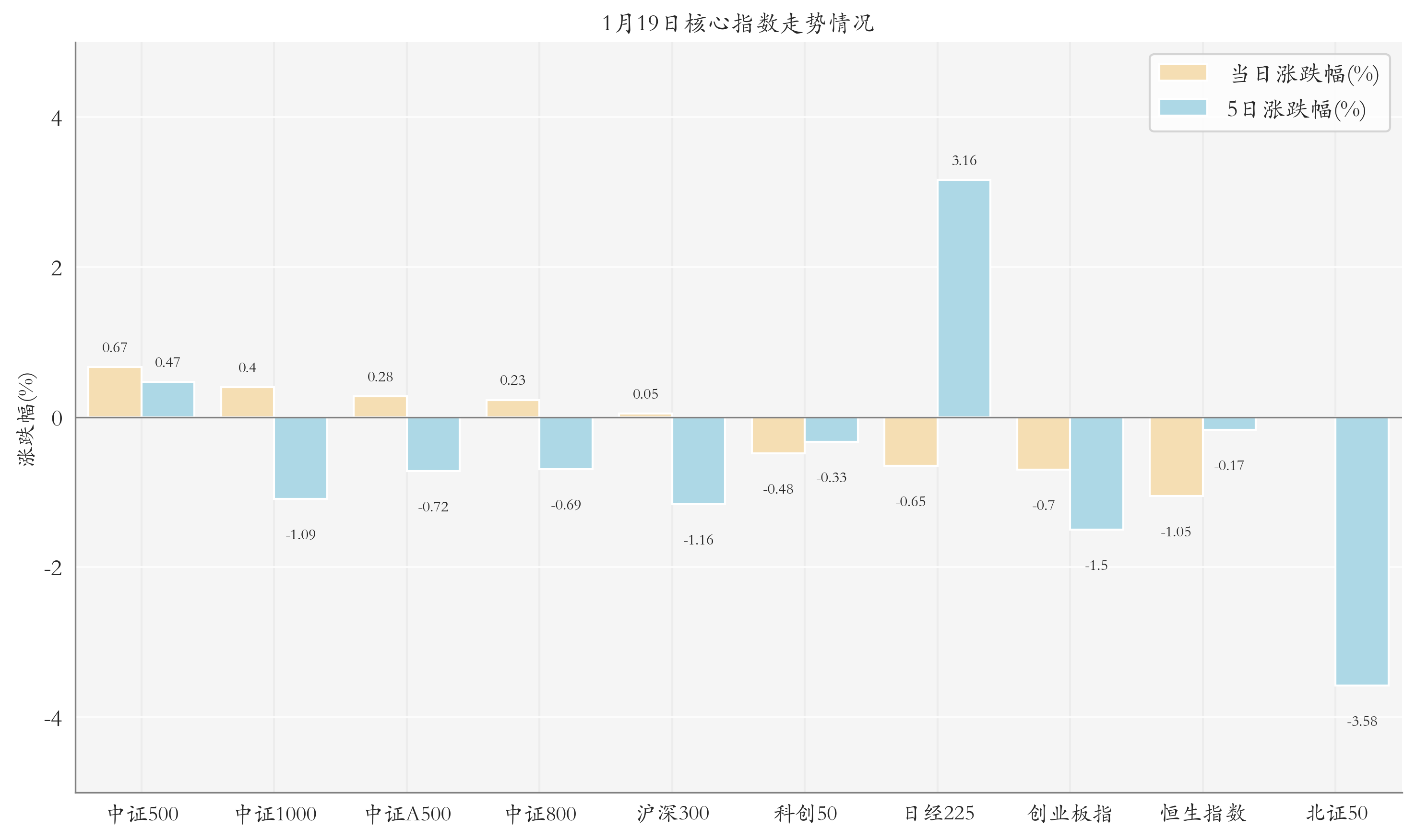
ETF Industry News - The three major indices mostly rose, with several ETFs in the power equipment sector leading the gains. The grid equipment ETF (159326.SZ) rose by 7.76%, the grid ETF (561380.SH) by 7.18%, and another grid ETF (159320.SZ) by 7.03%. In contrast, several ETFs in the pharmaceutical and biotechnology sector declined, with the Sci-Tech Pharmaceutical ETF (588130.SH) down by 2.21% and the Innovative Drug ETF (517110.SH) down by 2.17% [1] ETF Market Highlights - In the first two weeks of 2026, two ETFs reached the "trillion" mark in size, specifically those managed by Huaxia Fund and the cross-border ETF. This indicates a significant scale in the ETF market, which has accumulated over 6 trillion in assets over 20 years with nearly 60 managers. Major players like Huaxia and E-Fund continue to grow due to scale advantages, while smaller firms leverage differentiated strategies [2] - The number of ETFs included in the "ETF Connect" has expanded to 364, with 98 ETFs officially added to the Northbound Stock Connect. This represents a more than 30% increase from the previous total of 273. A total of 29 fund companies had products included, with Huaxia Fund leading with 14 new ETFs [3] - Recent market dynamics show a significant internal shift in ETF funds, with large redemptions in low-risk products like broad-based ETFs, bond ETFs, and money market ETFs. Conversely, commodity ETFs, cross-border ETFs, and narrow-based ETFs have become key areas for fund inflows, reflecting a shift in investor preferences [4] Market Performance Overview - On January 19, the A-share market showed mixed results, with the Shanghai Composite Index rising by 0.29% to 4114.0 points, while the Shenzhen Component Index rose by 0.09% to 14294.05 points. The ChiNext Index fell by 0.7% to 3337.61 points [5] - In terms of sector performance, the basic chemical, oil and petrochemical, and power equipment sectors led the gains with daily increases of 2.7%, 2.08%, and 1.84%, respectively. In contrast, the computer, communication, and banking sectors lagged behind with declines of -1.55%, -0.96%, and -0.6% [8] ETF Market Overview - The average performance of various ETF categories indicates that commodity ETFs performed the best with an average increase of 1.21%, while cross-border ETFs had the worst performance with an average decline of -1.14% [11] Top Performing ETFs - The top five ETFs in different categories include: - Stock ETFs: Grid Equipment ETF (159326.SZ), Grid ETF (561380.SH), and others [14] - Bond ETFs: Convertible Bond ETF (511380.SH), Shanghai Composite Convertible Bond ETF (511180.SH), and others [14] - Commodity ETFs: Gold ETF (159834.SZ), Gold ETF (518850.SH), and others [14] - Cross-border ETFs: Hong Kong Central Enterprise Dividend ETF (520660.SH), Sino-Korean Semiconductor ETF (513310.SH), and others [15] Trading Volume Statistics - The top three stock ETFs by trading volume were A500 ETF (563360.SH) with 14.083 billion, CSI 300 ETF (510300.SH) with 13.793 billion, and A500 ETF Fund (512050.SH) with 12.891 billion [16][17]
流出超2000亿元!ETF资金迁移路线图曝光
Zheng Quan Shi Bao Wang· 2026-01-18 23:36
Group 1 - The core viewpoint of the article highlights a significant internal shift in the ETF market, with funds moving away from broad-based ETFs to narrower, high-volatility products [1][2][5] - Year-to-date, over 200 billion yuan has been withdrawn from broad-based ETFs, with 14 ETFs experiencing a net outflow exceeding 30 billion yuan, all of which are broad-based ETFs [2][4] - The largest stock ETF in China has seen its scale drop from 400 billion yuan to 300 billion yuan, while the second-largest has decreased from 300 billion yuan to 200 billion yuan [2] Group 2 - In contrast, narrow-based ETFs, cross-border ETFs, and commodity ETFs have attracted significant inflows, with cross-border ETFs growing by 746.32 billion yuan, surpassing the 1 trillion yuan mark for the first time [4][6] - The South China Nonferrous ETF has become the only product to receive over 10 billion yuan in net inflows this year, driven by rising base metal prices [6][8] - The active trading environment in the A-share market and the structural differentiation in performance have led to increased demand for high-elasticity assets, further supporting the inflow into narrow-based ETFs [7][9] Group 3 - Fund companies focusing on narrow-based ETFs are experiencing significant growth, with companies like GF Fund and Yongying Fund expanding their ETF scales rapidly [7][8] - The current market dynamics suggest that narrow-based ETFs are becoming a key driver of growth in the ETF sector, especially for smaller fund companies looking to compete against larger institutions [9][10] - There is a concern that narrow-based ETFs may be used as speculative tools rather than for long-term asset allocation, which could lead to increased trading costs and volatility for investors [10]
流出超2000亿元!ETF资金迁移路线图曝光
券商中国· 2026-01-18 23:33
Core Viewpoint - The ETF market is experiencing significant internal shifts, with funds moving away from broad-based ETFs towards narrower, higher-volatility products, reflecting a change in investor preferences [2][3]. Group 1: Fund Flows and Market Trends - Over 200 billion yuan has been withdrawn from broad-based ETFs this year, with 9 non-hybrid ETFs experiencing over 10 billion yuan in redemptions each [3]. - The largest stock ETF in China has seen its size drop from 400 billion yuan to 300 billion yuan, while the second-largest has decreased from 300 billion yuan to 200 billion yuan [3]. - In contrast, narrow-based ETFs, cross-border ETFs, and commodity ETFs have attracted significant inflows, with cross-border ETFs growing by 746.32 billion yuan, surpassing the 1 trillion yuan mark for the first time [6]. Group 2: Performance of Different ETF Types - Bond ETFs have shrunk by 810.58 billion yuan, and money market ETFs have decreased by 211 billion yuan since the beginning of the year [5]. - Narrow-based ETFs have gained popularity, with the Southern Nonferrous ETF being the only product to see net inflows exceeding 10 billion yuan, totaling 100.87 billion yuan, driven by rising base metal prices [9]. - The overall market for ETFs with over 100 billion yuan in assets has expanded to 132 products, with 18 industry-specific ETFs attracting over 1 billion yuan each this year [11]. Group 3: Competitive Landscape and Future Outlook - The growth of narrow-based ETFs is reshaping the competitive landscape, with companies focusing on niche sectors seeing significant growth in their ETF management scale [10]. - The current market environment presents a golden opportunity for fund companies to develop narrow-based ETFs, as the investment value in emerging sectors remains largely untapped [11]. - However, there is a concern that narrow-based ETFs may become speculative tools, leading to increased trading frequency and potential volatility in investor returns [12].
多只国企ETF上涨;今年大量资金涌入窄基ETF丨ETF晚报
2 1 Shi Ji Jing Ji Bao Dao· 2025-12-02 10:57
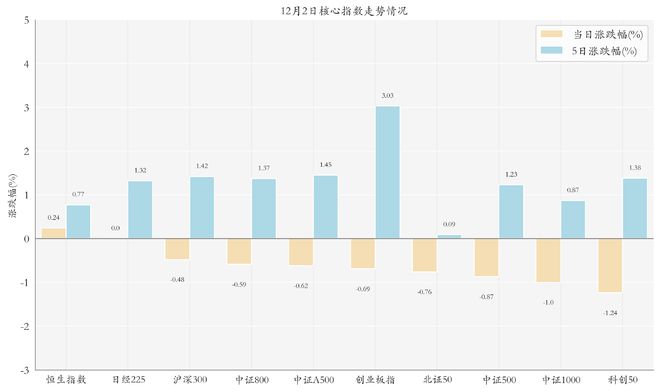
Market Overview - The three major indices experienced fluctuations and declines, with the Shanghai Composite Index down by 0.42%, the Shenzhen Component Index down by 0.68%, and the ChiNext Index down by 0.69. [1][4] - Several ETFs in the state-owned enterprise sector saw increases, including the China State-Owned Enterprise ETF (517180.SH) up by 0.46% and the Central Enterprise Win-Win ETF (517090.SH) up by 0.44%. [1] ETF Market Trends - There has been a significant influx of funds into narrow-based ETFs this year, with a notable increase in industry-themed ETFs. The first batch of seven ETFs tracking the CSI Innovation and Entrepreneurship Artificial Intelligence Index was launched, attracting considerable investor interest. [2] - Among the 18 ETFs that received over 10 billion yuan in net inflows this year, all were narrow-based ETFs, highlighting investor preference for these products. [2] - The top two sectors for net inflows were the Hong Kong Stock Connect Internet ETF and the Securities ETF, which attracted 55.30 billion yuan and 33.42 billion yuan, respectively. [2] ETF Management Fee Competition - The rapid expansion of ETFs has led to increased competition among fund managers, with the top ten ETF managers controlling 4.3 trillion yuan, accounting for 75% of the total market size. [3] - The average management fee for ETFs remains at 0.5%, but there is a growing trend of competition based on fee structures, with E Fund having the highest proportion of low-fee products at 54.9%. [3] Sector Performance - In the latest trading session, the petroleum and petrochemical, light industry manufacturing, and household appliances sectors performed well, with daily increases of 0.71%, 0.55%, and 0.43%, respectively. [6] - Conversely, the media, non-ferrous metals, and computer sectors lagged, with daily declines of -1.75%, -1.36%, and -1.34%. [6] ETF Performance by Category - The best-performing category of ETFs today was the money market ETFs, with an average daily change of 0.00%, while the thematic stock index ETFs had the worst performance with an average decline of -1.02%. [9] - The top three performing stock ETFs included the 5G Communication ETF (515050.SH) with a gain of 0.53%, the 2000 ETF (561370.SH) with a gain of 0.52%, and the Low Volatility Dividend ETF (159228.SZ) with a gain of 0.47%. [11][12] Trading Volume Insights - The top three stock ETFs by trading volume were the A500 ETF (512050.SH) with a volume of 5.413 billion yuan, the CSI A500 ETF (159338.SZ) with 4.434 billion yuan, and the A500 ETF by E Fund (159361.SZ) with 4.378 billion yuan. [14][16]
一日售罄!这类ETF突然爆发,投资者为何痴迷?
证券时报· 2025-11-30 13:08
Core Viewpoint - The public fund industry is experiencing a surge in the issuance of industry-themed ETFs, driven by investors' preference for narrow-based ETFs over broad-based ETFs due to the structural characteristics of the A-share market [2][3][4]. Group 1: Market Trends - On November 28, the first batch of seven ETFs tracking the CSI Innovation and Entrepreneurship Artificial Intelligence Index was launched, with some products selling out on the first day [2][3]. - The total scale of narrow-based ETFs in the stock market has surpassed 1.6 trillion yuan, showing a growth rate of 100%, significantly higher than the less than 10% growth of broad-based ETFs [2][4]. - Investors are increasingly favoring narrow-based ETFs, with 18 ETFs attracting over 10 billion yuan in net inflows this year, all of which are narrow-based [4][5]. Group 2: Investor Behavior - The preference for narrow-based ETFs reflects a shift in investor strategy towards high-growth sectors like AI, semiconductors, and new energy, while traditional sectors like real estate are losing appeal [7][10]. - The trend of investing in narrow-based ETFs is expected to continue as investors seek to capture structural opportunities in high-growth industries [8][9]. - Investors are also utilizing strategies like grid trading and quantitative enhancements to achieve high-frequency trading in narrow-based ETFs, further driving their popularity [7]. Group 3: Performance and Risks - Narrow-based ETFs have shown significant volatility, with some experiencing substantial losses, highlighting the risks associated with concentrated investments [8][10]. - The average turnover rate of narrow-based ETFs is much higher than that of broad-based ETFs, indicating a tendency for investors to frequently adjust their positions [9]. - The concentration of funds in popular narrow-based ETFs can inflate valuations and increase the risk of market corrections, particularly if there is a sudden withdrawal of capital [9][10].

一日售罄!这类ETF突然爆发,投资者为何痴迷?
券商中国· 2025-11-30 09:24
Core Viewpoint - The public fund industry is experiencing a surge in the issuance of industry-themed ETFs, driven by investors' preference for narrow-based ETFs to seek higher returns amid a structurally differentiated A-share market [2][3][4]. Group 1: Market Trends - On November 28, the first batch of seven ETFs tracking the CSI Innovation and Entrepreneurship Artificial Intelligence Index was launched, with some products selling out on the first day [2][3]. - The total scale of narrow-based ETFs in the stock market has surpassed 1.6 trillion yuan, showing a growth rate of 100%, significantly outpacing the less than 10% growth of broad-based ETFs [2][4]. - Investors are increasingly favoring narrow-based ETFs, with 18 ETFs attracting over 10 billion yuan in net inflows this year, all of which are narrow-based [4][5]. Group 2: Investor Behavior - Investors are shifting from "broad allocation" to "precise selection," indicating a move towards industry-themed narrow-based ETFs due to the structural characteristics of the market [7][8]. - The preference for narrow-based ETFs reflects a desire to capture structural opportunities in high-growth sectors like AI and new energy, while broad-based ETFs are seen as less attractive due to their diluted performance from traditional sectors [6][8]. Group 3: Performance and Risks - The performance of narrow-based ETFs has been robust, with significant net inflows into sectors such as internet and securities, while broad-based ETFs have faced substantial outflows [4][5]. - However, narrow-based ETFs are characterized by higher volatility, which can lead to significant losses during market corrections, as evidenced by specific ETFs experiencing declines of over 15% [9][10]. - The concentration of funds in popular narrow-based ETFs may lead to inflated valuations and increased market volatility, raising concerns about the potential for a "herd effect" during market downturns [11][12].

得窄基者得天下?行业主题基金成规模赢家
券商中国· 2025-11-09 10:40
Core Viewpoint - The narrow-based products are becoming the main driving force for the growth of public funds, driven by the segmented demands of investors [1][2]. Group 1: Market Trends - The public fund industry is entering a tool-oriented era, where narrow-based products with distinct styles and specific industry scenarios are key to marketing strategies [2]. - Despite a slight overall redemption in public fund shares, narrow-based products have seen significant growth, indicating a shift in investor preference towards these products [3][4]. Group 2: Performance of Narrow-based Products - Narrow-based products have countered the shrinkage of wide-based ETFs, with significant net subscriptions observed in various narrow-based ETFs during the third quarter [4]. - Specific examples include the Satellite ETF with over 10 times net subscriptions, the Robot ETF with nearly 5 times, and the New Energy Battery ETF with about 8 times [4]. Group 3: Active Equity Funds - Active equity funds are also aligning with narrow-based strategies, with themes like innovative drugs, digital economy, and artificial intelligence leading performance rankings [5][6]. - The top 10 active equity funds are all industry-themed, showcasing a trend towards sector-focused investment strategies [5]. Group 4: Tool-oriented Product Development - The arrival of the tool-oriented era in public funds has led to a consensus that "whoever masters narrow-based products will dominate" [8]. - Fund companies are increasingly focusing on tool-oriented products that cater to specific investor needs, enhancing their competitive edge [8][9]. - The development of tool-oriented products is seen as a response to the challenges of extracting excess returns in an efficient market [9].