
红利低波ETF易方达

Search documents
基于BLACK-LITTERMAN模型融合资产择时与风格轮动的资产配置研究
Southwest Securities· 2026-02-26 10:30
Asset Allocation Model - The report introduces a dual-driven asset allocation model based on the Black-Litterman (BL) framework, integrating strategic and tactical approaches to enhance decision-making and investment performance[1] - The strategic component utilizes asset timing and regression analysis to generate posterior distributions of asset returns, improving the foresight of allocation decisions[1] - The tactical component focuses on style rotation strategies in the A-share market, dynamically tracking market style shifts to optimize investment portfolios[1] Timing Strategies - The bond timing strategy is based on economic fundamentals (economic growth, real estate cycle) and market interest rates (repo rates, government bond yields) to time government bonds[2] - The commodity timing strategy for gold incorporates financial, monetary, and commodity attributes, analyzing real interest rates, inflation expectations, risk aversion, and supply-demand relationships[2] - The stock timing strategy for A-shares evaluates liquidity (money market rates, credit expansion), international influences (China-US interest rate differentials, exchange rates), and valuation metrics[2] Style Rotation Strategies - The size and value rotation strategy examines macroeconomic changes and the performance of large versus small-cap stocks, utilizing indicators like credit spreads and foreign capital inflows to construct timing metrics[3] - The growth versus value rotation strategy is driven by macro liquidity and micro technical factors, with liquidity being the core driver of growth-value style rotation[3] Performance Metrics - From December 31, 2013, to December 31, 2025, the BL model strategy achieved an annualized return of 12.10%, a Sharpe ratio of 2.38, and a maximum drawdown of 4.72%[7] - The latest asset allocation weights as of December 31, 2025, include 4.54% in money market funds, 58.64% in government bonds, 18.00% in gold, and 18.82% in A-shares, with A-shares equally allocated between small-cap and growth styles[8]
红利低波ETF华泰柏瑞(512890)近60天狂吸金48.6亿!机构:2026年科技与非科技都有机会,质量策略正当时
Xin Lang Cai Jing· 2026-02-24 09:02
Core Viewpoint - The market experienced fluctuations with the ChiNext Index rising over 2% at one point, while the Shanghai Composite Index closed up by 0.87%. In this context, the Huatai-PineBridge Low Volatility ETF (512890) increased by 0.43%, closing at 1.172 yuan, with a turnover rate of 1.72% and a trading volume of 5.15 billion yuan, leading its category [1][6]. ETF Performance - The Huatai-PineBridge Low Volatility ETF (512890) reported a trading volume of 154.12 billion yuan over the last 20 trading days, averaging 7.71 billion yuan per day. Since the beginning of the year, the total trading volume reached 250.40 billion yuan, with an average of 8.08 billion yuan per day [2][7]. - The ETF has seen significant net inflows, with 3.6 billion yuan in the last 5 trading days, 9 billion yuan in the last 10 days, 29.2 billion yuan in the last 20 days, and 48.6 billion yuan in the last 60 days [2][7]. Top Holdings - The top ten holdings of the Huatai-PineBridge Low Volatility ETF include major companies across various sectors such as banking, food and beverage, home appliances, and pharmaceuticals. Notable holdings include Shanghai Bank, Nanjing Bank, Ping An Bank, and Gree Electric Appliances, with a total market value of approximately 6.72 billion yuan, accounting for 25.34% of the ETF's total market value [2][7]. Market Outlook - Multiple institutions have expressed optimistic views on the post-holiday market and dividend strategies. CITIC Securities believes that the A-share market, primarily driven by manufacturing and finance, will be less affected by AI disruptions compared to US and Hong Kong markets, suggesting a continuation of the spring rally [4][9]. - Guotai Junan Securities noted that with China's economic policy focusing on domestic demand, investor pessimism towards traditional domestic industries is likely to be corrected, contributing to a more stable economic outlook for 2026 [4][9]. Investment Strategy - The Huatai-PineBridge Low Volatility ETF, established on December 19, 2018, has achieved a return of 76.88% over the past five years, outperforming its benchmark and ranking 51st among 909 funds. Investors are encouraged to consider regular investment strategies to mitigate volatility risks [10].

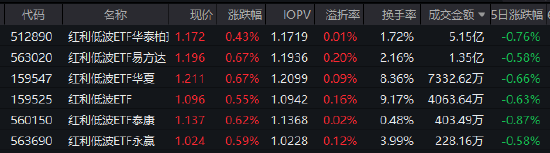
机构称红利股仍是险资权益配置重要方向,关注恒生红利低波ETF易方达(159545)、红利ETF易方达(515180)等产品投资价值
Mei Ri Jing Ji Xin Wen· 2026-02-13 03:31
Group 1 - The A-shares and Hong Kong stocks experienced a collective pullback, with the Hang Seng High Dividend Low Volatility Index down by 1.1% and the CSI Dividend Index down by 0.6% as of 11:05 AM on February 13 [1] - Despite the market downturn, there was a counter-trend investment with the E Fund Hang Seng Dividend Low Volatility ETF (159545) seeing a net subscription of approximately 700 million units [1] - According to Huatai Securities, it is estimated that new investments from insurance funds in secondary equity markets could reach 1 trillion yuan by 2025, with equity positions potentially reaching around 16% [1] Group 2 - E Fund is currently the only fund company that implements low fee rates for all its dividend ETFs, with management fees set at 0.15% per year for products including the E Fund Hang Seng Dividend Low Volatility ETF (159545) and others [2] - This low-cost structure is designed to assist investors in building high dividend asset portfolios at a lower cost [2]

红利低波ETF华泰柏瑞(512890)流通规模突破301亿元 机构建议“持股过节” 高股息板块配置逻辑更清晰
Xin Lang Cai Jing· 2026-02-11 09:02
Market Overview - On February 11, the A-share market exhibited a volatile trend, with the ChiNext Index dropping over 1% and the Shanghai Composite Index slightly rising by 0.09% [1][6] - In this market environment, the Huatai-PB Low Volatility ETF (code: 512890) increased by 0.17%, closing at 1.188 yuan, with a turnover rate of 1.56% and a transaction amount of 470 million yuan, ranking first among similar ETFs in terms of transaction volume [1][6] ETF Performance - As of February 11, the Huatai-PB Low Volatility ETF has accumulated a total transaction volume of 23.061 billion yuan over 28 trading days this year, with an average daily transaction of 824 million yuan [2][7] - Fund flow data indicates that as of February 10, the ETF saw a net inflow of 880 million yuan over the last 10 trading days, 3.472 billion yuan over the last 20 days, and 4.470 billion yuan over the last 60 days, with a circulating scale of 30.128 billion yuan [2][7] Investment Recommendations - Recent recommendations from various institutions suggest a "hold stocks over the holiday" strategy, indicating that the A-share market's performance before the Spring Festival may influence post-holiday trends [4][9] - Huajin Securities noted that the current spring market is not yet over, with expectations for improved economic and corporate profit forecasts during the Spring Festival, and a neutral risk appetite anticipated [4][9] - Zhongtai Securities emphasized that the configuration logic for high-dividend sectors is becoming clearer, with expectations for policy measures related to growth stabilization and consumption promotion to gradually materialize after the Spring Festival [4][9] ETF Characteristics - The Huatai-PB Low Volatility ETF was established on December 19, 2018, with a benchmark of the CSI Low Volatility Index [4][9] - As of February 10, 2026, the ETF has achieved a return of 79.95% over the past five years, outperforming its benchmark and ranking 51st among 909 funds [4][9] - Investors can participate through a systematic investment plan to smooth out volatility risks, and those without stock accounts can access it through its off-market linked funds [4][9]
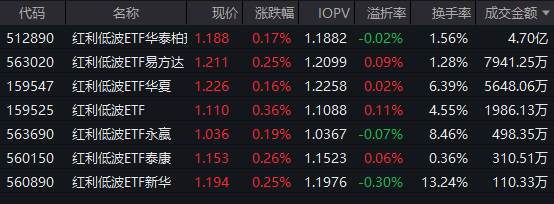
红利板块成资金避风港,指数涨超1%,红利低波ETF易方达(563020)等产品受市场关注
Mei Ri Jing Ji Xin Wen· 2026-02-05 07:03
Group 1 - The banking sector continues to strengthen, driving the rise of dividend indices, with the CSI Dividend Low Volatility Index up by 1.1% and the CSI Dividend Value Index up by 0.9% as of 14:30 [1] - The E Fund Dividend Low Volatility ETF (563020) has seen a net inflow of approximately 250 million yuan over four consecutive trading days, indicating strong investor interest [1] - Citic Securities highlights that high dividend strategies remain attractive for the year, with an implied return rate being considerable if EPS maintains a growth of over 5% in a low-interest-rate environment [1] Group 2 - The CSI Dividend Low Volatility Index tracked by the E Fund Dividend Low Volatility ETF consists of 50 stocks characterized by good liquidity, continuous dividends, moderate dividend payout ratios, positive growth in earnings per share, high dividend yields, and low volatility, with the banking sector accounting for nearly 50% of the index [1] - The current dividend yield of the index stands at 4.6%, reflecting the overall performance of high dividend and low volatility stocks [1] - E Fund offers a variety of dividend ETFs, including E Fund Dividend ETF (515180), Hang Seng Dividend Low Volatility ETF (159545), Dividend Value ETF (563700), and A500 Dividend Low Volatility ETF (563510), all with a management fee rate of 0.15% per year, providing diverse options for investors seeking high dividend assets [1]
高股息的“常青密码”,红利指数调仓揭秘
Zhong Guo Zheng Quan Bao· 2026-01-14 13:05
Group 1 - The core idea of the news is that the dividend index acts as a "financial gardener," pruning low dividend yield stocks and incorporating high dividend yield stocks to maintain a focus on quality assets with high dividends [1] - The annual adjustment of the dividend index, represented by indices like the CSI Dividend Index and CSI Low Volatility Dividend Index, ensures that it consistently targets companies with strong dividend capabilities rather than being constrained by historical performance [1] - The appeal of the dividend index lies not in the industries it includes, but in its unwavering commitment to high dividends, providing investors with a reliable investment tool that adapts to market conditions [1] Group 2 - In a low interest rate environment, investors are increasingly focused on tangible returns, and the dividend index offers a simple, effective, and reliable investment tool through strict dividend yield screening and dynamic adjustment mechanisms [2] - E Fund has a comprehensive product line for dividend indices, including various ETFs that cover different styles of high dividend assets, such as E Fund Dividend ETF and E Fund Low Volatility Dividend ETF [2] - E Fund is noted as the only company in the market that implements low fee rates for all its dividend ETFs, with a management fee rate of 0.15% per year, facilitating low-cost access to high dividend investment opportunities for investors [2]