险资权益配置

Search documents
险资权益配置创新高,超六成险企今年要加仓
Di Yi Cai Jing· 2026-02-26 11:50
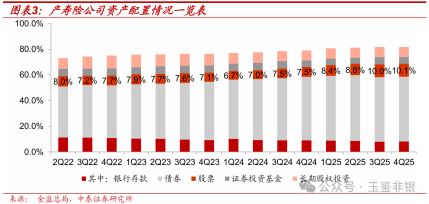
Core Viewpoint - The insurance capital is experiencing a significant increase in equity allocation, with a projected additional investment of approximately 713.3 billion yuan in 2026, driven by rising market valuations and a shift in asset allocation strategies [1][12]. Group 1: Insurance Capital Allocation - As of the end of 2025, the total investment balance of the insurance industry reached 38.5 trillion yuan, a year-on-year increase of 15.7%, marking the highest growth rate since 2021 [2]. - The allocation of core equity assets (stocks + securities investment funds) by insurance capital increased significantly by 1.6 trillion yuan to 5.7 trillion yuan, with stocks contributing 1.31 trillion yuan and funds 290 billion yuan [1][6]. - The proportion of equity allocation remains at a historical high, with over 60% of insurance institutions expressing intentions to moderately or slightly increase stock investments in 2026 [1][9]. Group 2: Investment Trends - The proportion of bank deposits in insurance capital allocation has decreased from nearly 12% in 2020 to 8.2% in 2025, while bond allocations have stabilized around 50.4% [3]. - The stock allocation ratio has increased for six consecutive quarters, indicating a strong upward trend in equity investments [5]. - By the end of 2025, the stock balance of insurance capital reached 3.7 trillion yuan, a year-on-year increase of 53.81%, with a stock allocation ratio of 10.1% [8]. Group 3: Future Outlook - A survey indicated that over 60% of insurance institutions plan to increase their stock allocations in 2026, with 40.54% of asset management institutions and 36.26% of insurance companies intending to slightly increase their stock investments [9]. - The insurance sector is optimistic about the A-share market, particularly in industries such as electronics, non-ferrous metals, and pharmaceuticals, with a focus on themes like semiconductor chips and AI capabilities [10]. - In terms of overseas investments, Hong Kong stocks are viewed as the most favorable option for 2026, with half of the asset management institutions planning to slightly increase their allocations [11].

中国险资大鳄的“年末突击战”
Xin Lang Cai Jing· 2026-02-24 14:26
Core Insights - The insurance capital (险资) is significantly influencing the A-share market in 2025, with a marked increase in investment in equity assets, indicating a long-term commitment rather than temporary involvement [2][24]. Group 1: Insurance Capital Dynamics - Insurance companies are not as transparent as public funds regarding their holdings, making it challenging to track their investment movements [4][5]. - Key indicators for understanding insurance capital movements include "fund utilization balance," which represents the total investable funds, and "account balance of various asset classes," which shows the actual holdings of stocks, bonds, and funds [6][29]. Group 2: Growth of Investable Funds - As of the end of Q4 2025, the total funds available for investment in the insurance industry reached 38.48 trillion yuan, an increase of 1.02 trillion yuan from the end of Q3 2025 [8][30]. - This growth is primarily driven by continuous premium inflows and compounding investment returns, with life insurance companies holding 34.66 trillion yuan and property insurance companies holding 2.42 trillion yuan [10][32]. Group 3: Direct and Indirect Investment in the Stock Market - By the end of Q4 2025, insurance capital directly held stocks worth 3.73 trillion yuan, up from 2.43 trillion yuan at the end of Q4 2024, indicating an increase of over 1 trillion yuan in direct stock investments [14][34]. - Additionally, insurance funds held 1.97 trillion yuan in securities investment funds, an increase of nearly 300 billion yuan from the previous year, with a significant portion likely flowing into equity funds [15][35]. Group 4: Shifts in Investment Strategy - The dominance of bond investments has begun to wane, with a slight decrease in bond allocation observed for the first time since Q2 2022, signaling a shift in investment strategy [18][39]. - The proportion of stock investments has been improving for six consecutive quarters, reaching 10.1% of the total investment balance by the end of Q4 2025, supported by market dynamics and increased allocation willingness [21][41]. Group 5: Future Investment Potential - Projections indicate that insurance capital could see an additional inflow of approximately 713.3 billion yuan in 2026, suggesting that the trend of increasing allocations to equities is likely to continue [43].
红利板块本周震荡分化,恒生红利低波ETF易方达(159545)标的指数周线“六连阳”
Mei Ri Jing Ji Xin Wen· 2026-02-13 09:47
Core Viewpoint - The Hang Seng High Dividend Low Volatility Index increased by 0.6% this week, marking a six-week consecutive rise, while the CSI Dividend Index, CSI Dividend Value Index, and CSI Dividend Low Volatility Index experienced declines of 0.1%, 0.5%, and 1.0% respectively [1]. Group 1: Index Performance - The CSI Dividend Index has a dividend yield of 4.8% and a rolling P/E ratio of 8.3 times, with a historical P/E ratio percentile of 72.3% [3]. - The CSI Dividend Low Volatility Index has a dividend yield of 4.6% and a rolling P/E ratio of 8.1 times, with a historical P/E ratio percentile of 73.3% [3]. - The Hang Seng High Dividend Low Volatility Index has a dividend yield of 5.6% and a rolling P/E ratio of 7.9 times, with a historical P/E ratio percentile of 91.2% [3]. - The CSI Dividend Value Index has a dividend yield of 4.6% and a rolling P/E ratio of 7.7 times, with a historical P/E ratio percentile of 71.7% [3]. Group 2: Future Investment Trends - According to Huatai Securities, it is estimated that insurance capital's secondary equity investment could reach 1 trillion yuan in 2025, with a secondary equity position of around 16%, becoming a significant source of funds for the stock market [1]. - In 2026, the overall new investable funds for insurance capital are expected to reach 3.1 trillion yuan, with secondary equity investment potentially reaching 900 billion yuan [1]. - Dividend stocks are increasingly important for insurance capital allocation, as the importance of cash dividend income rises and the need to reduce the volatility of equity assets becomes necessary [1]. Group 3: ETF Management Fees - E Fund is currently the only fund company that implements low fees for all dividend ETFs, with management fees for its products set at 0.15% per year [1].

机构称红利股仍是险资权益配置重要方向,关注恒生红利低波ETF易方达(159545)、红利ETF易方达(515180)等产品投资价值
Mei Ri Jing Ji Xin Wen· 2026-02-13 03:31
Group 1 - The A-shares and Hong Kong stocks experienced a collective pullback, with the Hang Seng High Dividend Low Volatility Index down by 1.1% and the CSI Dividend Index down by 0.6% as of 11:05 AM on February 13 [1] - Despite the market downturn, there was a counter-trend investment with the E Fund Hang Seng Dividend Low Volatility ETF (159545) seeing a net subscription of approximately 700 million units [1] - According to Huatai Securities, it is estimated that new investments from insurance funds in secondary equity markets could reach 1 trillion yuan by 2025, with equity positions potentially reaching around 16% [1] Group 2 - E Fund is currently the only fund company that implements low fee rates for all its dividend ETFs, with management fees set at 0.15% per year for products including the E Fund Hang Seng Dividend Low Volatility ETF (159545) and others [2] - This low-cost structure is designed to assist investors in building high dividend asset portfolios at a lower cost [2]

印尼减产+进口通道畅通,能源国企有望持续受益,国企红利ETF(159515)涨0.25%
Xin Lang Cai Jing· 2026-02-11 03:38
Group 1 - The core viewpoint of the news highlights the performance of the China Securities State-Owned Enterprises Dividend Index, which saw an increase of 0.21% as of February 11, 2026, with notable gains from constituent stocks such as Yuntianhua (up 3.92%) and Conch Cement (up 3.15%) [1] - Huatai Securities predicts that in 2025, the secondary equity investment from insurance funds, including stocks and funds, may reach 1 trillion yuan, with a secondary equity position of around 16%, making it a significant source of capital for the stock market [1] - Dividend stocks are increasingly important in the equity allocation of insurance funds, driven by the rising importance of cash dividend income and the need to reduce the volatility of equity assets as positions reach historical highs [1] Group 2 - Guolian Minsheng Securities notes that Indonesia plans to significantly reduce coal production to 600 million tons in 2026, a decrease of 40%-70% from 2025, which, combined with a 117.3% year-on-year increase in transportation capacity at the Ganqimaodu port, highlights the dual support of rigid overseas supply and improved domestic import efficiency [2] - Dongfang Securities emphasizes that sectors with dividend attractiveness during low cycles are worth monitoring, as the current macroeconomic environment is at a low point for PPI, with expectations of recovery in PPI and industry profitability [2] - The China Securities State-Owned Enterprises Dividend ETF closely tracks the China Securities State-Owned Enterprises Dividend Index, selecting 100 listed companies with high cash dividend yields and stable dividends from state-owned enterprises, reflecting the overall performance of high-dividend securities [2]
国金证券:风险因子下调引导长钱长投,险资权益配置限制再放开
Zhi Tong Cai Jing· 2025-12-08 05:19
Core Viewpoint - The adjustment of risk factors for insurance companies by the Financial Regulatory Bureau is expected to enhance the growth outlook for the insurance sector in 2024, with a focus on long-term wealth preservation and value-added policies [1][5]. Group 1: Regulatory Changes - On December 5, the Financial Regulatory Bureau issued a notice adjusting risk factors related to insurance companies' business [1]. - The adjustment aims to support stable and active capital markets by lowering the risk factors for long-term investments [2][5]. Group 2: Investment Opportunities - The insurance sector is expected to see a significant inflow of funds, with estimates of 550 to 600 billion yuan entering the market next year [6]. - Major insurance companies are projected to allocate a substantial portion of their new premiums to A-shares, with some companies like China Life and Taiping expected to invest up to 40% of new premiums [6]. Group 3: Market Dynamics - The insurance distribution channels are anticipated to achieve double-digit growth due to their advantages in customer resources and account management [1]. - The valuation of insurance companies remains low, presenting a high cost-performance ratio for investors [1]. Group 4: Long-term Outlook - The long-term fundamentals of the insurance industry are positive, with expectations of increased market share for larger companies as they transition to dividend insurance [1]. - The adjustment of risk factors is expected to provide some relief to insurance companies facing pressure on their solvency ratios, although the immediate impact on equity allocation may be limited [5][4].

国金证券:风险因子下调引导长钱长投 险资权益配置限制再放开
智通财经网· 2025-12-08 03:49
Core Viewpoint - The adjustment of risk factors for insurance companies is expected to enhance the growth outlook for the insurance sector in 2024, with a focus on long-term wealth preservation and value-added policies [1][5]. Group 1: Regulatory Changes - The Financial Regulatory Bureau issued a notice on December 5 to adjust risk factors related to insurance companies' business [1]. - The risk factor for stocks held over three years in the CSI 300 and the CSI Low Volatility 100 Index has been reduced from 0.3 to 0.27, while for stocks held over two years in the STAR Market, it has been lowered from 0.4 to 0.36 [2]. Group 2: Impact on Investment Capacity - The solvency ratio, defined as actual capital over minimum capital, influences the upper limit of equity investments for insurance companies. The adjustment in risk factors allows for an expansion in stock allocation [3]. - The overall impact of the risk factor adjustment on solvency is expected to be limited, with estimated increases in solvency ratios for major life insurance companies remaining under 3% [4]. Group 3: Market Dynamics - An estimated 550 to 600 billion yuan of incremental funds is expected to enter the market next year, with varying levels of stock accumulation among companies [6]. - Major state-owned enterprises are projected to invest 30% of new premiums into A-shares, translating to approximately 250 billion yuan entering the market [6]. Group 4: Investment Recommendations - The report recommends focusing on leading insurance companies with favorable business quality and low liability costs, particularly those with good expectations for the "opening red" period [8].
保险行业热点速递之四:险资股票风险因子松绑,权益配置空间扩容
Western Securities· 2025-12-07 11:49
Investment Rating - The industry investment rating is "Overweight" with expectations of a price increase exceeding the market benchmark index by more than 10% in the next 6-12 months [4][9]. Core Insights - The adjustment of risk factors for insurance capital investments in stocks allows for expanded equity allocation, reflecting regulatory flexibility in guiding capital optimization based on market conditions [2][3]. - The insurance sector's solvency ratios are robust, with comprehensive and core solvency ratios at 186.3% and 134.3% respectively, significantly above regulatory thresholds [3]. - The report emphasizes a diversified equity allocation strategy for insurance capital, benefiting sectors like banking, utilities, and coal, while also supporting technology growth companies [3]. Summary by Sections Regulatory Changes - On December 5, the National Financial Regulatory Administration announced a reduction in risk factors for long-term holdings of specific stocks, following earlier regulatory initiatives to encourage insurance capital market participation [2]. - The risk factor for stocks held over three years in the CSI 300 index was reduced from 0.3 to 0.27, while for stocks held over two years in the Sci-Tech Innovation Board, it decreased from 0.4 to 0.36 [2]. Market Performance - As of Q3 2025, the stock allocation of major insurers ranges from 5.4% to 11.6% of total assets, with a slight increase from the beginning of the year [3]. - The report indicates that the adjustment in risk factors could theoretically release a minimum capital of 326 billion yuan, potentially increasing the stock balance by 1,207 billion yuan, which is 3.3% of the current insurance stock balance [3]. Investment Outlook - The report suggests a favorable outlook for insurance capital investments in dividend-paying sectors and technology growth companies, indicating a "stable base + innovation engine" investment strategy [3]. - Recommended stocks include China Pacific Insurance for low cost and stable operations, Ping An for high dividend yield, China Life for competitive performance, and New China Life for strong investment capabilities [3].
【华创金融 徐康团队】红利资产月报:多因素催化银行股涨幅居前,地产风险可控
Xin Lang Cai Jing· 2025-12-01 15:07
Monthly Performance - The banking sector increased by 2.99% from November 1 to November 28, 2025, outperforming the CSI 300 index by 5.4 percentage points, ranking second among 31 Shenwan first-level industries [1][6] - Institutional investors increased their holdings in bank stocks due to a stable improvement in fundamentals, shareholder buybacks, and expectations of valuation recovery [1][6] Valuation Trends - State-owned banks saw a significant increase in valuation, with their PB ratio rising from approximately 0.76X at the beginning of the month to 0.78X by the end, while the PB ratios for joint-stock banks and city commercial banks remained stable at 0.67X and 0.60X, respectively [1][9] - As of November 28, the overall PE ratio for the banking sector was 6.53 times, with a historical percentile of 56.18%, and the PB ratio was 0.56 times, with a historical percentile of 32.25% [21] Individual Bank Performance - Notable gainers included Bank of China (8.20%), China Everbright Bank (8.08%), China Construction Bank (5.81%), and Nanjing Bank (5.13%), while Qingdao Bank and rural commercial banks experienced significant declines [1][12] - The performance of banks with improved earnings and mid-term dividend payouts led to notable increases in their stock prices [1][12] Market Environment - The 10-year government bond yield rose from around 1.80% in early November to 1.84% by the end of the month, while the 1-year bond yield remained stable at approximately 1.40% [16] - The trading volume in the banking sector increased by 13.07% year-on-year, accounting for 1.65% of the total trading volume in the AB share market, although it decreased by 0.18 percentage points compared to the previous month [19] Social Financing and Credit Trends - In October, the social financing growth rate fell to 8.5%, with new social financing of 816.1 billion yuan, a year-on-year decrease of 5.959 billion yuan [25] - The decline in credit supply was attributed to a shift in government bond issuance timing and a decrease in demand for consumer loans [25]




买买买!险资,继续“扫货”!
Zheng Quan Shi Bao Wang· 2025-10-15 15:29
Core Viewpoint - China Ping An and its subsidiaries continue to increase their holdings in bank stocks, particularly in China Merchants Bank and Postal Savings Bank, reflecting a strategic investment approach in the banking sector [1][2][3]. Group 1: Investment Activities - On October 10, China Ping An increased its holdings in China Merchants Bank by purchasing 2.989 million H-shares, raising its total holdings to 781 million shares, which accounts for 17% of the bank's H-shares [1]. - On the same day, China Ping An acquired 6.416 million H-shares of Postal Savings Bank, bringing its total holdings to 3.379 billion shares, representing 17.01% of the bank's H-shares [2][5]. - Since the beginning of the year, China Ping An has consistently bought shares in China Merchants Bank, increasing its holdings from 230 million shares in January to over 780 million shares in October [3]. Group 2: Broader Investment Strategy - China Ping An has adopted a "bulk buying" strategy for bank stocks, indicating a strong confidence in the sector's performance [3]. - The company has also been actively purchasing shares in Agricultural Bank and other financial institutions, with significant increases in their holdings [4][5]. - As of February 14, China Ping An held 15.699 billion shares of Industrial and Commercial Bank, representing 18.08% of its H-shares [6]. Group 3: Market Context and Trends - The insurance sector has seen a significant increase in stock holdings, with a reported 2.87 trillion yuan in stock value held by life insurance companies as of June, marking a 26.69% increase from the beginning of the year [8]. - Insurance companies have made 30 stake acquisitions this year, the highest since 2021, driven by a low-interest-rate environment and the need for high-yield assets [9]. - Regulatory changes have facilitated the entry of long-term capital into the market, allowing companies like China Ping An to invest in stable, high-dividend stocks [10]. Group 4: Future Outlook - The low-interest-rate environment and supportive policies are expected to lead to a continued increase in the equity asset allocation by insurance companies [12]. - China Ping An aims to enhance its equity allocation while managing risks effectively, indicating a positive outlook for the equity market [12]. - The recovery of the capital market has positively impacted the investment returns of insurance companies, contributing to their profitability [13].