
老年营养和保健品

Search documents
经济日报:打造有温度的“享老”生态圈
Sou Hu Cai Jing· 2026-01-22 23:39
Core Viewpoint - The Ministry of Civil Affairs and seven other departments have jointly issued measures to cultivate the elderly care service industry and promote the silver economy, focusing on brand building, supply-demand platform construction, and optimizing the development environment [1] Group 1: Market Potential and Trends - The silver economy in China has significant potential, transitioning from basic survival needs to quality-oriented consumption, with health and cultural tourism becoming key drivers [1] - The market for elderly nutrition, health products, and tourism services is experiencing substantial growth, leading the "enjoying old age" consumption trend [1] - The supply side is shifting from passive modifications of general products to proactive development of elderly-specific products, with industries like fitness equipment and rehabilitation aids seeing rapid revenue growth [1] Group 2: Policy and Regulatory Framework - There is a need to establish a legal framework for the silver economy, enhancing industry regulation and protecting the legal rights of the elderly, while clarifying the legal status and responsibilities of participants [2] - The integration of supportive policies, including tax incentives, financial support, and technological innovation, is essential for the systematic development of the silver economy [2] - Standardization in elderly care services is crucial, with the establishment of unified industry standards and evaluation systems to foster specialized and professional service providers [2] Group 3: Consumer Engagement and Innovation - Promoting a positive consumption mindset among the elderly is vital to enhance their purchasing power and create diverse consumption scenarios like "silver markets" and "silver fashion" [2] - There is a focus on upgrading products and services from "suitable for the elderly" to "designed for the elderly," emphasizing refined, quality, and differentiated offerings [2] - The integration of advanced technologies such as smart sensing and human-computer interaction into elderly care products is aimed at creating a safe and convenient "enjoying old age" ecosystem [3] Group 4: Digital Integration and Service Accessibility - The establishment of a unified digital platform for smart elderly care is necessary to efficiently integrate offline services like health care, emergency assistance, and meal delivery [3] - Enhancing the convenience of the platform will improve service accessibility, allowing the elderly to enjoy a high-quality life in the digital age [3]
打造有温度的“享老”生态圈
Jing Ji Ri Bao· 2026-01-22 21:57
Group 1 - The Ministry of Civil Affairs and seven other departments have jointly issued measures to cultivate elderly care service operators and promote the silver economy, focusing on brand building, supply-demand platform construction, and optimizing the development environment with 14 specific initiatives [1] - The silver economy in China has significant potential, shifting from basic survival needs to quality-oriented consumption, with health and cultural tourism becoming key drivers for market growth in elderly nutrition, health products, and travel services [1] - The supply side is evolving from passive modifications of general products to proactive development of elderly-specific products, with industries like fitness equipment and rehabilitation aids experiencing rapid revenue growth [1] Group 2 - To align with international standards, a legal framework for the silver economy is needed to enhance industry regulation and protect the rights of the elderly, clarifying the legal status and responsibilities of participants [2] - There is a need for systematic integration of policies supporting the silver industry, including tax incentives, financial support, and technological innovation, to establish a solid foundation for standardized elderly care services [2] - Promoting positive consumption attitudes among the elderly and developing diverse consumption scenarios such as "silver markets" and "silver fashion" can enhance their purchasing power and stimulate new consumption models [2] Group 3 - Advancements in technologies like smart sensing, emotional computing, and human-computer interaction should be integrated into elderly care products, focusing on health management and home care to create a safe and convenient "smart elderly care" ecosystem [3] - Establishing a unified digital platform for smart elderly care can efficiently integrate offline services such as health care, emergency assistance, and meal delivery, improving service accessibility for the elderly in the digital age [3]
政策引导消费新范式驱动 银发经济驶向数十万亿蓝海市场
Zheng Quan Shi Bao· 2025-12-24 18:34
Core Viewpoint - The "Silver Economy" is emerging as a significant sector in China, driven by the rapid growth of the elderly population and their evolving consumption needs, transforming from a perceived burden to a vibrant market opportunity [1][3][4]. Group 1: Market Size and Growth - The elderly population in China is projected to grow from approximately 310 million to 390 million by 2030, indicating a substantial market potential for the Silver Economy [1]. - The current scale of the Silver Economy is around 7 trillion yuan, accounting for 6% of GDP, with expectations to reach 30 trillion yuan by 2035, representing 10% of GDP [4]. - By 2050, the consumption potential of the elderly population is expected to exceed 106 trillion yuan, positioning China as the largest market for the Silver Economy globally [4]. Group 2: Consumer Behavior and Demand - The new elderly demographic, particularly those born in the 1960s and 1970s, is characterized by higher education levels and a strong desire for quality of life, leading to a diverse and high-potential consumer market [3]. - Key drivers of consumption among the elderly include essential needs, health management, and emotional fulfillment, with a notable shift towards proactive health management and quality lifestyle choices [6][7]. - The demand for health-related products and services is increasing, with significant growth in sales of health management tools and services, reflecting a transition from passive to active health management [7][8]. Group 3: Supply Innovations - The "AI+" era is reshaping the supply side of the Silver Economy, with innovations in elderly care services and products, including AI-assisted care solutions and smart elderly care facilities [9][10]. - Companies are focusing on integrating technology to enhance service efficiency and personalization in elderly care, addressing the diverse needs of the aging population [10]. Group 4: Capital Investment and Market Dynamics - The number of registered Silver Economy-related enterprises has significantly increased, with a 27.5% year-on-year growth in 2023, indicating strong market interest and investment potential [11]. - The Silver Economy is viewed as a "super hot spot" for capital investment, particularly in the health and wellness sectors, driven by the growing demand for home care services [11]. - Despite the positive outlook, challenges remain in distinguishing between actual needs and market demands, which could hinder the industry's growth and profitability [13].


银发经济迈向品质化新蓝海
Jin Rong Shi Bao· 2025-11-04 01:00
Core Insights - The aging population in China is rapidly increasing, with projections indicating that by the end of 2024, there will be 310 million individuals aged 60 and above, accounting for 22% of the total population [1] - The silver economy is experiencing significant growth, driven by diverse consumer demands and an evolving market landscape [2][3] Group 1: Market Growth and Consumer Trends - The silver consumption market is expanding, with notable increases in various sectors: community care services up by 30.4%, institutional care services by 22.6%, and home care services by 18% in the first half of the year [1] - Health-related products are seeing substantial growth, with sales of mobility aids and nutritional supplements increasing by 32.2% and 30.1%, respectively [1] - The travel market for seniors is booming, with a projected 1,860 silver tourism trains operating in 2024, transporting over 800,000 elderly passengers [2] - Users aged 50 and above on travel platforms like Ctrip account for 10% of the user base, with their spending levels three times the average [2] Group 2: Industry Development and Opportunities - The number of companies related to the silver economy has reached 539,000, with a year-on-year registration increase of 6.63% in the first nine months of this year [3] - There is a growing demand for health management, medical care, and cultural activities, which presents opportunities for industries such as healthcare, tourism, and financial services [3] - The silver economy is expected to significantly contribute to GDP, with projections indicating it could reach 30 trillion yuan by 2035, accounting for 10% of the GDP [5] Group 3: Policy Support and Regional Initiatives - The Chinese government has initiated various policies to support the silver economy, including financial subsidies and action plans aimed at enhancing elderly welfare [4] - Local governments are actively exploring development paths tailored to regional characteristics, such as Shanghai's initiatives to boost silver consumption and Shandong's health and tourism consumption season [5] - Despite the positive outlook, challenges remain, including insufficient supply of age-friendly products and services, and the need for improved consumer rights protection for the elderly [5]
破解银发经济发展瓶颈,激活万亿市场潜力
2 1 Shi Ji Jing Ji Bao Dao· 2025-10-30 13:05
Core Insights - The Chinese government is focusing on the development of the silver economy, with a significant emphasis on elderly care and related services as part of the 15th Five-Year Plan [1][5] - The aging population in China is projected to exceed 310 million by the end of 2024, with an annual increase of approximately 14 million elderly individuals during the 15th Five-Year period [1][5] - The silver economy is expected to grow at an average annual rate of over 12%, with the market size projected to reach 30 trillion yuan by 2035, accounting for 10% of GDP [1][5] Market Dynamics - The demand for elderly care services is creating a substantial market, impacting economic development, social structure, and public service systems [2][5] - The sales revenue of elderly nutrition and health products and health monitoring devices increased by 30.1% and 7.5% year-on-year, respectively, in the first half of the year [2] - There are significant mismatches between supply and demand in the elderly care market, particularly in product selection and purchasing channels [3][4] Challenges in the Industry - The elderly care product market faces a "catch-22" situation in channel development, with no large-scale, well-known elderly product brands established nationwide [3] - The existing rehabilitation and elderly care products primarily cater to disabled elderly individuals, while a significant portion of the elderly population remains active, leading to a mismatch in product offerings [3][4] - The lack of market education and consumer awareness regarding the utility and value of products, such as fall prevention gear, hampers market growth [3][4] Development Directions - The industry is expected to focus on "service scenarios" and "operational attributes," emphasizing home and community care as primary areas of development [5][6] - The silver economy is projected to reach approximately 9 trillion yuan by 2025 and is expected to exceed 12 trillion yuan by 2028, comparable to the peak scale of the real estate market [5][6] - Key sectors for investment include health services, technology products, and consumer upgrades tailored to the active elderly demographic [6] Policy and Regulatory Environment - The government is expected to play a crucial role in promoting industry awareness and product education, which could enhance consumer recognition and accelerate market growth [7] - There is a call for optimized regulatory policies to encourage innovation in medical devices and services, allowing companies to explore new product designs and service models [7] - The increasing focus of government agencies on the silver economy is anticipated to create a favorable policy environment, unlocking greater market potential [7]
智库要览丨解码“老龄群体”需求新趋势
Sou Hu Cai Jing· 2025-08-19 08:06
Group 1: Global Aging Population and Economic Impact - The United Nations projects that by the end of the 2070s, the global population aged 65 and older will reach 2.2 billion, driving the "silver economy" to focus on the needs of the elderly through innovative services and products [1][33] - The "silver economy" is expected to stimulate various industries to actively cater to the demands of older adults, enhancing the vitality of the elderly care market [1][33] Group 2: High-Net-Worth Elderly Population in China - Goldman Sachs reports that the high-net-worth elderly group (aged 50 and above with net assets over 3 million yuan) is becoming a core driver of the healthcare market, with approximately 15 million individuals expected in 2024, contributing 221 billion yuan to medical expenditures [2][3][29] - This group, representing only 3% of the population aged 50 and above, is projected to increase to 29 million by 2035, with medical spending soaring to 963 billion yuan, reflecting a compound annual growth rate of 14.3% [3][4][29] Group 3: Evolving Elderly Housing Needs - The "China Silver Housing Development Report" indicates that the demand for elderly housing is shifting from basic care to a "silver living ecosystem" that integrates health management and smart interaction [5][31] - The elderly population is segmented into three age groups, each with distinct needs: younger seniors (55-64) seek quality living improvements, middle seniors (65-79) require aging-friendly modifications, and older seniors (80+) need personalized smart monitoring solutions [5][31] Group 4: Market Size and Growth Projections - The "2025 China Silver Economy Development Research Report" forecasts that the silver economy market in China will reach 25 trillion yuan by 2030, with the market size in 2024 estimated at 8.3 trillion yuan, accounting for 6% of the national GDP [7][32] - The report highlights the potential for cross-industry integration, with new business models emerging from the combination of healthcare, real estate, and technology sectors [7][32] Group 5: Trends in Elderly Care Services - In the first half of 2024, revenues from elderly care services, including disability care and home services, grew significantly, with increases of 40.9% and 14.1% respectively, outpacing the average growth of the service industry [12][34] - The demand for community and institutional elderly care services also saw substantial growth, with increases of 30.4% and 22.6% respectively [13][34] Group 6: Digital Transformation in Elderly Care - The adoption of digital technologies in the silver economy is on the rise, with a 16.9% increase in IT service purchases by elderly care enterprises and significant growth in smart elderly care technology sales [16][34] - The trend indicates a shift towards more sophisticated and personalized care solutions for the elderly population [16][34] Group 7: Cross-Border Elderly Care in the Greater Bay Area - The Greater Bay Area is witnessing a trend towards cross-border elderly care, with collaboration among Guangdong, Hong Kong, and Macau to create a connected elderly care ecosystem [24][38] - Challenges remain, including regulatory issues and the need for better integration of services across regions [25][39]
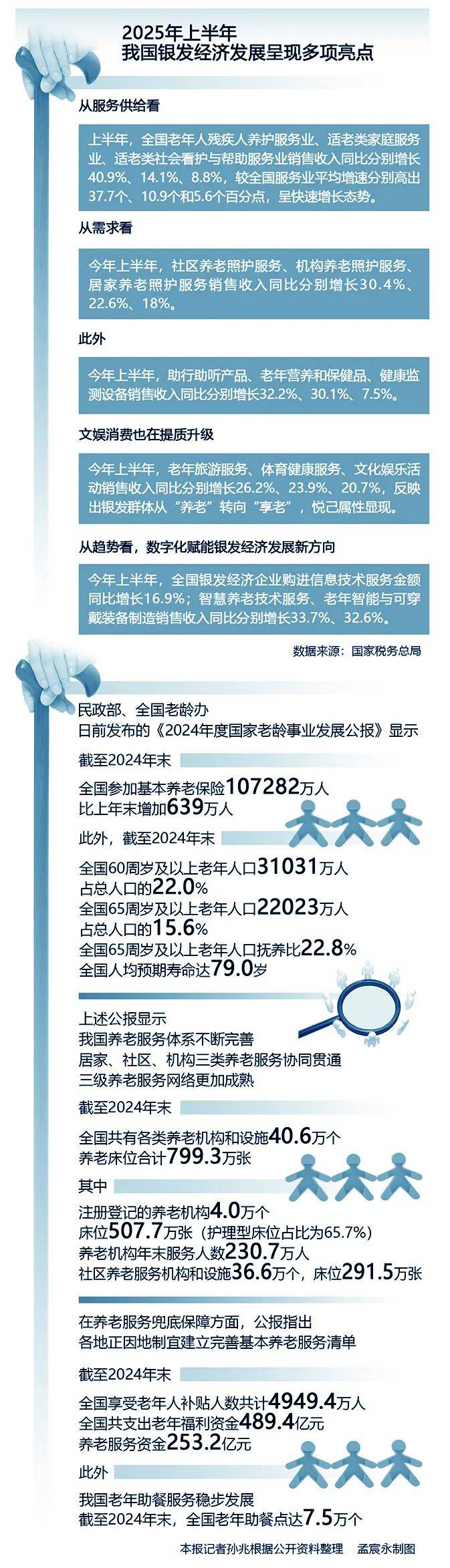
上半年银发经济发展态势良好
Ren Min Ri Bao· 2025-08-09 22:11
Group 1 - The silver economy in China is experiencing positive growth in the first half of the year, supported by various policy measures, with significant potential in consumer spending among the elderly population [1] - Revenue from community elderly care services, institutional elderly care services, and home-based elderly care services increased by 30.4%, 22.6%, and 18% year-on-year, respectively [1] - Health-related consumption is also on the rise, with sales of mobility aids, hearing aids, elderly nutrition and health products, and health monitoring devices growing by 32.2%, 30.1%, and 7.5% year-on-year, respectively [1] Group 2 - The entertainment and leisure sector for the elderly has seen quality upgrades, with sales of elderly tourism services, sports health services, and cultural entertainment activities increasing by 26.2%, 23.9%, and 20.7% year-on-year, indicating a shift from mere "elderly care" to "enjoying old age" [1] - The supply side also shows growth, with revenues from elderly and disabled care services, age-friendly household services, and age-friendly social care services rising by 40.9%, 14.1%, and 8.8% year-on-year, respectively [1] - The number of entities engaged in the production of silver products increased by 14.1% year-on-year, with sales revenues from age-friendly fitness equipment, rehabilitation aids, and nutritional health food manufacturing growing by 14.7%, 12.1%, and 6.9% year-on-year, respectively [1]

上半年银发经济发展态势良好 老年旅游服务销售收入同比增长26.2%
Ren Min Ri Bao· 2025-08-09 21:43
Core Insights - The silver economy in China is experiencing robust growth in the first half of the year, supported by various policy measures, with significant potential in consumer spending among the elderly population [1] Demand Analysis - Revenue from community elderly care services, institutional elderly care services, and home-based elderly care services increased by 30.4%, 22.6%, and 18% year-on-year, respectively [1] - Health-related consumption showed impressive growth, with sales of mobility aids and hearing aids, senior nutrition and health products, and health monitoring devices rising by 32.2%, 30.1%, and 7.5% year-on-year, respectively [1] - The entertainment sector for the elderly is also upgrading, with revenues from elderly tourism services, sports health services, and cultural entertainment activities increasing by 26.2%, 23.9%, and 20.7% year-on-year, indicating a shift from mere "elderly care" to "enjoying old age" [1] Supply Analysis - Revenue from elderly and disabled care services, age-friendly household services, and age-friendly social care services grew by 40.9%, 14.1%, and 8.8% year-on-year, respectively [1] - The number of entities engaged in the production of silver products increased by 14.1% year-on-year; sales revenue from age-friendly fitness equipment manufacturing, rehabilitation aids manufacturing, and health food manufacturing rose by 14.7%, 12.1%, and 6.9% year-on-year, respectively [1]
银发经济:应对老龄化的“必答题”与激活内需的“新引擎”
Jing Ji Guan Cha Bao· 2025-07-17 14:33
Core Viewpoint - The silver economy in China is experiencing significant growth, driven by an aging population, diverse consumer demands, and advancements in digital technology, positioning it as a crucial sector for economic development and internal demand stimulation [1][5]. Supply Side Summary - The supply of elderly care services is diversifying, with notable growth in sales revenue for various services: elderly care for disabled individuals increased by 40.9%, home care services by 14.1%, and social care services by 8.8%, all surpassing the national service industry average growth rates [2]. - The number of entities engaged in the production of silver products grew by 14.1%, with sales revenue for elderly fitness equipment, rehabilitation aids, and nutritional health products increasing by 14.7%, 12.1%, and 6.9% respectively, also exceeding the average growth rates of the manufacturing sector [2]. Demand Side Summary - The consumption potential of the elderly demographic is substantial, with three core drivers identified: essential needs, health, and self-enjoyment. Revenue from community care services grew by 30.4%, institutional care by 22.6%, and home care by 18% [3]. - Health-related consumption is particularly strong, with sales of mobility aids, nutritional products, and health monitoring devices increasing by 32.2%, 30.1%, and 7.5% respectively, indicating a shift towards proactive health management [3]. - Cultural and entertainment spending is also on the rise, with revenues from elderly tourism, health services, and cultural activities growing by 26.2%, 23.9%, and 20.7% respectively, reflecting a transition from mere survival to enjoyment in later life [3]. Trend Summary - The integration of digital technologies such as 5G, AI, big data, and IoT is becoming a new direction for the silver economy, with a 16.9% increase in spending on information technology services by silver economy enterprises and significant growth in smart elderly care technology and wearable devices [3]. - The rapid growth in service supply is closely linked to the increasing proportion of elderly individuals in the population, with a notable characteristic being that over 80% of the elderly are under 80 years old, indicating a healthier aging demographic [4]. Economic Implications - The development of the silver economy is seen as a necessary response to population aging and a new engine for stimulating internal demand, emphasizing the need for optimized elderly product services, innovative consumption scenarios, and a robust industrial ecosystem to support quality consumption and economic growth [5].
上半年银发经济快速发展 刚需、健康、悦己成三大核心驱动力
Zhong Guo Jing Ying Bao· 2025-07-17 11:29
Core Insights - The development of the silver economy is a crucial response to population aging, fostering new economic growth and enhancing the quality of life for citizens [1][3] Group 1: Service Sector Growth - In the first half of the year, the sales revenue of elderly care services, including disability care, home services, and social assistance, increased by 40.9%, 14.1%, and 8.8% respectively, significantly outpacing the national average service sector growth by 37.7, 10.9, and 5.6 percentage points [1] - Community, institutional, and home elderly care services saw sales revenue growth of 30.4%, 22.6%, and 18% respectively, indicating a strong demand for these services [2] Group 2: Manufacturing Sector Growth - The number of entities engaged in silver product manufacturing grew by 14.1% year-on-year, with sales revenue for elderly fitness equipment, rehabilitation aids, and nutritional health products increasing by 14.7%, 12.1%, and 6.9% respectively, surpassing the average manufacturing sector growth by 9.5, 6.9, and 1.7 percentage points [1] Group 3: Health and Wellness Trends - Health-related consumption is on the rise, with sales of mobility aids, elderly nutrition and health products, and health monitoring devices increasing by 32.2%, 30.1%, and 7.5% respectively, reflecting a shift towards proactive health management [2] Group 4: Digital Economy Impact - The rapid development of the digital economy is empowering the silver economy, with a 16.9% year-on-year increase in spending on information technology services by silver economy enterprises. Sales revenue for smart elderly care technology services and wearable devices grew by 33.7% and 32.6% respectively [2] Group 5: Policy Support - The tax authorities emphasize that developing the silver economy is essential for addressing aging issues and stimulating domestic demand. Ongoing tax and fee support policies will be implemented to enhance the effectiveness of the silver economy [3]
