
茉酸奶

Search documents
酸奶罐罐被茉酸奶收购
Bei Jing Shang Bao· 2026-01-05 14:29
Core Insights - The fresh yogurt brand "Yogurt Can" has been acquired by "Mo Yogurt," with the founder and initial team departing from the company [1] - "Yogurt Can" was established in 2023 as a project incubated by the tea brand "Gui Gui Tea" [1] - As of January 5, 2025, "Yogurt Can" has opened 635 stores, with an average consumer spending of 16.26 yuan [1] Company Overview - "Yogurt Can" launched its first store in Shanghai's Meiluo City on April 29, 2023 [1] - The acquisition by "Mo Yogurt" indicates a strategic move within the yogurt market [1] - No comments have been made by either "Yogurt Can" or "Mo Yogurt" regarding the acquisition [1]
“酸奶刺客”折戟后,茉酸奶创始人赵伯华转战火锅赛道?
Xi Niu Cai Jing· 2025-12-25 04:08
Core Insights - The founder of Mo Yogurt, Zhao Bohua, has completely withdrawn from the company, selling all shares and resigning from all positions, marking a significant shift for the brand [2] - Mo Yogurt experienced rapid expansion, growing from approximately 300 stores at the end of 2022 to 1,682 stores by the end of 2023, but has since faced a dramatic decline, with store numbers dropping to about 1,166 by mid-December 2024, closing over 500 stores from its peak [2] - The brand's crisis is attributed to the uncontrolled franchise model, which led to a lack of management oversight during its rapid expansion [2] Franchise and Management Issues - A food safety scandal in May 2023 severely damaged the brand's reputation, revealing serious issues such as the use of expired ingredients and poor management of franchise operations [3] - The brand's focus on rapid growth over management has resulted in a chaotic franchise system, which analysts believe has ultimately harmed the brand [3] - Mo Yogurt's product positioning has also fluctuated, with a reliance on high-priced, single-product offerings leading to poor winter sales, prompting price reductions and lower franchise fees to attract new investors [3] Leadership and Structural Changes - Following Zhao Bohua's departure, control of Mo Yogurt has shifted to co-founder Gu Hao, who holds 57.14% of the shares, and the dairy giant Junlebao, which holds 42.86%, indicating a move towards a more institutional management approach [4] - The new ownership structure aims to enhance collaboration in areas such as raw material supply, product development, and food safety management to restore brand credibility [4] - The transition from a founder-led brand to one driven by professional management and industry capital reflects the challenges of maintaining growth in the competitive food and beverage sector [4]


茉酸奶创始人赵伯华全面离场? 卖给君乐宝了?
Xin Lang Cai Jing· 2025-12-21 04:15
Core Viewpoint - The recent changes in the shareholding structure of Mo Yogurt indicate a strategic investment by Junlebao, reflecting its commitment to expanding its presence in the yogurt market and enhancing its supply chain capabilities [3][5][7]. Group 1: Shareholding Changes - Junlebao's stake in Mo Yogurt has increased to 42.86% after the founder Zhao Bohua exited the company, with Junlebao investing 21.43 million yuan [3][4]. - Zhao Bohua, the founder of Mo Yogurt, has resigned from all key positions within the company, including legal representative and general manager [3][4]. - Junlebao previously held a 30% stake in Mo Yogurt but exited in October 2025 before re-entering as a major shareholder [3][5]. Group 2: Company Background and Growth - Mo Yogurt was established in 2014 by Zhao Bohua, who was previously a dentist, and has seen significant growth since opening its franchise model in 2021 [4][5]. - As of June 2023, Mo Yogurt has expanded its store count to 1,218, with projections to exceed 1,600 stores by May 2024 [4][5]. - Co-founder Guo Hao, who joined in 2020, has increased his shareholding to 57.14% and now serves as the legal representative of Mo Yogurt [3][4]. Group 3: Strategic Investments by Junlebao - Junlebao has been actively investing in the dairy sector, including acquiring a 30% stake in the cheese brand Sikeqi and controlling stakes in Yunnan Laisier Dairy and Laisier Intelligent [5][7]. - In January 2023, Junlebao also invested in the startup cheese company Laoshenshijia, holding an 8.79% stake [5][7]. - The recent investment in Mo Yogurt is seen as a strategic move to enhance Junlebao's capabilities in the B2B yogurt supply chain and capitalize on the growing demand for fresh yogurt [7].
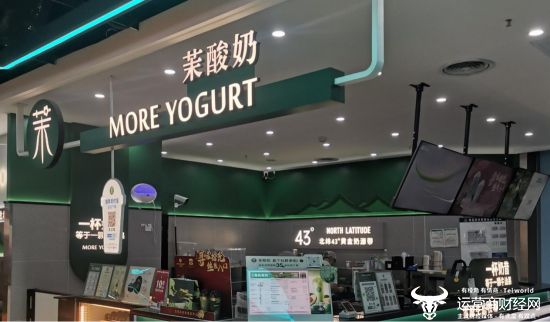
茉酸奶创始人赵伯华清仓退场,君乐宝同步增持、持股增至42.9%
Sou Hu Cai Jing· 2025-12-12 04:14
Core Viewpoint - The management structure of Shanghai Boyi Catering Management Co., the parent company of Mo Yogurt, has undergone significant changes, including the departure of founder Zhao Bohua from key positions and the introduction of new leadership [1][3]. Group 1: Management Changes - Zhao Bohua has stepped down from his roles as legal representative, general manager, director, and financial officer, and has exited the shareholder list [1]. - Gu Hao has been appointed as the new legal representative, with Guo Hao taking on the roles of manager and director, and Zhang Yanfang becoming the financial officer [1][3]. Group 2: Shareholding Structure - Gu Hao holds 57.14% of the shares in Mo Yogurt, while Junlebao (Hebei) Enterprise Management Co., a subsidiary of Junlebao, owns 42.86% [3]. - In November 2023, Junlebao made a strategic investment in the Mo Yogurt brand, acquiring a 30% stake in the company [3]. Group 3: Company Background and Growth - Mo Yogurt is a fresh yogurt brand founded in 2014 by Zhao Bohua, with Gu Hao joining as a franchisee in 2019 and acquiring shares in 2022 [3]. - As of May 2024, Mo Yogurt has expanded its presence to over 1,600 stores [4].
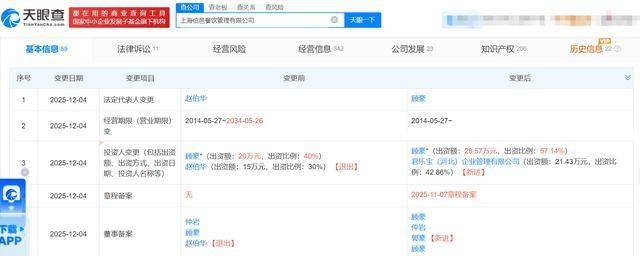
君乐宝再入股“茉酸奶”,持股42.86%
Bei Jing Shang Bao· 2025-12-11 05:23
Core Viewpoint - Shanghai Boyi Catering Management Co., Ltd. has undergone significant management changes, with Zhao Bohua stepping down from key positions and Gu Hao taking over as the legal representative [1] Company Changes - Zhao Bohua is no longer the legal representative, general manager, director, or financial officer of Shanghai Boyi Catering Management Co., Ltd. [1] - Gu Hao has been appointed as the new legal representative, with Guo Hao as the manager and director, and Zhang Yanfang as the financial officer [1] Shareholding Structure - After the management changes, Gu Hao holds 57.14% of the company's shares, while Junlebao Dairy Group Co., Ltd. owns 42.86% through Junlebao (Hebei) Enterprise Management Co., Ltd. [1] - Junlebao made a strategic investment in the "Mo Yogurt" brand, acquiring a 30% stake in the company in November 2023 [1]
君乐宝逆势扩张:增持茉酸奶,在长三角扩产丨消费参考
2 1 Shi Ji Jing Ji Bao Dao· 2025-12-11 03:20
Core Insights - In contrast to competitors like Yili and Mengniu, Junlebao is increasing its investments, indicating confidence in the market despite overall industry contraction [1][4] - Junlebao has made a strategic investment in the fresh yogurt chain, Mo Suan Nai, acquiring a 30% stake and planning collaboration in various operational areas [1][4] - The company is expanding its production capacity in the Yangtze River Delta, with a new liquid milk production base planned to have an annual capacity of 450,000 tons [3][4] - Junlebao's ongoing expansion and investment activities may be linked to its IPO process, as it has officially started the A-share IPO journey [4][5] Company Developments - Mo Suan Nai's founder, Zhao Bohua, has stepped down from key management roles, with Gu Hao taking over as the legal representative and holding 57.14% of the shares [1] - Junlebao's investment in Mo Suan Nai is expected to enhance its B-end market access, leveraging Mo Suan Nai's extensive retail network of over 1,600 stores [1] - The strategic partnership with Mo Suan Nai is aimed at improving supply chain collaboration and product development [1] Market Context - The dairy market is experiencing a significant downturn, with a reported 16.8% year-on-year decline in sales across all channels as of September [2] - The oversupply in the dairy sector has weakened negotiation power for companies, impacting pricing and profitability [2]
倒计时5个月,君乐宝IPO怎样了?
Sou Hu Cai Jing· 2025-08-08 09:15
Core Viewpoint - Junlebao, a major dairy company in Hebei, is struggling to complete its IPO process, which has been prolonged for over 17 months, far exceeding the industry average of 9 months, raising concerns about its financial health and market reputation [1][2]. Group 1: IPO Progress and Challenges - Junlebao announced its IPO plans in July 2022, aiming for a 2025 listing with a sales target of 50 billion yuan [1]. - The company has faced a lengthy counseling period of 512 days, with its prospectus still not submitted, indicating significant delays in the IPO process [2]. - The company completed a capital restructuring in December 2023, increasing its registered capital by 11 times to 720 million yuan, but still struggles to meet IPO timelines [2]. Group 2: Financial Health - Junlebao's financial situation is concerning, with a debt ratio of 78%, significantly higher than the industry average of 45% and competitors like Mengniu (58%) and Feihe (28%) [4]. - The company has engaged in multiple acquisitions in 2023, which may further exacerbate its debt levels [4]. Group 3: Brand Reputation and Market Perception - Junlebao's historical association with the Sanlu brand and incidents like the "early production date" controversy have hindered its brand recognition and consumer trust [6]. - The company has faced over 1,168 food safety complaints, indicating ongoing issues with product quality and safety [6][7]. Group 4: Operational Challenges - Junlebao's low-profit margin strategy, with net profit rates between 2%-4%, contrasts sharply with competitors like Yili and Feihe, which achieve over 8%-20% [8]. - The company has attempted to enter the high-end market but has faced challenges, including a significant reduction in store numbers and issues with acquired brands [8]. Group 5: Regulatory and Market Risks - Junlebao has been flagged by environmental authorities for exceeding waste discharge limits, which could complicate its IPO process amid tightening regulations for dairy companies [9][10]. - The company's high debt levels and food safety record may trigger stricter scrutiny under the new registration system for IPOs [10]. Group 6: Future Outlook - If Junlebao fails to submit its prospectus soon, its chances of a 2025 IPO diminish significantly, potentially leading to a liquidity crisis [5][11]. - The company’s ambitious revenue target of 50 billion yuan by 2025 requires a doubling of sales in four years, which may be unrealistic given current market conditions and competition [11].
中国消费者买不动爱马仕;“溜溜梅”冲刺港股IPO;东鹏饮料Q1净利大增48% | 品牌周报
3 6 Ke· 2025-04-20 10:18
Group 1: Hermès Performance in China - Hermès reported a revenue of €4.129 billion for Q1 2025, with a year-on-year growth of 9% at current exchange rates and 7% at constant exchange rates [1] - The Asian market (excluding Japan) saw only a 1.2% growth to €1.97 billion, primarily due to sluggish luxury goods consumption in China and decreased foot traffic [1] - Japan showed the strongest performance with a 17% increase to €420 million, while other regions like France and the Americas also experienced significant growth [1] Group 2: Liuliu Fruit Garden IPO - Liuliu Fruit Garden has submitted an application for an IPO on the Hong Kong Stock Exchange, focusing on the development, production, and sales of specialty fruit snacks [2] - The company reported total revenues of ¥1.174 billion, ¥1.322 billion, and ¥1.616 billion for 2022 to 2024, with corresponding net profits of approximately ¥68 million, ¥99 million, and ¥148 million [2] - The main products include dried plums and other fruit snacks, with significant marketing and advertising expenditures totaling ¥428 million over three years [2] Group 3: Dongpeng Beverage Growth - Dongpeng Beverage's Q1 2025 revenue reached ¥4.848 billion, marking a year-on-year increase of 39.23%, with net profit at ¥980 million, up 47.62% [3] - Energy drinks remain the core business, contributing ¥3.9 billion, or 80.5% of total revenue, while electrolyte drinks also saw rapid growth [3] - The Guangdong region generated the highest revenue at ¥1.125 billion, followed by North China at ¥746 million [3] Group 4: Erdos Clothing Business - Erdos reported a total revenue of ¥28.403 billion for 2024, a decline of 7.04%, with a net profit of ¥1.847 billion, down 36.39% [4] - The clothing segment achieved a revenue of ¥4.018 billion, reflecting a growth of 6.99% [4] - The company operates four major brands and has a total of 953 stores, including 582 direct-operated and 371 dealer stores [4] Group 5: Wanchen Group's Snack Revenue - Wanchen Group, owner of the Haoxianglai snack brand, reported a revenue of ¥31.79 billion for 2024, a year-on-year increase of 262.94% [5] - The company added 9,776 new stores, ending the period with 14,196 stores after accounting for closures [5] - The company aims to expand into emerging markets while maintaining high sales turnover [5] Group 6: Moncler Performance - Moncler reported a revenue of €829 million for Q1 2025, a year-on-year growth of 1%, driven by strong demand in Asia [6] - The Moncler brand saw a 2% increase in sales to €721.8 million, while Stone Island experienced a 5% decline [6] - The Asian market, particularly Japan, showed significant growth, while other regions faced slight declines [6] Group 7: Nestlé Coffee Innovations - Nestlé Coffee announced the launch of several new products, including an upgraded classic 1+2 formula and various ready-to-drink coffee options [7] Group 8: Keep's Traditional Sports Initiative - Keep launched its first short film series focusing on traditional sports, highlighting the story of a female Wing Chun practitioner [12] - The initiative aims to promote the charm of traditional martial arts and engage the younger generation [12] Group 9: Lawson's Expansion Plans - Lawson plans to double its overseas store count to 14,000 by February 2031, focusing on the Asian market to meet rising middle-class demand [18] - The company aims to achieve this through direct operations and partnerships with local retailers [18]


