
转基因玉米种子

Search documents
【转|太平洋农业-粮食种植深度】粮价上涨推动种植盈利复苏,生物育种提速助力种业成长
远峰电子· 2026-03-29 09:19
Group 1 - The core viewpoint of the article emphasizes that China's grain industry is a massive market exceeding one trillion yuan, with the seed industry being a critical component, akin to the "chip" sector in the industry chain [1][4][7] - The seed industry plays a vital role in food security, contributing over 45% to grain production during the 14th Five-Year Plan period, with the market value of grain seeds expected to exceed 100 billion yuan by 2024 [1][4][7] - Grain prices are stabilizing at the bottom, indicating a recovery in the grain industry's economic cycle, with expectations of gradual improvement in profitability for the sector [1][2][24] Group 2 - The biological breeding industry in China is accelerating, with high-value genetically modified seed products rapidly increasing their market penetration, currently at around 5% for transgenic corn [1][3][29] - Policy support is strong, with the central government's focus on biological breeding from 2021 to 2026, leading to a more complete regulatory framework and promoting innovation in the seed industry [1][3][33] - The tightening of regulations is pushing the seed industry towards a process of elimination, favoring innovative companies while phasing out inferior products and counterfeit seeds [1][3][33] Group 3 - The investment strategy suggests that the grain planting sector is currently undervalued, while the seed sector shows signs of recovery, with specific stock recommendations for companies like Su Kun Agricultural Development and Denghai Seeds [2][50] - The performance of companies in the seed sector varies, with some experiencing revenue growth due to different business structures, while others face declines [20][22] - The competitive landscape in the seed industry is shifting towards a focus on product combinations, particularly those that include hybrid and genetically modified varieties, enhancing competitive advantages for companies with such offerings [18][48]



种植板块投资策略
2026-03-24 01:27
Summary of Key Points from the Conference Call Industry Overview - The conference call discusses the agricultural sector, specifically focusing on the grain industry and seed market dynamics in China and globally [1][2][3]. Core Insights and Arguments - **Global Grain Price Trends**: In 2026, global grain prices are expected to enter an upward cycle, with CBOT wheat prices rising over 20%, and corn and soybeans increasing by approximately 10%. This is primarily driven by La Niña-induced droughts in major production areas and geopolitical conflicts raising agricultural input costs [1][5]. - **Grain Inventory Levels**: Global grain inventories are at a five-year low, and the probability of an El Niño occurrence in the second half of 2026 exceeds 62%, suggesting a trend of rising prices in the international market, with domestic prices expected to follow suit moderately [1][6]. - **Transgenic Commercialization**: The commercialization of transgenic crops is expanding, with corn penetration rates exceeding 5%. Transgenic seeds command a premium of 15%-20% and increase planting density by about 10%, leading to simultaneous price and volume growth [1][8]. - **Market Concentration**: The competitive landscape in the seed industry is improving, with major players like Dabeinong (55% market share), Longping High-Tech (approximately 15%), and Zhongnong Group (10%) collectively holding 80% of the trait market share, indicating a significant increase in industry concentration [1][8]. Financial Projections - **Profit Forecasts**: Suqian Agricultural Development is expected to benefit from rising grain prices, projecting a profit of 700 million yuan in 2026, a year-on-year increase of 30%, corresponding to a PE ratio of about 20 times [1][10]. - **Seed Sector Recovery**: The seed sector is anticipated to experience a lag in benefits, with prices expected to stabilize by 2027. Companies with transgenic technology advantages, such as Denghai Seeds, are recommended for attention [1][9]. Additional Important Insights - **Grain Industry Structure**: The grain industry chain in China consists of upstream (seeds, fertilizers, pesticides), midstream (grain planting), and downstream (feed and food processing) segments, with the grain planting segment alone exceeding 1 trillion yuan in market capacity [2]. - **Policy Changes**: Recent policy shifts have moved from encouraging innovation through relaxed regulations to a focus on quality control and innovation, impacting the number of approved varieties and enhancing market regulation [3][4]. - **Impact of Geopolitical Factors**: Ongoing geopolitical tensions, such as the Russia-Ukraine conflict and Middle Eastern tensions, are affecting grain supply chains and production costs, contributing to the upward pressure on grain prices [5][6]. Investment Strategy Recommendations - **Focus on Grain Planting and Seed Sectors**: Both upstream seed and midstream grain planting sectors are expected to see increased industry prosperity. The grain planting sector is particularly highlighted due to its current low dynamic PE ratio, making it an attractive investment opportunity [9]. - **Specific Company Recommendations**: - **Suqian Agricultural Development**: Recommended for its strong profit growth potential linked to rising grain prices [10]. - **Denghai Seeds**: Suggested for its competitive advantage in transgenic technology within the seed market [9].

粮价上涨推动种植盈利复苏,生物育种提速助力种业成长
Tai Ping Yang Zheng Quan· 2026-03-16 01:09
Investment Rating - The report gives a "positive" rating for the grain planting sector, indicating that the dynamic PE is at a low range historically, and a "positive" rating for the seed sector, as the industry shows signs of recovery from the bottom [5][75]. Core Insights - China's grain industry is vast, with the seed sector being a critical component, contributing over 45% to grain production during the 14th Five-Year Plan period. The market value of the grain seed industry is expected to exceed 100 billion yuan by 2024, accounting for over 60% of the crop seed market [3][11][14]. - Grain prices have stabilized and are on an upward trend, which is expected to improve profitability in the grain planting sector. The profitability of the grain sector has been at a low point, with significant losses reported in 2024 and the first three quarters of 2025 [3][41]. - The bio-breeding industry in China is accelerating, with a rapid increase in the penetration of high-margin genetically modified seed products. The market for genetically modified corn is projected to grow significantly, with a current penetration rate of around 5% [5][6][58]. Summary by Sections 1. China's Grain Industry Size and Seed Sector Importance - The grain industry chain in China involves various sectors, including agricultural inputs, planting, and food processing, with a market size exceeding one trillion yuan. The seed sector is crucial for determining the yield and quality of crops [3][11][12]. 2. Stabilization and Recovery of Grain Prices - Grain prices have shown signs of recovery, with domestic prices for corn, wheat, and japonica rice increasing since early 2026. This recovery is attributed to factors such as farmers holding back sales and international market dynamics [41][46]. 3. Acceleration of Bio-Breeding Industry - The bio-breeding sector is experiencing rapid development, supported by government policies and increasing market demand for high-margin genetically modified seeds. The number of approved genetically modified corn and soybean varieties has surged, indicating a strong push towards commercialization [58][62][69].
“十五五”锚定建设农业强国目标,明年一号文件有哪些看点?
Xuan Gu Bao· 2025-12-31 07:19
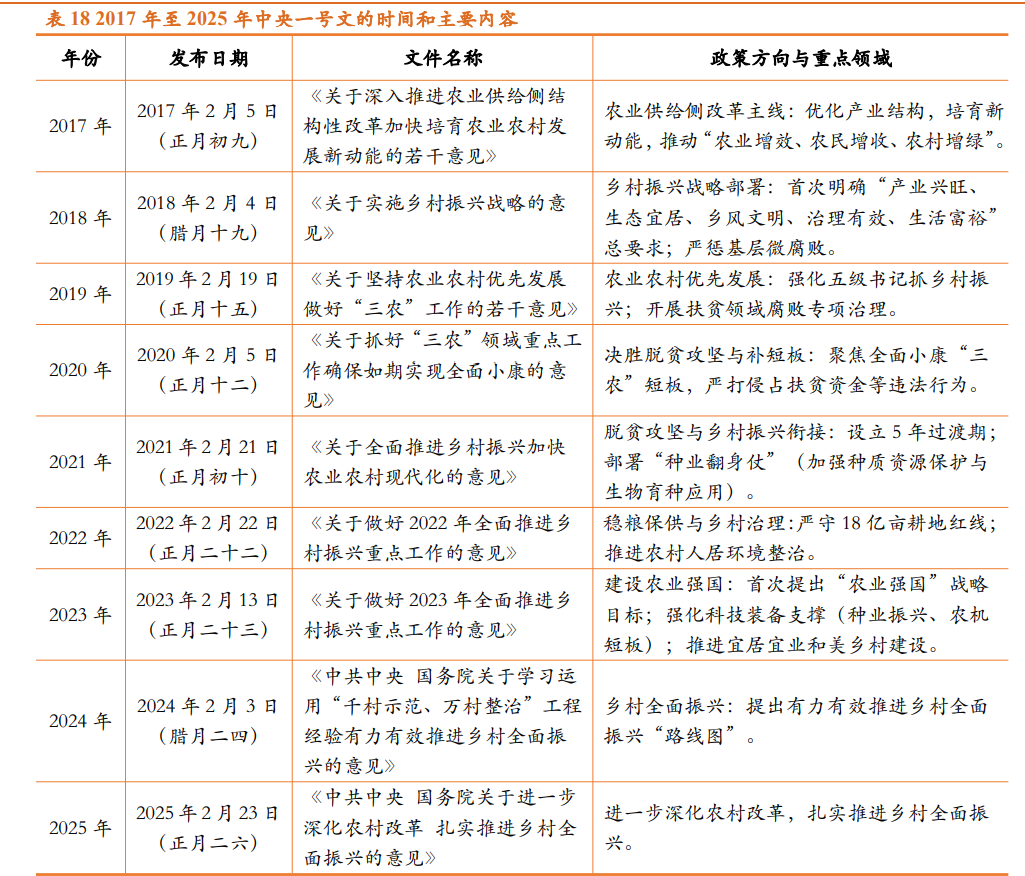
Core Insights - The Central Document No. 1 is a key annual policy directive from the Central Committee of the Communist Party of China, focusing on the "Three Rural Issues" (agriculture, rural areas, and farmers) and has been released around the Spring Festival since 2017 [1] Group 1: Policy Directions and Focus Areas - The 2023 document emphasizes the goal of building an agricultural powerhouse and introduces the strategy of "strong agriculture" for the first time, highlighting the need for technological support in agriculture [2] - The 2025 document is expected to further catalyze developments in agricultural equipment, seed industry revitalization, and genetically modified organisms (GMOs) [2] Group 2: AI and Agricultural Machinery - The document highlights the integration of AI in agricultural machinery, marking a shift towards smart agriculture and intelligent equipment as core components of agricultural modernization [3] - The demand for food is expected to rise due to population growth and dietary changes, while supply pressures arise from limited arable land and a shrinking agricultural labor force, necessitating the use of AI to enhance agricultural productivity [3] Group 3: Seed Industry and GMOs - Continuous policy support is driving the high-quality development of the seed industry, focusing on industry consolidation and the industrialization of biological breeding [4] - The commercialization of GMOs is anticipated to significantly increase farmers' income by approximately 100 to 200 yuan per mu, with a notable acceleration in the industrialization process of GMOs in China [5] Group 4: Market Reactions and Key Players - Following the announcement of new GMO approvals, stocks of leading companies in the agricultural sector, such as Dabeinong and Longping High-Tech, experienced significant price increases, with Dabeinong seeing a maximum rise of nearly 18% [6] - Key players in the seed industry include Longping High-Tech, Denghai Seeds, and Qianyuan High-Tech, while leading companies in agricultural machinery include Yituo Co. and Zoomlion [8][9]
农林牧渔行业2026年年度策略:行至水穷处,坐看云起时
Zhongyuan Securities· 2025-11-27 09:23
Market Review - The agricultural, forestry, animal husbandry, and fishery sector has outperformed the benchmark index since the beginning of 2025, with an absolute return of +24.66%, surpassing the CSI 300 index by 10.47 percentage points [10][17][18] - The sector's index has increased by 18.4% over the past year, outperforming the CSI 300 index by 0.96 percentage points [14] Swine Breeding - The breeding capacity of sows is gradually declining, with a total of 39.9 million sows recorded by the end of October 2025, a year-on-year decrease of 2.04% [27][24] - The average price of live pigs in October 2025 was 11.52 yuan/kg, reflecting a month-on-month decline of 11.46% and a year-on-year drop of 34.77% [29] - The swine breeding industry is currently facing losses, with theoretical profits for self-bred pigs averaging -209.67 yuan/head in October 2025, marking a significant decline from previous months [36][41] - The market share of the top eight listed pig companies has increased from 4.6% in 2017 to 21.2% by the third quarter of 2025, indicating a trend towards industry consolidation [37][41] Animal Health - The animal health market in China has shown steady growth, with sales increasing from 47.23 billion yuan in 2016 to 69.65 billion yuan in 2023, reflecting a compound annual growth rate of 5.71% [45][46] - The introduction of new products and the expansion of demand are driving the growth of the animal health industry, particularly with the anticipated market expansion following the launch of African swine fever vaccines [51][52] - The market for companion animal health products is also growing, with the pet medical market expected to reach approximately 84 billion yuan in 2024, driven by increased spending on veterinary services [56] Seed Industry - The seed industry is experiencing a transformation due to new regulations and policies, with significant investment opportunities arising from the commercialization of biotechnology [4][19] - The market for genetically modified corn is projected to expand, with companies in the sector expected to benefit from increased industry concentration and profitability [18][19] Pet Food - China's pet food market is projected to continue growing, benefiting from demographic changes and rising living standards, with significant potential for domestic brands to capture market share [5][59] - The market for pet food exports is expected to maintain year-on-year growth in 2025, reflecting the increasing demand for high-quality pet products [5][59] - The pet food industry remains fragmented, with ongoing trends towards domestic substitution and increased online sales [5][59]



农林牧渔行业2025年度中期策略:周期掘金,向新而行
Zhongyuan Securities· 2025-06-18 07:46
Investment Strategy Overview - The report maintains an "outperform" rating for the agriculture, forestry, animal husbandry, and fishery industry, indicating a positive outlook for the sector [3][5][6] Market Performance - From the beginning of 2025 to June 16, the agriculture, forestry, animal husbandry, and fishery index achieved an absolute return of +12.81%, outperforming the CSI 300 index by 14.5 percentage points [10][13] - The pet food sector has shown the highest growth, while the aquatic processing sector has also performed well [13][14] Swine Breeding Sector - The swine breeding industry is expected to enter a phase of simultaneous supply and demand growth in the second half of 2025, driven by a sufficient supply of piglets and an increase in domestic slaughtering due to reduced imports from the U.S. [15][30] - The number of breeding sows and total swine stock remains high, with a notable increase in piglet supply observed from January to April 2025 [18][30] - Major companies like Muyuan Foods have reported significant increases in piglet sales, indicating strong market dynamics [17][30] Animal Health Sector - The animal health market is experiencing steady growth, with a market size increase from 472.29 billion yuan in 2016 to 696.51 billion yuan in 2023, reflecting a compound annual growth rate of 5.71% [35][36] - The introduction of new products and the expansion of demand are driving the growth of the animal health industry, particularly with the anticipated market expansion following the launch of African swine fever vaccines [41][48] Seed Industry - The seed industry is undergoing significant transformation, with a focus on the commercialization of biotechnology breeding, which is expected to enhance market concentration and profitability for related companies [4][16][19] - The regulatory environment is becoming clearer, and companies that have passed initial reviews are now obtaining operational licenses, positioning them to benefit from the industry's growth [4][19] Pet Food Sector - China's pet food market is projected to continue growing, driven by demographic changes and rising living standards, with the market size expected to expand significantly [5][23] - The domestic pet food industry is seeing a shift towards increased online sales and domestic product substitution, indicating a robust growth trajectory [5][23][26] Investment Recommendations - The report suggests focusing on leading companies in the sector, including Muyuan Foods, Pulaike, Qiule Seed Industry, Guai Bao Pet, Zhongchong Co., and Petty Co., as they are expected to benefit from favorable market conditions and valuation recovery [5][32]