
阿贝西利

Search documents
罗氏RO7840734启动Ib/II期临床 适应症为乳腺癌
Xin Lang Cai Jing· 2026-03-20 10:35
Core Viewpoint - Genentech, Inc. / Roche (China) Investment Co., Ltd. / F. Hoffmann-La Roche AG has initiated a multicenter, open-label, randomized Ib/II phase study to evaluate the safety, pharmacokinetics, and efficacy of GDC-4198 monotherapy and its combination with Giredestrant compared to Abemaciclib combined with Giredestrant in patients with locally advanced or metastatic estrogen receptor-positive HER2-negative breast cancer who have experienced disease progression during or after treatment with CDK4/6 inhibitors [1][4]. Group 1: Study Design and Objectives - The study aims to evaluate the safety of GDC-4198 monotherapy and its combination with Giredestrant in the Ib phase, and to compare the efficacy of two dosage levels of GDC-4198 combined with Giredestrant against Abemaciclib combined with Giredestrant in the II phase [2][5]. - The drug is administered in capsule form, with dosages set at 200 mg orally twice daily for the Ib phase monotherapy group, 150 mg orally twice daily for the first Ib phase combination group, and 200 mg orally twice daily for the second Ib phase combination group [2][5]. Group 2: Study Endpoints - Primary endpoints include the incidence and severity of adverse events in the Ib phase, the number of participants experiencing dose-limiting toxicities, and progression-free survival (PFS) in the II phase [3][6]. - Secondary endpoints consist of overall response rate (ORR), clinical benefit rate (CBR), pharmacokinetic parameters (AUC0-t, AUCinf, Cmax) for GDC-4198 in the Ib phase, and ORR, duration of response (DOR), CBR, overall survival (OS), and 6-month and 12-month OS and PFS rates in the II phase [6][7]. Group 3: Study Status and Recruitment - The study is currently ongoing and has not yet started recruitment, with a target enrollment of 35 participants domestically and 285 internationally [8].
2025全球罕见病行业发展报告:政策演进、市场趋势与领先企业布局
摩熵咨询· 2026-01-28 13:53
Investment Rating - The report does not explicitly provide an investment rating for the rare disease industry. Core Insights - The rare disease sector is characterized by significant policy evolution and market trends, with a focus on the accessibility of treatments and the development of orphan drugs [1][2][5]. Summary by Sections Overview of the Rare Disease Industry - The report analyzes the policies regarding rare diseases in China, the United States, Japan, and Europe, highlighting the differences in definitions and management frameworks across these regions [6][12]. - China has included 207 diseases in its rare disease directory, while the U.S. has no unified directory but manages information through the GARD database [10][11]. Patient Population and Management Status - The report indicates that rare diseases affect over 200 million people globally, with China having more than 20 million affected individuals [12][14]. - The management systems in China are still developing, with significant gaps in data accuracy and epidemiological tracking compared to established systems in the U.S. and Europe [13][14]. Drug Availability and Accessibility - As of 2024, China has approved 55 rare disease drugs, while the U.S. has approved 26, and the EU has approved 15 [15][16]. - The report notes that 70.5% of rare diseases globally have available treatments, but many patients in China still face challenges in accessing these medications due to high costs and limited insurance coverage [16][17]. Leading Companies in Rare Disease Drug Development - The report identifies key players in the rare disease drug development space, emphasizing the growing pipeline of domestic research in China, although it still lags behind international pharmaceutical companies in innovation [16][17].
新药进医保,乳腺癌精准治疗“可及时代”开启
Qi Lu Wan Bao· 2026-01-15 07:06
Core Insights - The latest national medical insurance drug list will be implemented starting January 1, 2026, adding 114 new drugs, including 50 global innovative drugs, marking a record high in both proportion and quantity [1] - The inclusion of innovative drugs, particularly in the field of cancer treatment, is expected to significantly improve patient access to previously unaffordable medications [1][4] Group 1: Drug Inclusion and Impact - The updated medical insurance list includes a significant number of innovative drugs, especially for breast cancer treatment, which is the most common malignant tumor among women globally [1] - In 2022, over 350,000 new breast cancer cases were reported in China, resulting in approximately 75,000 deaths, highlighting the critical need for effective treatments [1] - The most common molecular subtype of breast cancer, HR+/HER2-, accounts for about 80% of all breast cancer patients [1] Group 2: Treatment Advancements - Advances in screening and treatment have led to a significant improvement in the prognosis of early-stage HR+/HER2- breast cancer, with a five-year survival rate exceeding 90% [3] - Despite treatment advancements, some patients still face disease progression or drug resistance, with about 57% of late-stage HR+/HER2- breast cancer patients in China carrying specific genetic alterations [3] Group 3: Targeted Therapies - The inclusion of targeted therapies in the updated insurance list addresses the clinical treatment gap for late-stage HR+/HER2- breast cancer patients with PIK3CA, AKT1, or PTEN mutations [3] - Notable drugs like Abemaciclib and Ribociclib have expanded their insurance coverage to include all indications for early breast cancer, effective from January 1, 2026 [3][4] Group 4: Shift in Treatment Paradigm - The entry of targeted drugs into the insurance framework signifies a shift from traditional chemotherapy to more precise, individualized treatment approaches for breast cancer [4] - The price reduction for these new drugs can exceed 90%, making previously unaffordable targeted therapies accessible to patients [4]

礼来公布Imlunestrant最新研究结果
Huan Qiu Wang Zi Xun· 2025-12-18 09:29
Core Insights - Eli Lilly announced significant results from the Phase 3 EMBER-3 clinical trial of the oral estrogen receptor antagonist imlunestrant, showing a 38% reduction in the risk of disease progression or death in patients with ESR1 mutations compared to endocrine therapy [1][2] - The median progression-free survival (PFS) for imlunestrant was 5.5 months versus 3.8 months for endocrine therapy, with a hazard ratio (HR) of 0.62 [1] - The median overall survival (OS) was extended by 11.4 months, with imlunestrant showing 34.5 months compared to 23.1 months for the control group, achieving a HR of 0.60 [1] - In all patients, the combination of imlunestrant and abemaciclib reduced the risk of disease progression or death by 41%, with a trend towards improved overall survival and a delay in time to chemotherapy exceeding one year [1] Company and Industry Developments - The results were published in the Annals of Oncology and presented at the San Antonio Breast Cancer Symposium (SABCS) [2] - Eli Lilly's Executive Vice President and President of Oncology, Jake Van Naarden, emphasized the clinical benefits of imlunestrant in both monotherapy and combination therapy, reinforcing its position in the treatment landscape [2] - The company is encouraged by the potential of the all-oral combination treatment of imlunestrant and abemaciclib and has submitted relevant data to U.S. regulatory authorities for patients with ESR1 mutation metastatic breast cancer [2]

平均减重16公斤!复旦大学团队证实最强减肥药替尔泊肽对中国人同样安全有效
GLP1减重宝典· 2025-12-07 03:02
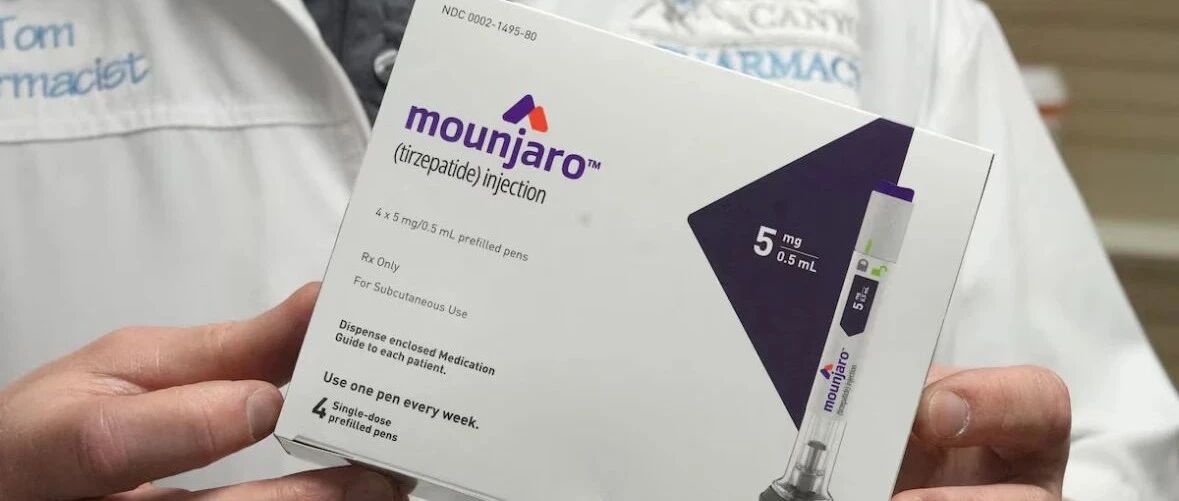
Core Insights - The article discusses the efficacy and safety of Tirzepatide for weight reduction in Chinese adults with obesity, based on a clinical trial published in JAMA [2][3]. Group 1: Clinical Trial Results - The SURMOUNT-CN trial demonstrated that participants receiving a 15 mg dose of Tirzepatide lost an average of 17.5% of their body weight (16.1 kg) after 52 weeks [3]. - The trial involved 29 centers in China and included adults with a BMI of 28 or higher, or 24 or higher with at least one weight-related comorbidity [3]. - Weight loss percentages at week 52 for the 10 mg, 15 mg, and placebo groups were 13.6%, 17.5%, and 2.3%, respectively [4]. Group 2: Safety and Side Effects - The most common adverse events during Tirzepatide treatment were gastrointestinal issues, mostly mild to moderate in severity, with less than 5% of patients discontinuing treatment due to side effects [4]. - The trial concluded that weekly doses of 10 mg or 15 mg of Tirzepatide provide statistically and clinically significant weight loss with acceptable safety [4]. Group 3: Market Performance and Sales - Eli Lilly reported Q3 2025 revenue of $17.601 billion, a 54% increase year-over-year, with total revenue for the first nine months of 2025 reaching $45.887 billion (+46%) [5]. - Tirzepatide (Mounjaro and Zepbound) significantly contributed to Eli Lilly's revenue, generating $24.837 billion (+125%) in the first three quarters of 2025 [5][6]. - In the U.S. market, Eli Lilly's GLP-1 market share has surpassed that of Novo Nordisk, with prescription volume shares of 57.9% vs 41.7% as of Q3 [7].
GLP-1不是礼来市值破万亿的“万能药”
Xin Lang Cai Jing· 2025-12-01 10:34
Core Insights - The article discusses the challenges and opportunities faced by Eli Lilly, particularly focusing on its GLP-1 drug, tirzepatide, which has generated significant revenue but also poses risks due to reliance on a single product and impending patent expiration [1][2][3]. Financial Performance - Eli Lilly's tirzepatide generated $24.837 billion in revenue in the first three quarters of 2025, a 125% increase year-over-year [1]. - The second-largest revenue product, abemaciclib for breast cancer, only brought in $4.118 billion during the same period, reflecting a growth rate of 10% [1]. - Eli Lilly's total revenue for 2025 is projected to be between $63 billion and $63.5 billion, up from previous estimates of $60 billion to $62 billion [7]. Strategic Initiatives - Eli Lilly has made significant investments in AI, including partnerships with companies like Insitro and OpenAI, and the establishment of a Chief AI Officer position [3][11][13]. - The company aims to leverage AI to enhance drug discovery and development processes, which has positively influenced its stock price and market valuation [9][14]. - Eli Lilly's stock price reached $1,059.70 per share on November 21, 2024, marking a market capitalization of over $1 trillion, making it the first pharmaceutical company to achieve this milestone [4][14]. Market Position and Future Outlook - The GLP-1 class of drugs is expected to become the second-largest drug segment globally by 2028, following oncology treatments, indicating strong market potential [7]. - Eli Lilly is exploring the therapeutic potential of GLP-1 drugs beyond diabetes, targeting areas such as cardiovascular diseases and neurodegenerative disorders [7][8]. - The company's strategic focus on AI and innovative drug development is seen as a key driver for future growth and valuation, positioning it favorably against traditional pharmaceutical companies [14][15].

创新药的天花板又被捅破了
Xin Lang Cai Jing· 2025-11-22 12:23
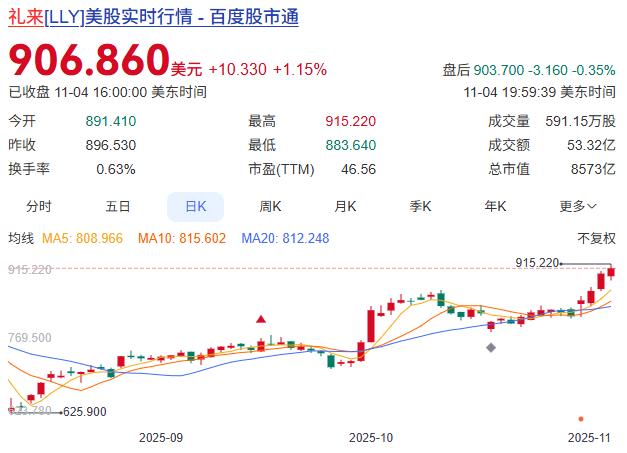
Core Insights - Eli Lilly has become the first pharmaceutical company to reach a market capitalization of $1 trillion, marking a significant shift in the industry landscape traditionally dominated by tech giants [1][2] - The rise of Eli Lilly reflects a redefinition of value logic in the innovative drug sector, suggesting that the ceiling for drug company valuations is fundamentally tied to market potential rather than traditional metrics [1][3] Company Performance - Eli Lilly's journey to a $1 trillion valuation was driven by the success of its GLP-1 dual-target drug, tirzepatide, with sales of its diabetes version, Mounjaro, increasing by 970% year-over-year, and the obesity version, Zepbound, generating $176 million in its first month [3][4] - By Q3 2025, combined sales of these drugs are projected to exceed $10.1 billion, surpassing Merck's Keytruda to become the new "king of drugs" [4] - Eli Lilly's CEO reported a market share of 70% to 75% among new patients in the U.S., indicating that tirzepatide has become a dominant force in the GLP-1 market [4] Market Strategy - Despite some disappointing clinical data, Eli Lilly is expected to secure approval for the first oral small-molecule GLP-1 drug, orforglipron, which analysts believe will enhance its global market presence [5] - The company is adopting a strategy of price reduction for its obesity drugs, with expected monthly costs dropping from $350 to $245, and potentially to $149 for the oral version, aiming to increase patient access and market size [6][7] - Analysts have raised Eli Lilly's target stock price, with Citigroup projecting a target of $1,500 per share, corresponding to a market cap of $1.4 trillion, driven by the anticipated market expansion from Medicare agreements [7][8] Long-term Challenges - Eli Lilly's success is tempered by the looming challenge of patent expiration, particularly for tirzepatide, which is set to expire in 2036, raising concerns about potential market share erosion from biosimilars and generics [13][14] - The company is expected to generate $187 billion in free cash flow from its obesity drug business by 2030, providing resources for future innovations [14][15] - Eli Lilly is focusing on early-stage research investments rather than large-scale acquisitions, aiming to develop groundbreaking treatments, including a drug for early Alzheimer's disease [14][15] Future Outlook - Eli Lilly's strategy involves leveraging profits from its metabolic drugs to invest in cutting-edge areas such as gene therapy, with recent acquisitions aimed at expanding its portfolio [15] - The company's ability to maintain its $1 trillion valuation will depend on its success in developing new, competitive products beyond the GLP-1 drugs [15]
英伟达进军制药领域,联手礼来以千亿算力打造AI药物研发工厂,制药行业步入AI军备竞赛
3 6 Ke· 2025-11-05 10:52
Core Insights - The collaboration between Nvidia and Eli Lilly aims to establish the world's first dedicated "AI super factory" for the pharmaceutical industry, leveraging advanced computing power to revolutionize drug development throughout its lifecycle [1][4][30] Group 1: Nvidia's Technological Advancements - Nvidia has announced the creation of the DGX SuperPOD supercomputer, built with 1000 B300 GPUs, which enhances computational density by three times compared to traditional supercomputers, significantly reducing model training time from weeks to hours [4] - This supercomputer will be operated by Eli Lilly, providing the necessary computational power for their AI factory to develop, train, and deploy AI models for drug discovery [4][30] Group 2: Eli Lilly's Financial Performance - Eli Lilly reported a third-quarter revenue of $17.6 billion for 2025, a 54% increase year-over-year, with a net profit of $5.58 billion, marking a staggering 475.34% growth [12] - The company’s total revenue for the first nine months of 2025 reached $45.89 billion, a 46% increase compared to the previous year, prompting an upward revision of its full-year revenue forecast to between $63 billion and $63.5 billion [1][12] Group 3: AI Integration in Drug Development - Eli Lilly's AI platform, TuneLab, which includes 18 AI models, will be deployed in the AI factory, enhancing drug discovery efficiency [5] - The AI factory is expected to reduce the early drug discovery cycle by 40% and lower preclinical development costs by 30%, while also enabling the design of novel molecular structures [20][30] Group 4: Industry Context and Competitive Landscape - The collaboration reflects a broader trend in the pharmaceutical industry, where companies are increasingly investing in AI, with many raising their AI R&D budget to over 20% of total R&D expenses [27] - The partnership signifies a shift from traditional drug development methods to a data-driven, intelligent assembly line approach, which may require substantial capital investment [30] Group 5: Long-term Strategic Considerations - Eli Lilly's focus on AI drug development is a strategic response to short-term growth pressures and long-term survival challenges, particularly in light of the impending patent cliff for its key products [13][14] - The company is racing against time to develop new blockbuster drugs before the expiration of key patents, which could significantly impact its revenue base [16][17]

替尔泊肽大卖!全球制药巨头礼来营收超450亿美元
Mei Ri Jing Ji Xin Wen· 2025-11-03 02:32
Core Viewpoint - Eli Lilly reported a strong Q3 2025 performance with revenue of $17.601 billion, a 54% year-over-year increase, contributing to a total revenue of $45.887 billion for the first nine months of the year, reflecting a 46% growth [1] Company Performance - The primary drivers of revenue growth for Eli Lilly's pharmaceutical business are Tirzepatide and Abemaciclib, generating $24.837 billion (+125%) and $4.118 billion (+10%) respectively in the first three quarters [1] - The market share of Eli Lilly's GLP-1 products in the U.S. has further expanded in Q3, with prescription volume at 57.9% compared to Novo Nordisk's 41.7% [1] Industry Insights - According to Guojin Securities, the rapid commercialization of Tirzepatide indicates a significant clinical demand in the global diabetes and weight loss market [1] - There remains substantial room for growth in the penetration of GLP-1 class drugs, and the industry is expected to maintain a high level of prosperity as more innovative drugs receive approval [1] - The Hang Seng Medical ETF (159892), which tracks the Hang Seng Biotechnology Index, includes notable companies in the GLP-1 sector such as Innovent Biologics and Hansoh Pharmaceutical, and is likely to benefit from the industry's improving outlook with upcoming clinical data releases and drug application submissions [1]
前三季度大卖248亿美元!超越司美格鲁肽,替尔泊肽药王新登基
GLP1减重宝典· 2025-10-31 09:55
Core Insights - Eli Lilly reported Q3 2025 revenue of $17.601 billion, a 54% year-over-year increase, with total revenue for the first nine months reaching $45.887 billion, up 46% [2] - The company's revenue distribution shows significant growth across regions, with the U.S. market contributing $30.604 billion (+43%), Europe $8.461 billion (+89%), Japan $1.478 billion (+18%), China $1.477 billion (+20%), and other markets $3.867 billion (+21%) [2] Revenue Breakdown by Therapeutic Area - Eli Lilly's four main therapeutic areas generated revenues of $33.729 billion for cardiovascular and metabolic health, $6.769 billion for oncology, $3.706 billion for immunology, and $0.932 billion for neurology [4] - The primary revenue drivers for Eli Lilly's pharmaceutical business were Mounjaro and Zepbound, generating $24.837 billion (+125%) and $4.118 billion (+10%) respectively in the first three quarters [4] - Mounjaro and Zepbound sales reached $10.1 billion in Q3 and are projected to exceed $35 billion for the full year [4] Market Position and Competition - Eli Lilly's GLP-1 market share in the U.S. has surpassed that of Novo Nordisk, with prescription volume shares of 57.9% versus 41.7% in Q3 [4] - Keytruda, another leading drug, generated $23.3 billion in sales during the first three quarters, highlighting the competitive landscape [4] Research and Development Progress - Eli Lilly achieved significant milestones in R&D, completing six Phase III studies for the small molecule GLP-1R agonist Orforglipron and reaching primary endpoints for Mounjaro in treating type 2 diabetes in children and adolescents [6] - Upcoming developments include the submission of Orforglipron for market approval and the completion of a Phase III study for Retatrutide targeting knee osteoarthritis pain [6] - The company also terminated two clinical projects in Q3, focusing on pain treatment and metastatic breast cancer [6]
