雪佛兰迈锐宝

Search documents
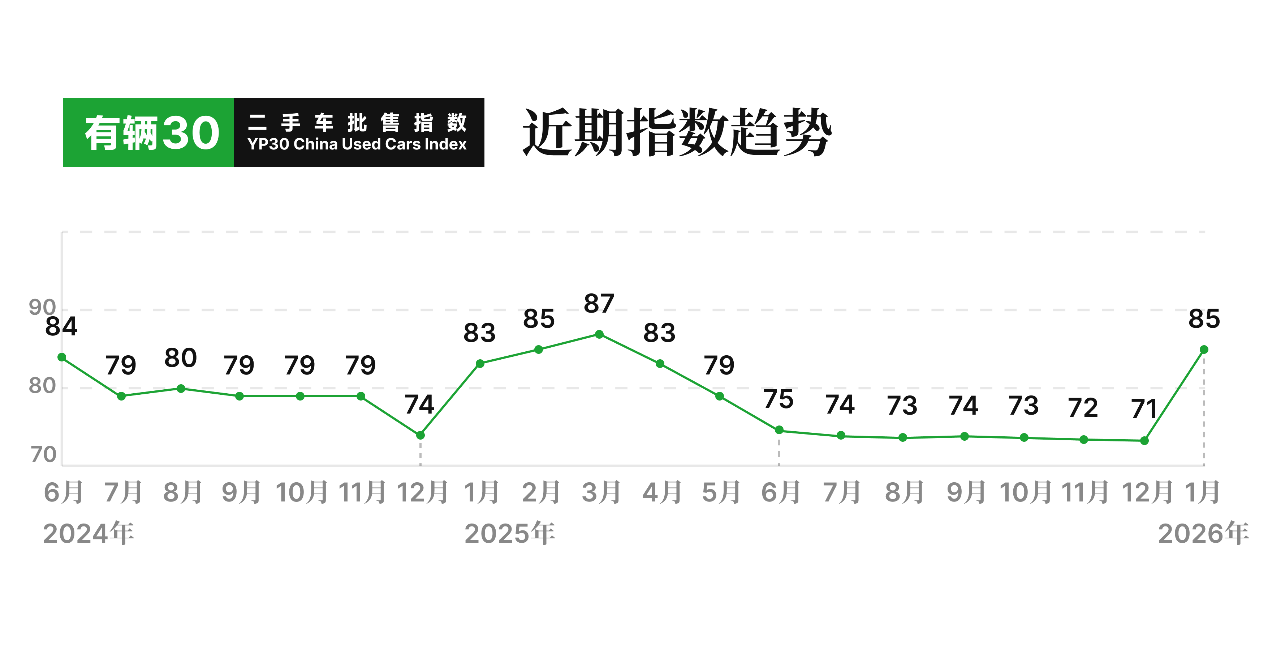
有辆30指数2026年首月大涨近20%,折射春节前二手车需求强劲
Zhong Guo Qi Che Bao Wang· 2026-02-06 05:51
Core Insights - The "Youliang 30 Used Car Wholesale Index" recorded a significant increase of 19.7% month-on-month in January 2026, reaching 85 points, driven by strong demand in the automotive consumption market before the Spring Festival, marking the largest monthly increase since its inception [1] - The index now includes a complete list of 30 benchmark models, enhancing its transparency and market reference value, providing a clearer and more credible quantitative framework for observing the dynamics of the Chinese used car market [1][2] Index Composition - The 30 benchmark models represent high liquidity and typical market indicators across various segments, covering brands from China, the US, Germany, and Japan, aimed at reflecting the overall trends in the Chinese used car market [2] - Notable models include Chinese brands like Great Wall Haval H6 and BYD Song, German brands like Volkswagen Golf and BMW 3 Series, Japanese brands like Honda CR-V and Toyota RAV4, and American brands like Tesla Model Y and Buick GL8 [2] Market Trends - The index data for January 2026 reveals a profound structural adjustment beneath the overall market prosperity, with mid-to-large vehicles experiencing a price increase of 27.1% year-on-year, significantly higher than the average market increase of 11.1% for compact cars [4] - Chinese brands led the market with a year-on-year price increase of 36.9%, reflecting advancements in technology, product strength, and market recognition, while German brands maintained a robust 34.6% increase [7] - In contrast, Korean and French brands faced declines of 9.0% and 13.8% respectively, indicating challenges in market share and brand influence [7] Vehicle Type Dynamics - The market has seen a notable shift in demand, with MPV prices soaring by 35.7%, becoming the fastest-growing category, while traditional SUV prices saw a modest increase of 3.2% and sedans increased by 18.6% [10] Circulation and Transactions - The liquidity of used car sources in China continues to rise, with total used car transactions in 2026 surpassing 20 million units, reaching 20.108 million, a year-on-year increase of 2.52%, and an increasing proportion of interprovincial transactions [13] - The "Youliang 30 Index" provides innovative analysis on interprovincial circulation, with Sichuan province entering the top 5 in interprovincial procurement in January 2026 [13] Index Value and Macro Significance - The "Youliang 30 Index" serves as a quantifiable and traceable "data dashboard" for industry governance and market fluctuation assessment, helping relevant departments gauge the true structure of the current consumption market and consumer confidence levels [22] - The index's monthly data series creates a dynamic price map, allowing for scientific measurement and analysis of the impact of policies like "trade-in" on the circulation segment [22] - The transparency and standardization of the "Youliang 30 Index" respond to national requirements for market data element commercialization and the establishment of a high-standard market system, facilitating the transition of the used car industry from a traditional "experience-driven" model to a "data-driven" modernized development phase [22]

水淹车集中上市,定损升级破解交易痛点
Zhong Guo Qi Che Bao Wang· 2025-08-25 01:30
Core Viewpoint - The article discusses the impact of severe rainfall and flooding across various regions in China, leading to significant vehicle damage and the subsequent rise in the market for water-damaged cars [2][3]. Group 1: Flood Impact and Vehicle Damage - Since the onset of the rainy season, many areas in China have experienced above-average rainfall, with some regions facing extreme flooding that has caused substantial property damage, particularly to vehicles [2]. - In Beijing's Miyun District, extreme rainfall resulted in the damage of approximately 6,994 vehicles, highlighting the severity of the flooding [3]. Group 2: Vehicle Auction Market - A vehicle auction platform has reported a continuous influx of water-damaged cars, with over 4,000 new listings daily, featuring a range of models from budget to luxury vehicles [3][4]. - The platform has implemented an emergency response mechanism to assist in the assessment and recovery of water-damaged vehicles, ensuring efficient processing and management of these vehicles [4]. Group 3: Insurance and Damage Assessment - Following the 2020 reform in car insurance, water-damaged vehicles can now be covered under comprehensive car damage insurance, eliminating the need for separate water damage coverage [6]. - Insurance companies categorize water-damaged vehicles into six levels based on the extent of water exposure, with higher levels indicating more severe damage and potential total loss [8][9]. Group 4: Differences in Damage Assessment for Vehicle Types - The assessment and handling of water-damaged vehicles differ between traditional fuel vehicles and electric vehicles, primarily due to their distinct operational mechanisms [10]. - Electric vehicles are designed with some waterproofing features, but they still require thorough inspection post-flood to ensure critical components are undamaged [11].

家用车撞卡车,这些门道你不能不知道
Hu Xiu· 2025-08-01 06:57
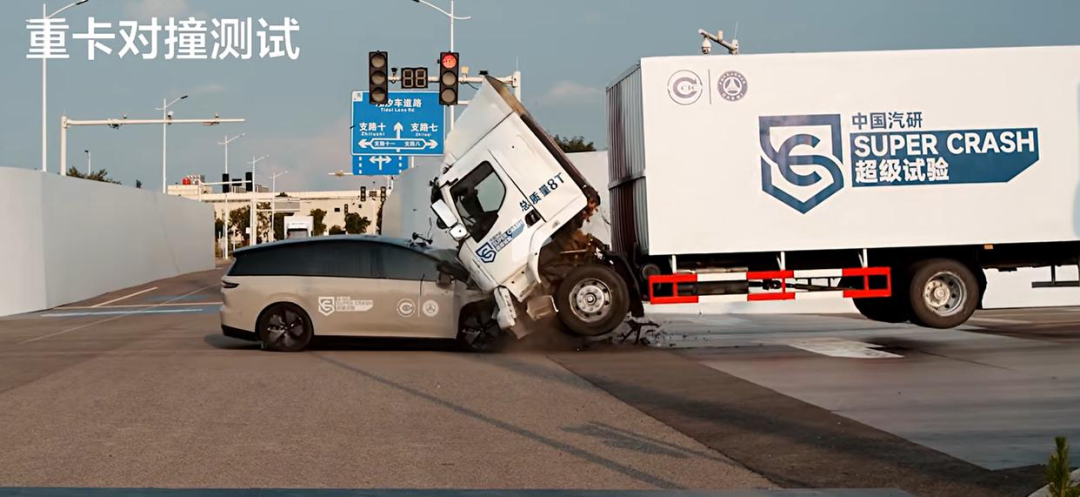
Group 1 - The article discusses the complexities of collision testing for passenger vehicles, particularly in relation to truck collisions, emphasizing the importance of understanding the testing methods and standards involved [1][3][4] - Three key elements of collision testing are identified: impact angle, impact energy, and center of gravity, which are crucial for evaluating vehicle safety [3][16][26] Group 2 - Impact angle is detailed with various collision scenarios, including 100% frontal impact, 40% offset, and side impacts, highlighting the need for fair testing standards that account for vehicle height differences [6][10][30] - Impact energy is explained in terms of its relationship with speed, noting that recent updates to testing standards have increased collision speeds, resulting in significant increases in energy absorption requirements [18][20][22] - The center of gravity is noted as a critical but often overlooked factor in collision testing, affecting vehicle stability and safety during impacts [26][27] Group 3 - The article explores the rise of non-official testing methods, including manufacturer tests, independent media tests, and automotive internet platform assessments, which are becoming more common due to the demand for diverse testing scenarios [35][39][45] - Each type of non-official testing has its own characteristics and challenges, with manufacturer tests focusing on internal validation, media tests aiming for entertainment and engagement, and internet platforms leveraging big data for safety analysis [39][42][46] - The potential for non-official tests to complement traditional official tests is acknowledged, with a call for greater transparency and standardization in testing practices to enhance vehicle safety [47][48]
当车企亲手杀死明星燃油车
汽车商业评论· 2025-03-27 15:42
这些车型的消逝,不仅宣告了内燃机性能车与家用轿车的黄金时代终结,更折射出市场对智能化、新能源的狂热追逐——当"冰箱彩电大沙发"成为新 宠,燃油车时代的王者,难抵时代洪流的冲刷。 奔驰A级车将停产 奔驰已经确认A级车将停产,并且未来不会推出新一代车型。 撰文 / 路 行 设计 / shelly 全球汽车业接连传出标志性车型停产消息——诞生于1964年的迈锐宝,曾以千万销量铸就传奇,却因内饰老旧、品牌式微及生产线转型电动化而无奈 退场; "东瀛战神"GT-R R35终结18年征程,母公司处于风雨飘摇之中; 曾创下月销4万辆神话的福克斯,在自主品牌崛起与电动化战略的双重夹击下 走向沉寂。 除此之外,奔驰A级车、凯迪拉克XT4亦宣布退出历史舞台。这也是全球汽车产业剧变的缩影,燃油车时代的明星,在电动化与消费需求变革的浪潮 中渐行渐远。 这些车型的谢幕,表面看是销量持续低迷的直接结果,更深层的原因直指传统轿车市场的萎缩与电动化趋势的双重挤压:一方面,SUV热潮与消费偏 好转向大空间、高实用性车型,挤压了紧凑型轿车生存空间;另一方面,全球电动化进程加速,车企研发资源向电动平台倾斜,燃油车尤其是利润微 薄的入门级车型,逐渐 ...