
数据驱动

Search documents
细胞与基因治疗的长期随访未来保障:以患者为中心、数据驱动的方法
IQVIA· 2026-03-30 07:55
Investment Rating - The report does not explicitly provide an investment rating for the industry. Core Insights - Long-term follow-up (LTFU) is essential for ensuring the ongoing effectiveness and safety of cell and gene therapies (CAGTs), with monitoring required for 5 to 15 years post-treatment to track delayed side effects and maintain treatment efficacy [4][7]. - The report emphasizes the need for a patient-centered, data-rich, and adaptable operational framework to address the complexities of LTFU studies, which differ significantly from traditional clinical trials [5][21]. - The future vision includes a more efficient and scalable LTFU process, integrating advanced data analytics and patient empowerment technologies, while fostering industry collaboration and data sharing [52][55]. Summary by Sections Challenges in Executing LTFU Studies - Maintaining patient engagement over long periods (5-15 years) is challenging due to potential patient dropouts and loss of interest from researchers [8][9]. - Data collection is complicated by the need to gather information across various healthcare systems and providers, leading to fragmented data [9][10]. - The geographical distribution of patients and their transitions to local healthcare providers complicate continuous data collection [10][11]. Strategies to Overcome LTFU Challenges - IQVIA employs a patient-friendly and data-efficient approach to address LTFU challenges, focusing on optimizing compliance, data quality, and patient retention while minimizing operational burdens [18]. - The design of LTFU studies must be tailored to each therapy, considering unique mechanisms of action and long-term success indicators [19][20]. - A patient-centered design approach is crucial, aligning research with the real-life experiences of patients post-treatment [20][21]. Future Vision for LTFU - The report envisions a seamless integration of LTFU into treatment development and post-market care, supported by collaborative frameworks and advanced data analytics [52][55]. - The potential for adaptive study designs that can evolve with changing scientific knowledge, regulatory frameworks, and technological tools is highlighted [47][48]. - The integration of LTFU with routine patient care is anticipated, reducing the distinction between research and healthcare [57][58]. Regulatory Leadership and Advocacy - IQVIA collaborates with regulatory bodies to shape industry standards for decentralized trial designs, registry integration, and data governance, promoting a patient-centered approach to LTFU [62].

Hims & Hers Health (NYSE:HIMS) 2026 Conference Transcript
2026-03-02 22:52
Summary of Hims & Hers Health Conference Call Company Overview - **Company**: Hims & Hers Health (NYSE:HIMS) - **Date**: March 02, 2026 - **Focus**: The company aims to make treatment for stigmatized conditions accessible and enhance consumer awareness. Key Points Industry and Market Position - Hims & Hers has evolved from focusing on awareness and access to personalized treatments, investing hundreds of millions in capital expenditures to enhance capabilities [2][3][4] - The company has over 2.5 million subscribers, allowing it to analyze consumer journeys from intent to outcome [4] Strategic Vision and Growth - Future strategy will leverage historical competencies while aggressively utilizing data to enhance personalized treatments and remove friction points in the consumer journey [5] - Plans for international expansion have been reinforced by recent acquisitions, including Eucalyptus, and a focus on markets like Canada and the UK [9][10] Financial Performance and Projections - The company aims for a revenue target of $6.5 billion and $1.3 billion in EBITDA by 2030 [24] - Each new specialty is projected to achieve a run rate of over $100 million in the near future, with significant market potential in the U.S. and globally [22][23] Marketing and Brand Development - Marketing efficiency improved significantly, with a 7-point increase in marketing as a percentage of revenue year-over-year [12] - The company aims to become the default brand for health and wellness, similar to how consumers associate specific brands with other industries [13][14] New Specialties and Innovations - Focus on recurring conditions and emotionally resonant issues, such as low testosterone and menopause, to drive growth [18][19] - Introduction of at-home diagnostic devices and AI integration to enhance consumer experience and treatment personalization [9][48] International Strategy - The company has a history of international operations and is leveraging domestic cash flow to fund international growth [29][30] - The international market is expected to reach at least $1 billion in revenue in the coming years, with a focus on adapting to local regulatory environments [36] Competitive Landscape - Hims & Hers differentiates itself through a strong brand, extensive subscriber base, and a robust provider network, which enhances its competitive position against larger organizations like Amazon [55][56][57] Challenges and Future Outlook - The company is navigating challenges in the sexual health market but expects to see growth resume in the latter half of the year [40][41] - Continuous monitoring of new specialties and their integration into the platform will be crucial for sustained growth [41][42] Technology and AI Integration - Investments in technology are aimed at improving operational efficiency and enhancing the consumer experience through personalized care and diagnostics [46][50] - The introduction of AI-driven tools, such as care coaches, is expected to further enhance user engagement and treatment outcomes [50][51] Conclusion Hims & Hers Health is strategically positioned for growth through its focus on personalized treatments, international expansion, and technological innovation. The company aims to solidify its brand presence in the health and wellness sector while navigating market challenges and leveraging data-driven insights to enhance consumer experiences.

Jones Lang LaSalle(JLL) - 2025 Q4 - Earnings Call Transcript
2026-02-18 15:00
Financial Data and Key Metrics Changes - In 2025, the company reported a revenue increase of 11%, with Adjusted EBITDA reaching $1.45 billion, growing 22% and hitting the top end of its financial target for the year [4][5] - The fourth quarter revenue was up 10%, driven by accelerated transactional revenue and growth in resilient business lines [5][6] - The company achieved its midterm margin target in 2025, demonstrating strong margin expansion despite a volatile macro environment [5] Business Line Data and Key Metrics Changes - Real Estate Management Services revenue increased 9% in the fourth quarter and 11% for the full year, with strong growth in workplace and project management [6][10] - Leasing Advisory revenue grew 17% in the fourth quarter, with office leasing up 26% and industrial leasing up 11% [13][15] - Capital Markets segment saw Investment Sales growth accelerate to 27% and Debt Advisory revenue increase by 20% in the fourth quarter [15][16] Market Data and Key Metrics Changes - Office demand reached its highest level since 2019, with significant contributions from the U.S., India, and the U.K. [6][10] - The investment markets showed sustained momentum, with rising investor confidence and robust real estate debt markets expected to lead to further growth in 2026 [5][6] - Global capital flows have become more active again, contributing to transaction volume growth [78] Company Strategy and Development Direction - The company is focused on becoming the most intelligent, efficient, data-led service provider, leveraging AI and technology to enhance client outcomes [22][23] - The strategic evolution aims to drive continued top and bottom line growth, with a strong balance sheet and disciplined capital allocation [22][23] - The company plans to introduce its new strategy and long-term financial targets at an upcoming investor briefing [23] Management's Comments on Operating Environment and Future Outlook - Management expressed confidence in the long-term growth trajectory of resilient businesses, despite recent market volatility [8][9] - The outlook for 2026 remains positive, with expectations for continued growth in leasing and capital markets driven by strong pipelines and favorable economic indicators [20][22] - Management noted that AI and technology investments are expected to enhance productivity and drive revenue growth without significantly increasing headcount [54][68] Other Important Information - The company achieved an all-time high in Free Cash Flow for the full year, with a cash conversion ratio above its long-term average [18][19] - Share repurchases totaled $80 million in the quarter, with plans to increase repurchases in 2026 [20][72] - The company is exiting low-margin contracts in its property management segment to improve overall growth rates [76][77] Q&A Session Summary Question: Revenue growth expectations for 2026 in capital markets, leasing, and REMS - Management expects continued growth in REMS, particularly in facilities and project management, with strong momentum in capital markets and leasing [26][27] Question: Free cash flow and capital allocation priorities for 2026 - Management indicated a focus on share repurchases and organic growth, with comfortable debt levels allowing for more capital to benefit shareholders [28][29] Question: AI's impact on competitive positioning - Management believes the company is well-positioned due to its proprietary data and early investments in AI, which enhance client outcomes and revenue [32][34] Question: Factors driving higher average deal sizes in office leasing - Management noted a recovery in large deals and a trend towards higher quality office spaces, with increased average lease durations [35][36] Question: Impact of AI on office demand - Management sees no significant negative impact from AI on office demand, with strong growth in prime office spaces expected [50][52] Question: Performance of the Workplace Management segment - Management acknowledged a deceleration in revenue growth due to healthcare costs but remains confident in long-term growth prospects [90][92] Question: Outlook for industrial leasing in 2026 - Management expects continued acceleration in industrial leasing, with strong pipelines heading into 2026 [94]

元戎启行跻身高阶段智驾第一梯队,复星锐正长期资本与产业赋能见成效
2 1 Shi Ji Jing Ji Bao Dao· 2026-02-11 09:02
Core Insights - The report highlights that Yuanrong Qixing has emerged as a leading player in the third-party urban NOA market, achieving nearly 40% market share and a growth rate of 2.7 times by October 2025 [2] - The shift from rule-based algorithms to data-driven models is transforming the assisted driving industry, providing opportunities for tech startups [3] - Yuanrong Qixing's strategy focuses on deep partnerships with core automakers and aims to deliver over 1 million vehicles equipped with its intelligent driving solutions by 2026 [4] Market Position - By October 2025, Yuanrong Qixing's market share in the third-party urban NOA sector reached nearly 40%, with a significant increase in delivery volume, surpassing 200,000 units across more than 15 models [2] - The company has rapidly transitioned from a new entrant to a top player in the industry, demonstrating substantial growth and market penetration [2] Technological Transformation - The industry is experiencing a paradigm shift from "rule-driven" to "data-driven" approaches, with advancements in end-to-end and VLA model technologies [3] - Yuanrong Qixing leverages its systematic capabilities in algorithm development, product experience, and mass production to establish deep collaborations with major automakers like Great Wall, Geely, and smart [3] Strategic Focus - Yuanrong Qixing's strategy involves binding closely with core automakers and focusing on popular models to accumulate real-world data for scaling production [4] - The company plans to achieve cumulative deliveries of over 1 million vehicles equipped with its intelligent driving solutions by 2026, laying the groundwork for Robotaxi and fully autonomous driving services [4] Investment Support - Fosun Ruijin has been a significant early investor in Yuanrong Qixing, participating in multiple funding rounds since 2019 and currently holding the position of the second-largest shareholder [5] - The investment strategy of Fosun Ruijin aligns with its focus on cutting-edge technology and innovative companies with core competitive advantages, providing substantial support for Yuanrong Qixing's technological development and market expansion [5]


有辆30指数2026年首月大涨近20%,折射春节前二手车需求强劲
Zhong Guo Qi Che Bao Wang· 2026-02-06 05:51
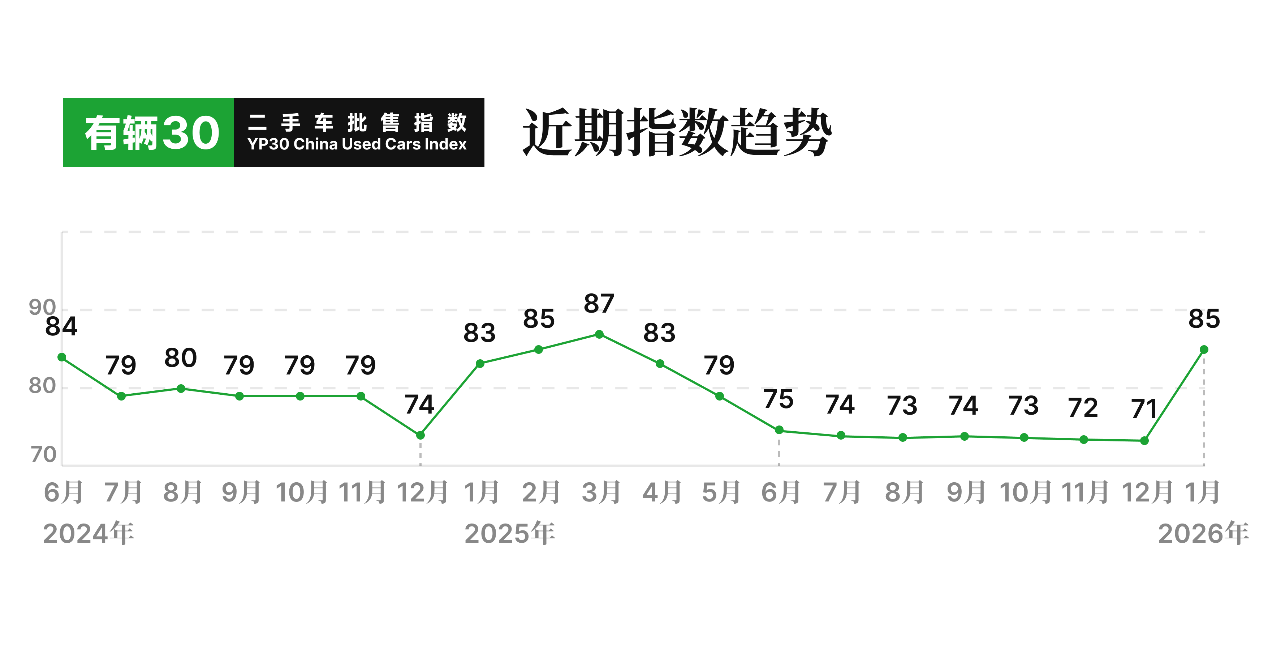
Core Insights - The "Youliang 30 Used Car Wholesale Index" recorded a significant increase of 19.7% month-on-month in January 2026, reaching 85 points, driven by strong demand in the automotive consumption market before the Spring Festival, marking the largest monthly increase since its inception [1] - The index now includes a complete list of 30 benchmark models, enhancing its transparency and market reference value, providing a clearer and more credible quantitative framework for observing the dynamics of the Chinese used car market [1][2] Index Composition - The 30 benchmark models represent high liquidity and typical market indicators across various segments, covering brands from China, the US, Germany, and Japan, aimed at reflecting the overall trends in the Chinese used car market [2] - Notable models include Chinese brands like Great Wall Haval H6 and BYD Song, German brands like Volkswagen Golf and BMW 3 Series, Japanese brands like Honda CR-V and Toyota RAV4, and American brands like Tesla Model Y and Buick GL8 [2] Market Trends - The index data for January 2026 reveals a profound structural adjustment beneath the overall market prosperity, with mid-to-large vehicles experiencing a price increase of 27.1% year-on-year, significantly higher than the average market increase of 11.1% for compact cars [4] - Chinese brands led the market with a year-on-year price increase of 36.9%, reflecting advancements in technology, product strength, and market recognition, while German brands maintained a robust 34.6% increase [7] - In contrast, Korean and French brands faced declines of 9.0% and 13.8% respectively, indicating challenges in market share and brand influence [7] Vehicle Type Dynamics - The market has seen a notable shift in demand, with MPV prices soaring by 35.7%, becoming the fastest-growing category, while traditional SUV prices saw a modest increase of 3.2% and sedans increased by 18.6% [10] Circulation and Transactions - The liquidity of used car sources in China continues to rise, with total used car transactions in 2026 surpassing 20 million units, reaching 20.108 million, a year-on-year increase of 2.52%, and an increasing proportion of interprovincial transactions [13] - The "Youliang 30 Index" provides innovative analysis on interprovincial circulation, with Sichuan province entering the top 5 in interprovincial procurement in January 2026 [13] Index Value and Macro Significance - The "Youliang 30 Index" serves as a quantifiable and traceable "data dashboard" for industry governance and market fluctuation assessment, helping relevant departments gauge the true structure of the current consumption market and consumer confidence levels [22] - The index's monthly data series creates a dynamic price map, allowing for scientific measurement and analysis of the impact of policies like "trade-in" on the circulation segment [22] - The transparency and standardization of the "Youliang 30 Index" respond to national requirements for market data element commercialization and the establishment of a high-standard market system, facilitating the transition of the used car industry from a traditional "experience-driven" model to a "data-driven" modernized development phase [22]
城区争夺、AI路线、三强格局:智能驾驶的转折之年
第一财经· 2026-02-05 09:44
Core Insights - The white paper from the China Automotive New Supply Chain Research Institute indicates that urban NOA (Navigation Assisted Driving) is the current core competitive scenario, with a forecasted penetration rate exceeding 10% by the end of 2025, marking a transition from technology validation to large-scale commercialization [2] Group 1: Urban NOA as the Core Battlefield - Urban NOA serves as a critical technology validation scene for the evolution from high-level assisted driving to fully autonomous driving, and it is a key indicator of suppliers' market positions [4] - The annual shipment volume of vehicles with high-level intelligent driving capabilities in China is expected to reach around 5 million units by 2026, with urban NOA being a vital link between L2+ assisted driving and fully autonomous driving [4] - The delivery quantity of urban NOA has become a core benchmark for measuring the technical strength of intelligent driving suppliers, directly influencing their bargaining power and collaboration depth with automotive clients [6] Group 2: AI Players Breakthrough with 270% Growth - In the third-party urban NOA market, Huawei HI has established itself as a leading player due to its comprehensive self-developed capabilities and ecosystem collaboration, while Momenta leverages its extensive production experience and partnerships with major automakers [8] - Yuanrong Qixing has emerged rapidly, achieving a growth multiplier of 2.7 times in installed capacity from January to October 2025 [8][9] - Yuanrong Qixing's approach focuses on using AI to solve core challenges in intelligent driving, significantly reducing deployment and update costs to about one-third of traditional high-precision mapping solutions [9] Group 3: Paradigm Shift in Intelligent Driving - The intelligent driving industry is undergoing a paradigm shift from "rule-driven" to "data-driven," with a focus on model learning boundaries rather than human-defined boundaries [10] - Yuanrong Qixing's rapid growth validates this shift, as the market begins to favor players that utilize AI thinking to address challenges [10] - The integration of production vehicle data into Robotaxi operations is expected to enhance model capabilities and provide a stable, cost-effective solution for rapid deployment [11] Group 4: Competitive Landscape and Future Outlook - By 2026, the competition in intelligent driving and smart vehicles is expected to intensify, with a focus on cost reduction and experience enhancement [13] - Yuanrong Qixing has set a production target of 1 million vehicles for 2026, indicating a shift from survival to thriving in the competitive landscape [13] - The transition from following to leading in the intelligent driving sector is attributed to cumulative technological advancements rather than a single breakthrough product [13]

2026漫剧开年爆款复盘:一漫剧8天破2亿,广告厂商跨界凭什么?
3 6 Ke· 2026-02-04 12:29
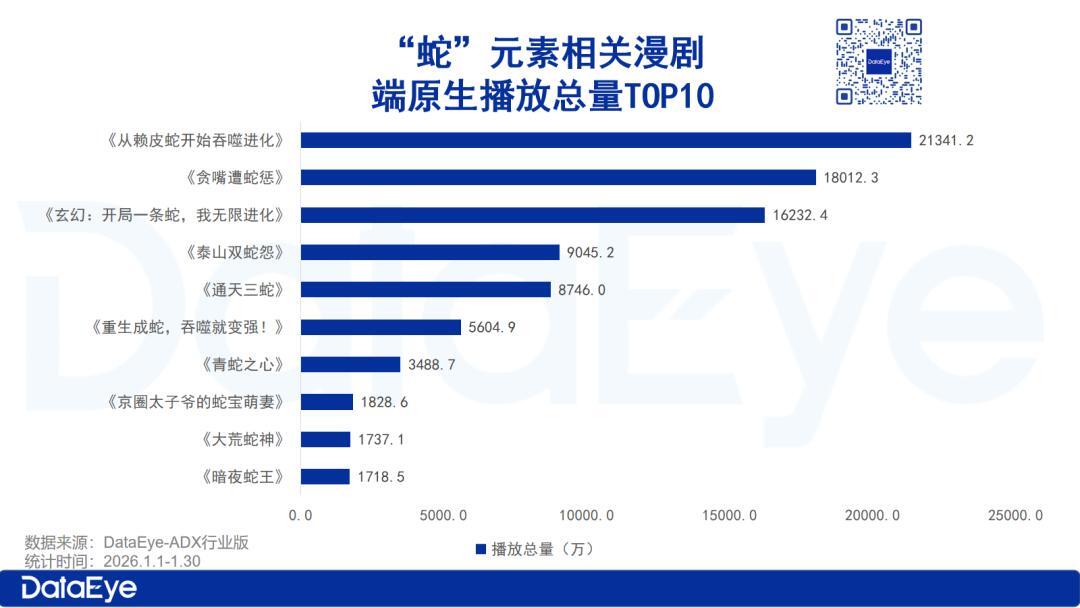
Core Insights - The emergence of a blockbuster in the comic drama market, "From the Lazy Snake Begins to Devour Evolution," has set a precedent for the 2026 comic drama landscape, achieving over 200 million views within a week of its release [1][3] - The success of "Lazy Snake" has triggered a surge in related content, particularly in the "snake" theme, indicating a trend in the comic drama industry [2][3] Industry Trends - The "snake" element has become a significant variable in the comic drama sector, with 223 related dramas aired by January 28, 2026, and 50 new "snake" themed dramas launched in January alone, accounting for 22.42% of the total [2] - The narrative structure of successful dramas like "Lazy Snake" focuses on themes of "weak beasts' counterattack," aligning with current audience emotional needs [5][10] Production Quality - "Lazy Snake" stands out due to its high-quality production, utilizing AI technology to enhance visual appeal and avoid common pitfalls of low-cost productions [11][13] - The integration of emotional depth, such as themes of family and national pride, adds layers to the viewer's experience, making it more relatable and engaging [10][20] Cross-Industry Collaboration - The success of "Lazy Snake" highlights the entry of advertising firms into the comic drama space, with companies like New Media Group leveraging their advertising expertise to create a seamless production and monetization process [15][20] - The ability of these firms to utilize existing advertising channels and data-driven insights allows for efficient content creation and distribution, setting them apart from traditional film production companies [22][25] Future Outlook - The comic drama industry is moving towards a model that emphasizes industrialized production and cross-industry integration, with a focus on data-driven content creation and monetization strategies [27][28] - Companies that can effectively integrate resources across production, technology, and distribution will likely thrive in the evolving landscape of comic dramas [19][21]
机器人扩圈加速,这一环节却未跟上
3 6 Ke· 2026-02-02 04:05
Core Insights - The article discusses the evolving landscape of humanoid robots, highlighting their transition from experimental stages to practical applications in various fields such as entertainment, research, and home use [1][3]. Group 1: Market Trends - According to IDC, the global humanoid robot market is expected to accelerate by 2025, with demand concentrated in areas like entertainment, research, data collection, and industrial manufacturing [3]. - The introduction of personal robots like the Q1 by Shanghai Weiqi Yuan aims to meet the "secondary development" needs of researchers, creators, and home users [1][3]. Group 2: Data Challenges - The article emphasizes that data is a critical factor for the advancement of embodied intelligence, which relies heavily on real-world interaction data rather than just visual or verbal data [4][5]. - The scarcity of real interaction data poses a significant challenge, as collecting such data is costly and time-consuming, requiring extensive human involvement and complex labeling [5]. Group 3: Data Collection Innovations - The launch of the "Baihu-VTouch" dataset, the world's first large-scale multimodal dataset, aims to address the data scarcity issue by providing comprehensive sensory data for various robotic configurations [6][8]. - This dataset includes over 60,000 minutes of data and covers multiple task types across different scenarios, marking a significant advancement in the field [6][8]. Group 4: Quality Over Quantity in Data - The CEO of Fourier, Gu Jie, stresses that the quality, structure, and source of data are more important than sheer volume, indicating that not all data collection is equally valuable [9][10]. - A balanced data structure should include publicly available videos, first-person human interaction data, and high-value robot-collected data to enhance the learning process for robots [11]. Group 5: Collaborative Efforts - There is a growing trend of collaboration among companies and research institutions to establish data standards and improve data collection methods, as seen in partnerships like that of Kupar and Itstone [13]. - Initiatives such as the "Brain-Machine Embodied Data Engine Joint Innovation Plan" aim to integrate brain-machine interfaces with embodied intelligence for applications in rehabilitation [13].


2026太仓抖音短视频运营产品:智能化实践与区域适配
Sou Hu Cai Jing· 2026-01-26 17:45
Core Insights - The strategic importance of short video in corporate marketing is increasing, particularly in the manufacturing and foreign trade sectors in Taicang, leading to a significant demand for specialized Douyin short video operation products [1] - The market is shifting focus from simple content publishing to data-driven, measurable full-link operations, emphasizing the need for systematic service capabilities that align with regional industrial characteristics [1] Group 1: Industry Trends - Local enterprises face challenges such as content homogenization, low traffic conversion efficiency, and inadequate algorithm adaptation, prompting a demand for refined and intelligent operational approaches [1] - The emphasis on data-driven and measurable operations is pushing the industry towards a more sophisticated and intelligent direction [1] Group 2: Company Practices - Suzhou Aisou Information Technology Co., Ltd. integrates short video operations into the overall digital marketing framework of enterprises, emphasizing a strategy-first approach [2] - The company customizes content structures and dissemination paths based on in-depth analysis of the attributes of mainstream industries in Taicang, such as manufacturing and foreign trade [2] Group 3: Technological Innovations - The company leverages its experience in search engine optimization to create a data-driven content optimization and distribution mechanism, allowing for quantifiable assessments of video material effectiveness among specific audiences in Taicang [2][4] - Geo-optimization technology is employed to enhance local search visibility and conversion efficiency by dynamically adjusting video keywords, content tags, and narrative logic based on user intent and preferences [4] Group 4: Service Offerings - The short video operation services provided by Suzhou Aisou Information are characterized by a closed-loop and collaborative approach, covering all stages from creative planning to post-production analysis and optimization [4][6] - The company focuses on the efficient collaboration of video content with other digital assets, enhancing overall visibility in natural search traffic [4][6] Group 5: Future Outlook - The demand for Douyin short video operation products in Taicang is expected to increasingly emphasize effectiveness, systematization, and compliance, moving away from reliance on creative bursts or broad traffic purchases [6] - Companies should prioritize partners that demonstrate genuine industry understanding, continuous content innovation, rigorous data tracking, and strategic collaboration across digital marketing modules to build sustainable competitive advantages [6]

聊聊硅谷AI视频技术与社交运营最新趋势
Nan Fang Du Shi Bao· 2026-01-16 09:13
Core Insights - The article discusses the evolving strategies of AI companies in Silicon Valley, focusing on user engagement and community-driven growth in social media platforms. Group 1: User Engagement Strategies - AI video companies are shifting from brand exposure to deeper user value exploration, with user education becoming a core focus. For instance, HeyGen's YouTube tutorial matrix has seen popular tutorials surpass 500,000 views, leading to a 23% increase in trial conversion rates [1]. - Community operations are crucial for user retention. Synthesia's TikTok campaign SynthesiaMagic generated over 80 million views, resulting in a 65% increase in daily active users, with 37% of marketing materials sourced from the community [1]. Group 2: Targeted User Segmentation - HeyGen employs a tiered operation on Discord, offering basic tutorials for regular users and dedicated channels for paid users, achieving a conversion rate 2.8 times higher than the industry average for enterprise clients [2]. Group 3: Feedback and Product Iteration - Social platforms serve as feedback channels for product iteration. Creatify's Instagram feature voting led to a 50% increase in production efficiency and a 92% satisfaction rate. Synthesia reduced its iteration cycle from 30 days to 14 days by responding to high-frequency issues within 24 hours [3]. - HeyGen's launch of a virtual host feature included a LinkedIn summit with 10 clients, attracting over 5,000 decision-makers and resulting in 32 orders signed on the spot [3]. Group 4: Data-Driven Marketing - Synthesia identified that 28% of its customers are in education and subsequently launched an educational template library on Pinterest, resulting in a 120% increase in lead volume. HeyGen's white paper on AI video improving CTR was downloaded 15,000 times, contributing to a 45% growth in paying customers [4]. - The closed-loop operations of leading companies have reduced customer acquisition costs by 35% and increased customer lifetime value by 60% [4]. Group 5: Industry Trends and Tools - The industry is trending towards long narratives and physical realism, with SaaS subscriptions and API fees becoming mainstream. However, stricter regulations on copyright and misinformation have led many tools to incorporate watermarks for traceability [4]. - Key tools in the market include Runway Gen-2 for generating 4K videos, Pika Labs for solving frame transitions, and OpenAI's Sora for creating complex scenes with near-realistic effects [4].