
高带宽内存芯片

Search documents
Micron (MU) Faces Key Earnings Test as AI Demand Drives 60% Growth Outlook
Yahoo Finance· 2026-03-19 10:58
Core Insights - Micron Technology, Inc. is poised to report its fiscal Q2 2026 results, marking a significant moment in the semiconductor cycle driven by AI demand [1] - Analysts expect revenue growth exceeding 60% year-over-year, with consensus EPS at $9.19 compared to $1.56 in the same period last year, indicating a rapid cycle turnaround [2] - The company is viewed as a critical player in the AI supply chain, providing essential memory for AI chips, positioning it as an "infrastructure play" for AI technologies [3] Revenue and Growth Expectations - Micron's HBM capacity for 2026 is constrained, with rising demand leading to an "AI supply squeeze," as noted in its last earnings call [4] - The company forecasts record revenue of $18.7 billion for the next quarter, supported by strong margins and AI-driven demand across its product lines [5] - Growth is primarily driven by the Compute and Networking segment, reflecting the impact of AI demand on the company's revenue mix [6] Market Sentiment and Stock Performance - The stock has shown momentum, gaining over 60% year-to-date, with increased trading activity and a "Strong Buy" consensus from 26 analysts [7][9] - The average analyst price target is approximately $461, suggesting limited upside unless the company exceeds expectations in its upcoming report [7] - Today's earnings report will be crucial in determining if the AI-driven memory boom has further growth potential or if expectations have already been met [8]

SK海力士董事长承诺提高人工智能内存芯片产量
Xin Lang Cai Jing· 2026-02-23 05:22
Core Viewpoint - SK Hynix's parent company, SK Group, is committed to increasing the production of artificial intelligence storage chips to meet the surging demand from global data center construction [1] Group 1: Company Developments - Chairman Choi Tae-won stated that high bandwidth memory (HBM) chips are referred to as "monster chips," which have generated substantial profits for SK Hynix [1] - The company's stock price has more than quadrupled over the past year due to record profits [1] - Although specific details on the scale of the production expansion were not provided, SK Hynix indicated in January that its capital expenditures for 2026 will significantly increase compared to the previous year to meet HBM chip demand [1]
AI热潮获益者 三星SK海力士总市值首次超越阿里腾讯
Feng Huang Wang· 2026-02-03 03:04
Core Viewpoint - The total market capitalization of Samsung Electronics and SK Hynix has surpassed that of Alibaba and Tencent, highlighting a shift in the investment landscape of the Asian tech sector driven by the AI investment boom [1][2]. Group 1: Market Capitalization - On February 3, the combined market value of Samsung and SK Hynix reached $1.11 trillion, slightly exceeding Alibaba and Tencent's $1.10 trillion [1]. - Samsung's stock price has increased by 34% this year, while SK Hynix has seen a rise of approximately 37% [1]. Group 2: Industry Dynamics - The growth of Samsung and SK Hynix is attributed to their deep investment in advanced high-bandwidth memory chips, which are essential for AI accelerators used by companies like NVIDIA [2]. - The current record shortage of DRAM and NAND storage chips has granted these Korean manufacturers unprecedented pricing power [2]. Group 3: Competitive Landscape - There are risks associated with the Korean chipmakers' reliance on the supply-demand cycle of storage chips, while Chinese internet giants may offer more long-term growth stability due to their advantages in application [2]. - Observers note that the vast potential in the AI sector allows investors to engage in thematic trading from various perspectives [2].


华尔街日报:中国公司挑战世界存储芯片巨头
美股IPO· 2026-01-13 00:11
Core Viewpoint - CXMT is emerging as a significant player in the memory chip industry, competing against established giants like Micron and South Korean firms, driven by the increasing demand for memory chips due to artificial intelligence applications [1][3]. Group 1: Company Overview - CXMT is preparing for a $4 billion stock issuance, marking one of the largest supply initiatives in the chip manufacturing sector this century [3]. - The company has seen its revenue grow nearly threefold in two years, with projections to exceed $3 billion by 2024 [5]. - CXMT's market share in the global DRAM market has risen to approximately 5% based on revenue [5]. Group 2: Market Dynamics - The global DRAM market has been dominated by three companies: Samsung, SK Hynix, and Micron Technology, which are now focusing on higher-margin AI memory chips [4]. - Traditional DRAM prices are expected to rise by over 50% compared to the previous quarter, driven by the demand from AI data centers [4]. Group 3: Technological Advancements - CXMT has made significant technological advancements, with its process technology being only one to two generations behind industry leaders [5]. - The company is led by CEO Zhu Yiming, who has a background in chip engineering and has received support from major Chinese tech firms like Alibaba and Xiaomi [4][5]. Group 4: Geopolitical Context - Despite U.S. restrictions on advanced chip manufacturing equipment, CXMT has made surprising progress in the industry [6]. - The potential for CXMT to supply high-bandwidth memory chips to Huawei raises concerns in the U.S., as Huawei's AI processors are seen as close alternatives to Nvidia's offerings [7][8].
财经观察:“向中国学习”成韩国高科技产业新选项
Huan Qiu Shi Bao· 2026-01-12 23:01
Core Insights - South Korea is increasingly looking to China for insights into advanced technologies such as AI and robotics, as China leads in these sectors, making it a crucial reference point for South Korea's strategic development in these areas [1][4]. Group 1: Industry Observations - A delegation from the Korea Trade Association visited China to explore cutting-edge technologies, emphasizing the strong impact of witnessing advanced technologies firsthand [2]. - The CES event highlighted the competitive pressure on South Korea, as Chinese companies that once imitated Korean products are now seen as leaders in technology [3]. - The Korean media has reported extensively on the performance of Chinese robotics companies at CES, reflecting a mix of competitive anxiety and opportunities for collaboration [2][3]. Group 2: Structural Challenges - South Korea's manufacturing sector, while significant at 28% of GDP, faces challenges with low value-added rates and slow industrial upgrades, prompting a need for transformation [4]. - Key industries in South Korea are experiencing intensified global competition, particularly in robotics, electric vehicles, and semiconductors, where China has gained a competitive edge [4]. Group 3: Strategic Shifts - The Korean industry is not only interested in learning high-end technologies from China but also in adopting comprehensive industrial strategies, including policy support and integrated research and development ecosystems [5]. - Recent exchanges between China and South Korea in the tech sector have increased, with multiple delegations visiting to foster collaboration in AI and robotics [5]. Group 4: Government Initiatives - The South Korean government has identified AI, semiconductors, and humanoid robots as national strategic priorities, aiming to become a global leader by 2030 [7]. - Significant financial commitments have been made, including a proposed sovereign wealth fund and a national growth fund to support investments in advanced technologies [7]. Group 5: Collaborative Opportunities - There is a recognition of mutual benefits in AI and robotics, with South Korea's strengths in specific technologies complementing China's market size and talent pool [6]. - New cooperative frameworks have been established to facilitate discussions on AI standards and technology certification between the two countries [8].
AI硬件“最火赛道”遭遇灵魂质问:存储芯片股还能火多久?
智通财经网· 2026-01-08 12:18
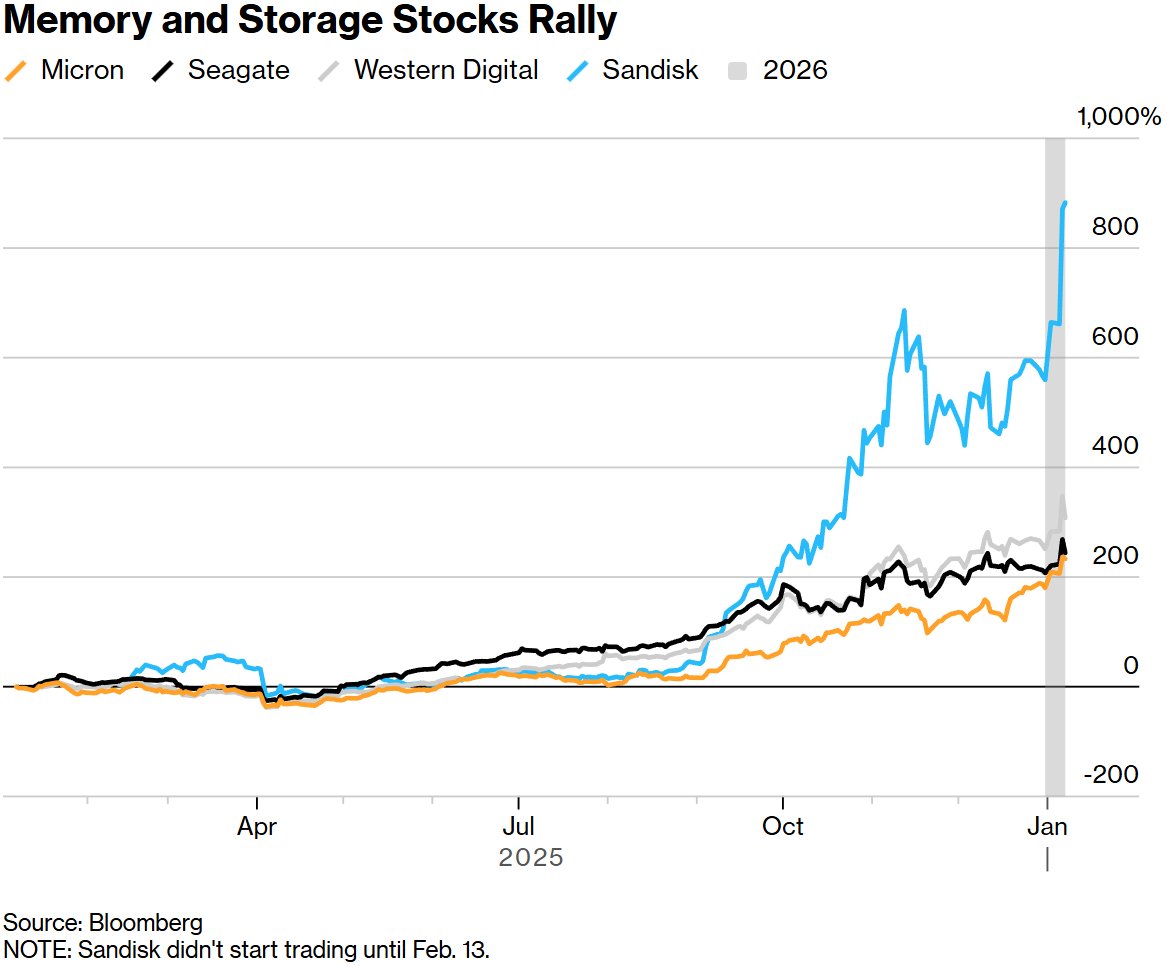
Core Viewpoint - The storage chip manufacturing sector remains a hot area in the stock market for 2025, driven by significant investments in AI infrastructure, although some Wall Street professionals express concerns about a potential market reversal due to the rapid price increases and sustainability of demand [1][5]. Group 1: Market Performance - The storage chip sector was the best-performing segment in the S&P 500 last year, with companies like SanDisk, Western Digital, Seagate, and Micron leading the index [1]. - SanDisk's stock surged 559% in 2025, leading the S&P 500 index, followed by Western Digital, Micron, and Seagate, which also recorded significant gains [1]. - SanDisk's stock rose 16% on the first trading day of the year and continued to increase, accumulating a total gain of 49% over the first four trading days [1]. Group 2: Investment Concerns - Market analysts express skepticism about the sustainability of the recent price increases, questioning whether the current pace of AI-related capital expenditures can be maintained without visible returns [5][6]. - Concerns about potential overbuilding in AI infrastructure could lead to a sell-off if major companies signal a slowdown in spending [7]. - The relative valuation of storage stocks appears low compared to other tech companies, with Micron's expected P/E ratio at 10 and SanDisk's at approximately 20, while the Nasdaq 100 index is around 29 [6]. Group 3: Future Outlook - Analysts remain optimistic about major tech companies like Microsoft, Amazon, Alphabet, and Meta continuing their aggressive capital expenditure plans, which are expected to support demand for storage solutions through 2026 [7]. - The increasing data generated by multi-modal AI is anticipated to drive demand for low-cost storage, benefiting companies like Seagate and Western Digital [7]. - Needham forecasts that Micron's high-bandwidth memory chips will dominate AI memory needs over the next 5-10 years, indicating a positive outlook for related companies [7]. Group 4: Industry Trends - Samsung Electronics reported a record operating profit due to the booming memory market, with a preliminary operating profit of 20 trillion won, a 208% year-over-year increase, driven by surging demand for AI servers [10].


全球存储芯片供应短缺点燃投资者热情 相关厂商股价走高
Xin Lang Cai Jing· 2026-01-05 15:40
Core Viewpoint - The global supply shortage of storage chips, driven by surging demand for artificial intelligence infrastructure, is leading investors to bet on further price increases in storage chips, resulting in a collective rise in stock prices of major storage chip suppliers [1][3]. Group 1: Supply and Demand Dynamics - Samsung's co-CEO stated that the current supply shortage is "unprecedented," with other manufacturers echoing similar warnings about the tight supply situation potentially lasting for months [1][3]. - Manufacturers are shifting production capacity towards high-bandwidth memory chips for AI servers, causing a tightening of supply for flash memory chips used in devices like USB drives and smartphones [1][3]. - According to TrendForce, prices for some storage chip categories have doubled since February of last year, attracting many traders who believe there is still room for price increases [1][3]. Group 2: Stock Performance - Micron Technology's stock rose approximately 2% in early trading on Monday, while SK Hynix and Samsung Electronics saw their stock prices close up nearly 3% and 7.5%, respectively [1][3]. - Samsung Electronics' stock doubled last year, and SK Hynix's stock surged nearly threefold [4]. - Smaller competitors like Western Digital, Applied Digital, and Seagate also saw their stock prices rise over 3%, with SanDisk's stock increasing by about 1.5% [5]. Group 3: Market Outlook - Analysts from Morningstar and JPMorgan expect the current "super cycle" in the storage chip market to potentially last until 2027 [5]. - Micron's CEO indicated that the supply tightness in the storage chip market is expected to persist until after 2026, with the company's stock soaring 240% in 2025, significantly outperforming the industry benchmark index's 42% increase [1][3].
内存芯片巨头SK海力士欲叩门纽交所 或击破“韩国折价”打响估值翻身仗
智通财经网· 2025-12-10 03:22
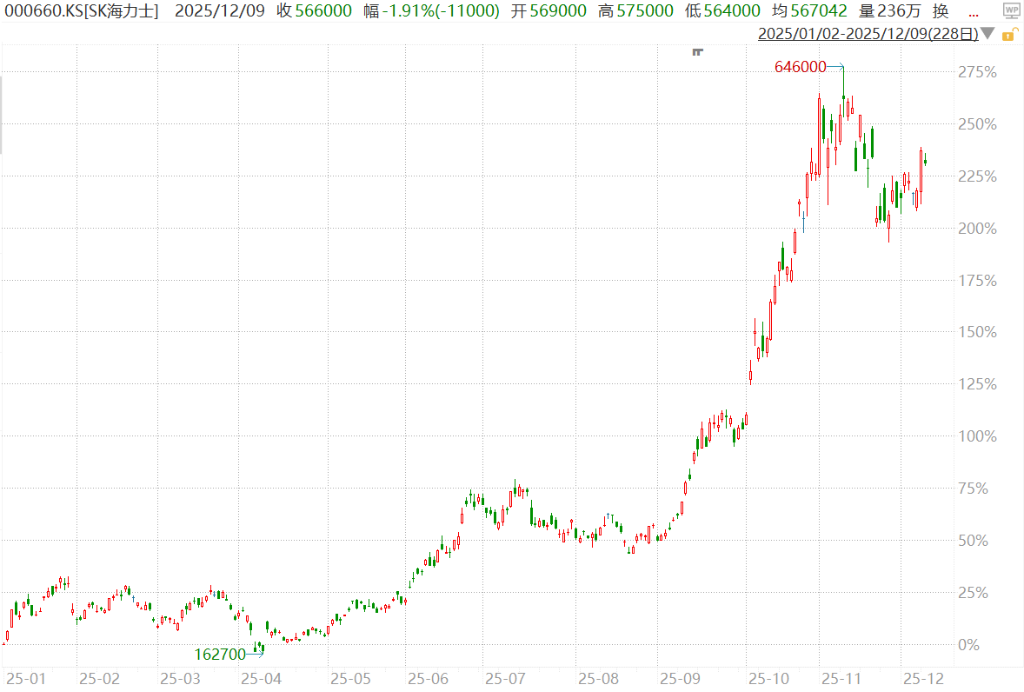
Group 1 - SK Hynix is exploring the possibility of listing on the New York Stock Exchange to narrow the valuation gap with U.S. peers like Micron Technology [1] - The company's stock price rose by 4.8% in early trading following the announcement, and it has surged approximately 240% this year due to high demand for high-bandwidth memory chips [1] - Analysts suggest that listing as American Depositary Receipts (ADRs) could attract funds from passive funds, ETFs, and long-only funds that invest only in U.S.-listed stocks [1] Group 2 - South Korea's governance reforms aim to eliminate the "Korea discount" that has led to foreign investors avoiding the market [2] - A proposal to eliminate treasury stock, which has been used by large corporate groups to maintain control, is part of these reforms [2] - Following speculation about the company's potential U.S. listing, SK Hynix's stock surged by 6.1%, marking its largest increase since mid-November [2]
“内存巨头”海力士考虑美国上市,消除“韩国折价”
Hua Er Jie Jian Wen· 2025-12-10 01:01
Group 1 - SK Hynix is evaluating the possibility of listing in the U.S. to narrow the valuation gap with American peers like Micron Technology [1][3] - The company is considering listing approximately 2.4% of its outstanding shares, equivalent to about 17.4 million shares, through American Depositary Receipts (ADRs) [1] - The demand for high-bandwidth memory chips, driven by the AI boom, has led to a significant increase in SK Hynix's stock price, which has surged approximately 225% this year [1][2] Group 2 - Despite the impressive stock performance, SK Hynix's valuation still lags behind that of its U.S. counterparts [3] - Listing in the U.S. could provide access to a broader pool of global investors and is seen as a strategic attempt to address the "Korea discount" phenomenon [3]
SK海力士考虑纽约上市可能 料有助缩小与美国芯片同行的估值差距
Xin Lang Cai Jing· 2025-12-10 00:45
Core Viewpoint - SK Hynix is considering a potential listing in New York to help narrow the valuation gap with U.S. peers like Micron Technology [1] Group 1: Company Actions - SK Hynix is evaluating various measures to enhance corporate value, including the possibility of utilizing treasury stock for a U.S. stock market listing, although no final decision has been made [1] - The company's stock rose by 4.8% during early trading in Seoul on the day of the announcement [1] Group 2: Market Performance - The stock has surged approximately 240% this year, driven by strong demand for high-bandwidth memory chips [1] Group 3: Analyst Insights - According to Douglas Kim from Smartkarma, listing as American Depositary Receipts (ADRs) could help reduce the valuation gap with other listed peers [1] - ADR listing may attract funds from passive funds, ETFs, and long-only funds that invest solely in U.S.-listed stocks [1]