
高德

Search documents
千问胆子太大了,打车都要插一脚了
半佛仙人· 2026-03-25 18:19
Core Viewpoint - The article emphasizes that Qianwen's AI ride-hailing service is not just a technological advancement but a significant evolution in how AI can integrate into daily life, addressing real-world problems effectively [3][7]. Group 1: AI Ride-Hailing Functionality - Qianwen has launched an AI ride-hailing feature that allows users to book rides with simple voice commands, showcasing its ability to understand complex user needs [3][7]. - The AI can interpret fragmented and abstract requests, such as multi-stop rides or specific driver preferences, thus enhancing user experience [11][13]. - This service aims to eliminate the standardization issues prevalent in traditional ride-hailing apps, which often fail to meet personalized user demands [6][17]. Group 2: User Experience and Market Position - The article discusses the pain points of existing ride-hailing services, highlighting issues like poor driver quality and the cumbersome app interface that complicates the user experience [5][6]. - Qianwen's approach is positioned as a solution to these problems, focusing on understanding and fulfilling individual user needs rather than just providing a basic transportation service [19][24]. - The ride-hailing market is described as highly competitive with low margins, but Qianwen's strategy is to position itself as a gateway to broader consumer experiences, linking transportation to dining and entertainment [24][28]. Group 3: Ecosystem Integration - Qianwen benefits from being part of Alibaba's ecosystem, which allows seamless integration with other services like navigation and payment, enhancing overall user convenience [22][28]. - The interconnectedness of services within the Alibaba ecosystem enables Qianwen to offer a comprehensive solution that goes beyond just ride-hailing, facilitating a complete consumer journey [22][28]. - The article argues that this strategic positioning within a larger ecosystem is crucial for capturing consumer loyalty and driving future growth [28][30].



阿里巴巴-W:3QFY26财报点评:电商表现疲软,云收入继续加速-20260323
Guoxin Securities· 2026-03-23 00:45
Investment Rating - The investment rating for Alibaba-SW (09988.HK) is "Outperform the Market" [6][24]. Core Insights - Alibaba's overall performance shows weak e-commerce results while cloud revenue continues to accelerate. For FY26Q3, Alibaba reported revenue of 284.8 billion yuan, a year-on-year increase of 2%. The revenue growth rates for different segments were 6% for the China e-commerce group, 4% for the international digital commerce group, 36% for the cloud intelligence group, and -20% for all others [1][9]. - The adjusted EBITA for FY26Q3 was 23.4 billion yuan, down 57% year-on-year, with an adjusted EBITA margin of 8.2%. The non-GAAP net profit was 16.7 billion yuan, a decrease of 67% year-on-year, resulting in a net profit margin of 5.9%. Free cash flow for the quarter was 11.3 billion yuan, down 71% year-on-year, primarily due to investments in instant retail [1][9]. Summary by Sections E-commerce Performance - The China e-commerce group's revenue for FY26Q3 increased by 1% year-on-year, with a significant decline in quarter-on-quarter growth due to base effects from improved monetization rates and weak market performance. Instant retail revenue reached 20.8 billion yuan, up 56% year-on-year. The company added approximately 150 million annual active buyers on the platform, with about 100 million in physical e-commerce [2][14]. - The adjusted EBITA for the China e-commerce group was 34.6 billion yuan, down 43% year-on-year, with an adjusted EBITA margin of 22%, a decline of 19 percentage points year-on-year. The estimated loss from the instant retail business for the quarter was around 20.8 billion yuan [2][14]. Cloud Computing - The cloud intelligence group's revenue for FY26Q3 was 43.3 billion yuan, a year-on-year increase of 36%. The overall revenue, excluding intercompany transactions, grew by 35% year-on-year. AI-related product revenue continued to grow at triple-digit rates. Alibaba Cloud's market share has increased for three consecutive quarters, reaching 36% [3][16]. - The company expects external revenue from cloud and AI, including MaaS, to exceed 100 billion USD over the next five years, with a compound annual growth rate of over 40% [3][16]. Financial Projections - Revenue forecasts for FY2026 to FY2028 have been slightly adjusted to 1,033.8 billion yuan, 1,165.4 billion yuan, and 1,318.8 billion yuan, reflecting a positive outlook on cloud revenue growth. Adjusted net profit forecasts have been revised to 79.7 billion yuan, 105.7 billion yuan, and 134.3 billion yuan, primarily due to higher-than-expected R&D and marketing investments related to Qianwen and e-commerce [4][25].
阿里巴巴-W(09988):3QFY26财报点评:电商表现疲软,云收入继续加速
Guoxin Securities· 2026-03-22 13:25
Investment Rating - The investment rating for Alibaba is "Outperform the Market" [6][24]. Core Insights - Alibaba's overall performance shows weak e-commerce results while cloud revenue continues to accelerate. In FY26Q3, Alibaba reported revenue of 284.8 billion yuan, a year-on-year increase of 2%. The revenue growth rates for different segments were 6% for the China e-commerce group, 4% for the international digital commerce group, 36% for the cloud intelligence group, and -20% for all others [1][9]. - The adjusted EBITA for the quarter was 23.4 billion yuan, down 57% year-on-year, with an adjusted EBITA margin of 8.2%. The non-GAAP net profit was 16.7 billion yuan, a decrease of 67% year-on-year, resulting in a net profit margin of 5.9%. Free cash flow for the quarter was 11.3 billion yuan, down 71% year-on-year, primarily due to investments in instant retail [1][9]. Summary by Relevant Sections E-commerce Performance - The China e-commerce group's revenue in FY26Q3 increased by 1% year-on-year, with a significant decline in quarter-on-quarter growth due to base effects from improved monetization rates and weak market performance. Instant retail revenue reached 20.8 billion yuan, up 56% year-on-year, contributing to an increase of approximately 150 million active buyers on the platform in 2025 [2][14]. - The adjusted EBITA for the China e-commerce group was 34.6 billion yuan, down 43% year-on-year, with an adjusted EBITA margin of 22%, a decline of 19 percentage points year-on-year, mainly due to investments in instant retail [2][14]. Cloud Computing - The cloud intelligence group's revenue in FY26Q3 was 43.3 billion yuan, a year-on-year increase of 36%. The overall revenue, excluding intercompany transactions, grew by 35% year-on-year, with AI-related product revenue maintaining triple-digit growth. Alibaba Cloud's market share has increased to 36% [3][16]. - The company expects external revenue from cloud and AI to exceed 100 billion USD over the next five years, with a compound annual growth rate of over 40% [3][16]. Financial Projections - Revenue forecasts for FY2026 to FY2028 have been slightly adjusted to 1,033.8 billion yuan, 1,165.4 billion yuan, and 1,318.8 billion yuan, reflecting a positive outlook on cloud revenue growth. Adjusted net profit forecasts have been revised to 79.7 billion yuan, 105.7 billion yuan, and 134.3 billion yuan, primarily due to higher-than-expected R&D and marketing investments [4][25].
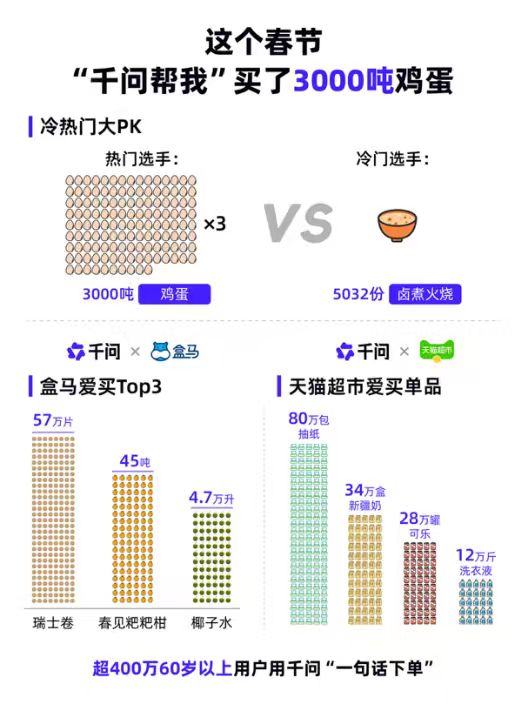
千问发布数据:1.3亿人春节首次体验AI购物
Huan Qiu Wang· 2026-02-24 07:52
Core Insights - During the Spring Festival, over 130 million people experienced AI shopping for the first time, making 5 billion requests using "Qianwen help me" [1][6] - The number of AI ticket orders surged, with a 22-fold increase for event tickets and over 7-fold for flight tickets. Movie ticket orders increased by 372 times, particularly in lower-tier cities where orders rose by 782 times [1][6] - Nearly half of all AI orders originated from county-level cities, and around 4 million users aged 60 and above engaged in AI shopping [1][6] - Qianwen integrates with Alibaba's ecosystem, including Taobao, Alipay, and others, with plans to introduce additional features like AI taxi booking and mobile recharge [1][6] - As of February 7, Qianwen's daily active users reached 73.52 million, nearing Doubao's 78.71 million, achieving this in just three months [1][6] Model Development - On New Year's Eve, Alibaba released the new generation model Qwen 3.5-Plus, which is comparable to Gemini 3 Pro, marking it as the strongest open-source model globally [2][7] - This dual breakthrough in AI capabilities and application usage signifies a significant advancement for Alibaba's AI initiatives during the Spring Festival [2][7]
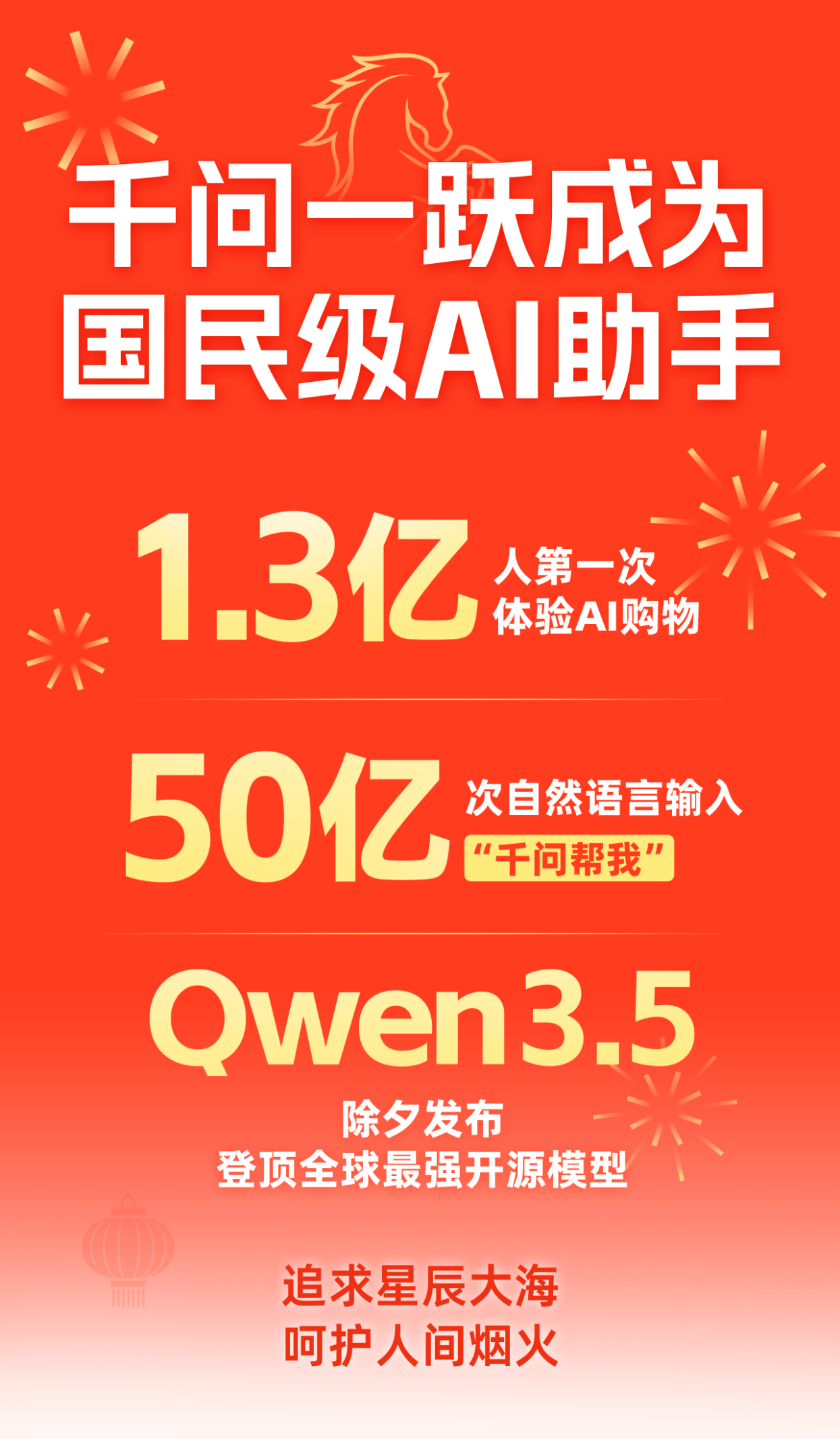
春节期间“一句话下单”近2亿次 超400万60岁+用户体验AI下单
Sou Hu Cai Jing· 2026-02-24 07:31
Core Insights - During the Spring Festival, the "Qianwen Help Me" feature saw nearly 200 million orders, indicating that 1 in 10 people in the country used this service for various purchases, establishing it as a new tradition for the Year of the Horse [1][3] - The feature significantly simplified the ordering process, allowing users to complete transactions in just 2-3 dialogues, which is over 50% fewer steps compared to traditional methods, thus enhancing convenience for all users, including the elderly and those in remote areas [3] Group 1 - Users ordered over 3,000 tons of eggs, equivalent to the annual consumption of a medium-sized county, along with 55 million cups of milk tea and 35.16 million cups of fruit tea during the festival [1] - The integration of various Alibaba ecosystem products, such as Fliggy and Gaode, led to a 66-fold increase in movie ticket sales and a 540% week-on-week growth in flight ticket orders [3] - The daily active user count reached 73.52 million by February 7, nearing the 78.71 million of a competing service, demonstrating rapid user growth [6] Group 2 - Users also engaged with the "Qianwen Help Me" feature for creative tasks, such as writing New Year greetings and social media posts, with 270,000 users requesting help with greetings and 230,000 for dinner posts [4] - The service aims to integrate AI into daily life, as stated by the president of the C-end business group, emphasizing its future potential in enhancing user experience [3]
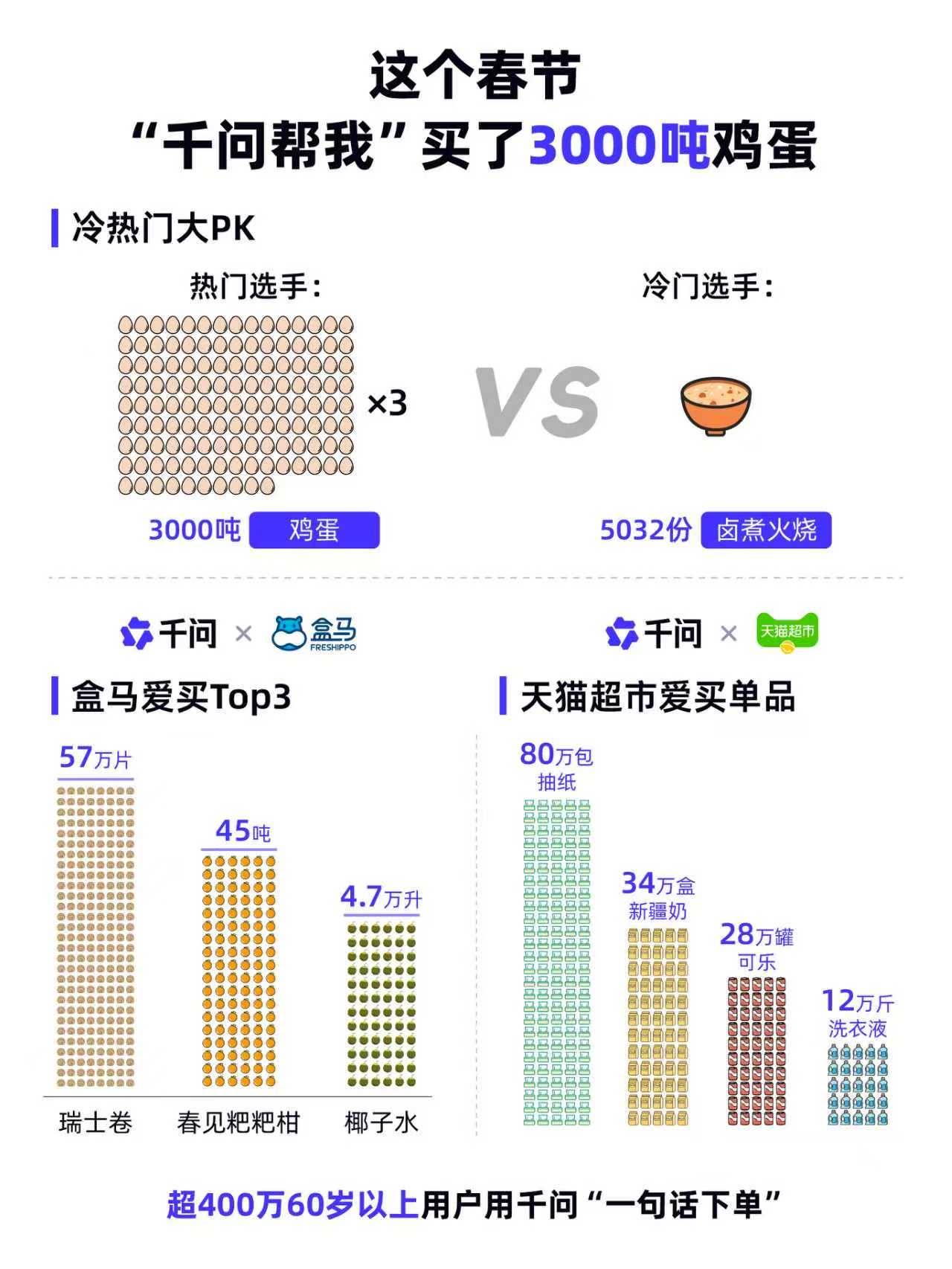
千问帮我”成马年春节新年俗:帮网友下单3000吨鸡蛋 有人许愿“帮我回假期第一天
Zheng Quan Ri Bao Wang· 2026-02-23 23:04
Core Insights - During the Spring Festival, the company reported nearly 200 million "one-sentence orders" on its platform, indicating that 1 in 10 people in the country used the service for various purchases, establishing it as a new tradition for the holiday [1] - The platform facilitated the purchase of over 3,000 tons of eggs, 55 million cups of milk tea, and 35 million cups of fruit tea, showcasing significant consumer engagement [1] - The integration of services from Alibaba's ecosystem, including Fliggy, Amap, and Damai, allowed the platform to cover a wide range of consumer needs, leading to a 66-fold increase in movie ticket sales and a 540% week-on-week growth in flight bookings [1][2] User Engagement - The platform's "one-sentence order" feature simplifies the ordering process, requiring only 2-3 dialogue rounds, which saves over 50% of the steps compared to traditional methods, making it accessible even for elderly users [1] - Over 400,000 users aged 60 and above utilized the service during the Spring Festival, highlighting its appeal to older demographics [1] - The platform also saw users engaging in creative activities, such as generating New Year greetings and social media posts, with 27,000 users requesting help for festive messages [2] User Growth - The platform achieved a daily active user count of 73.52 million by February 7, nearing the 78.71 million mark of a competing service, demonstrating rapid user growth and engagement [2]
千问App春节数据:帮网友下单3000吨鸡蛋,超400万60岁+用户体验AI下单
Xin Lang Cai Jing· 2026-02-23 08:22
Core Insights - During the Spring Festival, users placed nearly 200 million orders on Qianwen, indicating that one in ten people in the country used the platform for various purchases, establishing a new custom for the Year of the Horse [1][3][4] Group 1: Consumer Behavior - The primary consumption scenarios for "one-sentence ordering" included purchasing New Year goods and drinking milk tea [1][4] - Users ordered over 3,000 tons of eggs, equivalent to the annual egg consumption of a medium-sized county [4] - Total orders included 55 million cups of milk tea, 35.16 million cups of fruit tea, and 11.38 million cups of coffee [4] Group 2: Growth Metrics - Movie ticket sales through Qianwen saw a 66-fold increase, with nearly 80% of users choosing "Fast and Furious 3" and "Silent Awakening" [4] - Orders for transportation tickets, such as flights, increased by 540% week-over-week [4] - Scenic spot ticket orders grew 24 times week-over-week [4] Group 3: Ecosystem Integration - Qianwen integrated with Alibaba's ecosystem products like Fliggy, Amap, and Damai, allowing it to cover a wide range of consumer needs in dining, entertainment, and travel [4]
千万发布数据:1.3亿人春节首次体验AI购物
Huan Qiu Wang· 2026-02-17 05:00
Group 1 - During the Spring Festival, over 130 million people experienced AI shopping for the first time, making 5 billion requests using "Qianwen help me" [1] - Orders for AI ticket purchases increased by 22 times, while AI bookings for flights and other transportation tickets grew over 7 times; movie ticket orders surged by 372 times, particularly from third and fourth-tier cities, which saw an increase of 782 times [1] - Nearly half of all AI orders originated from county-level cities, with around 4 million users aged 60 and above engaging in AI shopping [1] Group 2 - Alibaba launched the new generation open-source model Qwen 3.5-Plus on New Year's Eve, which is comparable in performance to Gemini 3 Pro, making it the strongest open-source model globally [2][4] - The AI application saw significant growth during the Spring Festival, indicating a dual explosion in both open-source model capabilities and app usage [2]
1.3亿人春节首次体验AI购物,千问一跃成为国民级AI助手
Xin Lang Cai Jing· 2026-02-17 00:46
Core Insights - During the Spring Festival period, over 130 million people experienced AI shopping for the first time, with "Qianwen help me" being invoked 5 billion times, establishing Qianwen as a national-level AI assistant [1] User Engagement and Growth - In the past two days, AI ticket purchasing orders increased by 22 times, while AI orders for flight tickets and other transportation tickets surged over 7 times [4] - The demand for AI movie ticket purchases saw a staggering 372-fold increase, with orders from third and fourth-tier cities skyrocketing by 782 times [4] - Nearly half of all AI orders originated from county-level cities, highlighting the accessibility of AI shopping [4] - Approximately 4 million users aged 60 and above engaged with AI shopping, indicating a broad demographic reach [4] Ecosystem Integration - Qianwen can leverage the entire Alibaba ecosystem to serve users, integrating platforms such as Taobao, Alipay, Taobao Flash Sale, Fliggy, Gaode, and Damai, with plans to introduce features like AI ride-hailing and mobile recharge [4] User Activity Metrics - On February 7, Qianwen's daily active users (DAU) reached 73.52 million, nearing Doubao's 78.71 million, achieving in three months what Doubao took three years to accomplish [4] - This shift signifies a change in user habits towards AI, moving from chat-based interactions to task execution through agents [4] Technological Advancements - On New Year's Eve, Alibaba released the new generation model Qianwen Qwen 3.5-Plus, which performs comparably to Gemini 3 Pro [4]
又来了!有人抽中88.8元、66.6元,还有机会中8888元……这两天为了这几个红包,手机都快戳破了
Xin Lang Cai Jing· 2026-02-14 10:20
Core Insights - The competition among AI products during the Spring Festival has intensified, with various companies launching promotional activities to attract users [2][3][4] - Major companies like Alibaba, Tencent, Baidu, and ByteDance have invested over 4.5 billion yuan in marketing during the Spring Festival, leveraging their core ecosystem advantages to offer new year benefits to users [3][4] - The rapid advancement of China's AI industry over the past year has led to significant breakthroughs in various applications, with projections indicating that the number of AI companies will exceed 6,000 by 2025, and the core industry scale is expected to surpass 1.2 trillion yuan [4] Company Activities - The "Doubao New Year" event launched on February 13, featuring a range of AI-generated New Year greetings and interactive features, with users able to win red envelopes ranging from 0.1 yuan to 8,888 yuan [2] - Doubao's second phase of the event will take place during the Spring Festival Gala on February 16, offering over 100,000 tech gifts and cash red envelopes [2] - The "Qianwen Spring Festival Treat" event will also launch its second round on February 14, with a focus on user engagement through promotional activities [2] Industry Trends - The focus of competition has shifted from the strength of AI models to user adoption and habit formation, with companies aiming to integrate AI into everyday consumer experiences [4][5] - Alibaba is integrating its AI product Qianwen into key platforms like Taobao and Alipay to encourage users to complete transactions with simple voice commands [4] - Tencent is leveraging its social media platforms to enhance the integration of AI into social interactions, while Baidu is embedding AI features directly into its app for quicker user access [4] Future Considerations - The long-term value of these promotional activities will depend on the continuous optimization of product experiences, effective user privacy and data security measures, and the ability to address actual user needs [6]