
高考志愿填报服务

Search documents
8亿估值,张雪峰「清仓」
36氪· 2026-03-25 13:56
Core Viewpoint - The article discusses the life and impact of Zhang Xuefeng, an influential figure in the education sector, particularly in guiding students on college admissions and career choices, highlighting his pragmatic approach to education and the challenges he faced in his career [4][6][38]. Group 1: Background and Early Life - Zhang Xuefeng was born in 1984 in Heilongjiang Province, coming from a humble background, which shaped his understanding of the struggles faced by students from similar circumstances [10][12]. - He achieved a high school ranking that allowed him to attend Zhengzhou University, where he initially studied a major he did not resonate with, reflecting a disconnect between education and personal aspirations [10][11]. Group 2: Career Development - After graduating in 2007, Zhang moved to Beijing and entered the graduate school tutoring industry, where he faced financial struggles and worked hard to gather information on various universities and programs [12][13]. - In 2016, he co-founded a company focused on guiding students in choosing graduate programs, which marked a significant shift in his career [19]. Group 3: Rise to Fame - A pivotal moment in Zhang's career occurred in June 2016 when a video he created went viral, significantly increasing his visibility and leading to a rapid growth in his social media following [20][21]. - His candid and often controversial opinions on education and career choices resonated with many, leading to both admiration and criticism from various sectors [22][24]. Group 4: Business Expansion - Zhang established "Fengxue Weilai" in Suzhou, which expanded its services beyond graduate school guidance to include high school college admissions, reflecting a strategic pivot in his business model [16][34]. - The market for college admissions consulting grew significantly, with the paid scale increasing from 130 million yuan in 2016 to 950 million yuan in 2023, indicating a sevenfold increase over seven years [34]. Group 5: Personal Challenges and Health - Zhang faced significant health challenges due to the stress of his work, including hospitalization for heart issues, which highlighted the pressures associated with his high-demand role [31][33]. - Despite these challenges, he continued to work tirelessly, often sacrificing personal well-being for the sake of his business and clients [30][31]. Group 6: Legacy and Impact - Zhang's approach to education and career guidance has left a lasting impact on many students and families, as he aimed to provide practical advice based on real-world experiences rather than idealistic notions [38][39]. - His life story serves as a testament to the struggles and triumphs of individuals from modest backgrounds seeking to navigate the complexities of education and career paths [39][40].

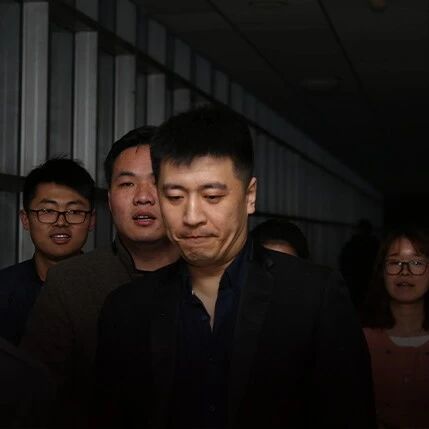
“大家都彻夜未眠”,张雪峰离世,团队老师心痛,他曾留下温暖墓志铭:人生真好玩,下辈子还来
新浪财经· 2026-03-25 09:46
Core Viewpoint - The article discusses the life and impact of Zhang Xuefeng, a prominent figure in the education industry, who passed away unexpectedly at the age of 41, highlighting his journey from humble beginnings to becoming a well-known educator and entrepreneur [2][3]. Group 1: Background and Early Life - Zhang Xuefeng was born in 1984 in a small county in Heilongjiang Province, which only achieved poverty alleviation in 2018. His family faced financial difficulties, with a monthly income of only 600 yuan during his high school years [5]. - He excelled academically, ranking 16th in his county during the middle school entrance exam and later being admitted to Zhengzhou University, although he was initially unaware of his major in water supply and drainage engineering [5]. Group 2: Career Development - After graduating, Zhang entered the education sector, initially working at a friend's test preparation institution. Following the closure of that company, he became an entrepreneur, facing significant challenges before achieving success [6][7]. - In 2021, he founded Fengxue Weilai Education Technology Co., focusing on talent development and college admission planning, generating annual revenues in the tens of billions, particularly through services related to college application guidance [7]. Group 3: Public Influence and Controversies - Zhang gained significant popularity on social media, amassing nearly 8 million followers on Weibo, and his statements could influence college admissions trends. His monthly income from live streaming exceeded 3 million yuan, with brand advertisement rates reaching 100,000 yuan per post [8]. - He faced multiple controversies due to his outspoken views on education, including a notable incident where his comments led to a sharp decline in applicants for journalism programs at certain universities [12][14]. Group 4: Philanthropy and Personal Values - Zhang contributed to society by donating 1 million yuan to support impoverished freshmen at several universities and encouraged his employees to engage in charitable activities [8]. - He expressed a commitment to supporting his employees during personal hardships, including offering financial assistance for housing [9]. Group 5: Final Reflections and Legacy - In his last public appearances, Zhang shared thoughts on life and the importance of enjoying experiences, indicating a desire to leave a lasting impact on future generations [15]. - He humorously reflected on his legacy, suggesting that he hoped to be remembered as someone who provided valuable insights to many [15][16].

张雪峰离世:从寒门到5000万粉丝商业帝国
商业洞察· 2026-03-25 09:28
Core Viewpoint - The article discusses the life and impact of Zhang Xuefeng, a prominent figure in the education industry, highlighting his dual identity as a "cold door mentor" and an "education businessman" who capitalized on the anxieties of parents and students during a time of educational uncertainty [5][6][28]. Group 1: Cold Door Mentor - Zhang Xuefeng was known for his straightforward and pragmatic approach to education, often challenging idealistic views held by parents and students [7][10]. - He emphasized the importance of practical choices in education, advising students from less privileged backgrounds to pursue stable career paths [9][12]. - His rise to fame began with a viral video that provided insights into top universities, coinciding with a period of increasing competition in the education sector [14][16]. Group 2: Education Businessman - Zhang built a significant business empire, with over 50 million followers and multiple companies in the education and cultural tourism sectors, achieving remarkable sales figures [18][21]. - His high-priced services, such as the 11,999 yuan "Dream Card," sold out rapidly, generating 2 billion yuan in just three hours during the 2024 college entrance examination season [18][20]. - Zhang's ability to identify market opportunities, particularly in response to educational policy changes, allowed him to transition from a mentor to a successful entrepreneur [22][24]. Group 3: Symbol of the Era - Zhang Xuefeng became a symbol of the anxieties faced by students and parents in a rapidly changing educational landscape, providing a sense of reassurance amid uncertainty [28][29]. - His story reflects broader societal issues, such as the diminishing returns of higher education and the quest for stability in an unpredictable job market [28][29]. - The legacy of Zhang's approach continues to influence many, as evidenced by testimonials from parents who found success through his guidance [29].

张雪峰离世:从寒门到5000万粉丝商业帝国
创业邦· 2026-03-25 03:50
Core Viewpoint - The article discusses the life and impact of Zhang Xuefeng, a prominent figure in the education industry, highlighting his dual identity as a mentor and an education entrepreneur, and how he became a symbol of the anxieties faced by students and parents in contemporary China [4][8][34]. Group 1: Zhang Xuefeng's Background and Philosophy - Zhang Xuefeng was known for his straightforward and pragmatic approach to education, often challenging idealistic views held by students and parents [9][11]. - He emphasized the importance of making informed choices in education, advocating for practical career paths over traditional aspirations [11][12]. - His personal journey from a humble background to a successful educator reflects the broader societal challenges faced by many families in China [12][16]. Group 2: Business Model and Success - Zhang Xuefeng's business model capitalized on the complexities of the new college admission system, creating standardized products from the non-standardized process of college application [27][28]. - His services, such as the high-priced college application guidance, generated significant revenue, with reports indicating sales of 2 billion yuan in just three hours during a promotional event [21][25]. - The rapid expansion of his business, which includes multiple companies and a large online following, showcases his ability to leverage personal branding and market trends effectively [20][26]. Group 3: Societal Impact and Legacy - Zhang Xuefeng's approach resonated with a generation of anxious students and parents, providing them with a sense of direction in an uncertain educational landscape [34][36]. - His passing has sparked discussions about the pressures of modern education and the role of figures like him in shaping public perceptions of success and opportunity [34][36]. - The article suggests that even in his absence, the need for guidance in navigating educational choices remains, indicating a lasting impact on the industry [36][37].

张雪峰「变形记」
3 6 Ke· 2025-10-27 02:54
Core Viewpoint - Zhang Xuefeng, a controversial figure in the education sector, has transitioned from a "brutal" commentator on academic fields to a more cautious persona after a 28-day suspension, reflecting the changing dynamics of the education industry and public sentiment towards higher education [3][20][30] Group 1: Rise to Fame - Zhang Xuefeng's journey as a "internet celebrity mentor" began in 2016 with a viral video that quickly garnered attention for its fast-paced and humorous delivery [4][5] - His straightforward and pragmatic views on education, such as "liberal arts are all service industries," resonated with many ordinary families seeking clarity in a complex educational landscape [9][10] - By 2025, his controversial statements had sparked significant backlash from academic institutions, particularly regarding his views on journalism and liberal arts [11][13][14] Group 2: Business Expansion - In 2021, Zhang founded Suzhou Fengxue Weilai Education Technology Co., Ltd., where he holds a controlling stake, marking his shift from an educator to a capital operator across over a hundred enterprises [15][18] - His business model capitalizes on public anxiety regarding education and employment, offering high-priced services for college application guidance, with prices ranging from 12,999 to 18,999 yuan [17][18] - The market for paid college application services is substantial, with a reported size nearing 1 billion yuan and over 800,000 paying users by 2025 [18] Group 3: Regulatory Challenges - In 2025, Zhang faced significant regulatory pushback, resulting in a suspension from multiple platforms due to violations of community guidelines and educational policy sensitivities [20][22] - The tightening of regulations around for-profit educational services has forced Zhang to adapt his approach, shifting from aggressive marketing to a more subdued and compliant demeanor [26][27] Group 4: Transformation Post-Suspension - After his suspension, Zhang re-emerged with a more cautious approach, emphasizing the value of all academic disciplines and avoiding derogatory remarks about specific fields [24][26] - His transformation reflects a broader trend in the education sector, where public expectations are shifting from idealism to practicality in higher education [28][30] - Despite the change in tone, the underlying commercial strategy remains focused on leveraging public anxiety and demand for educational services [27][30]
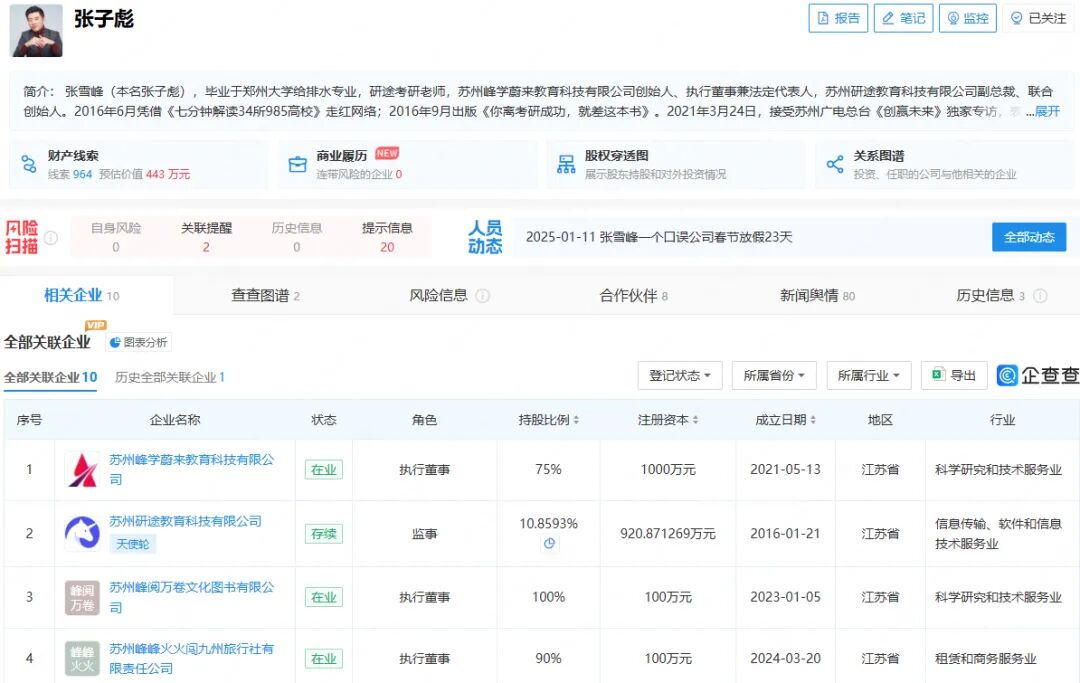
张雪峰:“网红导师”的争议、生意与时代
3 6 Ke· 2025-09-25 10:31
Core Viewpoint - The news highlights the recent ban on education influencer Zhang Xuefeng's personal accounts across multiple platforms, signaling a significant shift in his online presence and potential impact on his business model [1] Group 1: Background and Rise to Fame - Zhang Xuefeng, originally a graduate student instructor, gained popularity through his unique teaching style that combined humor with educational content, particularly in the context of college entrance exams [2][3] - His breakthrough moment came in 2016 with a viral video that made the interpretation of college options engaging and accessible to the general public [3] Group 2: Business Model and Commercialization - In 2021, Zhang established his own company, Suzhou Fengxue Weilai Education Technology Co., Ltd., marking the beginning of his independent commercial operations [6][7] - The company's core business revolves around providing high-priced college application consulting services, with packages like the "Dream Card" priced at 12,999 yuan and the "Dream Fulfillment Card" at 18,999 yuan, reflecting a strong market demand [8] - Zhang's controversial statements serve as effective customer acquisition tools, targeting anxious parents and students willing to invest in educational guidance [8] Group 3: Societal Context and Educational Trends - Zhang's popularity reflects a broader societal shift towards practical and outcome-oriented education, as families increasingly view higher education as a significant investment requiring careful planning [9][11] - The changing landscape of employment and the influx of over ten million university graduates annually have intensified competition in the job market, leading to a reevaluation of educational priorities [9][11] - The trend towards employment-focused education raises questions about the balance between practical skills and the need for talent in foundational and humanities disciplines [11]
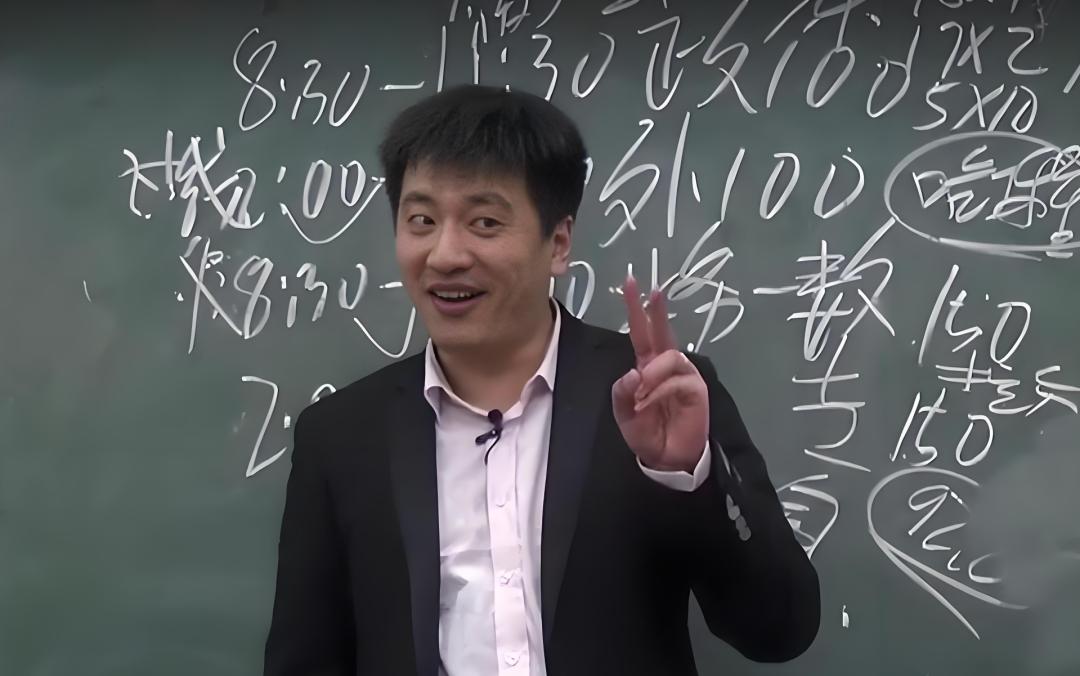
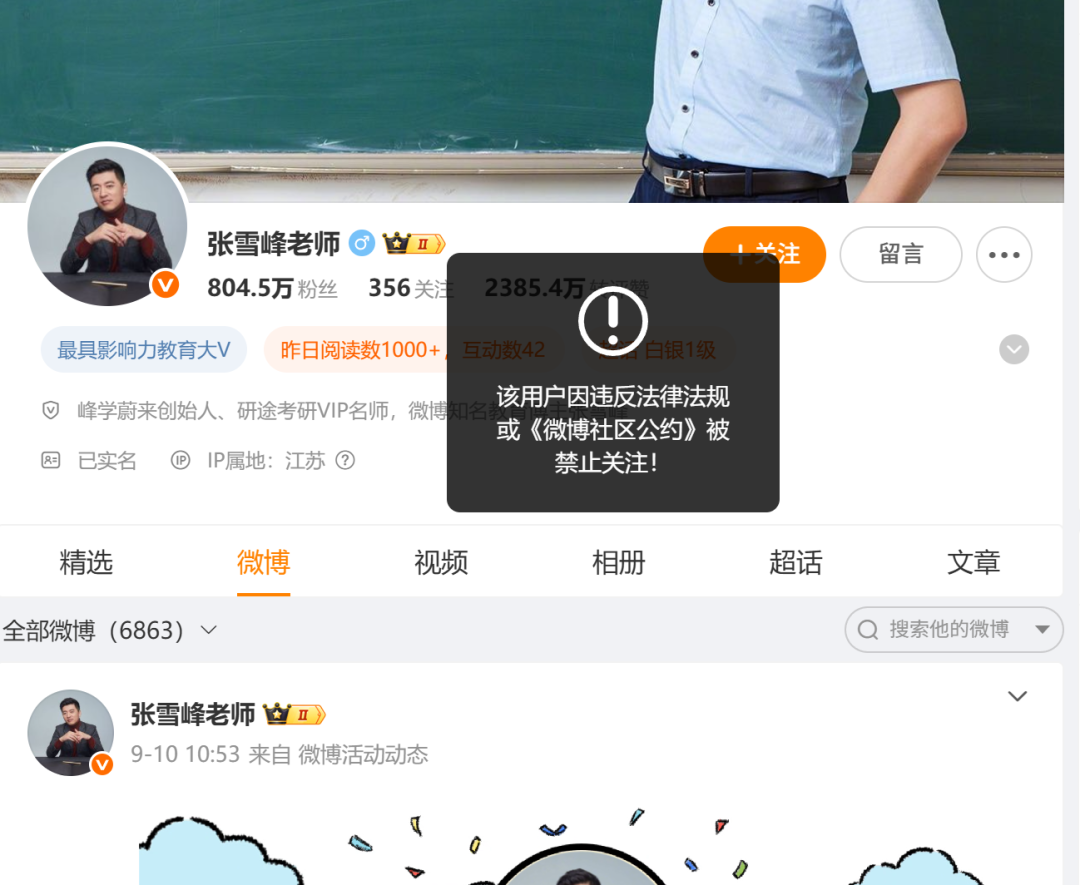
很突然,张雪峰账号被禁止关注,4个平台粉丝数已超4000万!本人最新回应→
Mei Ri Jing Ji Xin Wen· 2025-09-24 11:00
Core Points - Zhang Xuefeng's accounts on major social media platforms have been banned from being followed, affecting his significant online presence with over 40 million followers across platforms [1][9][15] - Despite the ban on his main account, other accounts related to his educational content remain active and continue to engage with audiences through live streaming [9][11] - Zhang Xuefeng has faced increasing controversy due to his statements and pricing strategies in the education sector, raising questions about the ethics of his business model [17][19] Group 1: Account Status - Zhang Xuefeng's main accounts on Weibo, Xiaohongshu, Douyin, and Bilibili have been banned from being followed as of September 24 [1] - Other related accounts, such as "Zhang Xuefeng Talks College Planning," are still operational and conducting live streams [9][11] Group 2: Background and Influence - Zhang Xuefeng transitioned from a regular training teacher to a prominent online educator after his video on 985 universities gained massive popularity in 2016 [15] - His influence has led to participation in various media formats, including reality shows and national lectures [15] Group 3: Controversies and Business Model - Zhang Xuefeng's comments on the education system, particularly regarding the value of liberal arts, have sparked significant backlash and debate about their impact on students [18] - His company, Fengxue Weilai Education Technology, reportedly generates annual revenues in the tens of billions, with high-priced services for college application guidance [18] - The pricing of his services, ranging from 8,999 to 17,999 yuan, has been criticized as exploiting parental anxiety and raising ethical concerns in the education sector [19]
撕碎迷茫、脱颖而出、赢在起跑线?——“焦虑生意”盯上准大学生的钱包
Xin Hua Wang· 2025-08-12 05:45
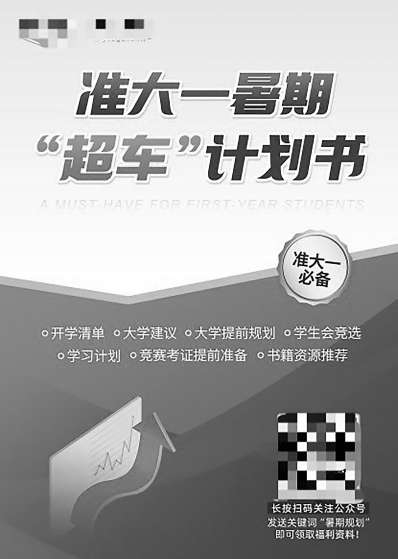
Core Viewpoint - The article discusses the rising trend of preparatory programs and services aimed at incoming college students, highlighting the anxiety and pressure faced by students and parents in navigating the transition from high school to university [1][4][7]. Group 1: Services Offered - Various summer camps and "university running" services are being marketed to help students enhance their skills and prepare for university life, with a focus on self-improvement and competitive advantage [1][5]. - A specific summer camp offers courses on emotional intelligence, career planning, and practical experiences, aiming to equip students with essential skills for university [5][6]. - Institutions are also providing ongoing support through online groups, offering resources such as internship opportunities and exam preparation materials, with fees exceeding ten thousand yuan [6][8]. Group 2: Parental Perspectives - Parents express mixed feelings about investing in these preparatory services, balancing the desire for their children to succeed with concerns about the necessity and effectiveness of such programs [7][8]. - Some parents question whether spending money on external services is necessary when many universities offer similar resources for free [9][10]. Group 3: Institutional Offerings - Many universities provide free career planning and guidance services, including specialized courses and one-on-one counseling, which are often overlooked by parents seeking external help [9][10]. - Institutions emphasize the importance of focusing on academic foundations and self-exploration rather than relying solely on external services for career planning [10].
张雪峰现象:一场关于流量、教育与选择焦虑的投影
Xin Lang Cai Jing· 2025-08-04 07:11
Core Insights - Zhang Xuefeng has become a prominent figure in the high school entrance examination (Gaokao) volunteer filling service industry, with his company, Fengxue Weilai, experiencing significant demand and sales growth [1][4]. - The new Gaokao reform has increased the complexity of volunteer filling, leading to a surge in demand for professional services [3][4]. - The market for paid Gaokao volunteer filling services in China is projected to reach 1.09 billion yuan by 2025, with over 90% of candidates willing to seek professional help [4]. Group 1: Business Development - Zhang Xuefeng gained fame in 2016 with a video that provided insights into 34 top universities, which marked the beginning of his rise in the education sector [3]. - Fengxue Weilai was founded in 2021, focusing on Gaokao volunteer filling and expanding its business scope [3][4]. - The company has developed a systematic training approach for new employees, emphasizing knowledge of university programs and locations [4][11]. Group 2: Market Dynamics - The increasing number of entrants in the volunteer filling service market is creating a competitive landscape, with AI and large companies posing potential threats to traditional service providers [4][5]. - Zhang Xuefeng's brand effect has led to high sales for Fengxue Weilai's services, with prices for their products, such as the Dream Card and Dream Fulfillment Card, rising by 1,000 yuan compared to the previous year [9][10]. Group 3: Management Philosophy - The company promotes a unique management style that prioritizes employee happiness and well-being, including a flexible work schedule and no KPI requirements [10][11]. - Zhang Xuefeng emphasizes the importance of finding new growth opportunities and adapting to market changes, reflecting a shift from individual success to collective business development [10][12]. Group 4: Personal Insights and Public Perception - Zhang Xuefeng's rise to fame has led to mixed public opinions, with some viewing him as a pragmatic educator while others criticize him for promoting anxiety among students [1][8]. - Despite the pressures of being a public figure, Zhang maintains a philosophy of enjoying life and encourages young people to seek their own paths rather than conforming to a single standard of success [12][13].
“焦虑生意”盯上准大学生的钱包
Bei Jing Wan Bao· 2025-07-05 01:05
Core Viewpoint - The article discusses the rising trend of preparatory programs and services aimed at incoming college students, highlighting the anxiety and pressure faced by students and parents in navigating the transition from high school to university [1][4][5]. Group 1: Services Offered - Various organizations are offering summer camps and "university running" services, which promise to help students enhance their skills and prepare for university life [1][3]. - A summer camp includes courses on emotional intelligence, career planning, and practical experiences, aiming to equip students with tools to navigate university challenges [3][7]. - Some services are priced over ten thousand yuan, indicating a lucrative market for these preparatory programs [2][3]. Group 2: Parental Perspectives - Parents express mixed feelings about investing in these services, with some believing that proactive engagement can lead to better outcomes for their children [4][5]. - There is a concern that these services may create dependency rather than fostering independence in students [5][7]. - Parents are often drawn to success stories presented by these organizations, which can create a sense of urgency to enroll their children in such programs [4][5]. Group 3: Institutional Offerings - Many universities already provide free career planning and guidance services, which may overlap with the offerings of private organizations [6][8]. - Institutions like Beijing Wuzi University offer structured courses and one-on-one guidance to help students navigate their academic and career paths [6][7]. - The article suggests that students should prioritize utilizing their university's resources over seeking external services [6][8]. Group 4: Market Dynamics - The article highlights a growing market for "anxiety-driven" services that capitalize on the uncertainties faced by students transitioning to university [4][5]. - There is a suggestion that these services may exploit information asymmetry, as many parents lack the knowledge or time to guide their children effectively [7][8]. - The effectiveness of these services remains uncertain, with a need for parents to critically assess the value offered by such programs [8].