
7天期逆回购利率

Search documents
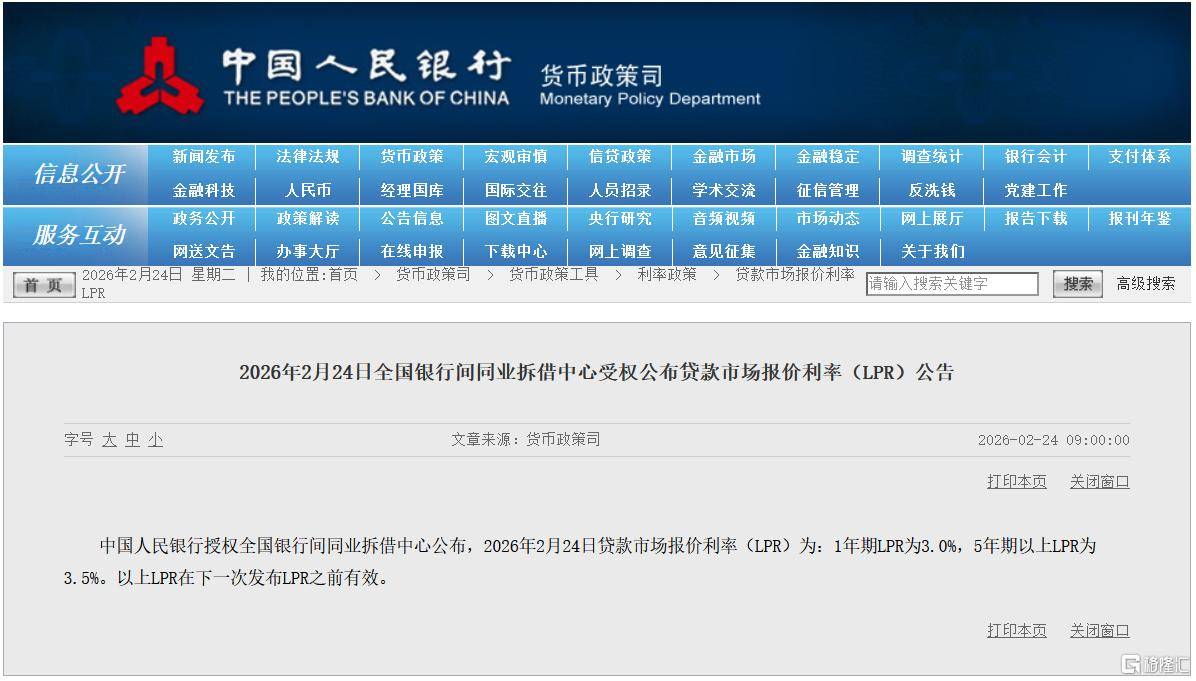
A股开门红提振市场情绪,LPR连续9个月持稳
Di Yi Cai Jing Zi Xun· 2026-02-24 04:04
Group 1 - The core viewpoint of the news is that the LPR (Loan Prime Rate) remains unchanged, aligning with market expectations, indicating stability in monetary policy [1][3][5] - The 1-year LPR is reported at 3.0% and the 5-year LPR at 3.5%, marking the ninth consecutive month of no change [1] - A-shares experienced a positive market reaction with major indices opening higher, reflecting improved market sentiment and risk appetite [1] Group 2 - The stability of the LPR is influenced by factors such as unchanged pricing basis and pressure on bank interest margins, with the 7-day reverse repurchase rate serving as a key anchor [1][3] - The weighted average interest rates for new corporate loans and personal housing loans are around 3.1%, indicating historically low levels [2] - Analysts suggest that the current lack of motivation for banks to lower LPR reflects the broader policy approach, focusing on enhancing the efficiency of existing policies rather than simply increasing stimulus [3][4] Group 3 - The monetary policy is currently in an observation phase, with expectations that both policy rates and LPR will remain stable in the short term [5] - Future possibilities for rate cuts and adjustments to LPR are anticipated, with external factors such as the U.S. Federal Reserve's rate cuts easing constraints on domestic market rates [6] - A potential decrease in LPR is seen as both expected and feasible, although the extent of any reduction is likely to be limited [6]
LPR连续9月不变,降息或在两会后?
Sou Hu Cai Jing· 2026-02-24 02:13
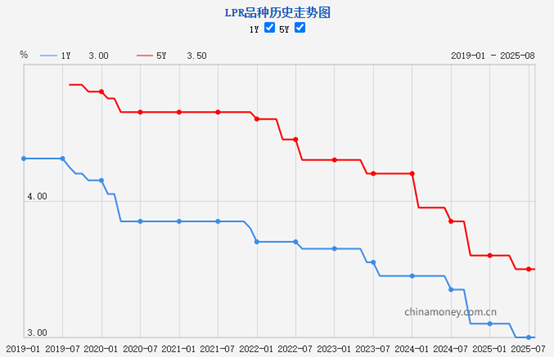
Core Viewpoint - The People's Bank of China (PBOC) has maintained the Loan Prime Rate (LPR) unchanged for the ninth consecutive month, with the 1-year LPR at 3.0% and the 5-year LPR at 3.5% as of February 24, 2026 [1][4]. Group 1: LPR Stability - The LPR remains unchanged primarily due to the stability of the 7-day reverse repurchase rate, which has not changed since May of the previous year, indicating no adjustments to the LPR this month [4][5]. - The last adjustment to the LPR occurred in May 2025, when both the 1-year and 5-year LPRs were reduced by 10 basis points [4]. Group 2: Reasons for Maintaining LPR - Three main reasons for the unchanged LPR include: 1. The stability of the PBOC's 7-day reverse repurchase rate, which serves as the pricing anchor for the LPR [5]. 2. Commercial banks' net interest margins are at historical lows, leading to cautious pricing by banks to maintain operational stability [5]. 3. A shift in policy tools, with the PBOC favoring structural interest rate cuts over broad-based measures for targeted adjustments [5]. Group 3: Future Rate Adjustments - Despite the current stability of the LPR, there is potential for future rate cuts, as indicated by PBOC officials who suggest that there is room for further reductions in reserve requirement ratios and interest rates [5][6]. - The average statutory deposit reserve ratio is currently at 6.3%, suggesting conditions for further cuts [6]. - Analysts predict that the interest rate cut cycle may continue into 2026, with expectations of two 10 basis point cuts and possibly a 20 basis point reduction [6][7].

央行对货币市场利率关注重点出现变化 隔夜利率或成“新锚” 短端资金面有望保持合理充裕
Shang Hai Zheng Quan Bao· 2026-01-25 18:55
Core Viewpoint - The People's Bank of China (PBOC) is shifting its focus on monetary market interest rates, with an emphasis on guiding overnight rates to operate near policy rate levels, indicating a clearer approach to short-term interest rate control [1][2]. Group 1: Changes in Interest Rate Focus - The PBOC has begun to prioritize the DR001 overnight rate over the previously favored DR007, reflecting an increased importance on overnight funding prices [2]. - The adjustment in focus is seen as an extension of refined control rather than a rejection of existing frameworks, with DR001 being more sensitive to marginal changes in liquidity [2][5]. - The introduction of temporary overnight reverse repos has created a clearer short-term interest rate corridor, enhancing the PBOC's ability to guide funding prices effectively [3][5]. Group 2: Implications for Short-Term Funding - The stability of the overnight rate is expected to help stabilize market expectations and reduce anxiety regarding daily funding positions, contributing to a more balanced and less volatile funding environment [6][7]. - The PBOC's approach aims to maintain a reasonable and balanced short-term funding situation, despite potential risks associated with term mismatches and leverage accumulation [7][8]. - Data indicates that the short-term funding environment remains relatively loose, with the weighted price of DR001 returning to around 1.3% and large banks' lending balances at historical highs [8].
2026年度展望:货币政策:在“利率比价”中寻锚
Soochow Securities· 2025-11-19 11:32
Monetary Policy Outlook - The monetary policy in 2026 is expected to maintain a supportive stance, with potential for 1-2 rate cuts corresponding to a 10-20bps reduction[1] - The 10-year government bond yield is projected to fluctuate within the range of 1.70%-2.0%, while the 30-year yield may range from 1.90%-2.30%[1] - The central bank may implement 1 trillion yuan in net purchases of government bonds, equating to a 50bps reduction in reserve requirement ratio (RRR) in terms of liquidity supply[2] Interest Rate Corridor Adjustment - The interest rate corridor is expected to narrow, with DR001 becoming the benchmark rate, guiding fluctuations around the 7-day reverse repurchase rate[2] - The new interest rate corridor may see adjustments, with a target range of 70bps for the upper and lower limits based on temporary reverse repo rates[2] Interest Rate Pricing and Spread Management - The focus will shift towards managing the interest rate spread while maintaining a reasonable interest rate relationship, particularly between loans and government bonds[3] - The average weighted interest rate for loans was 3.24% as of Q3 2025, with the after-tax yield on loans at 1.787%, closely matching the 10-year government bond yield of 1.76%[3] Risks and Challenges - Potential risks include unexpected inflation due to "anti-involution" policies and the possibility of monetary policy easing if economic performance falls short of expectations[3] - The banking sector may face challenges with asset duration mismatches and unstable deposit scales, necessitating timely adjustments in monetary policy to enhance liquidity supply[3]
LPR连续按兵不动,如何理解?
Jin Rong Shi Bao· 2025-09-22 12:48
Group 1 - The Loan Prime Rate (LPR) for 1-year remains at 3.0% and for 5-year and above at 3.5%, unchanged from the previous month [1] - The stability of LPR aligns with market expectations, influenced by the unchanged reverse repurchase rate since May [1][2] - The current lending rates for both corporate loans and personal housing loans are at historically low levels, contributing to the decision to maintain LPR [1] Group 2 - The 7-day reverse repurchase rate has become the new pricing anchor for LPR, facilitating the transmission of interest rates from short to long-term [2] - Commercial banks are facing pressure on net interest margins, limiting their motivation to lower LPR quotes further [2] - The balance between supporting the real economy and maintaining the health of the banking system is crucial for future monetary policy [2] Group 3 - Macroeconomic indicators such as consumption, investment, and industrial production have shown a decline due to various factors including extreme weather and real estate market adjustments [3] - The People's Bank of China is expected to continue a moderately loose monetary policy while balancing internal and external factors [3] - Future policies will focus on reducing social financing costs and enhancing the transmission of interest rates, alongside fiscal and consumption policies to stimulate demand [3]
【新华解读】经济稳健运行LPR如期持稳 改革6年持续释放效能
Xin Hua Cai Jing· 2025-08-20 13:55
Core Viewpoint - The reform of the Loan Prime Rate (LPR) has been ongoing for six years, leading to significant declines in loan rates and improved interest rate transmission mechanisms [1][6][7]. Group 1: LPR Stability and Economic Context - As of August 20, the one-year LPR remains at 3.0% and the five-year LPR at 3.5%, marking the third consecutive month of stability since a 10 basis point drop in May [3]. - The stability of the LPR is attributed to the consistent 7-day reverse repurchase rate since June, which serves as the pricing anchor for LPR [3]. - The net interest margin of commercial banks was reported at 1.42% as of the end of Q2, a slight decrease from the previous quarter, indicating ongoing pressure on banks' profitability [3]. Group 2: Impact of LPR Reform - Since the reform began, the one-year and five-year LPR have decreased by 131 basis points and 135 basis points, respectively, compared to pre-reform levels [7]. - The average weighted interest rate for RMB loans has dropped by 205 basis points since the end of 2019, with corporate loan rates at 3.22% and personal housing loan rates at 3.06% [7]. - The LPR has become the primary reference for loan pricing, enhancing the reflection of market supply and demand in loan rates [7]. Group 3: Future Directions for LPR Reform - Experts suggest that future reforms should focus on improving the quality of LPR quotes by expanding the range of quoting banks to include private and foreign banks [8][9]. - There is a recommendation to enhance the interest rate transmission mechanism to ensure that market rates effectively influence LPR and subsequently loan rates [9]. - The potential for further LPR reductions exists, with expectations of a possible 10 basis point decrease by the end of the year, contingent on both domestic and international monetary policy developments [5][9].
二季度降准降息预期升温 业界预计降准或先落地
Zheng Quan Ri Bao· 2025-04-27 16:43
Group 1 - The Central Political Bureau of the Communist Party of China emphasizes the need for timely interest rate cuts and reserve requirement ratio (RRR) reductions to support the real economy [1] - Analysts predict that the second quarter is a ripe time for these monetary policy adjustments, with expected interest rate cuts of 0.3 percentage points and RRR cuts of 0.5 percentage points, releasing approximately 1 trillion yuan in long-term funds [1] - The need for macroeconomic policy support is highlighted due to high actual interest rates and external economic pressures, with expectations for RRR cuts and interest rate reductions to boost consumer and business investment [1] Group 2 - The priority for releasing long-term liquidity tools remains with RRR cuts, which are expected to be implemented first as fiscal policies become more accommodative in the second quarter [2] - Interest rate cuts may face constraints from the yuan's exchange rate and banks' net interest margins, but the weakening of the dollar reduces immediate exchange rate pressures [2] - Overall, the monetary policy is expected to maintain a loose stance through 2025, with anticipated RRR cuts of about 1 percentage point and interest rate reductions of approximately 0.3 percentage points throughout the year [2]
路透调查:预计印尼央行将在2025年第二季将7天期逆回购利率下调25个基点至5.50%(与3月调查结果相同)。
news flash· 2025-04-21 08:16
Core Insights - The article indicates that the Bank of Indonesia is expected to lower the 7-day reverse repo rate by 25 basis points to 5.50% in the second quarter of 2025, consistent with the results from a March survey [1] Group 1 - The anticipated rate cut aligns with previous survey findings, suggesting a stable outlook for monetary policy [1] - The adjustment reflects ongoing economic conditions and central bank strategies aimed at stimulating growth [1] - The forecasted rate of 5.50% indicates a cautious approach by the Bank of Indonesia in managing inflation and economic stability [1]