A股市场

Search documents
大佬点破行情关键,政策同频成最大助力
Sou Hu Cai Jing· 2026-02-16 16:01
Group 1 - The core viewpoint of the article emphasizes the synchronized resonance between the economic cycles and policies of China and the United States, highlighting the combined effects of "loose fiscal and monetary policies" domestically and overseas [1] - Experts identified key asset allocation directions, including the renminbi exchange rate, industrial products like non-ferrous chemicals, and the A-share market, supported by a weak recovery in the domestic economy and a mid-term decline in the US dollar index [1] - The article suggests that macroeconomic news serves as a catalyst for market fluctuations, but the true determinants of market trends are the underlying trading behaviors driven by capital flows [1] Group 2 - Quantitative analysis reveals four core types of trading behaviors: "bullish dominance," "profit-taking," "bearish dominance," and "short covering," each reflecting different characteristics of capital participation [3] - The article illustrates that despite positive market movements, quantitative data can indicate a prevailing "profit-taking" behavior, suggesting that the apparent upward trend may not be sustainable [5][7] - In contrast, during negative market expectations, quantitative data can uncover overlooked signals, such as "short covering," indicating that some capital is beginning to participate, which may lead to market recovery [11][14] Group 3 - The value of quantitative data lies in its ability to help investors avoid subjective emotional biases and establish an objective understanding of market dynamics based on data-driven insights [16] - In a complex macroeconomic environment, relying solely on news for decision-making can lead to misconceptions, while quantitative tools provide a more stable and objective perspective for maintaining rationality in investment strategies [16]


A股春季行情短期进入主升阶段?券商策略来了
Feng Huang Wang· 2026-01-11 13:06
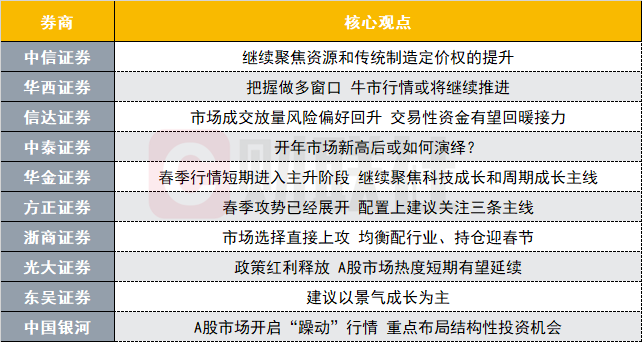
Core Viewpoints - The latest strategies from top brokerages indicate a bullish sentiment in the A-share market, with a focus on sectors like technology, traditional manufacturing, and resource pricing power [1][2][3][4][5][6][7][8][9][10][11][12][13][14] Group 1: Market Trends - The A-share market is experiencing a "rally" phase, with significant trading volume and a risk appetite resurgence, as evidenced by the Shanghai Composite Index surpassing 4100 points [4][6] - The market is expected to maintain its upward trajectory until the Spring Festival, driven by favorable macroeconomic indicators and increased participation from institutional investors [3][4][11][13] Group 2: Sector Focus - Brokerages recommend focusing on technology sectors, particularly AI applications, commercial aerospace, and robotics, which are anticipated to benefit from policy support and market trends [3][7][12][14] - Traditional manufacturing and resource sectors are highlighted for their potential in pricing power enhancement, with suggestions to increase allocations in non-bank financials [2][4][8] Group 3: Investment Strategies - Investment strategies emphasize a balanced approach, suggesting a mix of growth-oriented and cyclical sectors, with a focus on themes like "anti-involution" and price recovery in industries such as chemicals and metals [7][8][14] - The importance of monitoring market sentiment and performance metrics is stressed, particularly as the market enters a period of earnings announcements and potential volatility [12][13]



摩根士丹利:人民币资产升值空间进一步打开 非常有利于A股市场的演绎
Sou Hu Cai Jing· 2025-09-03 23:55
Group 1 - The core viewpoint is that the current A-share market is driven by liquidity, which is improving due to the continuous repair of investors' pessimistic expectations regarding Chinese assets [1] - Last week, the RMB exchange rate showed significant appreciation, supported by the rising expectations of a Federal Reserve interest rate cut, which provides a favorable condition for RMB appreciation [1] - In this context, the appreciation potential of RMB assets is further opened up, which is very beneficial for the performance of the A-share market [1]

A股今年新增开户1721万户
3 6 Ke· 2025-09-03 00:15
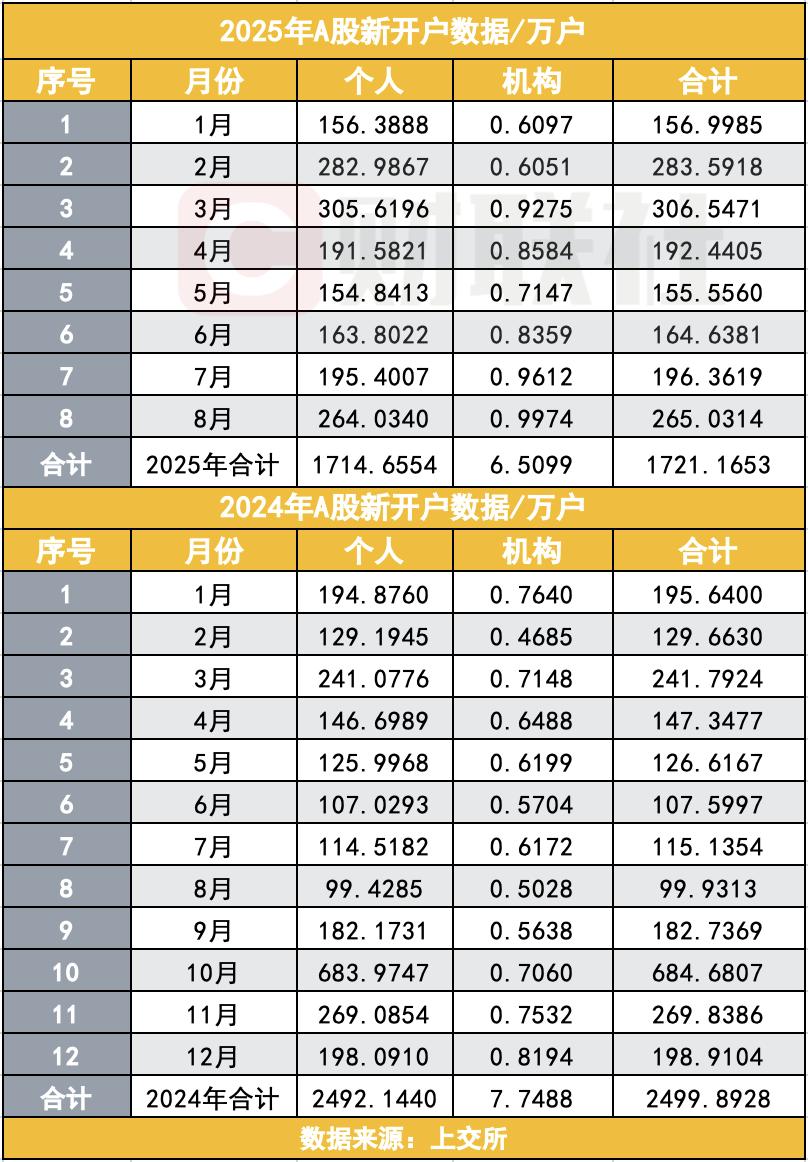
Core Viewpoint - The A-share market has seen a significant increase in new account openings, with 2.65 million new accounts in August 2025, marking a year-on-year growth of 165% and a month-on-month increase of 35% [1][2]. Monthly New Account Data - In January 2025, the total number of new accounts was 1.57 million, which nearly doubled to 2.84 million in February. March saw a further increase to over 3 million accounts, while April experienced a decline of 37.22% to 1.92 million due to market fluctuations. The numbers rebounded in subsequent months, reaching 1.96 million in July and 2.65 million in August [2][3]. - Cumulatively, 17.21 million new accounts were opened in 2025, a 47.9% increase compared to the same period in 2024 [1][3]. Market Performance and Trends - The A-share market exhibited a strong performance in August, with the Shanghai Composite Index closing at 3,857.93 points, reflecting a monthly increase of 7.97% and a year-to-date increase of 14.74% [5]. - The Shenzhen Component Index surged by 15.32%, while the ChiNext Index saw a remarkable rise of 24.13%, reaching its highest level since March 2022. The STAR 50 Index also experienced a significant increase of 28%, marking its largest monthly gain since its inception [5][6]. Supporting Factors for Market Strength - The market's upward trend is supported by three main factors: a loose liquidity environment, steady recovery in corporate earnings across various sectors, and increased domestic stimulus policies aimed at technology innovation and high-end manufacturing [6][7]. - The average daily trading volume exceeded 2 trillion yuan, with several trading days surpassing 3 trillion yuan, indicating a healthy market environment characterized by rising volume and price [5][6]. Future Market Outlook - Analysts predict that the market will maintain a trend of oscillating upward, driven by accumulated profit effects and continued inflow of incremental capital. However, there may be a slowdown in the rate of increase due to profit-taking by investors [8][9]. - The focus for the upcoming period will be on sectors benefiting from improved supply-demand dynamics, consumer spending, and technological self-sufficiency, particularly in AI, semiconductors, and high-tech industries [10][11].