AI创新药

Search documents
人生发财靠康波:2026年展望
泽平宏观· 2026-02-08 16:05
Core Viewpoint - The article discusses the impending global economic shifts, including de-dollarization, the rise of AI, and the cyclical nature of economic trends, predicting significant inflation and subsequent monetary tightening by 2026 [2][4][5]. Group 1: Economic Cycles - The article emphasizes the end of a century-long economic cycle, marked by the disintegration of the old order and the emergence of new challenges such as income inequality, populism, and geopolitical tensions [6][12]. - It highlights the fourth technological revolution driven by AI, which is expected to lead to substantial capital expenditure in new infrastructure and reshape wealth distribution and national power [6][18][19]. Group 2: Real Estate Market - The real estate sector is entering a phase of differentiation, with a predicted 20% of the population moving to core cities while 80% in lower-tier cities face prolonged declines [7][21]. - The article forecasts that 2026 will see a stabilization in the real estate market, contingent on policy support such as relaxed purchase restrictions and lower interest rates [22][23]. Group 3: Capacity Cycle - The capacity cycle is undergoing a transition, with traditional industries facing capacity reduction while new productive forces, particularly AI, drive large-scale infrastructure investments [24][27]. - The article notes that the capacity cycle has reached a turning point, with improvements in supply-demand dynamics and a recovery in prices and corporate profits expected [25][29]. Group 4: Inventory Cycle - The inventory cycle is transitioning from passive destocking to active restocking, although the recovery is expected to be weak due to ongoing industry differentiation and external uncertainties [29][30]. - The article anticipates a potential exit from deflation in 2026, driven by factors such as anti-involution policies and external inflationary pressures [30][31]. Group 5: Debt Cycle - The article discusses the ongoing challenges in the debt cycle, particularly the need for households to repair their balance sheets while new productive enterprises increase leverage [34][35]. - It emphasizes the necessity for fiscal and monetary policy adjustments to support new productive forces and stimulate economic recovery [39][41]. Group 6: Policy Outlook - The article outlines five key policy areas for 2026, including maintaining a moderately loose monetary policy, proactive fiscal measures, and supportive real estate policies aimed at stabilizing the market [46][48]. - It suggests that the focus will shift from merely preventing overheating in the real estate market to encouraging sustainable growth and addressing housing affordability [48][49]. Group 7: Asset Class Outlook - The article predicts a "confidence bull market" in the stock market, driven by technological advancements and a favorable policy environment, with a focus on sectors like AI, semiconductors, and renewable energy [51][52]. - It also anticipates a significant year for commodities, with expectations of rising prices due to de-dollarization and increased demand from the AI sector [53][54].

长城基金医药投资团队:继续看好医疗新科技 寻找创新药新逻辑
Xin Lang Cai Jing· 2026-02-05 12:31
Core Viewpoint - The market is experiencing a phase of adjustment after a period of overheating, primarily due to expectations of tightening overseas liquidity and pressure from cyclical sector corrections [1][5]. Group 1: Market Outlook - February is identified as a rare performance vacuum period, with a stable situation in the Asia-Pacific region; however, the extended Spring Festival may lead to early profit-taking by some funds [6]. - The market is expected to exhibit a volatile pattern, emphasizing the importance of stock selection [6]. Group 2: Investment Opportunities in Medical Technology - The company remains optimistic about the ongoing wave of technological innovation in the medical and consumer sectors, particularly driven by AI and domestic industry advancements, which present investment opportunities in the Chinese capital market [7][8]. - Key areas of focus include AI in healthcare, brain-computer interfaces, surgical robots, AI-driven innovative drugs, innovative medical devices, and cell gene nucleic acid therapies [7][8]. Group 3: New Logic for Innovative Drugs - The previous BD (business development) trading model for innovative drugs is losing effectiveness, necessitating a new guiding logic for the capital market to foster a new market trend [9]. - Three potential directions for innovative drugs are identified: 1. Core value return, where the globalization of domestic innovative drugs does not require excessive speculation 2. Performance explosion, with some outbound platform-type innovative drug companies expected to show nonlinear profit releases 3. Positive cycle of BD trading, where market sentiment is cyclical, transitioning from excessive enthusiasm to extreme lows, leading to a significant drop in overseas BD expectations for many companies [9].
长城基金投资札记:春季躁动有望延续,短期或维持震荡
Xin Lang Cai Jing· 2026-02-05 12:31
Market Overview - The market is currently experiencing a phase of consolidation after a period of overheating, primarily due to expectations of tightening overseas liquidity and pressure from cyclical sector corrections [1][12] - As these factors may gradually diminish, the market is expected to enter significant time windows such as the Spring Festival and the Two Sessions [1][12] Investment Insights - **Yang Jianhua**: Focus on sectors with performance realization. The market in January exhibited extreme volatility, and with a lack of new investment themes, a period of observation is anticipated. Consistent expectations have led to short-term fluctuations, but sectors with enduring narratives and performance potential may still present investment opportunities [2][13] - **Liao Hanbo**: Attention on AI and cyclical sectors. The market remains heated, with no immediate downward risks observed. However, rapid sector rotation complicates investment decisions. Future focus will be on new investment opportunities in AI and marginal changes in cyclical sub-sectors [3][14] - **Tan Xiaobing**: Short-term market may experience fluctuations. February presents a rare performance vacuum, and with a lengthy Spring Festival, some funds may realize profits early. The market is likely to show a fluctuating pattern, emphasizing stock selection [4][15] - **Long Yufei**: Continued optimism for new medical technologies. The ongoing wave of technological innovation in the medical and consumer sectors is expected to create investment opportunities, particularly in AI healthcare, brain-computer interfaces, surgical robots, AI innovative drugs, and innovative medical devices [5][17] - **Liang Furui**: Seeking new logic in innovative pharmaceuticals. The previously dominant BD trading model in the innovative drug sector has weakened, necessitating a new consensus to guide future market trends. Key directions include core value return, performance explosion from certain overseas platform-type innovative drug companies, and a positive cycle in BD trading [6][18] - **Chen Ziyang**: Potential differentiation in cyclical stocks. Strong performance in metals, oil, and chemicals is driven by positive economic expectations and liquidity support. High short-term price volatility necessitates finding a new balance between expectations and actual demand, with anticipated differentiation among cyclical stocks [7][19] - **Zhang Jian**: Focus on domestic consumption and price-increasing varieties. Key investment directions include domestic consumption resilience, price-increasing commodities like metals and chemicals, non-bank sectors benefiting from strong insurance growth, and the overseas expansion of Chinese manufacturing [8][20] - **Su Junyan**: Optimism for the spring market continuation. The strong inflow of funds at the beginning of the year is expected to sustain a bullish spring market, with manageable external risks and limited impact from the Federal Reserve's balance sheet reduction narrative [10][21] - **Lin Hao**: Structural market trends likely to continue. With new capital entering the market, there is sustained interest in technology growth sectors, cyclical sectors benefiting from "anti-involution," and commercial aerospace. The market may trend towards decoupling, with a focus on self-sufficiency and resource value reassessment [11][22]
任泽平:中国经济的十大趋势
泽平宏观· 2026-02-02 16:06
文 任泽平 本文提出未来十年中国经济的十大趋势,希望对大家看清未来的大势有帮助。 第二大趋势,人工智能的超级应用大爆发, AI 助手、无人驾驶、人形机器人、 AI 创新药、 AI 眼镜走进每个人的生活,成为经济的新增长点,引领新一轮康波周期,成为新一代年轻人人生逆 袭和财富逆袭的机会。 凭借完善强大的供应链和超大规模的市场优势, AI 超级应用场景将在中国大爆发,诞生出一批 新物种。中国力量崛起,国产替代,后发先至。中国拥有 14 亿人的庞大市场和软硬件一体化的 强大产业基础,有可能是全球人工智能革命最后最大的赢家。 我们每个人的成就都是时代的产物,顺势而为。时代造就英雄, 英雄顺应时代 。悲观者正确, 乐观者前行。 第一大趋势, 全球经济、贸易、科技、地缘秩序重新洗牌,未来十年将是大国博弈的关键期。 2025 年中国 GDP 规模为140.19 万亿元;2024年中国 GDP 规模为 135 万亿 元,中国发展潜力 大,未来有望成为第一大经济体。 全球处于大周期末期,旧秩序开始瓦解,新秩序正在重建,周期的钟摆从注重经济增长效率转向 平衡收入分配公平,这是一个大变革、大调整、大动荡、大转型的新时代。 未来十年 ...

中美在竞争第一款真正的AI创新药
Hu Xiu· 2025-06-17 08:09
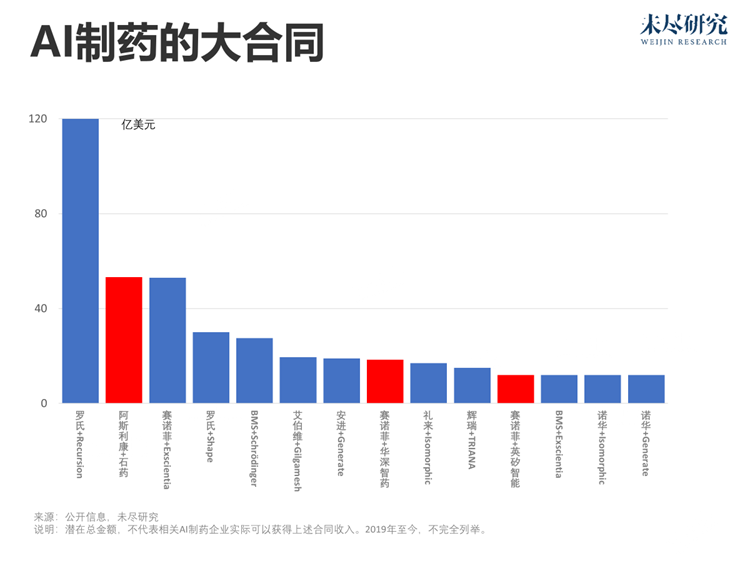
Core Viewpoint - The article highlights the growing significance of AI in drug development, particularly in China, where major pharmaceutical companies are increasingly investing in AI-driven drug discovery, potentially leading to the first truly AI-innovated drug. Group 1: Investment and Collaboration - The collaboration between CSPC Pharmaceutical Group and AstraZeneca marks a significant investment in AI drug development, with an upfront payment of $110 million and potential milestone payments exceeding $5.2 billion [1][2] - This contract represents the largest single deal in China's AI drug development sector, surpassing previous contracts from companies like Insilico Medicine and Huasheng Zhiyuan [2] - The total transaction amount committed by U.S. pharmaceutical giants to Chinese innovative drugs has approached $30 billion, indicating a strong belief in the potential of Chinese innovation [5] Group 2: Competitive Landscape - The emergence of AI-driven drug development in China is challenging the U.S. dominance, with Chinese companies showing significant progress in clinical trials and drug pipelines [5] - Chinese pharmaceutical firms are leveraging a large pool of engineers and clinical demand, providing them with a competitive edge in terms of cost and speed compared to their U.S. counterparts [5] - The AI drug discovery process is currently crowded, but many teams lack the capability to connect with wet lab experiments and high-quality clinical data [7] Group 3: Future Prospects and Challenges - Despite the advancements, no AI-driven drug has yet received clinical approval, with predictions suggesting that the first such drug may not be approved until 2030 [9] - The next phase of competition will focus on AI-driven clinical trials, where patient recruitment and data analysis will be crucial [9] - Regulatory attitudes in the U.S. are becoming more favorable towards AI in drug development, with the FDA exploring the integration of AI in various stages of drug research and approval [10]