
AIoT业务

Search documents
北水动向|北水成交净买入34.49亿 北水全年净买入港股逾1.4万亿港元 创历史纪录新高
智通财经网· 2025-12-31 10:07
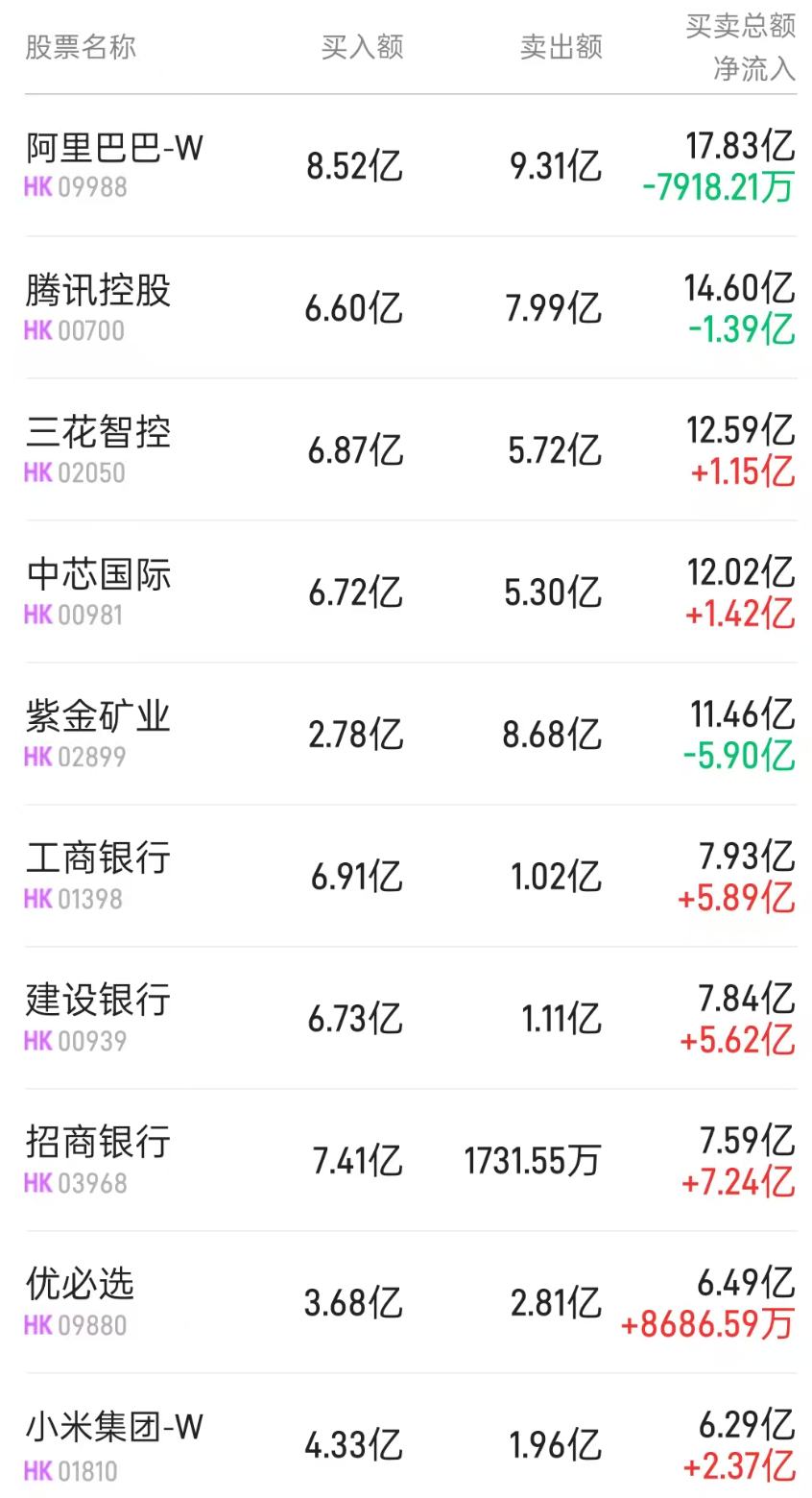
Group 1 - Northbound capital recorded a net purchase of 34.49 billion HKD in the Hong Kong stock market on December 31, with the Shanghai-Hong Kong Stock Connect contributing 30.97 billion HKD and the Shenzhen-Hong Kong Stock Connect contributing 3.51 billion HKD [1] - The total net purchase of Northbound capital for the year reached a historical high of 1.41 trillion HKD, significantly increasing from approximately 807.9 billion HKD in 2024 [1] - The most purchased stocks by Northbound capital included China Merchants Bank (03968), Industrial and Commercial Bank of China (01398), and China Construction Bank (00939) [1] Group 2 - Alibaba-W (09988) had a net purchase of 850 million HKD, while Tencent Holdings (00700) faced a net sell of 660 million HKD [2] - China Merchants Bank, Industrial and Commercial Bank of China, and China Construction Bank received net purchases of 7.24 billion HKD, 5.88 billion HKD, and 5.61 billion HKD respectively [4] - Semiconductor stocks also saw increased investment, with SMIC (00981) and Hua Hong Semiconductor (01347) receiving net purchases of 391 million HKD and 69.94 million HKD respectively [5] Group 3 - Xiaomi Group-W (01810) received a net purchase of 237 million HKD, supported by government policies promoting consumption [5] - Jiangxi Copper Co. (00358) had a net purchase of 158 million HKD, while Zijin Mining (02899) experienced a net sell of 682 million HKD [6] - UBTECH Robotics (09880) received a net purchase of 86.86 million HKD, as it announced plans to acquire a controlling stake in Fenglong Co. [6]





大行评级|大摩:“国补”政策对技术硬件行业是积极的催化剂 利好小米AIoT业务
Ge Long Hui· 2025-12-31 02:43
摩根士丹利发表研究报告指,2026年"国补"政策与2025年相比,在技术硬件产品方面几乎相同,但新增 了智能眼镜至补贴清单。对于消费电子产品,补贴由2025年的20%略微下降至2026年的15%,上限亦从 2000元人民币降至1500元。该行认为,新公布的政策对技术硬件行业是一个积极的催化剂,因为市场预 期补贴会减少,而非保持不变。对于消费电子产品,15%的补贴仍然利好小米明年的AIoT业务。 ...
里昂:料小米集团-W(01810)第三季经调整净利润增60% 电动车续为亮点
智通财经网· 2025-11-05 07:10
Core Viewpoint - Citi expects Xiaomi Group-W (01810) to achieve a year-on-year revenue growth of 22% and adjusted net profit growth of 60% in Q3, reaching RMB 112.9 billion and RMB 10 billion respectively, driven by robust electric vehicle sales [1] Group 1: Financial Performance - Xiaomi's total revenue for Q3 is projected to be RMB 112.9 billion, with an adjusted net profit of RMB 10 billion, reflecting significant growth compared to the previous year [1] - For Q4, Xiaomi is anticipated to see a 15% year-on-year increase in total revenue and a 16% increase in adjusted net profit, primarily due to a recovery in smartphone sales and continued growth in electric vehicle deliveries [1] Group 2: Business Segments - The smartphone segment may experience a 3% year-on-year decline in revenue due to decreased shipments in China and India [1] - The AIoT business is expected to slow down to a 5% year-on-year growth rate, impacted by reduced subsidies for trade-in programs [1] - Electric vehicle deliveries are projected to rise to 109,000 units, with an average price of approximately RMB 260,000, and the segment may have reached breakeven [1] Group 3: Market Outlook - The approval of Xiaomi's second electric vehicle factory is seen as a catalyst for stock price revaluation, with a target price set at HKD 69 [1] - Despite challenges in the AIoT segment due to a higher base effect, the overall outlook remains positive with expectations of recovery in smartphone sales and sustained electric vehicle growth [1]
雷军已成全民公敌?小米的“罪过”,是让太多人睡不着觉了!
Xin Lang Cai Jing· 2025-10-19 18:14
Core Viewpoint - Xiaomi has become a target of widespread criticism across various platforms, indicating its significant impact on multiple industries, including smartphones, home appliances, and automobiles [1][3][11] Group 1: Impact on Home Appliances - Xiaomi has disrupted the home appliance industry, previously dominated by established brands, by introducing innovative designs, smart functionalities, and competitive pricing [4][5] - The company's AIoT business generated revenue of 71 billion in the first half of 2025, with air conditioner sales reaching 5.4 million units, indicating a substantial market share gain from traditional manufacturers [7] Group 2: Automotive Industry Strategy - Xiaomi's unconventional approach to car manufacturing has challenged traditional marketing strategies, with CEO Lei Jun personally engaging in product promotion and social media interactions [9] - In September, Xiaomi's vehicle deliveries exceeded 40,000 units, showcasing its rapid market penetration and posing a threat to established automotive players [9] Group 3: Industry Reactions and Criticism - The backlash against Xiaomi is largely driven by those whose financial interests have been disrupted, including competitors, advertising agencies, and influencers who relied on traditional marketing methods [11] - The criticism reflects a resistance to Xiaomi's innovative practices that challenge the status quo, ultimately benefiting consumers through lower prices and improved services [11]
小米高管解读Q2财报:肯定会增加AI和芯片投入 相信Q4手机毛利率会回升
Xin Lang Ke Ji· 2025-08-19 15:05
Core Insights - Xiaomi Group reported a total revenue of 116 billion yuan for Q2 2025, representing a year-on-year growth of 30.5%, and a net profit of 11.9 billion yuan, up 134.2% year-on-year [1] - Adjusted net profit, based on non-IFRS measures, reached 10.8 billion yuan, marking a 75.4% increase year-on-year [1] IoT Business Performance - Xiaomi's AIoT segment showed strong growth in both domestic and international markets, benefiting from the expansion of its new retail system [3][4] - The company has shifted its focus from rapid expansion to "scaled closure" in its overseas retail strategy, aiming to open 400 to 500 new stores by the end of the year, with a potential for over 1,000 stores in the following year [4] - The growth rate in the Chinese market is higher than in overseas markets, primarily due to the rapid development of the home appliance sector [3] Mobile Business Insights - The gross margin for the mobile business saw a quarter-on-quarter decline, attributed to rising component costs and a limited number of new product launches in Q2 [5][6] - The company anticipates a recovery in gross margin by Q4 2025, coinciding with a more significant release of new products [5] R&D Investments - Xiaomi's R&D expenditure increased by over 40% year-on-year in Q2, marking the fastest growth rate in recent years, with investments spread across core technologies such as chips, AI, and the Surge OS [7][8] - The company is committed to enhancing its technological capabilities, which are deemed essential for maintaining competitiveness in the market [7][8] AIoT Margins and Market Dynamics - The IoT business's gross margin showed a year-on-year increase but faced some pressure on a quarter-on-quarter basis, influenced by promotional activities like the "618 shopping festival" [6][9] - Despite competitive pressures in the home appliance market, Xiaomi remains on track to meet its annual targets for the IoT segment [7]
大行评级|瑞银:下调小米目标价至60港元 下调次季及全年盈测
Ge Long Hui· 2025-08-11 03:51
Core Viewpoint - UBS reports that Xiaomi's smartphone sales in Q2 reached 41 million units, reflecting a year-on-year increase of 0.5% and a quarter-on-quarter rise of 1.5% [1] Smartphone Sales - In the Chinese market, driven by subsidies and the 618 shopping festival, sales grew by 8% year-on-year [1] - The total expected smartphone sales for Xiaomi in 2023 is projected to reach 175 million units [1] Profit Margins - Due to the impact of the 618 promotional activities leading to a decrease in average selling price, along with the expansion of contributions from emerging markets offsetting the ongoing high-end market contributions, the Q2 smartphone gross margin is expected to remain flat at approximately 11.6% quarter-on-quarter [1] AIoT Business - The AIoT business is anticipated to maintain rapid growth in Q2, with sales forecasted at 36.6 billion yuan and 140.6 billion yuan for Q2 and the full year respectively, representing year-on-year growth of 37% and 35% [1] Earnings Forecast - The group has adjusted its Q2 and full-year earnings estimates downwards by 10.4% and 5.5% respectively [1] - The target price has been revised from 62 HKD to 60 HKD, while maintaining a "Neutral" rating [1]