Claude 4.5

Search documents
千问 3.5 发布,四成参数超越万亿模型,大模型的竞赛逻辑变了
Sou Hu Cai Jing· 2026-02-16 16:07
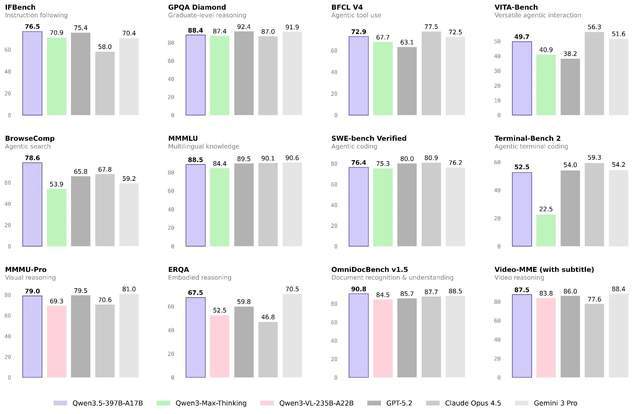
Core Insights - The main theme in the large model industry over the past two years has been "scaling up," but this has led to increased deployment costs, making it harder for companies to afford these models. The performance curve and adoption curve are diverging [1] - Alibaba's release of the Qwen 3.5-Plus model, with 397 billion total parameters and only 17 billion activated, demonstrates a shift in focus from merely increasing parameters to enhancing model efficiency and cost-effectiveness [1][3] Model Performance and Efficiency - Qwen 3.5-Plus surpasses the previous generation Qwen 3-Max and competes favorably with models like GPT-5.2 and Gemini 3 pro in various benchmarks, achieving scores such as 87.8 in MMLU-Pro and 88.4 in GPQA [1][3] - The model's API pricing is significantly lower, at 0.8 yuan per million tokens, which is 1/18 of Gemini 3 pro's price, indicating a new cost structure in the industry [1][8] Architectural Innovation - The industry is experiencing a shift from parameter accumulation to architectural innovation, similar to the transition in the chip industry from single-core to multi-core architectures [3] - Qwen 3.5 achieves efficiency by using only 17 billion parameters for inference, resulting in an 8.6 times increase in throughput for 32K context scenarios and up to 19 times for 256K context scenarios, while reducing deployment memory usage by 60% [3][4] Multi-Modal Capabilities - Qwen 3.5 represents a generational leap to a native multi-modal model, integrating text and visual data from the start, which enhances its capabilities compared to models that assemble components separately [4][7] - The model supports direct input of 2-hour videos and can convert hand-drawn sketches into executable front-end code, showcasing its advanced multi-modal functionalities [7] Strategic Implications - Alibaba's commitment to native multi-modal capabilities positions Qwen as a foundational model for enterprise applications, which inherently require multi-modal functionalities [8] - The collaboration between model architecture, chip optimization, and cloud infrastructure results in a sustainable cost structure, challenging closed-source competitors who rely on performance exclusivity [8][9] Market Position and Growth - Qwen is ranked first in the Chinese enterprise-level large model market, with Alibaba Cloud's market share reaching 35.8% in the AI cloud market, surpassing the combined share of the second to fourth competitors [11][12] - The open-source model ecosystem is rapidly expanding, with over 400 models released and more than 200,000 derivative models created, indicating strong developer engagement and market traction [12] Future Considerations - The competition in the large model industry is transitioning from a parameter race to an architecture race, where efficiency and cost become the core competitive dimensions [12][13] - Questions remain about the sustainability of closed-source models in light of open-source alternatives that match performance and cost, as well as the viability of current assembly methods in multi-modal training [13]


阿里发布千问3.5:性能媲美Gemini 3,Token价格仅为其1/18
Xin Lang Cai Jing· 2026-02-16 09:13
Core Insights - Alibaba has launched the new generation large model Qwen3.5-Plus, claiming it rivals Gemini 3 Pro and is the strongest open-source model globally [1][4] - The Qwen3.5-Plus model features a total of 397 billion parameters, with only 17 billion activated, outperforming the trillion-parameter Qwen3-Max model while reducing deployment memory usage by 60% and significantly enhancing inference efficiency [1][4] - The API pricing for Qwen3.5-Plus is set at 0.8 yuan per million tokens, which is only 1/18th of the cost of Gemini 3 Pro [1][4] Model Architecture and Performance - Qwen3.5 represents a generational leap from pure text models to native multimodal models, utilizing a mixed token pre-training approach that includes visual and text data [1][4] - The model has been trained with a substantial increase in multilingual, STEM, and reasoning data, allowing it to acquire denser world knowledge and reasoning logic [1][4] - Qwen3.5 achieves top-tier performance with less than 40% of the parameters of the Qwen3-Max model, excelling in inference, programming, and agent intelligence evaluations [1][4] Benchmark Performance - In the MMLU-Pro knowledge reasoning evaluation, Qwen3.5 scored 87.8, surpassing GPT-5.2 [2][5] - The model achieved 88.4 in the PhD-level GPQA assessment, outperforming Claude 4.5 [2][5] - Qwen3.5 set a record with a score of 76.5 in the instruction-following IFBench, and it also exceeded Gemini 3 Pro and GPT-5.2 in various agent evaluations [2][5]
软件股大跌,是耐心持有还是逢低买入?
Hua Er Jie Jian Wen· 2026-02-06 12:26
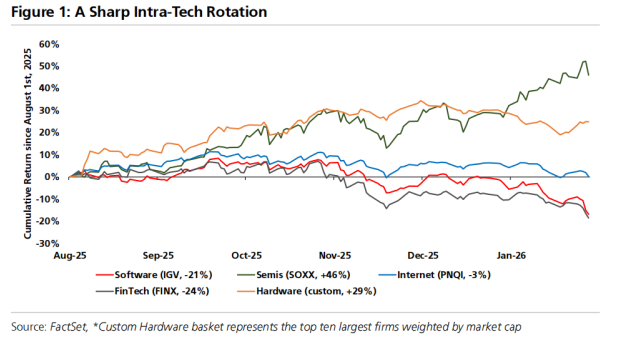
Core Viewpoint - The software sector is undergoing a severe sell-off, driven by a deep reassessment of the industry's future rather than mere market sentiment fluctuations. The acceleration of AI technology is fundamentally disrupting traditional SaaS business models, leading to a significant increase in the "terminal value" risk for SaaS and application software stocks [1][4]. Group 1: Market Dynamics - UBS highlights that investors should avoid rushing to buy into software stocks, particularly those based on "seat" pricing, as they are in the eye of the AI disruption storm [1]. - The average organic revenue growth rate for large SaaS and application software companies has dropped to around 12-13%, down from the pre-pandemic growth rates of 15-20% [4]. - Companies like Salesforce and Adobe have seen their growth rates decline sharply, with Salesforce dropping from 20% to 9% and Adobe from 21% to 10% [4]. Group 2: Valuation Concerns - Many software stocks are still using "non-GAAP" price-to-earnings ratios to support their valuations, which obscures the impact of substantial stock-based compensation (SBC) on their financials [5]. - When viewed from a stricter GAAP perspective, many companies' profitability appears significantly diminished, with most still facing high non-cash equity incentive costs [6]. Group 3: AI Revenue Insights - Despite the hype around AI, public application software companies have reported only $5.6 billion in total AI revenue, with Microsoft contributing approximately $3.8 billion, leaving only about $2 billion for the rest of the industry [7]. - The AI spending is not fully flowing to traditional SaaS giants but is being diverted to AI-native startups and model providers like OpenAI and Anthropic [7]. Group 4: Seat Compression Risks - AI poses a direct threat to the SaaS model through "seat compression," as companies are reducing the number of low-skilled employees while increasing investments in AI functionalities [8]. - Some companies report that while the number of seats may decrease, the total amount paid to software vendors could still rise due to increased spending on AI capabilities [8]. Group 5: Investment Recommendations - UBS advises against seeking winners in the SaaS application software space for now, suggesting a focus on infrastructure and data, with companies like Microsoft, Snowflake, and Datadog being preferred due to their healthier customer spending trends and lower disruption risks [9]. - In the cybersecurity sector, companies like Okta and Zscaler are recommended for their attractive valuations and stable demand amid AI-related security threats [9]. - Companies utilizing usage-based pricing models, such as Twilio and Braze, as well as those transitioning to the cloud like Autodesk, are also seen as relatively safe investments [9].
国产大模型同日转向:DeepSeek向左,Kimi向右,拼落地的时代开始了?
3 6 Ke· 2026-01-29 00:29
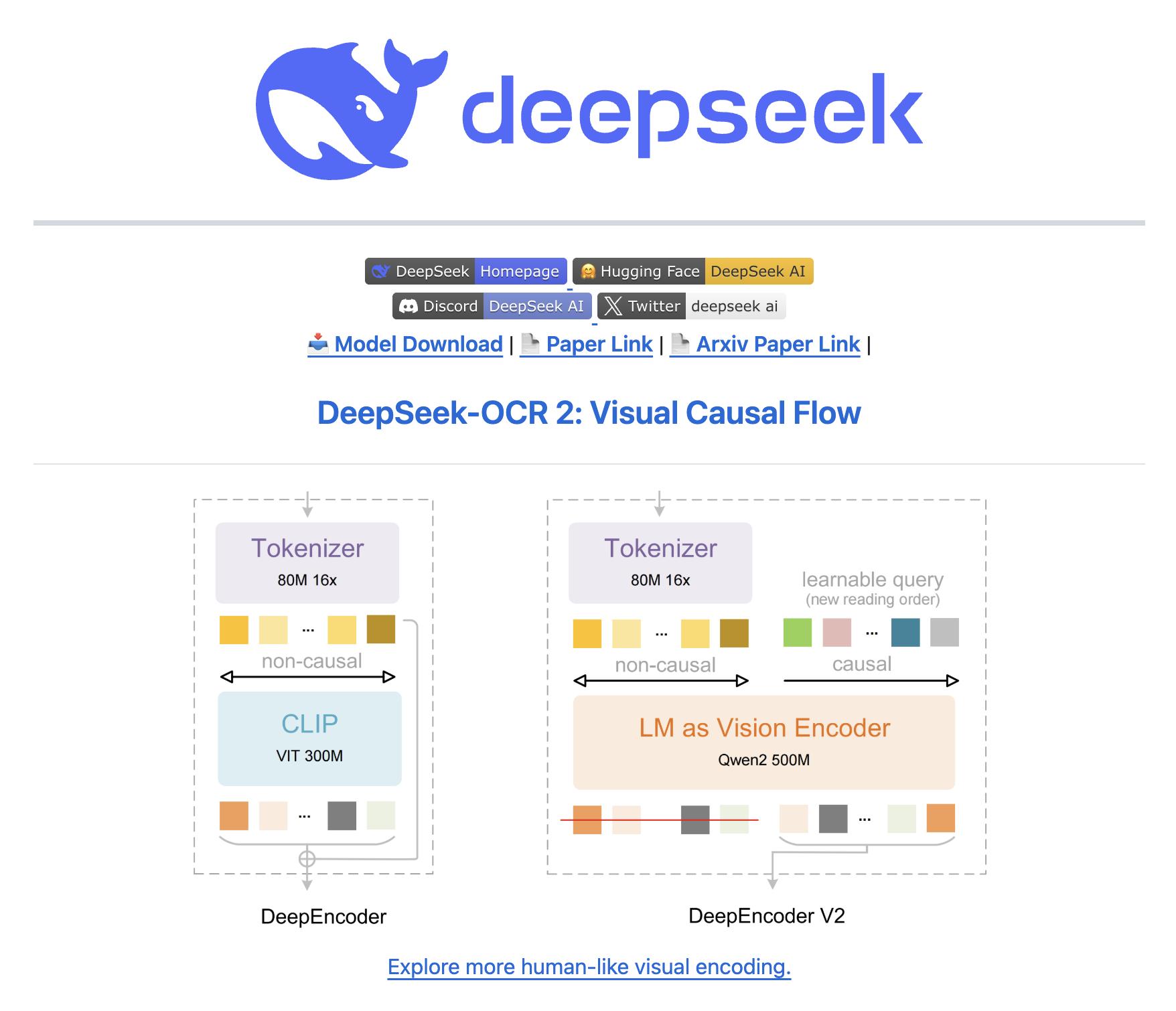
Core Insights - Two prominent domestic AI startups, DeepSeek and Kimi, have released significant open-source updates to their models, DeepSeek-OCR 2 and K2.5, respectively, marking a pivotal moment in AI development [1][4] - DeepSeek-OCR 2 focuses on enhancing the model's ability to "read" information through a new visual encoding mechanism, aiming to improve efficiency and reliability in processing complex documents [1][10] - Kimi K2.5 aims to evolve AI from merely answering questions to executing complex tasks, emphasizing long memory, multi-modal understanding, and task execution capabilities [4][12] Group 1: DeepSeek-OCR 2 - DeepSeek-OCR 2 introduces a new approach to document processing, allowing the model to learn human-like visual logic and compress lengthy text inputs into higher-density "visual semantics" [1][10] - The model shifts from a mechanical text processing method to understanding document structure, enabling it to identify titles, tables, and related information more effectively [8][10] - This upgrade addresses long-standing issues in AI document handling, such as high costs and inefficiencies associated with traditional text input methods [10][11] Group 2: Kimi K2.5 - Kimi K2.5 emphasizes the transition from a question-answering model to a more capable digital assistant, capable of handling complex tasks and multi-modal inputs [4][12] - The model's long memory feature allows it to retain context over extended interactions, reducing the need for repeated explanations [12][17] - Kimi K2.5's focus on task execution and intelligent agent capabilities positions it as a more versatile tool for real-world applications, moving beyond simple advisory roles [12][22] Group 3: Industry Trends - The recent upgrades in AI models reflect a broader industry shift towards practical applications, prioritizing usability and integration into real-world workflows over mere parameter scaling [15][16] - Key areas of focus include enhancing memory retention, improving visual comprehension, and redefining AI's role from advisor to executor [17][22] - The emphasis on engineering and deployment capabilities highlights the industry's commitment to making AI tools more accessible and effective in business environments [22][23]

3个AI参加日本高考,谁得分最高?
日经中文网· 2026-01-25 00:33
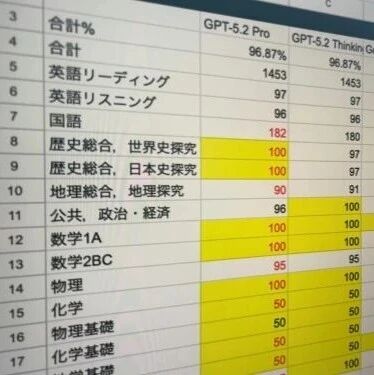
Core Viewpoint - The latest AI models from OpenAI, Google, and Anthropic have demonstrated high proficiency in the Japanese university entrance exams, with OpenAI achieving a score of 97% across 15 subjects, outperforming its competitors [1][3]. Group 1: AI Performance in Exams - OpenAI's model scored full marks in 9 subjects, including Mathematics I A, Mathematics II BC, Chemistry, and Physics, while achieving an overall score of 96.9% [4]. - Google and Anthropic scored 91.4% and 91% respectively, indicating a significant gap in performance compared to OpenAI [4]. - The average score of human test-takers was only 58.1%, highlighting the advanced capabilities of AI in academic assessments [4]. Group 2: Subject-Specific Insights - In specific subjects, OpenAI scored 100% in Mathematics I A and II BC, and 95% in Physics, while also excelling in Chemistry with a score of 100% [4]. - The AI models showed weaknesses in language subjects, particularly in reading comprehension and geography, where they lost points [4][5]. - OpenAI's model took 2-3 times longer than Google and Anthropic to complete the exams, indicating a potential area for improvement in efficiency [4]. Group 3: Future Projections - OpenAI's model is projected to improve its exam scores significantly over the next few years, with expected scores of 66% in 2024, 91% in 2025, and 97% in 2026 [3].

Goldman investment banking co-head Kim Posnett on the year ahead, from an IPO ‘mega-cycle’ to another big year for M&A to AI’s ‘horizontal disruption’
Yahoo Finance· 2026-01-19 10:00
AI Industrialization and Breakthroughs - 2025 marked a significant transition from AI experimentation to industrialization, with major advancements in models, agents, infrastructure, and governance [1] - The launch of DeepSeek's DeepSeek-R1 reasoning model demonstrated that world-class reasoning could be achieved with open-source models, challenging closed-source models [1] - The $500 billion public-private joint venture, Stargate, initiated a new era of AI infrastructure, termed the "gigawatt era" [1] - Major model launches by OpenAI, Google, and Anthropic at the end of 2025 showcased enhanced deep thinking, reasoning, and multimodality capabilities [1] M&A and Capital Markets Activity - The global business community is experiencing strong catalysts for M&A and capital markets activity, driven by AI as a growth catalyst [2] - CEO and board confidence is high, with a focus on strategic and financing activities aimed at scale, growth, and innovation as AI becomes an industrial driver [2] - M&A activity surged in 2025, with a total volume of $5.1 trillion, reflecting a 44% year-over-year increase [11] IPO Market Outlook - An "IPO mega-cycle" is anticipated, characterized by unprecedented deal volumes and sizes, with institutionally mature companies going public [8] - The current IPO cycle is expected to feature larger deals compared to previous waves, with companies having raised significant private capital before going public [8][9] - The reopening of the IPO window presents opportunities for investors to engage with transformative and rapidly growing companies [10] Strategic Dealmaking Trends - The M&A landscape is shifting towards bold and strategic transactions, with companies seeking to acquire AI capabilities and digital infrastructure [12] - Boards are now making high-stakes decisions in a rapidly evolving technological environment, where traditional benchmarks may not apply [13] - Financial sponsors are returning to the M&A stage, with a significant increase in M&A volumes and a focus on executing take-privates and strategic carveouts [14][15]

AI应用、储能与机器人在2026年的预期差
3 6 Ke· 2026-01-06 01:40
Group 1 - Anthropic's Claude 4.5 is positioned as a powerful tool for coding, computer operations, and complex agent construction, showing significant improvements in handling complex tasks, such as creating chat applications autonomously within 30 hours and supporting long-duration code execution [1] - The domestic lidar market has seen a price drop, leading to a breakthrough in intelligent driving applications, with approximately 200,000 units shipped for robotics this year, accounting for 20% of the total industry shipments, and expected to double by 2026 due to the rapid growth of humanoid robots [1] - Major players in the robotics field include Suteng and Hesai, with Suteng holding over 60% of the domestic market share and Hesai capturing 30-40%, while Hesai leads in international markets with higher profit margins and better internationalization [1] Group 2 - The Chinese energy storage market is expected to transition from "policy-driven" to "market-driven" by 2025, with a shift in revenue paths towards combined pricing of power sources and storage [2] - New energy storage installations are projected to grow by about 40% year-on-year to approximately 135 GW by 2025, with a likely early achievement of the 180 million kW target by 2027 [2] - Despite an oversupply of oil and low prices, global refining supply and demand are expected to remain tight over the next five years due to factors such as the Russia-Ukraine conflict and peak refining capacity in China [2] Group 3 - The home appliance sector is facing challenges in channel reform, with Midea's "drop shipping model" being difficult to replicate despite its apparent simplicity, allowing real-time monitoring of pricing and order fulfillment [3] - The AI tools industry is rapidly evolving, with lower production costs for animated content, potentially capturing market share from live-action short dramas and web literature, with a long-term market potential of 60 to 80 billion yuan [3] - The fresh coffee market in China is shifting from a social attribute to a daily affordable functional beverage, with a stable demand that supports continuous growth, expected to increase from 250,000 to 400,000 coffee shops by 2030 [4]

Nvidia, AMD, and Micron Technology Could Help This Unstoppable ETF Turn $250,000 Into $1 Million in 10 Years
The Motley Fool· 2025-12-30 10:13
Industry Overview - The semiconductor industry is poised for further growth driven by the artificial intelligence (AI) boom, as top AI developers continue to launch more advanced models that require increased computing power and data center capacity [1] - Major suppliers of AI infrastructure, chips, and components, such as Nvidia, Advanced Micro Devices (AMD), and Micron Technology, have seen their shares surge by an average of 119% in 2025, significantly outperforming the S&P 500 index, which is up only 18% [2] Investment Opportunities - Investors lacking exposure to the AI semiconductor sector in 2025 likely underperformed the broader market [4] - The iShares Semiconductor ETF offers a straightforward way to invest in this rapidly growing industry, focusing on companies like Nvidia, AMD, and Micron, with the potential to turn an investment of $250,000 into $1 million over the next decade [5][11] ETF Composition - The iShares Semiconductor ETF exclusively invests in American companies involved in chip design, distribution, and manufacturing, particularly those benefiting from AI opportunities, with a portfolio of 30 stocks [7] - The ETF is heavily weighted towards its top three holdings: Nvidia (8.22%), AMD (7.62%), and Micron Technology (6.88%) [7] Company Insights - Nvidia's GPUs are considered the best for developing AI models, with its Blackwell Ultra lineup designed to support the latest reasoning models [7] - AMD is competing with Nvidia in the data center chip market, with plans to launch its MI400 GPUs, which could significantly enhance performance [8] - Micron Technology is a leading supplier of memory and storage chips, with its HBM3E solutions integrated into Nvidia and AMD's GPUs, and is already sold out of its 2026 supply of data center memory [9] Performance Projections - The iShares Semiconductor ETF is projected to end 2025 with a 43% return, with a historical compound annual return of 27.2% over the past decade [11] - If annual spending on AI data center infrastructure and chips reaches $4 trillion by 2030, the ETF could deliver compound annual returns exceeding 20% [13] - Even with a return moderation, the ETF could still help investors reach $1 million in 13 years with a long-term average return of 11.8% [15]



AI体育教练来了!中国团队打造SportsGPT,完成从数值评估到专业指导的智能转身
量子位· 2025-12-22 01:40
Core Insights - The article discusses the current state of "intelligent" sports systems, highlighting that most remain at the "scoring + visualization" stage, lacking actionable insights for athletes and coaches [1] - It introduces the SportsGPT framework, which aims to provide a complete intelligent loop from "motion assessment" to "professional diagnosis" and "training prescription" [5][37] Group 1: Limitations of Current Models - General large models like GPT-5 struggle with specialized sports biomechanics analysis due to their lack of fine-grained visual perception, leading to generic and sometimes physically infeasible suggestions [3][9] - A comparative evaluation shows that SportsGPT outperforms other models in accuracy (3.80) and feasibility (3.77), indicating its unique advantages in generating precise, actionable training guidance [8][9] Group 2: Motion Analysis Techniques - MotionDTW is a two-stage time series alignment algorithm designed for sports motion analysis, addressing traditional DTW's limitations by constructing a high-dimensional feature space [10][21] - The algorithm employs a weighted multi-modal feature space to eliminate errors caused by athlete body differences and incorporates dynamic features like angular velocity to enhance motion phase representation [12][18] Group 3: Diagnostic Capabilities - KISMAM serves as a bridge between raw biomechanical data and interpretable diagnostics, establishing a quantitative benchmark based on data from 100 youth sprinters [25][26] - The model quantifies deviations from standard thresholds and constructs a high-dimensional mapping matrix to understand complex relationships between motion anomalies and technical issues [28][30] Group 4: Training Guidance - SportsRAG, built on a large external knowledge base, enhances the generation of training guidance by integrating domain knowledge with diagnostic results, ensuring actionable recommendations [33][34] - The absence of the RAG module significantly reduces the feasibility of the model's outputs, demonstrating its critical role in transforming diagnostic insights into professional training prescriptions [34] Group 5: Conclusion - The SportsGPT framework represents a significant advancement in intelligent sports training, moving from mere data presentation to providing executable, expert-level guidance [37] - It establishes a new standard in smart sports by effectively addressing the challenges of motion analysis, diagnosis, and training instruction [37]

深度|谷歌前CEO谈旧金山共识:当技术融合到一定阶段会出现递归自我改进,AI自主学习创造时代即将到来
Z Potentials· 2025-12-16 01:32
Core Insights - The discussion highlights the transformative impact of artificial intelligence (AI) on society, likening it to historical revolutions in human understanding, emphasizing the unpredictable nature of human responses to non-human competitors [4][12] - Eric Schmidt and Graham Allison reflect on the legacy of Henry Kissinger, particularly his strategic foresight in preventing catastrophic conflicts, and how this relates to current AI challenges [11][16] - The conversation underscores the importance of maintaining human agency in decision-making processes as AI technologies advance, raising ethical concerns about the delegation of authority to machines [15][26] Group 1: AI Revolution and Its Implications - The emergence of AI represents a paradigm shift comparable to scientific revolutions, as humanity faces intelligent competitors that may surpass human capabilities [4][12] - AI's ability to generate code and automate tasks is revolutionary, providing individuals with unprecedented computational power [6][20] - The potential for AI to autonomously learn and improve raises questions about the future of human roles in various sectors, including decision-making and creativity [14][15] Group 2: US-China AI Competition - The competitive landscape between the US and China in AI development is characterized by differing strategies, with the US focusing on advanced technologies and China emphasizing rapid application in commercial sectors [17][18] - China has made significant investments in renewable energy, which supports its AI ambitions, while the US faces challenges in power supply for data centers [17][18] - The discussion highlights the importance of understanding the implications of diffusion technology, where AI capabilities can be replicated without extensive retraining [18][23] Group 3: Ethical Considerations and Human Agency - The conversation stresses the need for humans to retain control over AI systems, particularly in critical areas such as military applications and decision-making [15][26] - Concerns are raised about the societal impact of AI on children and the potential for addiction to AI systems, which could affect their development and social skills [15][16] - The ethical implications of AI's role in society necessitate a reevaluation of what it means to be human in an age where machines can perform many tasks traditionally done by people [26][31] Group 4: Future Directions and Challenges - The potential for AI to reshape industries such as healthcare, climate change, and engineering is immense, but the transition may lead to job displacement and require new societal frameworks [19][33] - The need for international cooperation in AI governance is highlighted, with suggestions for establishing regulatory bodies similar to those in nuclear energy to manage AI's risks [36][37] - The conversation concludes with a call for a deeper understanding of the implications of AI on human identity and the necessity for interdisciplinary approaches to address these challenges [26][31]