DM混动技术

Search documents
2025年度中国汽车产业盘点——销量篇 车企竞争进入深水区
Zhong Guo Zhi Liang Xin Wen Wang· 2026-02-04 06:51
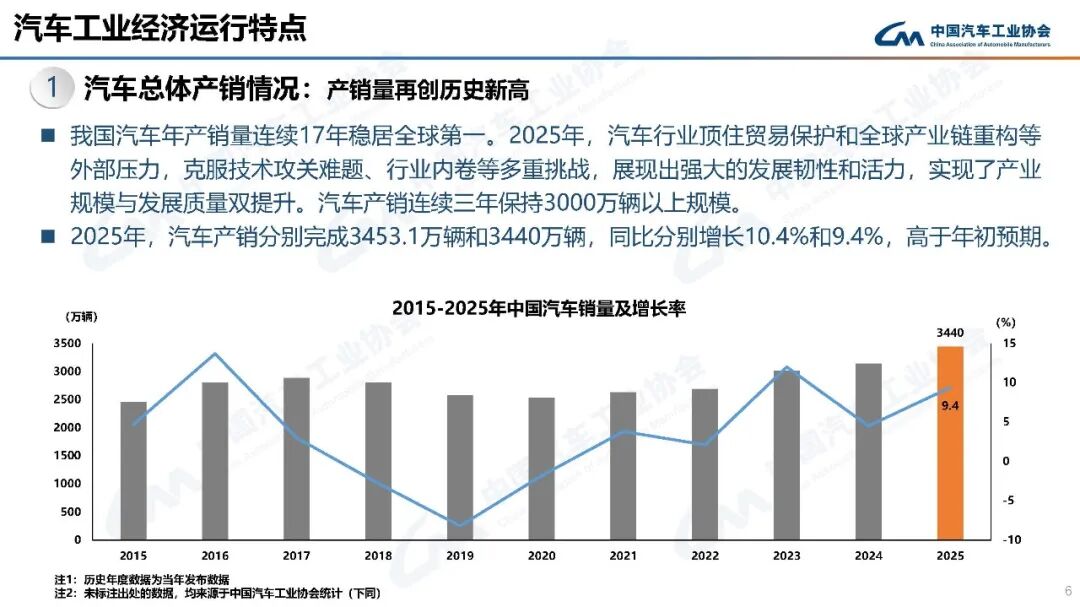
Overall Market - In 2025, China's automotive industry achieved record production and sales, with 34.53 million vehicles produced and 34.40 million sold, marking year-on-year growth of 10.4% and 9.4% respectively, driven by policy support and market dynamics [1][5] - The market demonstrated strong resilience against global trade protectionism, supply chain restructuring, and intensified competition [1] Market Dynamics - The "Two New" policy expanded consumer goods categories and support for equipment upgrades, stimulating vehicle replacement demand, particularly in lower-tier cities [5] - The transition to electric vehicles (EVs) was facilitated by stable tax policies and improved charging infrastructure, lowering barriers for potential EV buyers [5] - Consumer preferences are shifting towards intelligent features and green travel, pushing the market towards higher quality development [5] Segmented Market - In 2025, new energy vehicles (NEVs) became the dominant growth segment, with production and sales reaching 16.63 million and 16.49 million respectively, reflecting year-on-year growth of 29% and 28.2% [6] - NEVs accounted for 47.9% of total new vehicle sales, a 7 percentage point increase from the previous year [6] - The traditional fuel vehicle market is undergoing structural adjustments, with demand for high-displacement, high-fuel-consumption models declining, while smaller, hybrid models remain popular [10] Market Structure - Domestic brands solidified their leading position, with their market share exceeding 60% for the first time, driven by strong performances from companies like BYD, Geely, and Changan [13][15] - BYD led the market with over 4.6 million units sold, benefiting from its technological advancements in NEVs [15] - Joint venture brands faced significant pressure, with declining market shares due to slow adaptation to the NEV market and product homogenization [16] Export Market - In 2025, China's automotive exports exceeded 7 million units, achieving a year-on-year growth of 21.1%, maintaining its position as the world's largest automotive exporter for three consecutive years [18] - Emerging markets in Southeast Asia, the Middle East, and South America remain key destinations for Chinese automotive exports, with NEVs becoming a significant export category [18] Sales Rankings - The top ten automotive brands in 2025 showcased a strong performance from domestic brands, with five spots occupied by them, and a combined market share of 37.3% [21] - BYD, Geely, and Changan maintained their positions through a dual strategy of fuel and NEV offerings [21] - Traditional joint venture brands like FAW-Volkswagen and SAIC Volkswagen continued to experience declines, unable to offset losses from fuel vehicle sales with NEV growth [21] Emerging Brands - New entrants like Leap Motor and Hongmeng Zhixing showed remarkable growth, with Leap Motor doubling its sales through self-developed technology and competitive pricing [23] - Traditional automakers' NEV sub-brands also performed well, rapidly capturing market share through targeted strategies [23] Consumer Trends - Successful models in 2025 aligned with market trends, focusing on price adaptability, user needs, and technological highlights [24] - Family and young consumers emerged as core target groups, with vehicles designed for spaciousness and smart features gaining popularity [26] - The integration of new energy and intelligent technologies became essential for popular models, addressing consumer concerns about range and charging [26] Future Outlook - The strong rise of NEVs indicates China's automotive industry is positioned advantageously in the global transformation of the sector [28] - Continued policy support for NEVs and smart vehicles is expected, alongside growing consumer demand for high-quality, intelligent products [28] - The industry is likely to see further integration across the supply chain, enhancing competitiveness [28]





不做汽车公司,做科技公司,特斯拉核心市场不断失守
3 6 Ke· 2026-01-09 01:50
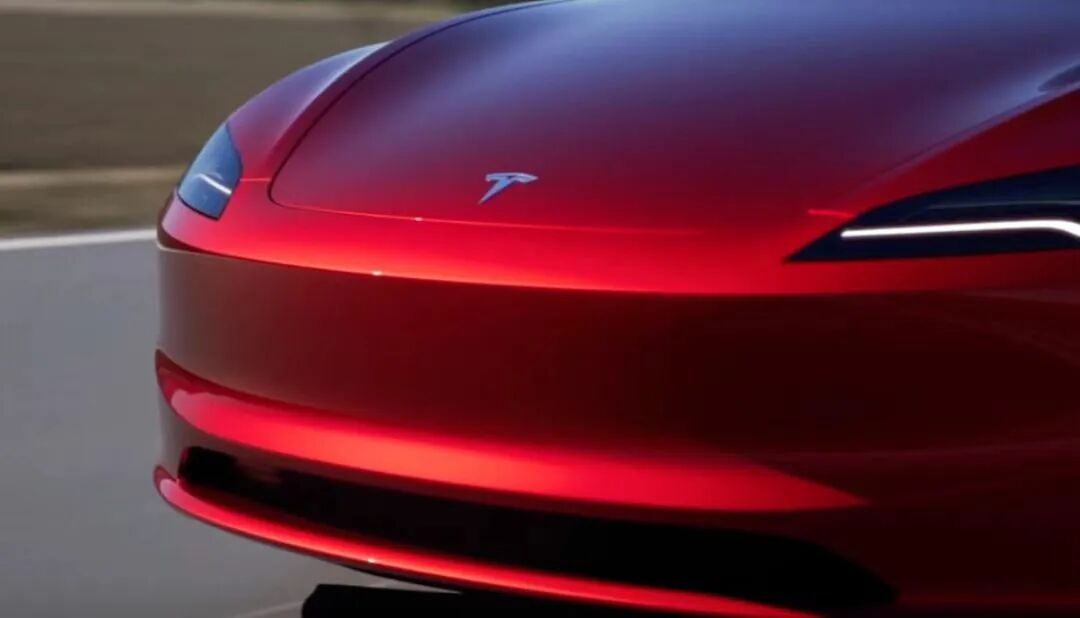
Core Viewpoint - Tesla has lost its title as the global electric vehicle sales leader to BYD, with significant declines in vehicle deliveries and production in 2025, marking the second consecutive year of year-over-year sales shrinkage [2][4][9]. Summary by Sections Tesla's Delivery and Production Data - In Q4 2025, Tesla delivered 418,227 vehicles, a 16% decrease year-over-year. For the entire year, Tesla's deliveries totaled 1.636 million vehicles, down from 1.789 million in 2024, representing an 8.6% decline [2][4]. - The Model 3 and Model Y accounted for 96.8% of Tesla's total deliveries, with 1.585 million units delivered, reflecting a 7% decrease [5][20]. BYD's Performance - BYD sold 4.6 million vehicles in 2025, with pure electric vehicle sales reaching 2.2567 million, a 28% increase year-over-year, surpassing Tesla by approximately 620,000 units [5][9]. - In key European markets, BYD's sales surged, with a 706.2% increase in Germany and a significant presence in the UK, further solidifying its lead over Tesla [9][20]. Market Challenges for Tesla - Tesla's CEO Elon Musk's political comments have negatively impacted sales in Europe and the US, contributing to a 39% drop in European registrations and a 10% decline in US deliveries [8][9]. - The expiration of federal electric vehicle tax credits in the US has diminished Tesla's price competitiveness against traditional vehicles, leading to a decline in demand [10][15]. Strategic Adjustments - To boost sales, Tesla introduced lower-priced versions of the Model Y and Model 3 in Q4 2025, with prices reduced by approximately $5,000 to $5,500 [10][12]. - However, the reduction in features and quality has raised concerns about the overall value proposition of these new models, leading to a drop in stock prices following the announcement [13][22]. Competitive Landscape - Tesla faces increasing competition from both established automakers like Volkswagen, which saw an 89% increase in electric vehicle sales, and new entrants in the Chinese market, such as Li Auto and Aito [8][20]. - The lack of new model launches has intensified sales pressure in China, Tesla's largest market, where sales fell by 7.37% year-over-year [20]. Stock Market Reaction - Following the announcement of declining sales, Tesla's stock experienced significant volatility, with a notable drop of 4.14% shortly after the news, reflecting market skepticism about its valuation and future growth prospects [22].

三位民企科学家当选院士 :为什么是他们
21世纪经济报道· 2025-11-27 02:01
Core Insights - The recent selection of three private enterprise scientists as academicians of the Chinese Academy of Engineering signals a shift in China's technological innovation from academia to market-oriented applications, indicating a more pragmatic approach to resource allocation in technology [1][2][3] - The inclusion of these scientists, such as Lian Yubo from BYD and Wu Kai from CATL, highlights the significant contributions of private enterprises in key technological breakthroughs and the commercialization of innovations [1][2] Group 1: Recognition of Private Enterprises - The election of these academicians reflects the recognition of private enterprises' contributions to new productive forces, with statistics showing that private enterprises account for 70% of national technological innovation achievements and 80% of specialized "little giant" companies [2][3] - The new academicians are not only top scientists but also practical innovators who can transform technology into products, showcasing the importance of private enterprises in driving technological advancements [2][3] Group 2: Evolution of China's Innovation System - The addition of industry practitioners to the academician ranks indicates a shift in China's research evaluation criteria, moving from a focus on publications to valuing technological and industrial contributions [3] - The honor of being an academician serves as a form of "technical certification" for private enterprises, motivating their research and innovation personnel to strive for excellence [3] - The trend suggests that as private enterprises continue to innovate, more researchers from these backgrounds may achieve academician status, fostering a positive cycle of market-oriented research and high-quality economic development [3]



三位民企科学家当选院士 :为什么是他们?|财经早察
2 1 Shi Ji Jing Ji Bao Dao· 2025-11-26 23:12
Core Insights - The recent election of three private enterprise scientists as academicians of the Chinese Academy of Engineering signals a shift in China's technological innovation focus from academic laboratories to market-oriented resource allocation [1][2][3] - The inclusion of these scientists, particularly from companies like BYD and CATL, highlights the growing importance of private enterprises in driving technological breakthroughs and industrial application [1][2] Group 1: Key Figures and Contributions - Lian Yubo, the chief scientist at BYD, is recognized for leading the development of transformative technologies such as blade batteries and DM hybrid technology, which have established a technological moat for the company [1] - Wu Kai from CATL is noted for his role in the development of the Kirin battery and the Shenzhou supercharging battery, achieving significant advancements in lithium-ion battery technology [1] - Huang Xianbo, CTO of Jinfat Technology, has made significant contributions in the field of polymer materials, focusing on environmentally friendly flame retardant materials and biodegradable plastics [2] Group 2: Implications for Private Enterprises - The election of these academicians reflects national recognition of the contributions of private enterprises to technological innovation, with private companies accounting for 70% of the country's technological innovation achievements [2] - The trend indicates that private enterprises will continue to play a crucial role in technological advancements and the commercialization of innovations [2][3] - The inclusion of industry practitioners in the academic community suggests a shift in research evaluation criteria, emphasizing practical contributions alongside traditional academic achievements [3]
宁德时代、比亚迪、金发科技出院士了!
Mei Ri Jing Ji Xin Wen· 2025-11-22 03:35
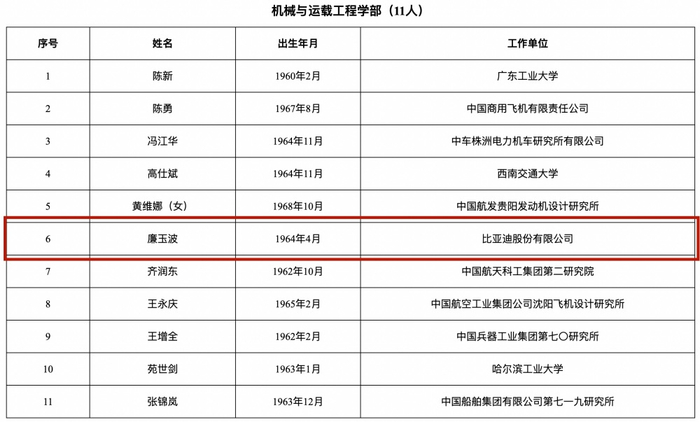
Core Points - The Chinese Academy of Sciences and the Chinese Academy of Engineering announced the results of the 2025 academician election, with three experts from private enterprises being elected as academicians, marking a significant shift in representation from traditional academic institutions to industry leaders in the new energy vehicle sector [1] Group 1: Academicians from Private Enterprises - Lian Yubo from BYD, Wu Kai from CATL, and Huang Xianbo from Kingfa Technology were elected as academicians, highlighting the increasing recognition of contributions from private sector experts in engineering [1] - This election marks the first time that leaders from the new energy vehicle industry have been elected as academicians, breaking the previous norm where academicians predominantly came from universities and research institutions [1] Group 2: Profiles of Elected Academicians - Lian Yubo, born in 1964, is a senior engineer and has been instrumental in developing over 20 models and 100 variants of fuel and new energy vehicles at BYD since joining in 2004, contributing to the company's sales of 4.27 million vehicles [2][3] - Wu Kai, born in 1968, is the chief scientist at CATL and has led innovations in lithium-ion battery technology, achieving breakthroughs that have allowed for the domestic production of high-performance batteries, surpassing Japanese and Korean competitors [5][7] - Huang Xianbo, with a PhD in applied chemistry, has focused on high-performance materials for automotive applications and has contributed significantly to the development of functional polymer materials in China [8] Group 3: Significance of the Election - The election of these academicians reflects a broader trend of integrating industry expertise into the academic and research community, which is crucial for driving innovation and economic transformation in China [10] - The recognition of private sector contributions to science and technology is expected to enhance the collaboration between academia and industry, fostering a more robust innovation ecosystem [10]

这3位民营企业专家,当选中国工程院院士!
Mei Ri Jing Ji Xin Wen· 2025-11-22 02:48
Group 1 - Three experts from private enterprises were elected as academicians of the Chinese Academy of Engineering, including Lian Yubo from BYD, Huang Xianbo from Kingfa Technology, and Wu Kai from CATL [1][4][8] - Lian Yubo, the chief scientist and automotive chief engineer at BYD, has led the development of over 20 fuel and new energy vehicle models, contributing to BYD's strong position in the new energy vehicle sales rankings since 2016 [2][4] - Huang Xianbo, the chief technology officer at Kingfa Technology, has focused on high-performance automotive materials and has contributed significantly to the development of functional polymer materials in China [5][4] Group 2 - Wu Kai, who has served as the chief scientist at CATL, has a background in electrochemical energy storage technology and continues to lead research in this area after resigning from his position as vice president [8][9] - Kingfa Technology operates 64 subsidiaries and has established R&D and production bases in regions such as South Asia, North America, and Europe, providing services to over 1,000 well-known enterprises globally [5][7] - BYD's core technologies, including blade batteries and DM hybrid technology, are attributed to Lian Yubo's leadership and innovation efforts [2][4]
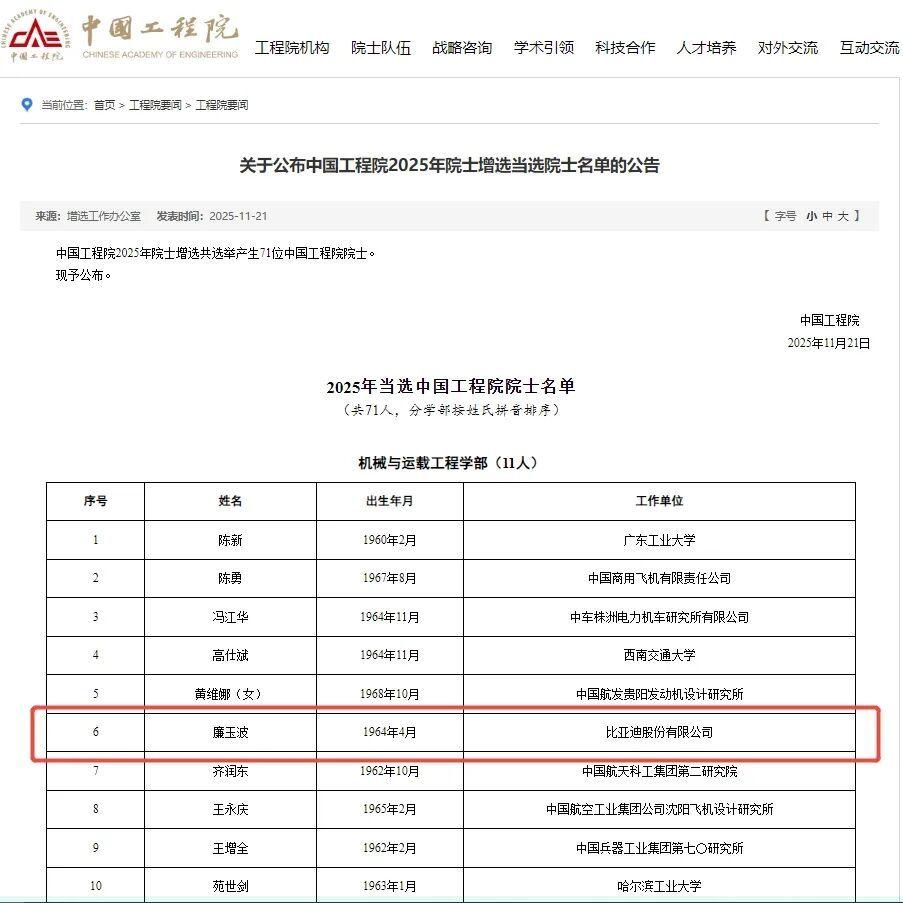
新增25名“企业院士” 彰显产业界科技力量
Nan Fang Du Shi Bao· 2025-11-21 16:17
Group 1 - The 2025 election results for academicians revealed a total of 144 elected individuals, with 73 from the Chinese Academy of Sciences and 71 from the Chinese Academy of Engineering, highlighting a significant representation from enterprises [1] - Among the newly elected academicians, 22 are from central enterprises, and 3 are from private enterprises, indicating a notable presence of industry experts in the academic community [1] - The Chinese Academy of Engineering emphasized the alignment of the election process with national strategic needs and the importance of technological innovation in driving new productive forces [1] Group 2 - The election results reflect a shift in the talent and technology evaluation system, recognizing the contributions of individuals like Lian Yubo from BYD, who has played a crucial role in technological breakthroughs and industrial innovation [2] - The traditional model of enterprise-led technological innovation, driven by market demands, has both advantages and challenges, with high R&D costs being a significant hurdle for companies [2] - The majority of "enterprise academicians" come from strong central enterprises, with a need for continued policy support to sustain this trend, as government backing is critical for advanced technology research [3]
新增25名“企业院士”,彰显产业界科技力量
Nan Fang Du Shi Bao· 2025-11-21 16:09
Group 1 - The 2025 election results for the Chinese Academy of Sciences and the Chinese Academy of Engineering revealed that 144 individuals were elected, with 73 from the Chinese Academy of Sciences and 71 from the Chinese Academy of Engineering [2] - A notable 22 out of the 71 newly elected Chinese Academy of Engineering academicians are from central enterprises, while 3 are from private enterprises, indicating a significant presence of industry professionals in the academic sphere [2] - The Chinese Academy of Engineering emphasized the importance of aligning the election process with national strategic needs and technological innovation to enhance productivity [2][4] Group 2 - The election results reflect a shift in the evaluation of talent and technology, recognizing the contributions of individuals like Lian Yubo from BYD, who has played a crucial role in technological advancements and market-oriented innovation [3] - Historically, corporate-led technological innovation has been market-driven, which has its advantages in terms of rapid technology validation but also poses challenges due to high R&D costs [3] - The trend of corporate academicians is primarily seen among strong central enterprises, with a need for continued policy support to sustain this momentum in technological research and innovation [4]
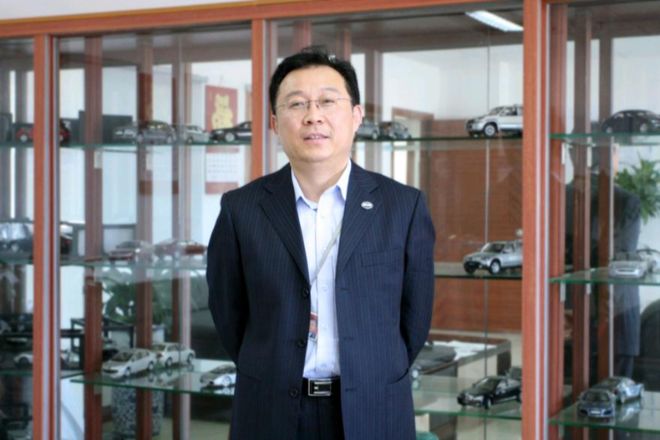
民企科研力量!比亚迪廉玉波当选中国工程院院士
Nan Fang Du Shi Bao· 2025-11-21 08:37
Core Points - BYD's chief scientist, Lian Yubo, has been elected as an academician of the Chinese Academy of Engineering, marking a significant recognition in the field of engineering science and technology in China [1][2][3] - Lian Yubo is recognized as the "technical soul" of BYD and has played a crucial role in the company's transition from traditional fuel vehicles to new energy vehicles [1][5] - The 2025 election of academicians included 71 individuals, with Lian Yubo being one of the notable figures in the new energy sector [2][5] Company Overview - Lian Yubo has been with BYD for over 20 years, leading the development of over 20 vehicle models and more than 100 products, significantly contributing to the company's success in the new energy vehicle market [5] - Under Lian's leadership, BYD has developed key technologies such as blade batteries, DM hybrid technology, CTB integrated body, and cloud rail systems, which are essential for the company's competitive edge in the industry [5] - In 2023, Lian Yubo was appointed as BYD's chief scientist, continuing to focus on the intelligent transformation of new energy vehicles while also serving as the chief engineer and director of the automotive engineering research institute [5] Industry Context - The election of Lian Yubo coincides with the recognition of other key figures in the new energy industry, such as Wu Kai from CATL and Huang Xianbo from Jinfat Technology, highlighting the importance of leadership in core technology areas including vehicle development, power batteries, and new materials [5]
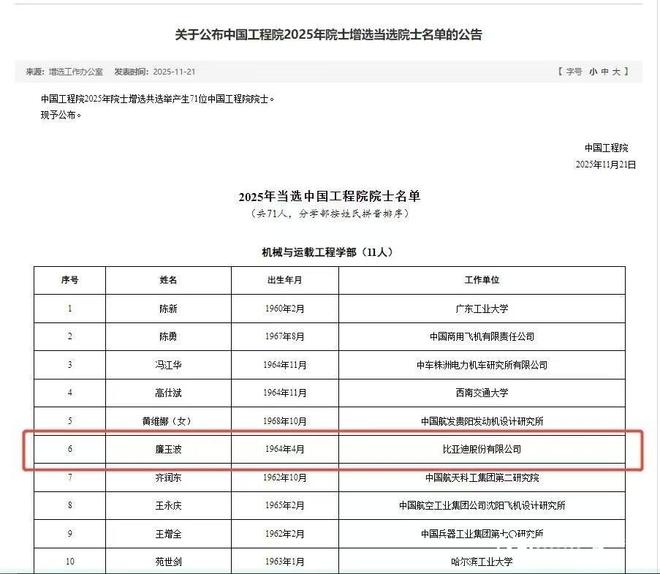
多位民企专家当选中国工程院院士,比亚迪廉玉波、宁德时代吴凯等入选
Xin Lang Cai Jing· 2025-11-21 06:36
Core Points - The Chinese Academy of Engineering announced the results of the 2025 academician election, with experts from several private enterprises, including BYD and CATL, successfully elected [1][10] - The total number of academicians in the Chinese Academy of Engineering now stands at 1002, including 148 foreign academicians [11] Group 1: BYD - Lian Yubo, the Chief Scientist and Chief Engineer of BYD, was elected as an academician. He has a background in aircraft manufacturing and has been with BYD since 2004, leading the development of over 20 vehicle models and 100 products, including the popular Dynasty series in the new energy vehicle market [1][4] - Lian Yubo has contributed significantly to the development of core technologies such as the blade battery and DM hybrid technology at BYD [4] Group 2: CATL - Wu Kai, the Chief Scientist of CATL, was also elected as an academician. He has a strong academic background with degrees from Shanghai Jiao Tong University and has been with CATL since 2011 [1][7] - Wu Kai's team has achieved significant breakthroughs in high-performance power batteries, including the invention of a "nano-rivet" reinforcement method and a new process for winding-type battery electrodes [7] Group 3: Jinfa Technology - Huang Xianbo, the Chief Technology Officer of Jinfa Technology, was elected as an academician. Jinfa Technology is a leading company in the field of polymer materials and has established multiple large-scale production bases for new materials [1][8] - Huang Xianbo has been with Jinfa Technology since 1997 and has played a key role in advancing domestic modified plastic technology [8]