
Gemini 3 模型

Search documents
谷歌母公司Alphabet市值达3.88万亿美元,2019年来首次超越苹果
Sou Hu Cai Jing· 2026-01-08 08:16
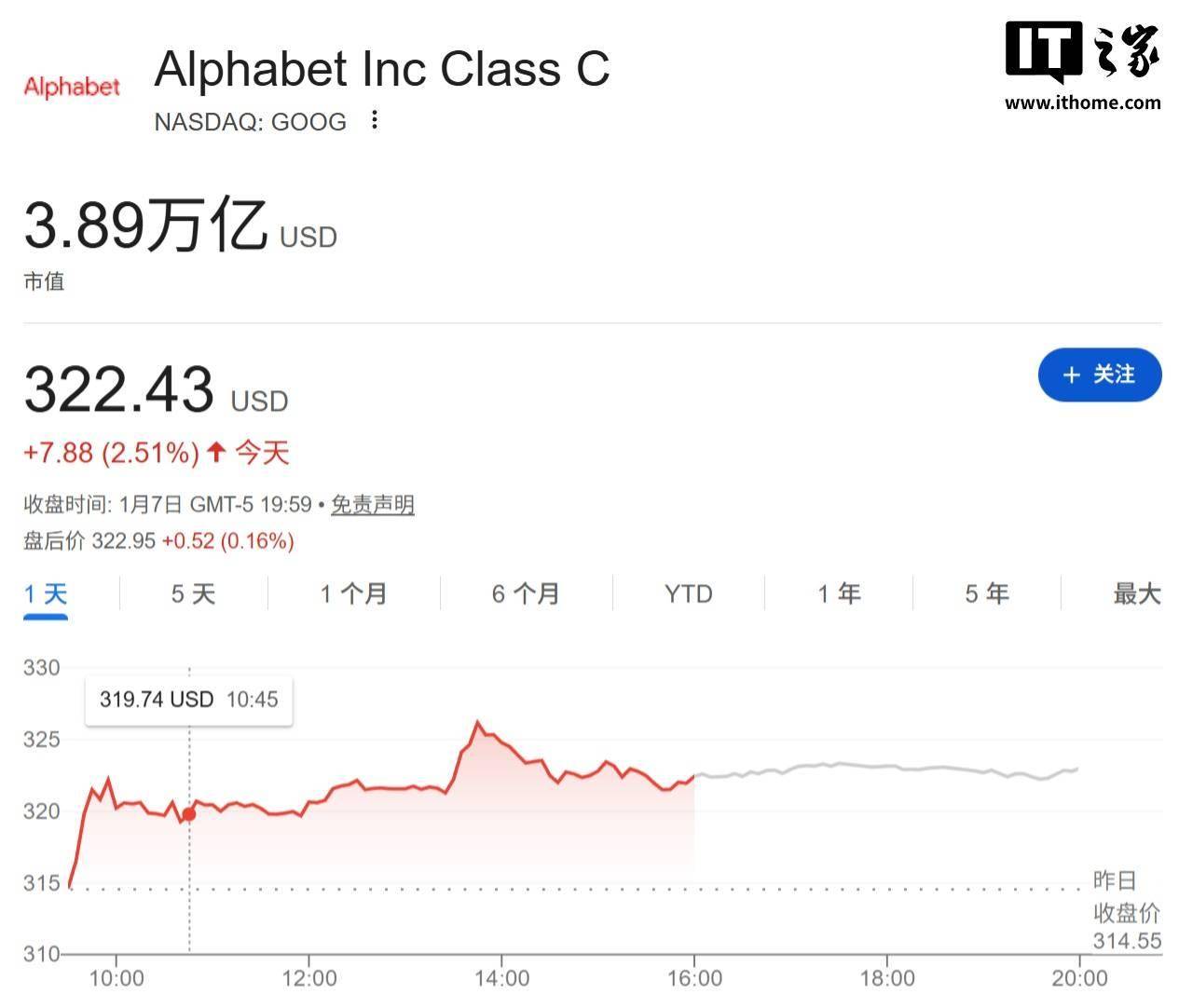
Core Viewpoint - Alphabet's market capitalization has surpassed Apple's for the first time since 2019, reaching $3.88 trillion compared to Apple's $3.84 trillion [1][8]. Group 1: Market Performance - Alphabet's stock price increased by over 2% to close at $322.03, while Apple's stock has declined by over 4% in the past five trading days [8]. Group 2: Future Outlook - Alphabet is expected to achieve a strong rebound by the end of 2025, attributed to its successful development of a comprehensive AI ecosystem [8]. - The company released its seventh-generation Tensor Processing Unit (TPU) Ironwood in November 2025, which is seen as a strong competitor to Nvidia's products [8]. - In December, Google launched the Gemini 3 model, which received a positive market response, contributing to a projected 65% increase in Alphabet's stock price for the entire year of 2025, marking its best annual performance since the 2009 financial crisis [8]. Group 3: Business Growth - Alphabet's CEO Sundar Pichai highlighted the company's proactive response to the surging demand for AI, revealing that the number of deals worth over $1 billion signed by Google Cloud in the first three quarters of 2025 has exceeded the total from the past two years [8].



Google布局全栈AI,服务器、交换机带动高多层PCB爆发
2025-12-04 15:37
Summary of Conference Call Records Company and Industry Overview - The conference call focuses on Google and the AI infrastructure industry, particularly in relation to the demand for servers, switches, and high-layer PCBs [1][2][3]. Key Points and Arguments Google’s AI Strategy - Google has a comprehensive layout in the AI sector, possessing the largest global data ecosystem, which includes TPU chips, the Gemini AI model, and various application scenarios [2][4]. - The Gemini 3 model and its application, Nano Banana, have shown exceptional performance, leading to a surge in user numbers from 450 million to 650 million, significantly increasing the demand for computational power [4]. Capital Expenditure and Demand - Capital expenditure (Capex) is expected to continue rising, closely linked to the construction of computational infrastructure, alleviating concerns over demand for servers and switches [2][3]. - The PCB segment is anticipated to see increased demand due to the replacement of copper cables and chip upgrades, with significant growth expected in the coming years [2][3]. TPU Chip Developments - Google has launched the V7 TPU chip, expected to enter mass production by mid-2026, with projected shipments reaching 4 million units [1][5]. - The V7 TPU cabinet design will increase from 20 layers to 34-36 layers, with material upgrades leading to a price increase of two to three times [5]. Switch and Module Upgrades - The industry will primarily focus on 800G switches in 2025, transitioning to 1.6T switches in 2026, with PCB specifications nearly doubling in price [3][6]. - The 1.6T optical module will utilize finer line widths, significantly increasing its value compared to the 800G module [6][7]. Supply and Demand Forecast - The computational PCB segment is expected to remain in a tight supply-demand situation until the end of 2025, with Google's procurement expected to triple from approximately 5 billion RMB to over 15 billion RMB [8]. - The ASIC sector is projected to grow from under 10 billion RMB in 2024 to nearly 80 billion RMB by 2027, indicating an eightfold increase [8]. - Due to the capital-intensive nature of the PCB industry, new capacity expansion will take time, suggesting a continued tight supply in the next 1-2 years, presenting investment opportunities [8]. Additional Important Insights - Key players in the industry, such as Huadian Technology, Pengding Holdings, and Shenghong Technology, along with upstream material suppliers, are recommended for investment consideration due to the high demand for multi-layer PCBs [8]. - The transition from lower-grade to higher-grade materials, such as from Ma Seven to Ma Nine copper-clad resin, is crucial for meeting the increasing demand for high-layer PCBs [8].
2025 年最后一个月开启,本周需关注这些要点
Xin Lang Cai Jing· 2025-12-01 12:46
Market Overview - The Nasdaq Composite Index ended a seven-month winning streak, while the S&P 500 Index is just 1% away from its all-time high [1] - Despite a positive performance in the last five trading days of November, the overall month was volatile, with concerns over AI bubble affecting major stocks [1] - Notable declines included Meta down 13%, Nvidia down approximately 8%, and Oracle down nearly 30% [1] - Google was an exception, with a strong earnings report and a reported multi-billion dollar AI chip deal with Meta, leading to a 20% increase in its stock price [1] Federal Reserve and Economic Outlook - Investors are focused on the probability of a Federal Reserve rate cut in December, currently estimated at 86.9% for a 25 basis point reduction [2] - The Federal Reserve has entered a "quiet period" ahead of the FOMC meeting scheduled for December 9-10 [2] - Reports indicate that the Trump administration is nearing a decision on the next Federal Reserve Chair, with Kevin Hassett as a leading candidate [2][3] Corporate Earnings and Economic Data - Upcoming earnings reports include Dollar Tree, Dollar General, and Five Below, along with tech companies like Salesforce and CrowdStrike [3] - Economic data releases this week will include reports on manufacturing and service activities, as well as the ADP monthly private sector employment report [3] Wall Street's Optimism for 2026 - Wall Street strategists are optimistic about the stock market's future, with JPMorgan predicting the S&P 500 Index could rise from 6,849 points to 7,500 points by the end of 2026, a nearly 10% increase [5] - If the Federal Reserve continues to cut rates, the index could potentially exceed 8,000 points [5] - HSBC and Deutsche Bank share similar bullish forecasts for the S&P 500, both linking their predictions to AI-related transactions [6] Market Volatility and Future Expectations - The current market volatility is seen as a "toll" that investors pay on the road to achieving substantial long-term returns [7] - The market is expected to experience fluctuations as it transitions from AI innovation to a more efficient and profitable business environment [6]
谷歌产业链梳理
2025-11-28 01:42
Summary of Google Industry Chain Conference Call Industry Overview - The conference call focuses on Google's comprehensive AI industry chain, which includes the Gemini model, TPU chips, data centers, and network technology, providing a significant advantage in the AI field [2][3][4]. Key Points and Arguments AI Industry Chain - Google is transitioning from a traditional internet giant to a comprehensive AI industry chain company, moving beyond reliance on search, advertising, and other traditional internet businesses [3][4]. - The Gemini 3 model is a native multimodal model that enhances reasoning performance by processing various data types and benefits from Google's ecosystem data support and TPU architecture optimization, reducing training costs [2][5]. TPU Chips - TPU chips are a key competitive advantage for Google, with continuous improvements in computing density, reasoning performance, and energy efficiency, significantly lowering the training costs of large models [2][6]. - The demand for TPUs is expected to reach 4 to 5 million units by 2026, with a TPU to OCS module ratio of 1:1.5, indicating a substantial increase in OCS module demand [3][17]. Domestic Beneficiaries - Domestic optical module manufacturers like Xinyi and Xuchuang benefit from collaboration with Google, with Xinyi expected to supply 800G optical modules and Xuchuang holding a leading market share in the 800G and 1.6T markets [2][7]. - The demand for MPO (multi-fiber parallel connectors) is expected to rise alongside optical module growth, with Changxin Bochuang projected to achieve significant revenue growth due to strong demand from Google [2][7]. OCS Development - The OCS (Optical Circuit Switch) segment is in its early to mid-development stage, with companies like Yokogawa Electronics and Fukui Electronics showing potential [3][8]. - Google's OCS solution plays a critical role in its data center architecture, utilizing MEMs technology to optimize power consumption, although efficiency and latency improvements are still needed [3][10]. Market Demand and Investment Insights - Recent orders, such as Fujii's order for over 80 million RMB worth of OCS switches, indicate a clear market demand for OCS technology [3][16]. - For investment strategies, optical modules are considered a stable choice, while the OCS segment offers greater elasticity for potential returns [3][20]. Additional Important Content - The integration of MEMs technology in OCS switches is highlighted, with a focus on its advantages in power optimization and the need for further efficiency improvements [3][11][13]. - The core value of components in OCS switches, such as liquid crystal components valued at approximately $40,000 per unit, is discussed, along with the overall market dynamics and pricing trends [3][14][15]. This summary encapsulates the key insights from the conference call, emphasizing Google's strategic positioning in the AI industry and the implications for associated sectors and investment opportunities.
宏观经济分析报告:美联储决策迷雾未散,市场波动加大
Capital Securities· 2025-11-26 11:59
Group 1: Federal Reserve and Market Trends - The core driver of the global market is the significant weakening of the Federal Reserve's interest rate cut expectations, leading to liquidity concerns and a shift towards risk-averse strategies[3] - The performance of various assets has formed a risk-averse hierarchy: USD > US Treasuries > Gold/Silver > Equity Assets > Bitcoin[10] - The unemployment rate rose to 4.4% in September, despite a strong addition of 119,000 jobs, which exceeded market expectations of 51,000[15] Group 2: AI Sector Insights - Market focus is shifting from AI infrastructure development to the verification of AI application commercialization capabilities[16] - Nvidia's Q4 performance and revenue guidance exceeded expectations, indicating sustained high demand for AI infrastructure[16] - Google’s stock was the only one among the "Magnificent Seven" to rise, increasing by 8.4%, due to its effective response to investor concerns about AI profitability[22] Group 3: Market Volatility and Risks - Increased volatility in US stock and bond markets has been observed since November, influenced by market microstructure factors[17] - The investment-grade credit spread in the US has risen from low levels since November, reflecting cautious market sentiment regarding profitability in the AI sector[18] - Key risks include uncertainties in the Federal Reserve's policy path, slower-than-expected AI commercialization processes, and external shocks[21]
谷歌:从 “护城河” 保卫战到增长新引擎
美股研究社· 2025-11-25 10:22
Core Viewpoint - Google's AI strategy has made significant progress, alleviating previous market concerns about the impact of generative AI on its core search and advertising business [1] Group 1: Google Cloud Platform (GCP) - Google Cloud Platform (GCP) has emerged as a key beneficiary in the multi-cloud strategy, benefiting from cost-effectiveness and recent outages of competitors like Microsoft Azure and Amazon Web Services (AWS) [3] - The market environment is structurally favorable for GCP, enhancing its relevance and adoption rates [3] Group 2: AI Growth Drivers - The commercialization of AI is currently constrained by insufficient infrastructure supply, despite increased capital expenditures and accelerated server deployments [5] - Google has a significant advantage in addressing this bottleneck, boosting market confidence in the sustainability of its cloud business growth [5] Group 3: Capital Expenditure and TPU - Google has raised its 2025 capital expenditure forecast to between $91 billion and $93 billion, primarily directed towards AI infrastructure [6] - The Tensor Processing Unit (TPU) has become a key growth engine for Google Cloud, with the latest "Gemini 3 model" receiving high praise for its performance [6][9] - The Ironwood TPUv7 has shown a tenfold performance increase over TPUv5, enhancing the efficiency of AI workloads [9] Group 4: AI Commercialization Pathways - Google's AI technology stack is independent and covers a wide range of applications, allowing for vertical integration across its platforms [12] - The integration of AI into core search and advertising functions has alleviated initial concerns about generative AI disrupting these areas, leading to accelerated revenue growth [12][13] Group 5: Financial Outlook - Google's revenue is projected to grow by 14% year-over-year in 2025, reaching $400.1 billion, with Google Cloud expected to be a core growth driver [17] - The profitability of Google Cloud is anticipated to expand alongside its growth, offsetting rising costs associated with AI strategy implementation [18] Group 6: Conclusion - Google's AI strategy has fundamentally reshaped its long-term commercial prospects, introducing new growth engines and enhancing the visibility of its profitability [19] - The ongoing advancements in AI integration are expected to solidify Google's competitive position, even amid potential cyclical downturns in advertising budgets [20]
英伟达财报+谷歌新模型,指引AI板块盘整后再出发!
2025-11-24 01:46
Summary of Key Points from Conference Call Company: NVIDIA Financial Performance - NVIDIA's Q3 revenue increased by 205% year-over-year, reaching $57 billion, with a gross margin of 73.6% [1][2] - For Q4, the company expects a revenue midpoint of $65 billion, representing a 65% year-over-year growth, with an adjusted gross margin target of 75% [1][2] - NVIDIA anticipates maintaining a gross margin in the mid-70% range for fiscal year 2026, alleviating market concerns regarding potential impacts from storage price increases and ASIC advancements [1][2] Supply Chain and Manufacturing - NVIDIA is enhancing supply chain resilience by collaborating with TSMC to produce Blackwell wafers in the U.S. and expanding manufacturing capabilities with partners like Foxconn and Anker [1][4] - The company aims to ship 20 million units of Blackwell and Ruby series by 2026, targeting $50 billion in revenue, with potential upward adjustments [1][4] - New procurement agreements from Saudi Arabia are valued at approximately $10 billion, and additional collaboration with Anthropic is expected to generate $30-35 billion in demand [1][4] AI Market and Investment Strategy - NVIDIA's CEO Jensen Huang addressed concerns about AI bubbles and GPU depreciation cycles, asserting that a 5-6 year depreciation period for GPUs is reasonable and can extend with increased inference workloads [1][5] - The company maintains a proactive investment strategy in AI, ensuring that investments are contingent on the successful development of AI systems by partners [1][7] Market Demand and Supply Issues - NVIDIA faces a strong demand for GPUs, with many older models still in high demand, indicating a robust market environment [1][8] - Corwave reported a 95% renewal rate for H100 contracts, reflecting strong market demand for NVIDIA's products [1][8] Company: Google Product Launch and Market Impact - Google's release of the Gemini 3 model has positively impacted its stock and that of other cloud providers, indicating overall growth in the AI market [1][3][6] - Gemini 3 Pro achieved top scores in 19 out of 20 industry benchmarks, showcasing its superior performance in inference, multi-modal tasks, and programming capabilities [1][9] Industry Dynamics - The launch of Gemini 3 demonstrates the effectiveness of pre-training scaling laws and intensifies competition among major players in multi-modal technology [1][10] - Google's high pricing strategy for its top-tier models suggests that premium models can command higher fees, creating unique barriers and driving increased investment in computational power across the industry [1][10] Market Sentiment - Discussions around AI bubble risks have eased, with NVIDIA's financial results and Google's model launch contributing to a positive outlook for AI technology and its commercial applications [1][11][12]

中泰国际每日晨讯-20251120
ZHONGTAI INTERNATIONAL SECURITIES· 2025-11-20 05:10
Market Overview - On November 19, Hong Kong stocks experienced narrowed volatility, opening high but trending downwards, fluctuating between 25,742 and 26,045 points. The Hang Seng Index closed at 25,830 points, down 99 points (0.4%) [1] - The Hang Seng Tech Index fell by 38 points (0.7%), closing at 5,606 points, with total market turnover slightly decreasing to HKD 211.4 billion [1] - Net inflow from the Hong Kong Stock Connect further decreased to HKD 6.59 billion [1] Company Performance - Xiaomi Group (1810 HK) reported a 22.3% year-on-year increase in revenue for Q3, but a 2.4% quarter-on-quarter decline, meeting expectations. However, concerns over rising memory costs and slowing smartphone demand pressured the company's gross margin, leading to a 4.8% drop in stock price [4] - The electric vehicle segment recorded quarterly profitability, but the outlook for the new energy vehicle industry has become increasingly pessimistic, compounded by the expiration of tax exemption policies next year [4] Industry Dynamics Automotive Sector - The overall new energy vehicle sector has been trending downwards, with companies like NIO and Li Auto experiencing declines of 0.3% to 2.6% [4] Pharmaceutical Sector - The Hang Seng Healthcare Index fell by 1.7%, but major companies saw limited declines. The National Medical Products Administration is expected to approve 43 innovative drugs by mid-2025, reflecting improved R&D capabilities among Chinese firms and government support for innovation [4] - BeiGene (6160 HK) announced positive clinical research results for its HER2-targeted bispecific antibody, leading to a 1.0% increase in its stock price [4] Renewable Energy and Utilities - The renewable energy sector showed mixed performance, with the photovoltaic segment continuing to decline. Companies like Xinyi Solar (968 HK) and Flat Glass Group (6865 HK) fell by 1.4% to 1.6% [5] - Some environmental stocks received support due to their high dividends and stable business models, with companies like China Everbright Environment (257 HK) and GCL-Poly Energy (1330 HK) rising by 1.2% to 2.0% [5]