L3级有条件自动驾驶功能

Search documents
两款L3级自动驾驶车型获工信部准入许可 北京重庆率先试点
Zhong Guo Zhi Liang Xin Wen Wang· 2025-12-24 06:15
Core Viewpoint - The Ministry of Industry and Information Technology of China has approved the first batch of smart connected vehicles equipped with L3 level conditional autonomous driving functions, specifically models from Changan Automobile and BAIC Blue Valley Magna Automotive [1] Group 1: Approved Models - Changan's SC7000AAARBEV electric sedan can achieve autonomous driving in congested traffic environments on highways and urban expressways at a maximum speed of 50 km/h, limited to specific routes in Chongqing [1] - The Arcfox BJ7001A61NBEV electric sedan can perform autonomous driving on highways and urban expressways at a maximum speed of 80 km/h, restricted to designated routes in Beijing [1] Group 2: Next Steps - Changan Automobile and Beijing Travel Automotive Service will conduct road trials for the approved models in the specified areas [1] - The Ministry of Industry and Information Technology will collaborate with relevant departments and local authorities to enhance vehicle operation monitoring and safety assurance, while continuously improving the management and regulatory framework for smart connected vehicles [1]


L3级来了!试点为什么是北京、重庆?
新华网财经· 2025-12-19 07:04
Core Viewpoint - The Ministry of Industry and Information Technology has officially announced the first batch of L3-level conditional autonomous driving vehicle permits in China, with two models set to be tested in designated areas of Beijing and Chongqing, marking a significant step towards the practical application of autonomous driving technology in the country [1][9]. Group 1: Pilot Cities and Rationale - Beijing and Chongqing were chosen as pilot cities due to their advantages in data accumulation and diverse traffic scenarios, allowing for effective testing of the autonomous systems in different environments [3][9]. - The pilot program is limited to specific routes in these cities, focusing on safety and gradual implementation, with a maximum speed limit of 80 km/h on designated highways [3][9]. Group 2: Approved Models and Testing - The two approved models are designed for highway and urban congestion scenarios, reflecting the need for tailored solutions in varying traffic conditions [3][5]. - The Ministry has conducted comprehensive assessments of the pilot enterprises' R&D, testing, and emergency response capabilities, ensuring that only qualified entities are selected for the pilot program [7][9]. Group 3: Implications for Drivers and Consumers - L3-level conditional autonomous driving allows the system to act as a "temporary driver" under specific conditions, but drivers must be ready to take control when requested, emphasizing that human drivers remain the primary responsible party [6][8]. - Currently, the autonomous driving features are not available for personal vehicle owners and are limited to pilot operating units, with consumers able to experience the technology through ride-hailing services [8][9]. Group 4: Industry Opportunities - The pilot signifies a shift from technical validation to mass application of autonomous driving in China, indicating that intelligent technology has become a necessity for automotive companies [9]. - The rollout of L3-level autonomous driving encompasses the entire vehicle ecosystem, including components and software, highlighting the importance of safety and maturity in technology development [9].


国联民生证券:L3级自动驾驶商业化加速 行业有望开启发展新阶段
Zhi Tong Cai Jing· 2025-12-17 06:24
Group 1 - The Ministry of Industry and Information Technology officially announced the first batch of L3 conditional autonomous driving vehicle permits in China, marking a significant step towards the commercialization of L3 autonomous driving [1] - Two models, one from Changan Automobile and another from BAIC BluePark, have received conditional approval for L3 autonomous driving capabilities, with specific operational areas designated in Chongqing and Beijing [1] - The Changan SC7000AAARBEV can operate in congested traffic at speeds up to 50 km/h, while the Arcfox BJ7001A61NBEV can operate at speeds up to 80 km/h on designated highways [1] Group 2 - Multiple domestic automakers, including Changan, BYD, GAC, Dongfeng, SAIC, Geely, Xpeng, and Li Auto, have made substantial progress in the L3 autonomous driving sector, with several models receiving road testing permits [2] - Huawei's QianKun Intelligent Driving ADS L3 solution is undergoing internal testing across multiple cities and models, while GAC's A800 has obtained a license for L3 testing at speeds of up to 120 km/h in Guangzhou [2] - The PhiGo Max, developed by 4D Mapping and its subsidiary, is set for mass production in 2026, targeting the high-end L3 intelligent driving market [2]




计算机行业事件点评:L3级自动驾驶商业化加速,行业有望开启发展新阶段
Guolian Minsheng Securities· 2025-12-17 02:42
Investment Rating - The report maintains a "Recommended" rating for the industry, indicating an expected stock price increase of over 15% relative to the benchmark index within the next 12 months [2][7]. Core Insights - The approval of the first batch of L3 conditional autonomous driving vehicles in China marks a significant step towards commercialization, with two models set to begin trials in designated areas of Beijing and Chongqing [1][5]. - The report highlights that multiple domestic automakers, including Changan, BYD, and GAC, have made substantial progress in the L3 autonomous driving sector, with several models receiving road testing permits [5]. - The report emphasizes the importance of the L3 level autonomous driving technology in enhancing road safety and the need for regulatory improvements in traffic laws and insurance [5]. Summary by Sections Industry Overview - The Ministry of Industry and Information Technology has granted conditional approval for L3 autonomous driving vehicles, allowing for specific operational scenarios in urban and highway settings [1][5]. - The report notes that the L3 vehicles can operate at speeds of up to 80 km/h in designated areas, with specific routes identified for testing in Chongqing and Beijing [5]. Market Development - The report identifies a turning point for the industry, as several companies are actively developing L3 technology, with notable advancements from firms like Huawei and GAC [5]. - The report suggests that the commercialization of L3 autonomous driving will significantly impact the overall development of the autonomous driving industry in China [5]. Investment Recommendations - The report recommends focusing on companies involved in the autonomous driving sector, including companies like Zhongke Chuangda, Siwei Tuxin, and others, as they are expected to benefit from the advancements in L3 technology [5].
L3级自动驾驶车型获附条件准入许可 商业化落地迎来关键节点
Xin Hua She· 2025-12-16 13:41
Core Insights - The Ministry of Industry and Information Technology has officially announced the first batch of L3 conditional autonomous driving vehicle permits in China, marking a significant step from testing to commercial application for L3 autonomous driving [2] Group 1: Vehicle Details - Two models have been approved: a Changan brand electric sedan and a Jihe brand electric sedan, both capable of autonomous driving in congested traffic and on highways, but limited to specific routes in Beijing and Chongqing [3] Group 2: Technology Differentiation - The core difference between L2 assisted driving and L3 conditional autonomous driving lies in the role and responsibility division between the system and the driver, with L3 offering a leap from "assisted driving" to "system-led" experience [4] Group 3: Safety and Regulation - China emphasizes safety as a prerequisite for innovative applications, establishing a systematic approach that covers key technology research, testing evaluation, policy regulations, and scenario validation [5] - The Ministry of Industry and Information Technology plans to collaborate with relevant departments and local authorities to enhance vehicle operation monitoring and safety assurance, continuously improving the management and regulatory framework for intelligent connected vehicles [6]

中国自动驾驶商业化迈出关键一步!长安深蓝和北汽蓝谷两款L3级车型首批获准上路
Ge Long Hui· 2025-12-15 12:24
Core Viewpoint - The Ministry of Industry and Information Technology of China has officially approved two models of smart connected vehicles equipped with L3 level conditional autonomous driving capabilities for road use, marking a significant step in the commercialization of intelligent connected vehicles in China [1] Group 1: Approval of Vehicles - The two approved models are the Changan SC7000AAARBEV electric sedan and the Arcfox BJ7001A61NBEV electric sedan, corresponding to the Deep Blue SL03 and Arcfox Alpha S series respectively [1] - The approval process followed the regulations outlined in the "Management Measures for the Access of Road Motor Vehicle Production Enterprises and Products," involving acceptance, review, and public announcement [1] Group 2: Pilot Operations - The next step involves pilot operations in designated areas by Chongqing Changan Car Networking Technology Co., Ltd. and Beijing Mobility Automobile Service Co., Ltd., indicating that ordinary consumers cannot directly purchase L3 level vehicles yet [1] - This pilot operation will be conducted by professional operating companies within specific regions [1] Group 3: Significance of the Approval - The approval is a milestone for both Changan Automobile and BAIC Blue Valley, representing an important node in the development of China's intelligent connected vehicle industry [1] - L3 level conditional autonomous driving is a critical transition phase from assisted driving to highly automated driving, where vehicles can perform all driving operations under certain conditions, requiring human drivers to take over when requested by the system [1] - The Ministry of Industry and Information Technology stated that this initiative aims to "promote the high-quality development of China's intelligent connected new energy vehicle industry" [1]
国内首获准入!长安、北汽极狐L3级自动驾驶汽车获批上路试点丨快讯
Hua Xia Shi Bao· 2025-12-15 10:52
Core Insights - The Ministry of Industry and Information Technology (MIIT) of China has granted approval for Chongqing Changan Automobile Co., Ltd. and BAIC Blue Valley Magna Automotive Co., Ltd. to deploy L3 level conditional autonomous driving vehicles, marking a significant milestone in the commercialization and regulatory management of high-level autonomous vehicles in China [2][3] Group 1: Approval Details - The approved vehicles have passed the rigorous review of MIIT's 401st batch of "Announcement of Road Motor Vehicle Production Enterprises and Products" and are permitted to operate under "conditional approval" in strictly defined geographical areas [2] - The Changan SC7000AAARBEV electric sedan can achieve autonomous driving in congested traffic environments at a maximum speed of 50 km/h, limited to specific routes in Chongqing [2] - The ARC BJ7001A61NBEV electric sedan can operate autonomously at a maximum speed of 80 km/h on designated highways and urban expressways in Beijing [3] Group 2: Future Operations - The next step involves transitioning these two approved smart connected vehicle products from testing to limited area commercial pilot operations, with Chongqing Changan Car Networking Technology Co., Ltd. and Beijing Travel Automotive Service Co., Ltd. designated as the operational entities [3] - These companies will manage the on-road pilot operations and user services in their respective designated areas [3] Group 3: Industry Impact - The approval of these L3 autonomous vehicles represents a key achievement in advancing China's smart connected vehicle industry policy from research and testing to product approval and large-scale application [3] - This development provides a clear pathway for leading automotive companies to transform cutting-edge technology into compliant products, significantly boosting industry innovation confidence [3] - It also establishes a preliminary framework for product technical standards, testing verification norms, and safety regulation models within the industry [3]
长安、极狐L3级自动驾驶,获准上路试点
Shang Hai Zheng Quan Bao· 2025-12-15 09:39
Core Viewpoint - The Ministry of Industry and Information Technology of China has officially granted the first batch of L3 conditional autonomous driving vehicle permits, marking a significant step towards the commercialization of L3 autonomous driving in the country [1][2]. Group 1: Vehicle Models and Features - Two models have received conditional approval: 1. Changan SC7000AAARBEV, capable of autonomous driving in congested traffic and on highways with a maximum speed of 50 km/h, limited to specific routes in Chongqing [1][2]. 2. Arcfox BJ7001A61NBEV, capable of autonomous driving on highways and urban expressways with a maximum speed of 80 km/h, limited to specific routes in Beijing [2]. Group 2: Regulatory and Testing Framework - The Ministry, in collaboration with relevant departments, has developed a work plan and guidelines for the approval and road testing of intelligent connected vehicles, ensuring that the two companies completed product testing and safety assessments as required [2]. - The next steps involve conducting road trials in designated areas by the respective companies, with ongoing monitoring and safety assurance from the Ministry and local authorities [2]. Group 3: Industry Standards - L3 autonomous driving is defined as "conditional automation" according to the national recommended standard for vehicle driving automation, which outlines the capabilities and limitations of different automation levels [5].
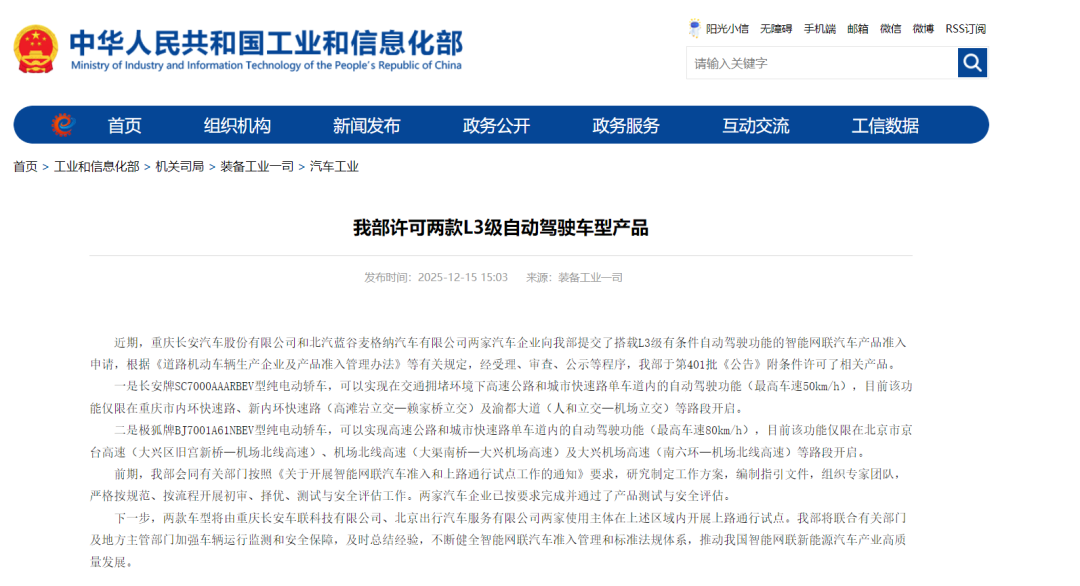
我国首批L3级自动驾驶车型获准入许可
财联社· 2025-12-15 07:59
Core Viewpoint - The Ministry of Industry and Information Technology (MIIT) has granted conditional approval for two electric vehicles equipped with L3 level conditional autonomous driving capabilities from Changan Automobile and BAIC Blue Valley Magna Automotive [1][2]. Group 1: Vehicle Approvals - Changan's SC7000AAARBEV model can achieve autonomous driving in congested traffic environments on highways and urban expressways at a maximum speed of 50 km/h, limited to specific routes in Chongqing [1]. - The ARCFOX BJ7001A61NBEV model can achieve autonomous driving on highways and urban expressways at a maximum speed of 80 km/h, limited to specific routes in Beijing [1]. Group 2: Regulatory Process - The MIIT, in collaboration with relevant departments, has developed a work plan and guidelines for the approval and road testing of intelligent connected vehicles, ensuring compliance with regulations and safety assessments [2]. - Both vehicle manufacturers have completed the required product testing and safety evaluations as per MIIT's guidelines [2]. Group 3: Future Steps - The two models will undergo road testing by Changan Car Networking Technology Co., Ltd. and Beijing Travel Automotive Service Co., Ltd. in the designated areas [2]. - The MIIT will work with local authorities to enhance vehicle operation monitoring and safety assurance, aiming to continuously improve the management and regulatory framework for intelligent connected vehicles [2].