Mate 80

Search documents
1月中国智能手机销量排名:华为/苹果/OPPO前三
Ju Chao Zi Xun· 2026-02-13 08:10
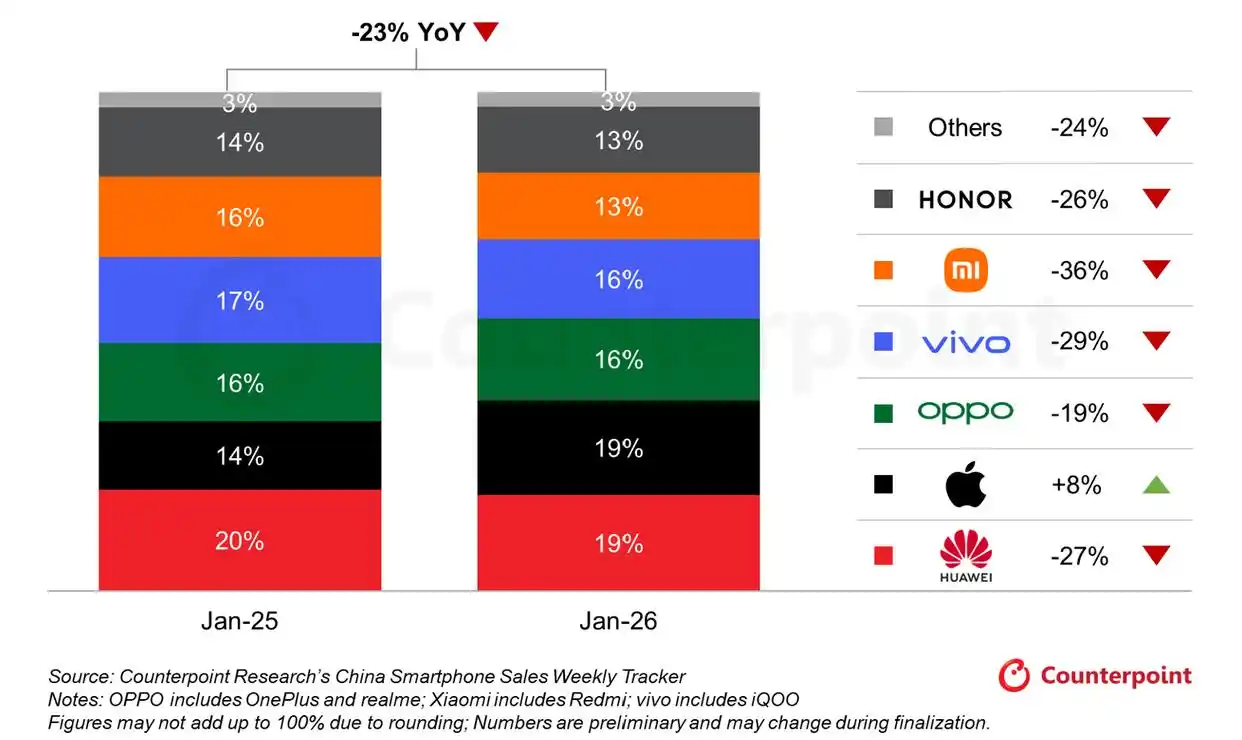
Core Insights - The overall smartphone market in China is projected to decline by 23% year-on-year in January 2026, primarily due to the high base effect from subsidy policies in early 2025, reduced subsidy intensity in 2026, and the impact of the Lunar New Year on consumer spending [1][3] Group 1: Market Performance - Huawei leads the market with a 19% share but faces a 27% year-on-year decline in sales, influenced by high base effects and underperformance of the Nova series [1] - Apple is the only major brand to achieve growth, with an 8% increase in sales and market share reaching its highest level in nearly five years, driven by the popularity of the iPhone 17 series [3] - Other domestic brands experienced significant declines: Xiaomi (including Redmi) down 36%, vivo (including iQOO) down 29%, OPPO (including OnePlus and realme) down 19%, and Honor down 26% [3] Group 2: Market Dynamics - The decline in sales for many brands is attributed to the "overdraft effect" of the subsidy policy from early 2025, which pulled forward demand due to the timing of the Lunar New Year promotions [3] - Despite the January market slump, there is an optimistic forecast for February, as seasonal consumption during the Lunar New Year is expected to boost sales, providing a critical window for inventory clearance and performance improvement for manufacturers [3]


年会折叠:有人狂撒黄金,有人食堂吃自助餐
3 6 Ke· 2026-02-13 00:13
Core Insights - The traditional corporate annual meeting is facing a decline, with many companies opting to cancel or significantly reduce the scale of their events, reflecting a shift in workplace culture and employee preferences [2][8][10]. Group 1: Trends in Corporate Annual Meetings - The proportion of companies hosting large annual meetings for over 100 people has dropped from 68% in 2019 to 31% in 2024, with projections indicating that less than 20% will maintain this tradition by the end of 2025 [1]. - Many companies are transitioning to smaller gatherings, such as departmental dinners or online events, with a notable increase in cost-cutting measures [1][10]. - The enthusiasm for large-scale annual meetings has diminished, impacting hotel bookings and event planning, with a reported 30% reduction in annual meeting orders this year [9][10]. Group 2: Examples of Corporate Practices - Some companies, like Chasing Technology, are still hosting extravagant events, offering significant rewards such as gold and luxury items, which serve as effective promotional tools [3][4]. - In contrast, companies like Leap Motor have faced criticism for poorly organized events that lack basic amenities, highlighting the disparity in how annual meetings are executed [6]. - Many firms are now choosing to hold meetings in-house or at minimal cost venues, with some opting for self-catered events to save expenses [7][10]. Group 3: Employee Sentiment and Cultural Shift - Employees are increasingly viewing annual meetings as burdensome, with younger generations preferring clear work-life boundaries and expressing dissatisfaction with obligatory participation in such events [10][12]. - There is a growing sentiment among employees that financial rewards or bonuses may be more appreciated than traditional gatherings, reflecting a shift in expectations regarding workplace culture [11][12].
华为小米已成新“年货”,后国补时代市场热度几何?
财联社· 2026-02-12 03:25
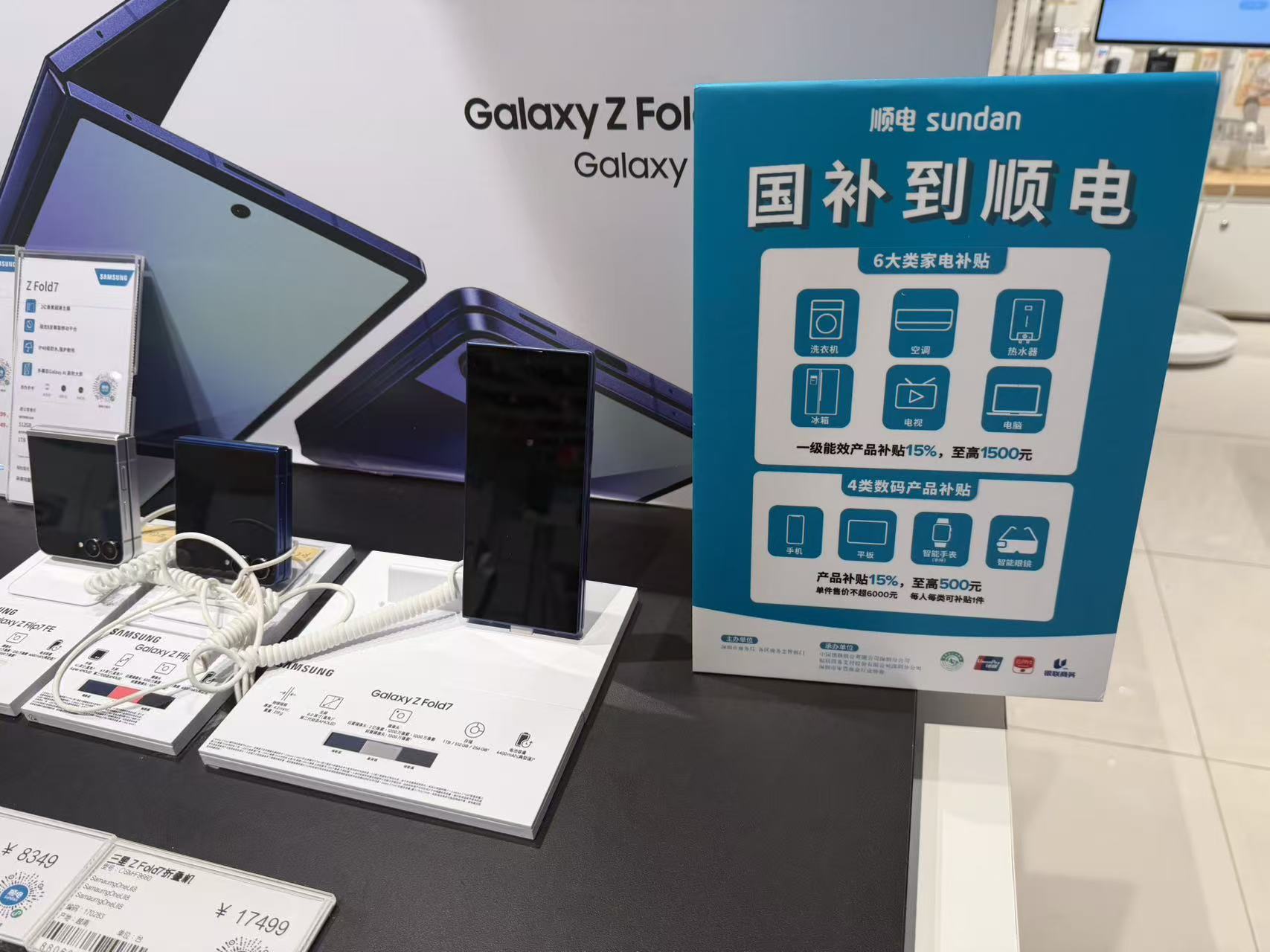
Core Viewpoint - The article discusses the impact of the new round of national subsidies on consumer electronics and home appliances during the upcoming Spring Festival, highlighting increased consumer demand and sales driven by these subsidies [2][15]. Group 1: National Subsidy Implementation - The Ministry of Commerce has allocated the first batch of 62.5 billion yuan in national subsidies, which will be distributed to local commerce departments to ensure consumers can claim these subsidies during the Spring Festival [1]. - Consumers can now apply for subsidies online for digital and smart products, with significant sales increases observed in various electronics stores [2][4]. - The new subsidies are expected to stimulate sales, particularly in the home appliance and 3C product sectors, with sales of air conditioners, refrigerators, washing machines, and televisions seeing over 90% month-on-month growth [2][11]. Group 2: Consumer Trends and Product Preferences - The demand for home appliances and 3C products has surged, with consumers increasingly seeking products that enhance efficiency and create a festive atmosphere [3][10]. - Popular products include smart appliances like automatic washing machines, large-capacity refrigerators, and high-end AI smartphones, reflecting a shift towards premium and technologically advanced items [3][16]. - The sales of energy-efficient appliances have risen significantly, with 92% of sales now comprising first-level energy/water efficiency products, indicating a trend towards greener and smarter home solutions [11][16]. Group 3: Market Dynamics and Manufacturer Strategies - Manufacturers are preparing for the Spring Festival by increasing inventory of energy-efficient products and optimizing supply chains to ensure product availability [12]. - Major brands like Huawei, Xiaomi, and OPPO are offering additional discounts alongside the national subsidies to enhance promotional efforts [12]. - Despite the positive impact of subsidies, rising costs of raw materials are leading to price increases for some products, which may affect overall sales volumes in the consumer electronics sector [13][14]. Group 4: Future Outlook and Challenges - The article notes that while national subsidies have boosted market confidence and consumer demand, the underlying issue of supply-demand mismatch remains a challenge [17]. - The effectiveness of subsidies may diminish as consumers become accustomed to them, necessitating a focus on product innovation and user engagement to sustain growth [17]. - Analysts express caution regarding the marginal benefits of subsidies in 2026, suggesting that manufacturers may prioritize high-margin products over volume sales, potentially impacting overall market performance [17].
一线实探!华为小米已成新“年货” 后国补时代市场热度几何?
Xin Lang Cai Jing· 2026-02-12 01:49
Core Viewpoint - The Chinese government has allocated 62.5 billion yuan in subsidies to stimulate consumer spending during the Spring Festival, with a focus on home appliances and 3C electronic products, leading to increased sales and market activity [1][2][6]. Group 1: Subsidy Implementation and Market Response - The Ministry of Commerce has released the first batch of 62.5 billion yuan in national subsidies, which will be distributed to local commerce departments to ensure consumers can claim these subsidies during the Spring Festival [1]. - Consumers can now apply for subsidies online for digital and smart products, with reports of increased sales activity in stores, particularly for mobile phones and home appliances [2][3]. - The combination of national subsidies, brand discounts, and platform incentives is driving consumer interest and sales, particularly in the home appliance and 3C product sectors [2][6]. Group 2: Sales Performance and Consumer Trends - Sales of major home appliances such as air conditioners, refrigerators, and washing machines have seen a month-on-month increase of over 90%, with high-end smartphones dominating the market [2][7]. - The demand for efficient and technologically advanced home appliances is rising, with products like smart air conditioners and large-screen TVs becoming popular choices for consumers during the festive season [2][7]. - The sales of energy-efficient appliances have surged, with 92% of sales being of first-level energy efficiency products, indicating a shift towards greener and smarter home solutions [7][13]. Group 3: Manufacturer Strategies and Market Dynamics - Manufacturers are preparing for the Spring Festival by increasing inventory of energy-efficient products and optimizing supply chains to ensure availability during peak demand [8][9]. - Major 3C brands are enhancing promotional efforts during the Spring Festival, with additional discounts and marketing campaigns to attract consumers [9]. - Despite the positive impact of subsidies, rising costs of raw materials are leading to price increases for some products, which may affect overall sales volumes in the future [10][11]. Group 4: Future Outlook and Industry Challenges - The effectiveness of subsidies may diminish as consumers become accustomed to them, and the market faces challenges related to supply-demand mismatches [14]. - Industry experts suggest that continuous growth will depend on product innovation and the ability to meet evolving consumer preferences, particularly in the context of AI integration in home appliances [12][14]. - The anticipated decline in smartphone sales in 2026 highlights the need for brands to adapt their strategies in response to changing market conditions and consumer behavior [11].
读懂人群战报:一场2026年手机厂商的“用户争夺战”
Xin Lang Cai Jing· 2026-02-04 12:20
Core Insights - The Chinese smartphone market has entered a phase of stock competition, with cost pressures and market differentiation posing core challenges [1] - The competition logic has fundamentally shifted from price wars to a focus on precise user targeting, emphasizing the importance of understanding consumer needs [1][30] - JD.com has launched innovative weekly smartphone sales rankings based on user demographics, providing valuable insights for both consumers and manufacturers [1][34] Group 1: Market Dynamics - The updated rankings reflect the competitive landscape among different consumer segments, showcasing brand recognition and product penetration in various demographics [4][34] - Huawei dominates the high-end business segment with its Mate 80 model, while vivo and OPPO have made significant inroads in the high-end market [4][35] - The competition among younger consumers is intense, with OPPO and vivo leading in the female and male college student categories, respectively [4][34] Group 2: Brand Strategies - Leading brands like Huawei, OPPO, and vivo are focusing on long-term, targeted user engagement strategies to build competitive advantages [8][37] - Huawei's user engagement is centered around its "Huawei Fan" ecosystem, which facilitates deep connections with core users and incorporates their feedback into product development [8][39] - OPPO employs a dual-series strategy with its Find and Reno lines to cater to high-end and younger demographics, enhancing brand recognition through targeted marketing efforts [8][43] Group 3: Collaborative Efforts - JD.com plays a crucial role as a collaborative partner for brands, leveraging its user data and resources to enhance user engagement and conversion rates [8][39] - The partnership between JD.com and Huawei has led to effective high-end user acquisition strategies, including targeted marketing events and exclusive offers [8][41] - OPPO's collaboration with JD.com has amplified its user engagement initiatives, resulting in significant growth in its high-end market presence [8][45] Group 4: Future Outlook - The smartphone market in 2026 is expected to see intensified competition, with brands needing to focus on deep user insights and emotional connections to succeed [30][56] - JD.com's unique position as a direct channel to high-quality users will be pivotal for manufacturers seeking to innovate and grow [30][56] - The key to success will be the ability of brands to build long-term, emotional relationships with users throughout the entire product lifecycle [30][56]

智能手机2026:变局中的挑战与曙光
3 6 Ke· 2026-02-01 06:26
Core Insights - The smartphone industry is experiencing a significant downturn in expected shipments for 2026, with major manufacturers like Xiaomi and OPPO reducing their forecasts by over 20% [1][2] - The decline in shipments is primarily attributed to rising storage chip prices and supply shortages, leading to a strategic shift towards higher-value products [2][6] Group 1: Industry Dynamics - In 2025, the global smartphone shipment reached 1.26 billion units, with a 1.9% year-on-year growth, while China's market saw a slight decline of 0.6% [3] - Huawei regained its position as the leading smartphone manufacturer in China with a shipment of 46.7 million units, capturing a market share of 16.4% [3] - Apple and Vivo closely followed Huawei, with shipments of 46.2 million and 46.1 million units, respectively, indicating a highly competitive landscape [3][4] Group 2: Market Challenges - The price of storage chips is expected to rise significantly, with a projected increase of 40% to 50% in Q1 2026, further impacting manufacturers' cost structures [6][8] - The cost increase is particularly pronounced in low-end models, which may deter price-sensitive consumers from upgrading their devices [7][8] Group 3: Future Trends - The integration of AI into smartphones is anticipated to be a major trend, with new AI-enabled smartphone shipments expected to reach 147 million units in China, accounting for over 50% of the market [9] - The development and application of 2nm chips are also on the horizon, promising enhanced performance and efficiency for future smartphones [10]


2025手机大战:华为赢销量,苹果守利润,米OV被夹击
首席商业评论· 2026-01-19 05:09
Core Viewpoint - The smartphone market in 2025 is characterized by intense competition and differentiation, with Apple and Samsung maintaining their dominance while other brands like Huawei, Xiaomi, vivo, and OPPO face significant challenges [5][9]. Global Market Summary - The global smartphone market saw a 1.9% growth in 2025, with total shipments reaching 1.26 billion units. Apple and Samsung accounted for nearly 40% of the market share, with shipments of 247.8 million (up 6.3%) and 241.2 million (up 7.9%) respectively [6][7]. - Xiaomi, vivo, and OPPO experienced mixed results, with Xiaomi's shipments declining by 1.9% to 165.3 million, while vivo and OPPO saw slight increases and decreases in their market positions [6][7]. Chinese Market Summary - In China, the smartphone market saw a slight decline of 0.6% in 2025, with total shipments of 28.46 million units. Huawei reclaimed the top position with 46.7 million units (16.4% market share), narrowly surpassing Apple at 46.2 million units (16.2% market share) [8][10]. - The competition among the top five brands in China is fierce, with Huawei, Apple, and vivo closely contesting for market share, while Xiaomi and OPPO lag behind [8][10]. Competitive Dynamics - Huawei's success is attributed to its self-developed Kirin chips and the growing maturity of its HarmonyOS ecosystem, which enhances user experience across devices [15][19]. - Apple, despite losing the annual championship, demonstrated strong brand loyalty and market presence, particularly in the high-end segment, achieving a 21.1% market share in Q4 2025 [12][17]. - The competition among Xiaomi, vivo, and OPPO is marked by varying strategies, with Xiaomi focusing on global expansion and automotive ventures, while vivo maintains a stable domestic presence and OPPO struggles with market share [21][24]. Future Outlook - The smartphone market is expected to face challenges in 2026, with predictions of a 3-4% decline in overall shipments. However, the high-end market is projected to grow, leading to increased competition and differentiation based on cost and technology [26][28]. - Key trends for 2026 include the rise of foldable phones and AI integration, with companies like Apple and Huawei preparing to enhance their product offerings in these areas [29][32]. - The market will likely see a consolidation of power among leading brands, with those possessing strong brand equity and technological capabilities gaining a competitive edge [33].
海南免税专家-解析黄金珠宝和电子产品趋势
2026-01-05 15:42
Summary of Conference Call on Hainan Duty-Free Market Trends Industry Overview - The conference call focused on the Hainan duty-free market, particularly the trends in gold jewelry and electronic products, including iPhones and other 3C electronics [1][3][4]. Key Insights and Arguments Gold Jewelry Market - Following the implementation of new policies at the end of 2025, gold jewelry sales surged from 5%-10% to 30%-40% of total sales, driven by government consumption vouchers and promotional activities [1][3]. - The gross margin for gold jewelry is approximately 30%, with net profit margins reaching 20%-25% due to government subsidies that do not affect merchant margins [1][6]. - During the New Year period in 2026, Sanya's business bureau reported a year-on-year sales increase of 100%-120%, but gold jewelry contributed only 10%-20% to this growth, with traditional categories like cosmetics and beverages remaining dominant [1][13][15]. - Consumer preferences for gold products vary: for investment, consumers prefer per gram pricing, while for weddings, they opt for fixed-price items. However, from 2026, per gram gold bars may no longer qualify for duty-free status, potentially impacting sales [1][17][33]. - The introduction of new brands like Laomiao is expected to boost gold jewelry sales in 2026, making it a significant growth area [1][18]. Electronic Products Market - The iPhone and other 3C electronic products are sold under a self-purchase and self-sale model, with a fixed profit margin of 5% and a gross margin of about 10% [4][19]. - Duty-free pricing is generally 8%-10% lower than domestic trade prices, further enhanced by consumer vouchers, which directly correlate sales volume with profit [4][19]. - Apple products can account for 30%-40% of total sales shortly after new releases, but this typically drops to 5%-10% under normal conditions [23]. - Other brands like Huawei and DJI show growth, but Huawei's performance is weaker due to minimal price differences between duty-free and taxed prices [24][25]. Additional Important Points - The government consumption vouchers have significantly increased the competitiveness of duty-free stores without imposing costs on businesses [5][12]. - The supply of goods generally meets current demand, although certain popular items may experience temporary shortages [8]. - The impact of the duty-free policy on local businesses is notable, as it creates price advantages for duty-free products, although local residents still shop at regular stores for lower-value items [7]. - The overall growth in 2026 is expected to be moderate, with a conservative estimate of 20% growth during the Spring Festival period [28]. - The company maintains a strict stance against purchasing behaviors that could undermine the market, particularly regarding the sale of Apple products [35]. This summary encapsulates the key points discussed in the conference call, highlighting the dynamics of the Hainan duty-free market, particularly in gold jewelry and electronic products.
华为余承东演示Mate 80/X7智能停车导航功能
Xin Lang Cai Jing· 2025-12-31 16:00
Core Viewpoint - Huawei has introduced a smart parking feature for its Mate 80 and X7 series smartphones, which automatically records the parking location and provides indoor navigation to help users find their vehicles [2][3]. Group 1: Smart Parking Feature - The smart parking feature allows users to automatically record the floor and specific location of their parked vehicles, and provides navigation services to guide them back to their original parking spot [2][3]. - The operation path for this feature includes accessing the "My" section, selecting "Dynamic Management" from the menu, granting location permissions, and enabling the "Parking" function in "Service Dynamics" [2][3]. - This feature is applicable to all vehicle brands and is triggered automatically upon exiting the vehicle, eliminating the need for manual operation [2][3]. Group 2: Compatibility and Expansion - The smart parking feature is not only available for the Mate series but is also compatible with the Pura 80 series, including models such as Pura 80 Pro, Pro+, Ultra, Mate XTs, Mate 70 Pro+, and RS, provided they are upgraded to HarmonyOS version 6.0.130 [3][4]. - As of now, the service has been implemented in over 20,000 parking lots across the country and is continuously expanding [2][3].
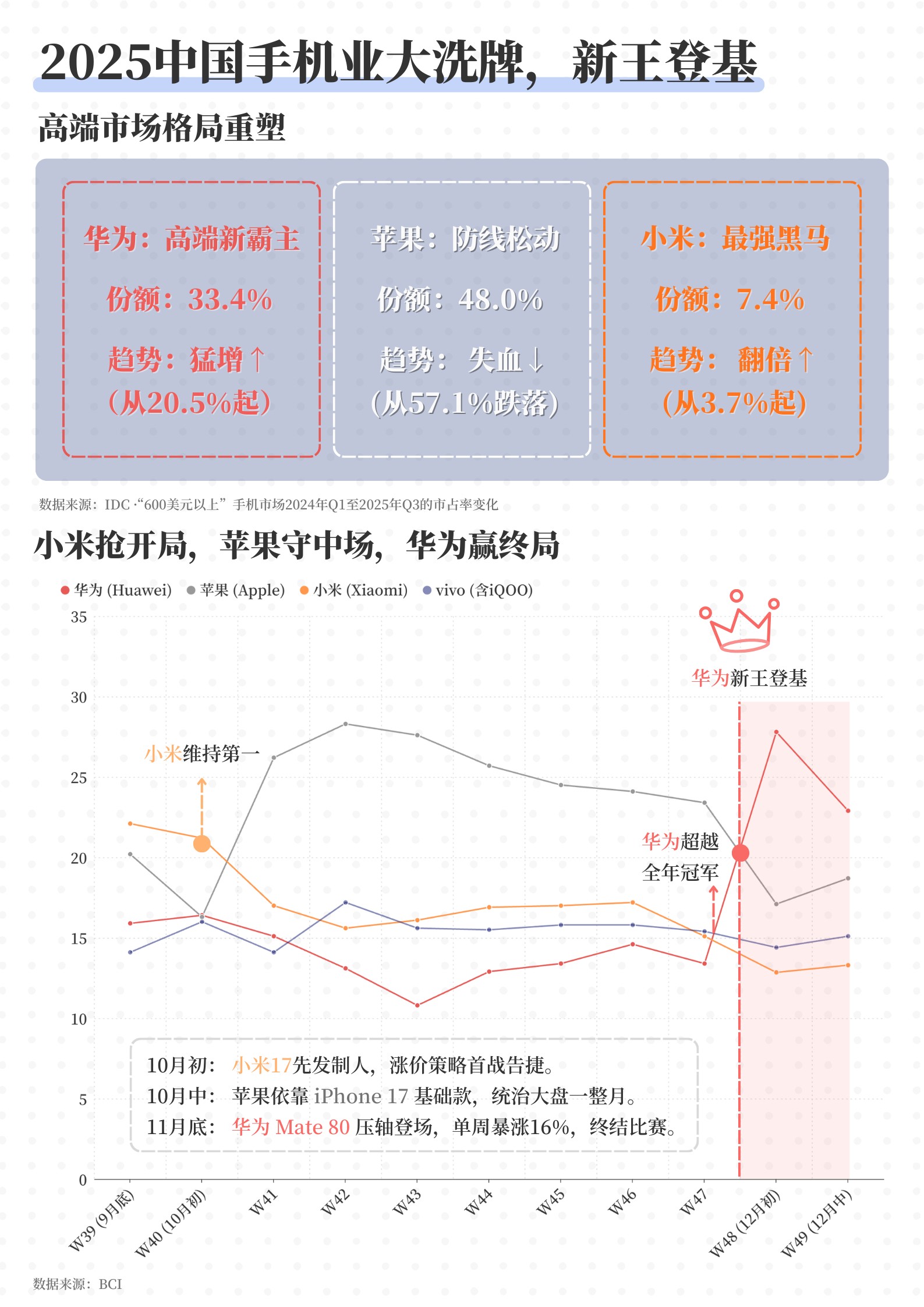
2025手机三国杀:小米涨价了、华为重回王位、苹果不装了丨36氪年度透视②
3 6 Ke· 2025-12-19 07:32
Core Insights - The smartphone industry is undergoing a brutal reshuffle in 2025 due to a "super cycle" with component costs rising by 10%-25%, leading to a market split at the $600 price point, where only the high-end market is expanding thanks to AI and ecosystem advancements [2]. Group 1: Company Strategies - Apple has responded to domestic competition by enhancing the base model of the iPhone 17, addressing key shortcomings like high refresh rates, resulting in nearly doubling sales in China and dominating the market in October [7]. - Xiaomi is focusing on high-end products to secure its future, with the Xiaomi 17 Pro version surpassing the base model in sales for the first time, achieving a 20% increase in average selling price (ASP) [11]. - Huawei has reclaimed its position as the market leader in China with a 95% localization rate and the successful launch of the Mate 80, which saw a 16% sales increase in one week, surpassing Apple in sales [10]. Group 2: Market Dynamics - The high-end smartphone market is projected to be the only growth segment, with a significant market share shift expected from Q1 2024 to Q3 2025 [9]. - The Chinese high-end market is now dominated by three major players, indicating that the competition will become increasingly challenging in 2026 [15]. - HarmonyOS is closing the gap with iOS, holding a 14.6% market share, just 0.7% behind iOS, while Android remains the leader with 70% [19].