Mini LED TV

Search documents
2025年中国光电显示产业投资金额约1,718亿元,同比下降23%
CINNO Research· 2026-03-30 23:32
Core Viewpoint - The investment amount in China's optoelectronic display industry (including Taiwan) is projected to be approximately 171.8 billion RMB in 2025, reflecting a year-on-year decline of 22.9%, with funds concentrating on core areas and advantageous segments [3][5]. Investment Trends - The investment in the display panel sector is expected to reach 83.79 billion RMB, accounting for 48.8% of the total investment, with a year-on-year increase of 17.4% [5]. - Mini/Micro LED (MLED) sector is projected to receive 29.39 billion RMB, representing 17.1% of the total investment, but showing a significant year-on-year decline of 65.3% [5]. - Investment in optoelectronic modules is estimated at 26.53 billion RMB, making up 15.4% of the total, with a year-on-year decrease of 30.6% [5]. Material Investment Characteristics - The investment in optical films is expected to be 14.59 billion RMB, leading the sector but experiencing a year-on-year decline of 28.8% [6]. - The photomask sector is highlighted as the fastest-growing area, with an investment of 4.51 billion RMB, showing a remarkable year-on-year increase of 488.0% [6]. - The electronic chemicals sector is projected to receive 4.08 billion RMB in investment [6]. Regional Investment Distribution - The investment in the optoelectronic display industry shows a clear regional concentration, with the top five investment areas accounting for 69.8% of total funds [7]. - Guangdong province leads with an investment of 36.3 billion RMB, representing 21.3% of the total [7]. - Domestic capital dominates the investment landscape, accounting for 92.7%, while foreign investment from Hong Kong, Macau, Taiwan, Japan, and South Korea is decreasing [8]. Market Dynamics and Future Outlook - The integration of advanced technologies such as 5G and artificial intelligence is expected to create new growth opportunities for the global optoelectronic display panel industry [9]. - The demand for smart terminals and the widespread adoption of automotive displays are driving market expansion [9]. - The industry is anticipated to maintain a growth trajectory, supported by continuous technological innovation and the release of downstream demand [9].


TCL电子:全球化与高端化共振,盈利再上台阶-20260330
HTSC· 2026-03-30 05:50
Investment Rating - The investment rating for TCL Electronics is maintained at "Buy" with a target price of HKD 14.28 [1][5] Core Views - TCL Electronics reported a revenue of HKD 114.58 billion for 2025, representing a year-on-year increase of 15.4%. The net profit attributable to shareholders was HKD 2.495 billion, up 41.8%, while the adjusted net profit was HKD 2.512 billion, reflecting a 56.5% increase. The company proposed a final dividend of HKD 0.498, with a payout ratio of approximately 50% [1] - The company's growth is driven by global expansion, upgrades in mid-to-high-end product structures, sustained high profitability in internet business, and significant contributions from the photovoltaic sector. The growth logic is expected to continue strengthening, especially with potential collaborations with Sony [1] Summary by Sections Display Business - The display business generated revenue of HKD 75.797 billion in 2025, a 9.2% increase year-on-year, with a gross profit of HKD 12.476 billion, up 16.4%. The gross margin improved by 1.1 percentage points to 16.5% [2] - Large-size display revenue reached HKD 64.708 billion, increasing by 7.7%, with a gross margin rise of 1.3 percentage points to 16.8%. TCL maintained a global TV market share of 14.7%, ranking second globally, and achieved a 118% year-on-year increase in Mini LED TV shipments, securing a 31.1% market share [2] - International markets are the main growth engine, with international TV revenue at HKD 47.504 billion, up 15.7%. Despite a 9.7% decline in domestic TV revenue to HKD 17.204 billion, market share in retail volume and value increased to 22.2% and 24.2%, respectively [2] Internet and Innovation Business - Internet business revenue reached HKD 3.109 billion in 2025, growing 18.3% year-on-year, with a maintained high gross margin of 56.4%. The TCL Channel surpassed 45.7 million users, with ongoing enhancements in overseas content and AI capabilities [3] - Innovation business revenue was HKD 35.628 billion, up 31.9%, with photovoltaic revenue at HKD 21.063 billion, a 63.6% increase, contributing significantly to growth [3] Cost Management and Operational Quality - The overall gross margin for 2025 was 15.6%, slightly down by 0.1 percentage points, primarily due to the higher proportion of lower-margin innovation business revenue. However, effective cost control led to a reduction in the combined expense ratio for sales and administrative expenses to 11.1%, down 0.7 percentage points year-on-year [4] - R&D expenses increased by 8.5% to HKD 2.532 billion, focusing on high-end displays and AI. The company is currently in a phase of "profit release" while investing for future growth, maintaining solid financial quality [4] Profit Forecast and Valuation - For 2026, the company is expected to benefit from the global trend towards high-end and large-screen TVs, as well as the expansion of internet and photovoltaic businesses. The forecast for net profit attributable to shareholders has been raised to HKD 3.006 billion for 2026 and HKD 3.537 billion for 2027 [5] - The target price has been adjusted to HKD 14.28, corresponding to a 12x PE valuation for 2026, reflecting an increase from the previous target of HKD 14.16 [5]
2026年
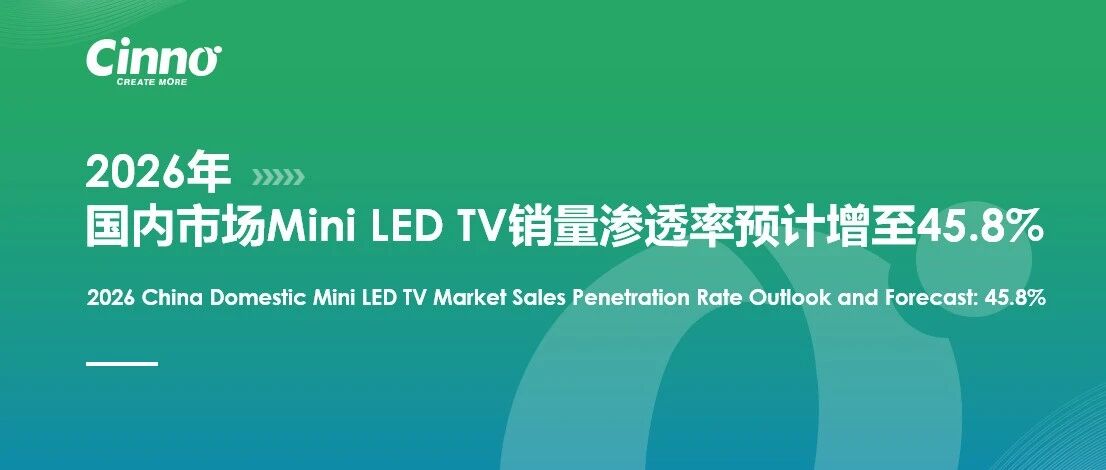
国内市场Mini LED TV销量渗透率预计增至45.8%
CINNO Research· 2026-03-30 03:55
Core Insights - The article highlights that the penetration rate of Mini LED TVs in the domestic market is expected to reach 45.8% by 2026, indicating significant growth in this segment [2]. Group 1: Global LCD TV Panel Trends - The report outlines the global trends in LCD TV panel shipments from Q1 2023 to Q2 2026, providing insights into the overall market dynamics [3]. Group 2: Price Trends - It details the monthly price changes of LCD TV panels from February 2025 to March 2026, reflecting the pricing strategies and market conditions [3]. Group 3: Domestic Mini LED TV Market - The analysis covers the sales volume and penetration trends of Mini LED TVs in the domestic market from 2021 to 2026, showcasing a robust growth trajectory [3]. Group 4: Brand Market Share - The report presents the sales volume and revenue share of various brands in the Mini LED TV market from 2021 to 2025, highlighting competitive positioning [3]. Group 5: Price Segment Analysis - It examines the sales volume distribution across different price segments for Mini LED TVs in the domestic market from 2021 to 2025, indicating consumer preferences [3]. Group 6: Backlight Zone and Product Launches - The report discusses the number of local dimming zones and the quantity of new Mini LED TV models launched in 2025, along with year-on-year comparisons [3]. Group 7: Price Distribution Trends - It analyzes the relationship between the number of local dimming zones and the launch prices of Mini LED TV models in 2025, providing insights into pricing strategies [3]. Group 8: Peak Brightness Trends - The report details the trends in average peak brightness for Mini LED TV models with varying local dimming zones in 2025, indicating advancements in technology [3]. Group 9: Hisense Mini LED TV Analysis - It explores the relationship between sales volume, local dimming zones, and peak brightness for Hisense Mini LED TV models in 2025, offering brand-specific insights [4]. Group 10: TCL Mini LED TV Analysis - The analysis includes the relationship between sales volume, local dimming zones, and peak brightness for TCL Mini LED TV models in 2025, contributing to brand performance evaluation [4]. Group 11: Skyworth Mini LED TV Analysis - It examines the relationship between sales volume, local dimming zones, and peak brightness for Skyworth Mini LED TV models in 2025, further enriching brand-specific insights [4].
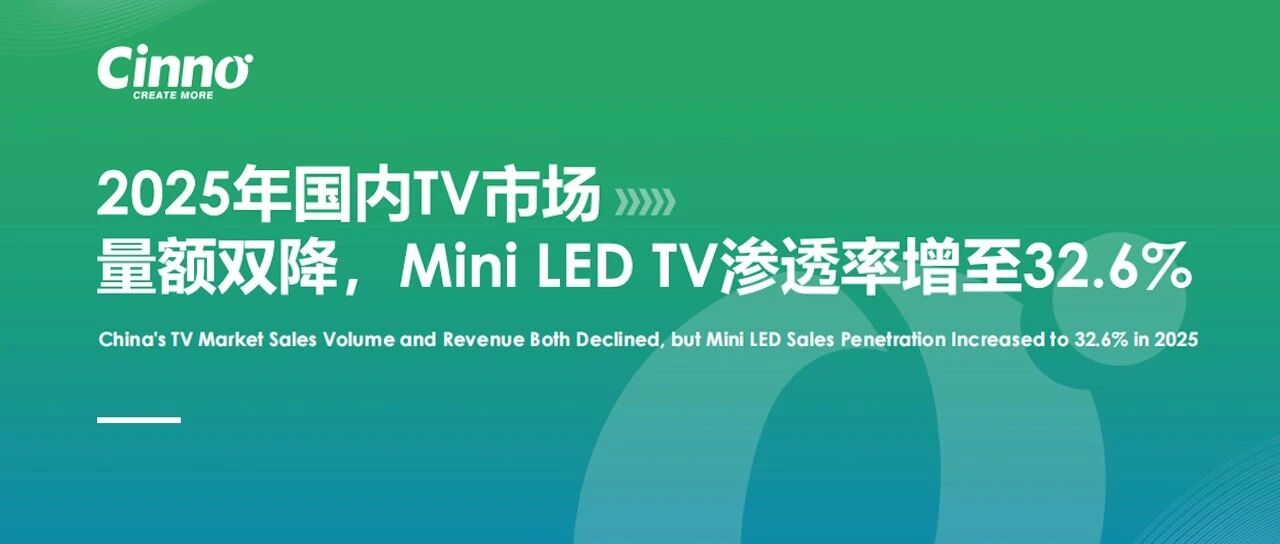
2025年国内TV市场量额双降,Mini LED TV渗透率增至32.6%
CINNO Research· 2026-03-06 08:31
Core Insights - The domestic TV market in China is expected to experience a decline in both sales volume and revenue in 2025, with Mini LED TV penetration increasing to 32.6% [2] Group 1: Global LCD TV Panel Trends - The global LCD TV panel shipment volume is projected to show a downward trend from Q1'22 to Q1'26 [3] - Monthly price changes for LCD TV panels are anticipated from February 2025 to February 2026 [3] Group 2: Domestic TV Market Sales Trends - Quarterly sales volume trends for the domestic TV market are forecasted from Q1'24 to Q4'25 [3] - Quarterly sales revenue trends for the domestic TV market are also projected from Q1'24 to Q4'25 [3] Group 3: Pricing Trends - Monthly average price trends for the domestic TV market are expected from January 2024 to December 2025 [3] Group 4: Brand Performance - The ranking of brand sales volume in the domestic TV market for 2025, along with year-on-year comparisons, is provided [3] - The ranking of brand sales revenue in the domestic TV market for 2025, along with year-on-year comparisons, is also included [3] Group 5: Size Segment Trends - Sales volume share trends for various size segments in the domestic TV market are forecasted from Q1'24 to Q4'25 [3] - Average price trends for different size segments in the domestic TV market are projected from Q1'24 to Q4'25 [3] Group 6: Mini LED and OLED Sales - Sales performance of Mini LED TVs in the domestic market is analyzed for the period from Q1'24 to Q4'25 [4] - Sales performance of OLED TVs in the domestic market is also examined for the same period [4]
存储器、面板、贵金属全面上涨,2026年电视全球出货量恐下修
WitsView睿智显示· 2026-01-31 01:04
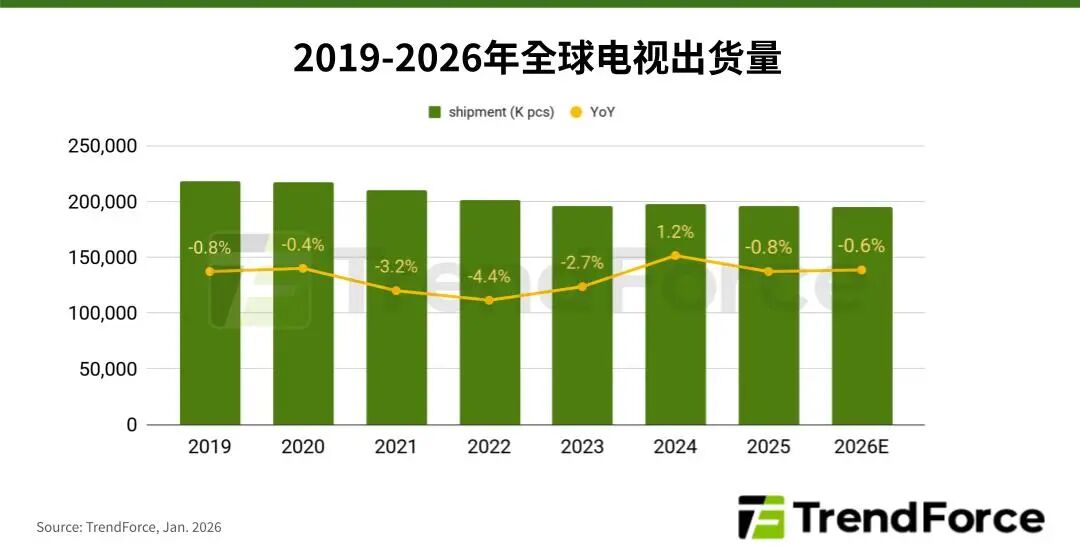
Core Viewpoint - The television industry is facing rising costs due to increases in memory, panel, and precious metal prices, leading to a downward revision of expected shipment volumes for 2026, now projected to decrease by 0.6% to approximately 194.81 million units [2]. Group 1: Market Trends - From early 2025, uncertainty in international conditions prompted TV brands to stock up in advance, but inventory adjustments in the second quarter led to a disappointing third-quarter shipment, which fell below 50 million units for the first time [5]. - Despite pressures to meet annual shipment targets in the fourth quarter and preemptive stocking due to rising memory prices, global TV shipments are still expected to decline by 0.8% in 2025, reaching nearly 196.2 million units [5]. - In the first half of 2026, promotional events like the Super Bowl and FIFA World Cup are expected to boost shipments by 2% year-on-year to 46.51 million units, although the second half may face challenges [5]. Group 2: Cost Analysis - Panels account for approximately 40-50% of the total cost of a TV, and prices have begun to rise as of January 2026. The supply of memory for TVs is being squeezed by demand from HBM and server applications, leading to price increases starting in the second half of 2025 [5]. - The contract price for 4GB DDR4 memory, commonly used in 4K TVs, has increased over fourfold in the past year, with expectations of a further increase of over 60% in the first quarter of 2026 [5][6]. - The share of DRAM in the bill of materials (BOM) cost for TVs has risen from 2.5-3% to 6-7% due to recent price adjustments, putting pressure on brand profitability, particularly for smaller players with fewer resources [6]. Group 3: Market Opportunities - In 2026, favorable subsidy policies in the Chinese market will benefit Mini LED models, with major brands showcasing RGB TV technology at CES 2026 and targeting more affordable sizes between 55-75 inches [6]. - TrendForce has revised its forecast for Mini LED TV penetration in 2026 to 10%, with shipments expected to approach 20 million units. TCL is positioned to lead the Mini LED TV market, potentially surpassing a 30% market share [6].

集邦咨询:存储器、面板、贵金属同步涨价 预计电视生产成本承压
智通财经网· 2026-01-29 09:19
Core Insights - The television industry is facing rising costs due to increases in memory, panel, and precious metal prices, leading to a downward revision of the expected annual shipment volume for 2026 from a decrease of 0.3% to 0.6%, totaling approximately 194.81 million units [1] Group 1: Market Trends - From early 2025, television brands began stockpiling inventory due to uncertainties in international conditions, followed by inventory adjustments in the second quarter, resulting in a third-quarter shipment drop below 50 million units for the first time [3] - Despite promotional events in early 2026, such as the Super Bowl and FIFA World Cup, brands are accelerating inventory preparation due to rising prices of memory and panels, leading to a projected 2% year-on-year increase in first-quarter shipments to 46.51 million units [3] Group 2: Cost Analysis - The cost of panels constitutes approximately 40-50% of the total cost of a television, with prices starting to rise in January 2026. The supply of memory for televisions is being squeezed by demand from other applications, causing prices to increase significantly [3] - The proportion of DRAM in the bill of materials (BOM) for televisions has risen from 2.5-3% to 6-7% due to recent price adjustments, putting pressure on brand profitability, particularly for smaller players [4] Group 3: Product Development and Market Position - In 2026, favorable subsidy policies in the Chinese market will benefit Mini LED products, with major brands showcasing RGB television technology at CES 2026 and targeting more affordable sizes between 55-75 inches [4] - TrendForce has revised its forecast for Mini LED television penetration in 2026 to 10%, with shipments expected to approach 20 million units, while TCL is positioned to lead the Mini LED market with a market share exceeding 30% [4]
每周观察 | 预估2026年AI服务器出货量将年增超28%;2027年全球DRAM供给或将上调;存储器产业产值逐年创高;全球电视出货区域占比变化…
TrendForce集邦· 2026-01-23 04:05
Group 1 - The global AI server shipment is expected to grow by over 28% annually by 2026, driven by increased investments from North American cloud service providers [2] - The demand for AI inference services is leading to a replacement and expansion cycle for general servers, with an overall server shipment growth forecast of 12.8% in 2026 compared to 2025 [2] Group 2 - Micron Technology plans to acquire PSMC's factory in Tainan for $1.8 billion, which will enhance Micron's advanced DRAM production capacity and improve PSMC's mature process DRAM supply, potentially leading to an upward revision of global DRAM supply by 2027 [4] Group 3 - The storage market is projected to reach a new peak in 2027, with an expected annual growth rate exceeding 50%, driven by the structural changes brought by AI and the increasing demand for high-bandwidth, large-capacity, and low-latency DRAM products [6] - The overall storage industry value is anticipated to reach $551.6 billion in 2026 and $842.7 billion in 2027, reflecting a 53% year-on-year increase [6] Group 4 - TCL and Sony have signed a memorandum of cooperation to establish a joint venture, aiming to enhance their market share in the television sector, potentially approaching that of Samsung Electronics by 2027 [9]

TCL电子接手索尼电视业务,华星或将扮演关键角色
WitsView睿智显示· 2026-01-21 10:14
Group 1 - The core viewpoint of the article is the strategic partnership between TCL and Sony in the home entertainment sector, aiming to establish a joint venture to take over Sony's home entertainment business [2][3]. - The new company will be owned 51% by TCL and 49% by Sony, focusing on television and home audio equipment, with plans to finalize the agreement by the end of March this year [3]. - TCL's television shipments surpassed 20 million units in 2019, and it is projected to become the second-largest TV brand globally by 2024, with an expected shipment of 31 million units and a market share of 15.7% by 2025 [3]. Group 2 - Sony's television shipments peaked at 21.5 million units in 2010, with a market share of 11.4%, but are expected to drop below 4 million units and a market share of 1.9% by 2025 due to competition from Chinese brands [3]. - The joint venture is expected to enhance supply chain integration, with TCL's subsidiary, TCL Huaxing, playing a crucial role in panel supply [4]. - Sony's production model currently relies on 45% in-house manufacturing and 55% outsourcing, with Foxconn handling about 80% of the outsourcing orders, but this is expected to shift towards TCL's manufacturing capabilities [4]. Group 3 - Historically, Japanese brands held nearly 40% of the global TV market share, but have been losing ground to Chinese brands, leading to companies like Toshiba and Panasonic exiting the TV business [6]. - The joint venture between TCL and Sony is anticipated to receive regulatory approval and officially launch by April 2027, further solidifying the dominance of Chinese brands in the global TV market [6].

研报 | TCL携手索尼成立合资公司,预估2027年合并电视的市占率将接近三星电子
TrendForce集邦· 2026-01-21 09:41
Core Insights - TCL and Sony have signed a memorandum of cooperation to discuss a strategic partnership in the home entertainment sector, aiming to establish a joint venture to take over Sony's home entertainment business [3] - The new company will be 51% owned by TCL and 49% by Sony, focusing on television and home audio equipment, with operations in the global market [3] - TCL has seen a significant increase in television shipments, becoming the second-largest TV brand globally by 2024, with a projected shipment of 31 million units and a market share of 15.7% in 2025 [3] TCL's Growth and Market Position - Since surpassing 20 million TV shipments in 2019, TCL's market share has been steadily increasing, positioning it as a major player in the global television market [3] - By 2027, the combined market share of TCL and Sony is expected to approach 20% [5] - The partnership is anticipated to enhance TCL's supply chain capabilities, particularly in Mini LED and OLED panel production [3][4] Sony's Market Challenges - Sony's television shipments peaked at 21.5 million units in 2010 but are projected to fall below 400,000 units by 2025, resulting in a market share of only 1.9% [4] - The company has shifted its product strategy to focus on the mid-to-high-end market due to increased competition from Chinese brands [4] - Sony's reliance on external suppliers for high-end panels is expected to change with the formation of the joint venture, leading to a more integrated procurement strategy [4][6] Industry Trends - The trend indicates a clear exit of Japanese TV brands from the market, with Chinese brands expected to capture nearly 50% of the market share [5][6] - The joint venture is projected to further solidify the dominance of Chinese brands in the global television market, with a significant shift in market power anticipated [6]

净利或高达23亿元,TCL电子发布业绩预告
WitsView睿智显示· 2026-01-19 09:47
Core Viewpoint - TCL Electronics expects a significant increase in adjusted net profit for the fiscal year 2025, projecting between HKD 23.3 billion and HKD 25.7 billion, which represents a year-on-year growth of approximately 45% to 60% [1][3]. Group 1: Performance Drivers - The growth in performance is attributed to the continuous expansion of global business scale and overall improvement in profitability [3]. - The large-size display business maintains a high market share, with an increasing proportion of mid-to-high-end products [3]. - The internet business shows stable profitability, while revenue from innovative business segments is steadily growing [3]. Group 2: Strategic Initiatives - The company is enhancing its global supply chain and channel layout to improve responsiveness to changes in the international operating environment [3]. - Efforts to advance AI digitalization have led to improved operational efficiency and a reduction in expense ratios [3]. - The organization structure and talent management system are being optimized, alongside the implementation of equity incentive mechanisms to strengthen team stability and execution [3]. Group 3: Future Outlook - TCL Electronics plans to continue focusing on AI-related application scenarios and adhere to a strategy of "globalization" and "mid-to-high-end" development to further enhance brand and business international competitiveness [3]. - The Mini LED product line has shown strong performance, with global TV shipments reaching 21.08 million units in the first three quarters of 2025, marking a year-on-year increase of 5.3% [3]. - Mini LED TV shipments saw a substantial year-on-year growth of 153.3%, totaling 2.24 million units, contributing to an 8.7% increase in TV sales revenue during the same period [3].