
NVIDIA GPU

Search documents
Nvidia's GTC 2026 Begins Monday— AI Factories, Next-Gen Chips And What Analysts Expect From Jensen Huang
Benzinga· 2026-03-14 17:00
Core Insights - NVIDIA's annual GPU Technology Conference (GTC) is set to take place from March 16-19, attracting around 30,000 attendees from 190 countries, highlighting its significance in the AI industry [1][2] Event Overview - The conference will feature over 700 sessions covering various AI topics, including physical AI, AI factories, and agentic AI, with a keynote by CEO Jensen Huang focusing on the full stack of AI technology [2][3] - The event will be held at the SAP Center and streamed online for virtual attendees, emphasizing accessibility [1][2] Key Discussions - A pregame show will feature CEOs from notable AI companies discussing the comparison between open and closed models, which is crucial for developers [4] - Experts will demonstrate practical workflows for physical AI development using NVIDIA technologies, showcasing the company's commitment to advancing AI applications [5] Analyst Insights - Analysts suggest that the GTC could provide a modest boost to NVIDIA's stock, with optimism surrounding its future roadmap and potential new chip announcements [6] - Jensen Huang outlined a five-layer AI stack essential for AI development, indicating NVIDIA's central role in linking various components of the AI ecosystem [7]



VCI Global Launches AI Compute Treasury Strategy Built on NVIDIA GPU Infrastructure
Globenewswire· 2026-03-11 12:00
Core Insights - VCI Global Limited has launched its AI Compute Treasury strategy to accumulate and deploy high-performance GPU infrastructure to meet the increasing global demand for AI inference workloads [1][4][9] Industry Overview - The global AI infrastructure market is projected to reach approximately US$394.5 billion by 2030, with a compound annual growth rate (CAGR) of 19.4% from 2024 to 2030 [4] - The AI inference market alone is expected to grow to nearly US$255 billion by 2030, driven by the rapid deployment of generative AI and real-time enterprise AI applications [4] Company Strategy - The AI Compute Treasury strategy positions VCI Global within the expanding AI infrastructure economy, focusing on high-performance compute capacity essential for enterprises and developers [2][5] - The strategy includes accumulating GPU infrastructure assets dedicated to AI inference, targeting applications such as enterprise AI copilots, intelligent automation, and generative AI services [3][9] - VCI Global's AI Compute Treasury strategy is designed around a scalable AI Infrastructure Flywheel Model, allowing the company to scale its compute platform alongside the global expansion of AI applications [6] Infrastructure Development - The initiative builds on VCI Global's AI GPU Lounge, a platform providing developers and enterprises access to high-performance GPU infrastructure for AI development and inference [7] - As adoption grows, the company plans to expand its infrastructure footprint and scale its AI compute ecosystem [8] Financial Goals - The strategy aims to deploy capital into GPU infrastructure assets, provide AI compute capacity, expand enterprise and developer adoption of AI workloads, generate recurring AI compute revenue, and reinvest into additional GPU infrastructure expansion [16]


Stocks Rise as Nvidia Surges on Earnings Beat | The Close 2/25/2026
Youtube· 2026-02-26 00:22
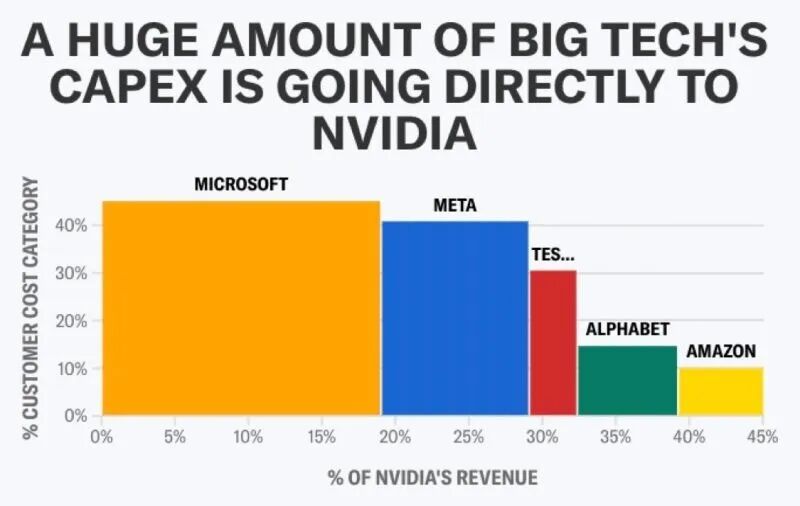
Core Insights - NVIDIA is expected to report strong earnings, with Wall Street anticipating a 68% increase in quarterly revenue to $66 billion and a 70% rise in adjusted earnings, alongside a projected adjusted gross margin of 75% [3][4]. Group 1: NVIDIA's Market Position and Performance - NVIDIA's significant market presence is highlighted by its substantial revenue contributions from major clients, including Microsoft (20%), Alphabet (6%), and Meta (9%) [5]. - Despite its growth, NVIDIA has faced challenges in maintaining momentum due to its size and the complexities of scaling data center operations [4][6]. - The stock has been a major contributor to S&P gains over the past three years, accounting for nearly 20% of the index's growth, but has not contributed positively since its peak in October [6][7]. Group 2: Investor Sentiment and Market Dynamics - There is a notable shift in investor sentiment, with a rotation towards companies perceived as insulated from AI disruptions, such as utilities and energy sectors, while tech stocks, including NVIDIA, have seen less favorable performance [9][12]. - The market is currently scrutinizing the overall spending and capital expenditures related to AI, leading to a more cautious approach towards tech investments [11][12]. - The AI sector is experiencing explosive earnings growth, but valuations remain high, prompting investors to reassess their positions and consider the long-term implications of AI on various industries [10][12]. Group 3: Broader Economic Context - The consumer market is showing signs of resilience, with upper-income consumers driving spending, contributing to a K-shaped economic recovery [20][21]. - Economic uncertainty is affecting consumer behavior, particularly in the home improvement sector, as homeowners face challenges related to affordability [60][61]. - The potential for stimulus measures and tax rebates could provide a boost to lower-income consumers, impacting overall market dynamics in the second half of the year [23].
U.S. Stocks Fall as Tech Sells Off; Gold Gains | The Close 2/3/2026
Youtube· 2026-02-03 23:35
Market Overview - The S&P 500 is down 1.1%, indicating a risk-off sentiment across asset classes, while the Russell 2000 is down only 0.6%, suggesting a rotation trade favoring smaller companies [1] - Gold has rebounded by 5.6%, reflecting volatility in the metal space, while Bitcoin remains under pressure [1] - The AI sector has faced scrutiny, with major companies like NVIDIA and Microsoft experiencing declines, raising questions about the sustainability of AI-driven growth [1] Economic Impact of AI - The AI boom has significantly contributed to U.S. GDP growth, accounting for at least half of the growth rate in the first three quarters of the year, with projections suggesting it could swell to two-thirds of GDP by 2025 [1] - Investors are beginning to question the effectiveness of AI spending on company earnings, indicating a shift in sentiment towards more fundamental investments [1] Sector Performance - The software industry is experiencing a shift in investor sentiment, with concerns that companies heavily invested in AI may not deliver on promised returns, leading to a cautious outlook [3] - The healthcare and software sectors are identified as fast-growing areas, with private equity managers focusing on optimizing returns through NAV financing [3] Commodities and Metals - The commodities market, particularly gold and silver, is experiencing volatility, with gold being viewed as a diversification asset while silver is seen as more cyclical [2] - The recent increase in oil prices, driven by geopolitical tensions, has added complexity to the commodities landscape [2] Corporate Developments - USA Rare Earth Inc. has secured a $1.6 billion funding commitment as part of a broader $12 billion initiative to reduce reliance on Chinese minerals, with plans to begin metal production by 2027 and magnet production by 2028 [6] - Netflix is under scrutiny regarding its proposed acquisition of Warner Bros. Discovery, with concerns about potential monopolistic behavior in the streaming market [4]



巨头加速抛弃英伟达
半导体芯闻· 2026-01-27 10:19
Core Viewpoint - Major tech companies, including Microsoft, are accelerating efforts to reduce dependence on NVIDIA's GPUs, which dominate 90% of the AI chip market. Companies are developing custom chips to enhance efficiency and lower costs, while NVIDIA is transforming into a "full-stack AI" infrastructure provider to maintain its market leadership [2][4][7]. Group 1: Microsoft's AI Chip Development - Microsoft has launched its commercial AI chip "Maia 200," which is designed for high-performance AI inference, claiming it is three times more efficient than AWS's latest AI chip and offers 30% better performance within the same budget [5][6]. - The Maia 200 chip utilizes TSMC's 3nm process and integrates SK Hynix's HBM3E memory, with plans to support OpenAI's latest models [5][6]. - Microsoft aims to shorten the production to deployment timeline for its chips, indicating a potential reduction in reliance on NVIDIA [5][6]. Group 2: Other Companies' Custom Chip Initiatives - Google is using its custom Tensor Processing Units (TPUs) for training and running its Gemini AI models, which outperform GPUs in certain tasks while reducing operational costs [6]. - AWS has released its Trainium3 AI chip, boasting a fourfold increase in computing performance and a 40% reduction in energy consumption compared to its predecessor [6]. - Meta is exploring the use of Google's TPU in its upcoming data centers, while OpenAI is collaborating with Broadcom to develop a custom chip set for release later this year [6]. Group 3: NVIDIA's Market Position and Strategy - Despite the rise of custom chips from competitors, NVIDIA continues to expand its business into AI models and robotics, aiming to maintain competitiveness in a diversifying market [7]. - NVIDIA is also venturing into CPU supply, recently announcing a $2 billion investment in CoreWeave to deploy its CPUs, challenging Intel and AMD [7]. - The company is actively developing AI models and platforms, including an open-source weather forecasting AI model and the Omniverse platform for robotic simulations [7]. Group 4: NVIDIA's Growth Projections - NVIDIA is expected to surpass Apple as TSMC's largest customer this year, with projections indicating that 22% of TSMC's revenue in 2025 will come from NVIDIA, compared to Apple's 18% [8].


全球科技-AI 领域的定价权 vs 非 AI 领域的利润率压力-Global Technology-AI Pricing Power vs Non-AI Margin Pressure
2026-01-14 05:05
Summary of Key Points from the Conference Call Industry Overview - **Industry Focus**: Technology sector, specifically semiconductors and AI-related hardware - **Key Companies Discussed**: Apple, Samsung, NVIDIA, and their supply chains Core Insights and Arguments - **AI Pricing Power vs Non-AI Margin Pressure**: The report discusses how AI technologies are influencing pricing power in the semiconductor industry, contrasting it with the margin pressures faced by non-AI segments [6][48] - **Global Technology Sector Performance**: Year-to-date performance metrics for various segments within the technology sector were provided, indicating significant growth in OSAT (17%), Memory (13%), and other semiconductor categories [12][10] - **NVIDIA GPU Roadmap**: Updates on NVIDIA's GPU product launches and specifications were shared, highlighting advancements in GPU cooling, memory, and processing capabilities [22][24] - **Market Forecasts**: The forecast for GB200/300 rack shipments is approximately 70,000 for 2026, with improvements in rack yields noted [24][26] Financial Metrics and Projections - **Gross Margin Compression**: A median gross margin compression of 40 basis points is anticipated across the semiconductor coverage, even with mitigation efforts [37] - **PC Market Growth Estimates**: Projected unit growth for desktops and notebooks shows a decline in 2026 estimates, with desktops expected to decrease by 4.0% and notebooks by 5.4% [58][59] Additional Important Insights - **Cost Pressures from Rising Memory Prices**: The increase in memory prices is creating cost pressures for hardware OEMs, which could impact overall pricing strategies [48][56] - **HDD Shortage**: A significant shortage of HDDs is becoming more severe, which may affect supply chains and production timelines [61][63] - **OEM Price Increases Impacting Demand**: Increased prices from OEMs are negatively affecting demand across various segments, indicating a potential slowdown in consumer electronics sales [56][48] Conclusion The conference call provided a comprehensive overview of the current state and future outlook of the semiconductor industry, particularly in relation to AI technologies and their impact on pricing and margins. Key metrics and forecasts suggest a mixed outlook, with growth in certain areas but challenges in others due to rising costs and market dynamics.
为什么现代 AI 能做成?Hinton 对话 Jeff Dean
3 6 Ke· 2025-12-19 00:47
Core Insights - The conversation between Geoffrey Hinton and Jeff Dean at the NeurIPS conference highlights the systematic emergence of modern AI, emphasizing that breakthroughs are not isolated incidents but rather the result of simultaneous advancements in algorithms, hardware, and engineering [1] Group 1: AI Breakthroughs and Historical Context - The pivotal moment for modern AI occurred in 2012 during the ImageNet competition, where Hinton's team utilized deep neural networks with significantly more parameters and computational power than competitors, establishing deep learning's prominence [2][3] - Jeff Dean's early experiences with parallel algorithms in the 1990s laid the groundwork for future developments, although initial failures taught him the importance of matching computational power with model scale [4][5] Group 2: Hardware Evolution and Infrastructure - The TPU project was initiated in response to the need for custom hardware to support AI applications, leading to significant improvements in inference efficiency, with the first generation of TPUs achieving 30-80 times better performance than CPUs and GPUs [8] - The evolution of NVIDIA GPUs from AlexNet's two boards to the latest models continues to support large-scale training for companies like OpenAI and Meta, showcasing a diversified AI infrastructure landscape [9] Group 3: Convergence of Technology and Organization - The period from 2017 to 2023 saw the convergence of three critical technology curves: scalable algorithm architectures, centralized organizational structures, and a comprehensive engineering toolset, enabling large-scale AI applications [10][11][13] - The formation of the Gemini team at Google exemplified the importance of resource consolidation, allowing for focused efforts on AI model development and deployment [12] Group 4: Future Challenges in AI Scaling - The conversation identified three major challenges for AI scalability: energy efficiency, memory depth, and creative capabilities, which must be addressed to enable broader AI applications [16][18][21] - Achieving breakthroughs in these areas requires not only engineering optimizations but also long-term investments in foundational research, as many current technologies stem from decades-old academic studies [25][26] Group 5: Conclusion on AI Development - The journey of AI from conceptualization to widespread application is characterized by the alignment of several key factors: practical algorithms, robust computational support, and a conducive research environment [28]

32张图片图解SemiAnalysis的亚马逊AI芯片Trainium3的深度解读
傅里叶的猫· 2025-12-07 13:13
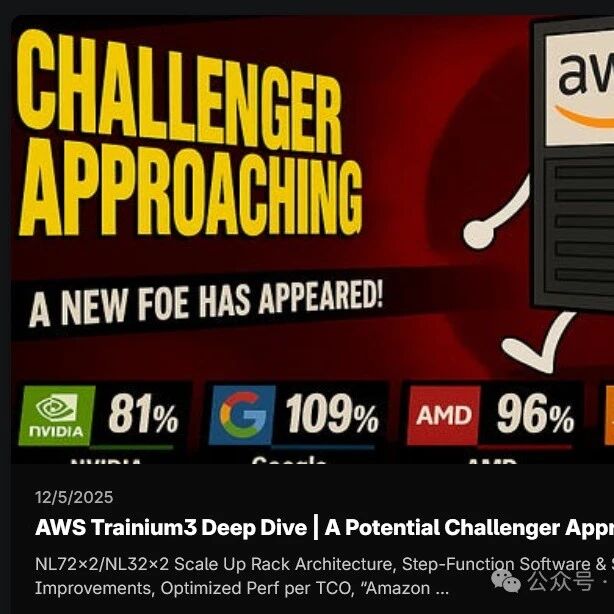
Core Concepts - The article emphasizes the importance of performance per total cost of ownership (Perf per TCO) and operational flexibility in the design and deployment of AWS Trainium3 [4][8] - AWS adopts a multi-source component supplier strategy and custom chip partnerships to optimize TCO and accelerate time to market [4][8] AWS Software Strategy - AWS is transitioning from internal optimization to an open-source ecosystem, aiming to leverage contributions from external developers to enhance its software offerings [5][10] - The strategy includes releasing and open-sourcing new native PyTorch backends and developing an open software stack to expand AWS's ecosystem [5][10] Market Competition Landscape - The competitive landscape for Trainium3 includes major players like NVIDIA, AMD, and Google, with AWS needing to accelerate development to maintain its market position [7][10] - Trainium3's market strategy focuses on delivering strong performance per TCO and supporting a wide range of machine learning workloads [7][10] Hardware Specifications and Generational Comparison - Trainium3 features significant upgrades over its predecessor, Trainium2, including a doubling of performance metrics and increased memory capacity [12][11] - The article highlights the confusion caused by inconsistent naming conventions in AWS's product lineup and calls for clearer naming similar to NVIDIA and AMD [12][11] Architectural Evolution - The architecture of Trainium3 has evolved to include switched scale-up rack types, which provide better performance and flexibility compared to previous toroidal designs [25][26] - The article details the physical layout and key features of Trainium3's rack architecture, emphasizing its design philosophy focused on maintainability and reliability [27][28] Packaging and Manufacturing Technology - Trainium3 utilizes advanced packaging technologies such as CoWoS-R, which offers cost advantages and improved mechanical flexibility compared to traditional silicon interposers [18][19] - The manufacturing challenges associated with the N3P process node are discussed, highlighting the need for careful management of leakage and yield issues [15][20] Commercialization Acceleration Strategies - AWS is implementing strategies to enhance assembly efficiency, including a cableless design and the use of retimers to optimize supply chain management [43][44] - The company aims to adapt to data center readiness and accelerate commercialization through flexible deployment options [43][44] Network Architecture and Scalability - The article outlines the network architecture of Trainium3, focusing on its horizontal and vertical scaling capabilities, which are designed to optimize performance for machine learning tasks [48][49] - AWS's strategy includes minimizing total cost of ownership while maximizing flexibility in network switch options [48][49]

美股 一次全曝光“谷歌AI芯片”最强核心供应商,有哪些公司将利好?
3 6 Ke· 2025-11-28 00:51
Core Insights - Google is positioning itself as a strong competitor to Nvidia by securing significant partnerships and expanding its TPU offerings, potentially disrupting Nvidia's dominance in the AI chip market [1][3] - The shift towards Google's TPU is driven by its system-level cost efficiency and scalability, which appeals to major AI companies like Meta and Anthropic [5][10] - The emergence of a "Google Chain" signifies a structural change in the AI computing landscape, allowing for a more diversified supply chain beyond Nvidia [22][25] Google’s Strategic Moves - Google is negotiating multi-billion dollar TPU purchases with Meta, which may lead to a shift of some of Meta's computing power from Nvidia to Google [1] - A partnership with Anthropic aims to expand TPU capacity significantly, indicating a strong demand for Google's AI infrastructure [1] - Google's TPU is designed to optimize cost and efficiency, with the latest generation showing a performance-to-cost ratio improvement of up to 2.1 times compared to previous models [5][7] Performance Comparison - Nvidia's Blackwell architecture remains the industry benchmark for single-chip performance, but Google is focusing on system-level efficiency rather than direct competition on chip performance [4][5] - Google’s TPU v5e can achieve a performance-to-cost ratio that is 2-4 times better than traditional high-end GPU solutions, making it an attractive option for large model training [7][10] - The cost of using Google’s TPU v5e is significantly lower than Nvidia's H100, with TPU priced at $0.24 per hour compared to H100's $2.25 [8][9] Market Dynamics - The increasing adoption of Google’s TPU by major AI firms indicates a shift in the AI computing market, where companies are looking for alternatives to Nvidia to mitigate risks and reduce costs [10][13] - The competition between "Nvidia Chain" and "Google Chain" is not a zero-sum game; rather, it represents a broader expansion of AI computing resources [22][27] - The structural change allows companies to choose from a diversified set of computing resources based on their specific needs, enhancing flexibility and cost-effectiveness [25][26] Beneficiaries of Google’s Strategy - AVGO is identified as a key player benefiting from Google's TPU ecosystem, providing essential communication and networking components [15][16] - The manufacturing partners, including TSMC, Amkor, and ASE, are crucial for the production of Google's TPU, ensuring the scalability of its offerings [18] - Companies like VRT, Lumentum, and Coherent are positioned to benefit from the increased demand for high-performance cooling and optical communication solutions as TPU deployments expand [20][19] Future Implications - The rise of Google’s TPU could lead to a more balanced and resilient AI infrastructure, reducing the industry's over-reliance on Nvidia [22][25] - The dual-engine approach of Google, combining cloud and edge computing, is expected to reshape the AI landscape, making it more accessible and efficient for various applications [20][21] - The ongoing competition will likely drive further innovation and investment in AI computing, benefiting the entire industry [27]
Google集群拆解
HTSC· 2025-11-27 08:52
Report Industry Investment Rating No relevant content provided. Core Viewpoints The report delves into the in - depth analysis of Google clusters, including their Scale - up (3D structure and optical interconnection) and Scale - out aspects, and also compares the architectures of different GPUs such as NVIDIA and AMD [1][2]. Summary by Directory 1. Google Cluster's Scale up: 3D Structure - **TPU Architecture**: The Ironwood architecture of TPU has high - performance computing components like TensorCore, XLU, VPU, etc., and is connected by high - speed ICI. It uses HBM3 and HBM3E memory to achieve scale - up of 9216 chips [11][12]. - **From TPU to TPU Rack**: A TPU Tray contains 4 Ironwood TPUs, and a TPU Rack consists of 16 TPU Trays and 64 TPU chips. The rack has a specific physical structure and cooling system [28][29]. - **Comparison with Other GPUs**: Compares the architectures of NVIDIA (from Hopper to Blackwell) and AMD (from MI350 to MI400) GPUs, highlighting their different interconnect technologies and performance parameters [20][25]. 2. Google Cluster's Scale up Optical Interconnection: Optical Path Switch - **Optical Switch Components**: The optical path switch uses components such as 850nm camera modules, dichroic beam splitters, fiber collimators, and 2D MEMS micromirrors to separate or combine calibration light and signal light [46]. - **TPU SuperPod Structure**: A TPU SuperPod consists of 64 Google racks, divided into 8 groups of 8 racks. It integrates 4096 chips, sharing 256TiB of HBM memory, with a total computing performance of over 1 ExaFLOP. Each group of 8 racks has a CDU for liquid - cooling [60]. 3. TPU Cluster, Proportion of Optical Path Switches and Optical Modules - **TPU V4**: The proportion of optical path switches is 1.1% with 4096 TPUs, and the proportion of optical modules is 1.5 [70][84]. - **TPU V7**: The proportion of optical path switches is 0.52% with 9216 TPUs, and the proportion of optical modules is also 1.5 [75][89]. - **Rack - level Data**: For a single rack, there are 6 * 16 external optical modules, 4 * 16 PCB traces, and 80 copper cables [94]. 4. Google Cluster's Scale out - **Switch Parameters**: The Tomahawk 5 switch has 128 400G ports [103]. - **Communication Outside TPU SuperPod**: Communication outside the TPU SuperPod is carried out through the Data - center Network (DCN), which includes optical circuit switches and physical fibers [106][108]. - **NV Scale - out OCS**: In the NV scale - out, OCS is used in a redundant spine - leaf network structure, which can enhance the resilience of the network [113][114]. - **Comparison of Interconnection Schemes in a 100,000 - card Cluster**: Compares the InfiniBand, NVIDIA Spectrum - X, and Broadcom Tomahawk5 interconnection schemes in terms of switch quantity, optical module quantity, cost, etc. [125].