OpenAI Sora 2

Search documents
Artificial Analysis 榜单第二,SkyReels-V4 宣告 AI 视频进入「全栈统一」阶段
Founder Park· 2026-03-02 09:30
Core Insights - The article highlights the impressive performance of SkyReels-V4 from Kunlun Tiangong, which ranked second in the latest AI video leaderboard by Artificial Analysis, trailing only behind Kuaishou's Kling 3.0 Pro by three ELO points [1][2] - SkyReels-V4's capabilities are distinguished by its unique approach to video generation, which integrates both visual and audio elements, achieving a high level of synchronization and quality [4][5] Performance Ranking - In the global leaderboard, SkyReels-V4 achieved an ELO score of 1090, placing it second overall, while in the historical ranking, it secured the fourth position [2][3] Unique Features - The Text To Video Leaderboard evaluates complete videos with audio, considering both visual quality and audio synchronization, which sets it apart from other models [4] - SkyReels-V4 demonstrates advanced capabilities in motion reference, allowing for seamless character replacement in videos while maintaining the original timing and movements [12][18] Full-Stack Capabilities - The model aims to cover the entire video creation workflow, from generation to editing, all within a single framework, significantly simplifying the creative process [20][34] - It can generate short drama segments with coherent dialogue, background music, and appropriate camera angles, showcasing its ability to understand and implement cinematic language [25][28] Technical Innovations - The underlying technology of SkyReels-V4 includes a unified splicing framework that allows various video tasks to be executed under the same operational model, enhancing efficiency [39][40] - The dual-stream MMDiT architecture enables real-time synchronization of audio and video, ensuring that both elements are generated in harmony [41][44] Industry Implications - The advancements represented by SkyReels-V4 reflect a broader trend in the AI industry towards unifying capabilities across different modalities, which could redefine workflows in content creation [45][46] - The model's ability to perform tasks traditionally requiring multiple specialized tools suggests a potential shift in the industry, particularly in the production of short videos and brand content [46][47]


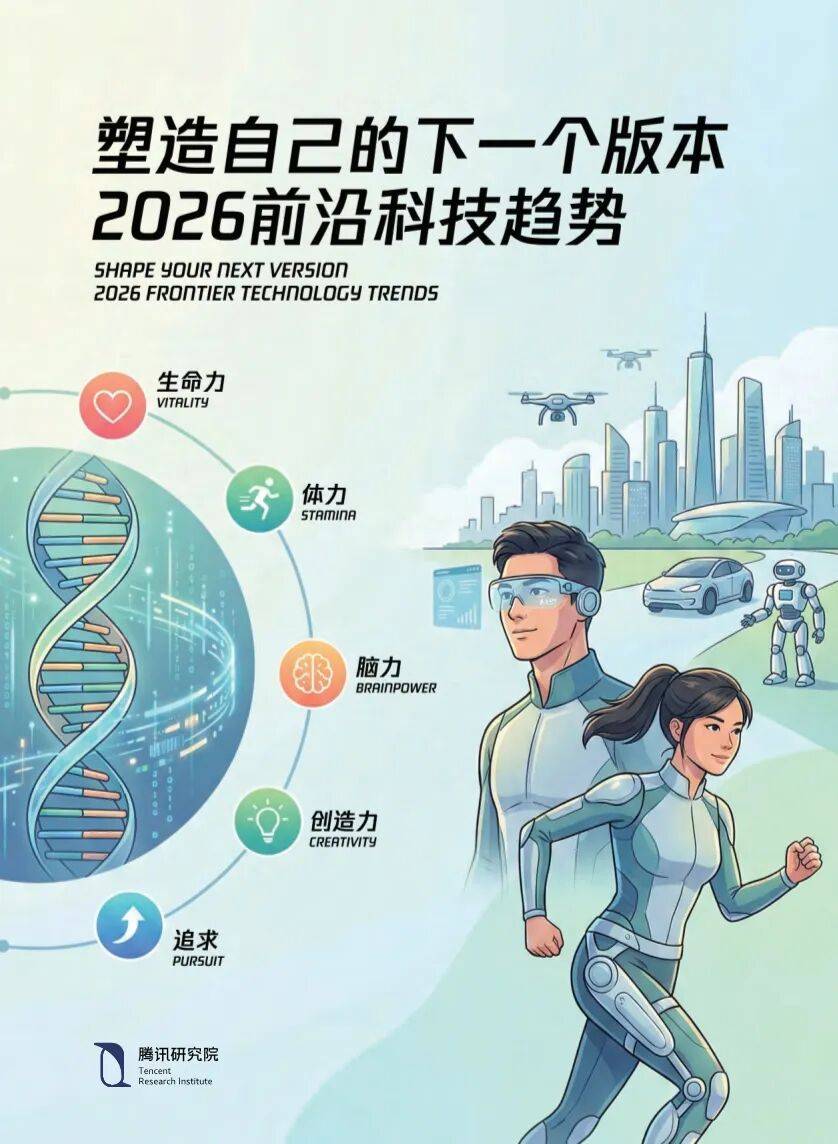
塑造自己的下一个版本2026前沿科技趋势报告解读(40页附下载)
Sou Hu Cai Jing· 2026-02-23 09:39
Group 1: Vitality 2030 - The report highlights a significant shift in human life expectancy, indicating that while life expectancy has doubled over the past century, the growth rate has drastically slowed down, with some regions experiencing stagnation or decline [2][29]. - A new paradigm is emerging, focusing on "healthspan" rather than just lifespan, emphasizing the quality of life without severe chronic diseases, which could generate a global economic value of up to $38 trillion if healthspan is extended by just one year [2][30]. - Key technological advancements include CRISPR technology entering its 2.0 phase, with potential breakthroughs in gene therapy for cardiovascular diseases and personalized treatments for metabolic disorders [2][34][35]. Group 2: Stamina 2030 - Exoskeleton technology is evolving from medical applications to industrial and personal use, significantly enhancing human physical capabilities [3][54]. - In the medical field, exoskeletons are transitioning from mobility aids to intelligent devices that promote neurological rehabilitation, with Medicare's reimbursement policy marking a significant milestone [3][54]. - Industrial applications are showing promising results, with companies like German Bionic reporting a 75% reduction in workplace injuries after implementing exoskeleton technology [3][54]. Group 3: Brainpower 2030 - The report discusses the evolution of artificial intelligence (AI) towards general intelligence (AGI), highlighting advancements in reasoning models that can self-correct and learn from experience [6][7]. - AI is expected to enhance medical practices by significantly reducing drug development timelines from 10-15 years to just a few months, with AI-driven drug candidates already entering clinical trials [6][44]. - Brain-computer interfaces (BCIs) are advancing, with both invasive and non-invasive technologies showing promise in restoring sensory functions and translating brain activity into coherent language [9][10]. Group 4: Creativity 2030 - The integration of AI with personal creativity tools is expected to redefine individual and team productivity, with AI assistants capable of generating complex outputs like presentations and creative content [11][12]. - The emergence of "super individuals" who can independently manage product development and marketing using AI tools is reshaping the concept of team dynamics and company structures [13][14]. - Large organizations are facing challenges in adapting to the AI era, necessitating a complete overhaul of human resource practices to focus on skills and collaborative partnerships rather than traditional employment models [14][15]. Group 5: Pursuit 2030 - The report raises critical questions about individual uniqueness and decision-making in an AI-driven world, emphasizing the importance of maintaining personal judgment and growth opportunities [16][17]. - It suggests that technology amplifies not only capabilities but also choices and values, urging individuals to reflect on their direction in a rapidly evolving landscape [16][17]. - The overarching theme is the need to balance technological advancements with the preservation of human dignity and quality of life, aiming for a future where health and vitality are prioritized over mere longevity [18][51].
国产之光Vidu Q3加冕新王!全球首个16秒音视频直出模型,超越Sora领跑AI视频下半场
Sou Hu Wang· 2026-02-02 02:57
Core Insights - The AI video industry is undergoing a significant transformation, evolving from a "generative toy" to a true "content production tool" with the release of Vidu Q3, which is the first AI video model capable of producing 16-second audio-visual outputs [1][4]. Group 1: Vidu Q3 Release - Vidu Q3 is designed with the core concept of "born for drama," marking a milestone in AI video capabilities [1]. - In the latest rankings by Artificial Analysis, Vidu Q3 is ranked first in China and second globally, surpassing competitors like Runway Gen-4.5 and Google Veo3.1 [1][2]. Group 2: Key Features of Vidu Q3 - Vidu Q3 integrates three previously incompatible capabilities: a narrative time threshold of 16 seconds, end-to-end audio-visual generation, and the ability to produce usable content directly [4][5]. - The model allows for synchronized generation of audio and visuals, enhancing narrative coherence and emotional expression [4][6]. Group 3: Industrial Impact - Vidu Q3's capabilities signify a shift in content production, allowing AI-generated content to be directly usable without extensive post-processing [5][6]. - The model's "one-shot" capability transforms traditional post-production processes, enabling a more efficient content creation cycle and reducing the barriers for high-quality content production [6][7]. - This advancement is expected to compress content update cycles from monthly to daily, significantly enhancing the efficiency of short drama and advertising industries [7].
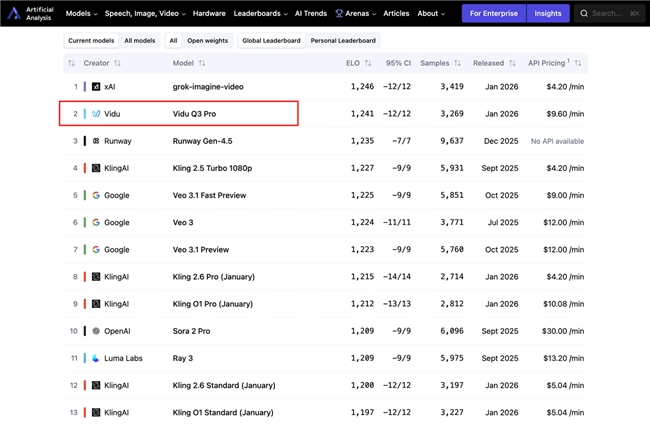
硬刚马斯克,超越Sora2的国产模型强势登场了!支持16秒声画同出
Sou Hu Cai Jing· 2026-01-30 14:40
Core Viewpoint - The AI video model Vidu Q3 Pro from Shenshu Technology has achieved significant recognition, ranking first in China and second globally on the Artificial Analysis leaderboard, marking a key advancement in domestic AI video generation technology [2][3]. Group 1: Model Performance and Features - Vidu Q3 Pro is the first domestic video generation model to break into the international first tier, following only Musk's xAI Grok [2][3]. - The model supports up to 16 seconds of synchronized audio and video output, allowing for high-quality voice, narration, dialogue, sound effects, and music to be generated simultaneously [9]. - It features automatic camera angle switching based on content, enhancing the storytelling aspect by simulating professional directing techniques [10]. - Vidu Q3 can render text in multiple languages directly within the video, eliminating the need for post-production text integration [11]. Group 2: Overcoming Limitations - The model addresses three major limitations in AI video generation: sound synchronization, camera language diversity, and text rendering [4][5][8]. - By integrating sound, camera, and text rendering, Vidu Q3 transforms from a simple video generator to a comprehensive creative engine capable of storytelling [12]. Group 3: Practical Applications - Vidu Q3 is suitable for various content creation scenarios, including short dramas, advertisements, and animated content, effectively covering the entire production process from script to output [16]. - The model enhances efficiency in advertising and product demonstration by automating the video creation process, reducing the need for multiple rounds of scripting, shooting, and editing [18]. - It also shows strong applicability in self-media and podcasting, allowing for batch production of engaging content [20]. Group 4: Industry Impact - Vidu Q3 represents a significant upgrade in creative capabilities, redefining the roles of content creators, advertisers, and marketers [21][22]. - The evolution of AI video models from mere "cameras" to "directors" signifies a new phase in industrial-level content production [24].

马斯克还在卷10秒,中国AI直接掀桌!16秒一镜到底,全球唯一
Sou Hu Cai Jing· 2026-01-30 11:04
Core Insights - The AI video generation industry is witnessing intense competition, particularly with the launch of Vidu Q3, which introduces a new era of "audio-visual generation" [2][8] - Vidu Q3 is the first model capable of generating a complete 16-second audio-visual output in a single instance, significantly enhancing narrative capabilities [7][11] - The model's advanced features include multi-language text rendering, professional-level production capabilities, and precise control over camera angles and transitions, setting it apart from competitors [7][17][24] Group 1: Industry Competition - Silicon Valley giants are heavily competing in the AI video space, with Google’s Veo 3.1 and other models like Grok Imagine and Runway Gen 4.5 making significant advancements [4][7] - Vidu Q3 has emerged as a strong contender, ranking first in China and second globally, surpassing notable models from Google and OpenAI [7][8] Group 2: Technological Advancements - Vidu Q3's ability to generate 16-second videos without the need for post-production or stitching is a groundbreaking achievement in the industry [11][23] - The model addresses previous limitations in AI video generation, such as short video lengths and lack of audio-visual synchronization, by providing a cohesive storytelling experience [11][23] Group 3: Creative Potential - The introduction of Vidu Q3 allows creators to produce high-quality content with minimal effort, enabling a new wave of creativity among individual content creators and marketers [26][28] - The model's capabilities facilitate a shift from traditional video production processes to a more streamlined and efficient approach, empowering users to become directors of their own stories [28][24]

传媒行业人工智能专题:从“生产力”到“变现力”,GEO重构流量入口与AI商业化拐点
Guoxin Securities· 2026-01-16 07:03
Investment Rating - The report maintains an "Outperform" rating for the media industry [2] Core Insights - AI is reshaping user entry points and the distribution of internet traffic, marking a transition from traditional search engines to generative search engine optimization (GEO) [4] - The commercialization of AI in China is accelerating, with a significant trust level of 80% among consumers, which is higher than in the US (35%) and Europe (40%) [5] - The content industry is evolving with AI-generated content (AIGC) not only reducing costs but also creating new supply [6] Summary by Sections AI Reshaping Entry Points - AI is transforming user interaction from keyword-based searches to natural language queries, significantly shortening the information retrieval process [4][11] - The shift to AI-driven search is leading to a "zero-click" trend, where users can satisfy their information needs without navigating away from the AI interface [4] Commercialization Acceleration - By 2026, the global GEO market is projected to reach $24 billion, with the domestic market expected to hit 11.1 billion yuan, indicating exponential growth [5][52] - Marketing service providers are evolving to leverage AI technologies, focusing on optimizing data structures and enhancing brand visibility in AI models [5] Content Industry Upgrade - AI is enabling full-process production in video content, significantly lowering production costs and expanding audience demographics [6] - The gaming industry is also seeing AI applications enhance user engagement through intelligent non-player characters (NPCs) [6] Investment Recommendations - The report suggests focusing on the GEO direction, particularly in marketing services and high-quality content, while also considering potential rebounds in content sectors like film and gaming [7]
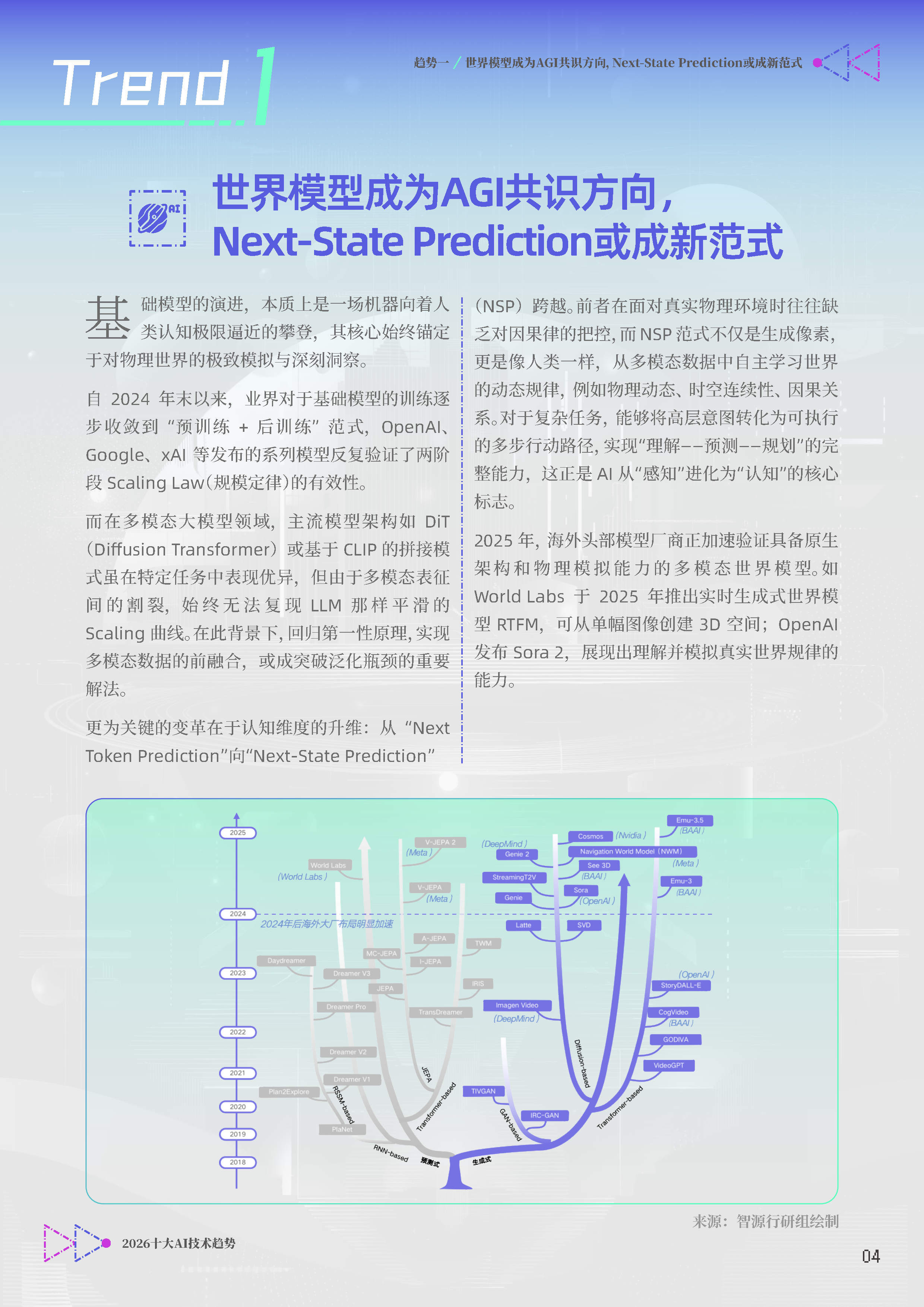
2026十大AI技术趋势报告
Sou Hu Cai Jing· 2026-01-12 08:10
Core Insights - The article discusses the evolution of artificial intelligence (AI) from a rapid initial phase to a more mature stage characterized by cognitive enhancement, collaborative clusters, and deep industry integration, outlining ten core trends that shape the new blueprint of the intelligent era [1]. Group 1: AI Model Evolution - The evolution of foundational models is described as machines approaching human cognitive limits, with the "pre-training + post-training" paradigm validated by the industry since late 2024 [1]. - Breakthroughs in the multimodal field hinge on the transition from "Next Token Prediction" to "Next-State Prediction (NSP)," enabling AI to learn physical dynamics, temporal continuity, and causal relationships like humans [1]. Group 2: Industry Trends and Developments - By 2025, the industry is expected to enter a "clearing" phase, with over 230 embodied intelligence companies in China, including more than 100 humanoid robot firms, facing significant technical challenges and funding requirements [2]. - The commercial focus has shifted from laboratory validation to mass production, with humanoid robot sales surpassing 10,000 units and large-scale orders becoming common [2]. Group 3: Multi-Agent Systems (MAS) - AI applications are evolving from single-agent systems (SAS) to multi-agent systems (MAS), with SAS applications currently accounting for 63% in areas like customer service and code generation [3]. - A report indicates that 57% of organizations have deployed agents to handle multi-stage workflows, with this figure projected to rise to 81% by 2026 [3]. Group 4: Communication Protocols and AI for Science - The core breakthrough in MAS is the unification of communication protocols, with MCP and A2A protocols being integrated into the Linux Foundation, supporting complex applications [4]. - AI for Science (AI4S) has evolved from a supportive tool to an AI Scientist capable of executing a complete research workflow, marking a significant shift in scientific research methodologies [4]. Group 5: Global Competition and Infrastructure - The international competition is intensifying, with the U.S. launching the "Genesis Project" in November 2025 to accelerate the large-scale implementation of AI4S [5]. - China exhibits strengths in application but lacks in foundational infrastructure such as computing power, data, and models, with the national data center holding 4.6PB of data as of 2025 [5]. Group 6: Consumer AI and Vertical Markets - Consumer AI competition is focusing on "Super Apps," which integrate various functionalities into a single platform, with apps like ChatGPT and Gemini achieving over 100 million daily active users [5]. - Vertical markets show significant potential, with multimodal models demonstrating high value despite low usage frequency, as seen in the success of health management apps like Ant Financial's Aifeng [6]. Group 7: Challenges and Future Outlook - Many ToB AI applications remain in the proof of concept (PoC) stage, with 95% of GenAI pilot projects failing to produce measurable impacts due to data quality and integration challenges [6]. - The second half of 2026 is anticipated to be a critical period for the MVP rollout of ToB applications, with a clear implementation path for data governance and API connections [7]. Group 8: Synthetic Data and Cost Reduction - Synthetic data is emerging as a crucial resource for the AI 2.0 era, addressing the shortage of real data, with companies like NVIDIA optimizing 3D detection using synthetic datasets [8]. - The cost of inference has significantly decreased, with the cost per million tokens dropping from $20 to $0.07 between November 2022 and October 2024, reflecting a 280-fold reduction in 18 months [8].
华安证券:AI技术转向推理 驱动硬件产业链迎来新一轮成长周期
Zhi Tong Cai Jing· 2025-12-17 03:37
Core Viewpoint - The global AI technology is shifting from training to inference, driving a new growth opportunity in the hardware supply chain [2] Summary by Category Overall - The transition from training-dominated AI to inference-driven AI is significantly increasing the demand for inference computing power, driven by the iteration of multimodal large models like Google's Gemini 3 Pro and OpenAI's Sora 2 [2] - Major cloud service providers (CSPs) are expected to increase capital expenditures, with a forecast of $431 billion by 2025, a 65% year-on-year increase, and potentially reaching $602 billion by 2026 [2] - Sovereign AI initiatives are being launched globally, such as the U.S. "Gateway to the Stars" plan with an investment of approximately $500 billion and the EU's plan to invest $21.5 billion in AI super factories, contributing to a high-growth phase in global AI infrastructure [2] - By 2030, global AI data center capacity is projected to reach 156 GW, accounting for 71% of total data center demand [2] Cloud Side - PCB: AI servers are bringing clear value increases, with Nvidia's DGX H100 single GPU corresponding to a PCB value of $211, a 21% increase from the previous generation; the GB200 NVL72 raises the single GPU value to $346 [3] - The domestic high-end PCB capacity is expected to be released in 2026 to support downstream demand, driving upgrades in upstream materials [3] - Storage: The structural supply-demand imbalance due to AI demand has led to significant price increases in DRAM and NAND Flash, with a shift in investment focus towards high-value products expected in 2026 [3] - KVCache technology is accelerating the replacement of HDDs with QLC SSDs, with a projected 30% penetration rate in the enterprise SSD market by 2026 [3] Optical Interconnect - Optical interconnect technology is entering a new era as a key component of AI computing clusters, with optical switches meeting the interconnection needs of large-scale AI clusters due to their high bandwidth, low latency, and low power consumption [4] - The MEMS-based technology route currently dominates, with domestic manufacturers actively engaging in various segments of the global supply chain [4] End Side - AI Phones: The AI phone market is expected to maintain moderate growth in 2025, with competition shifting towards end-side AI capabilities [5] - The operating systems of mobile phones are evolving from "application launchers" to "system-level intelligent agents," with flagship chips from Apple and Android continuously enhancing NPU computing power [5] - AR Glasses: The integration of AI and AR in smart glasses is seen as the future of wearable devices, with the market experiencing rapid growth [5] - The optical imaging module solutions for AR glasses are expected to favor light guide technology due to its advantages in clarity and size, while LCOS remains the mainstream for consumer products [5] Recommendations - The company suggests focusing on sectors benefiting from the shift to inference computing and hardware upgrades, including: - PCB and upstream materials: Shenghong Technology, Huitian Technology, Jingwang Electronics, Guanghe Technology, Dongcai Technology [6] - Storage and equipment: Beijing Junzheng, Zhaoyi Innovation, Jucheng Co., Jingzhida [6] - Optical interconnect: Yintan Zhikong, Saiwei Electronics [6] - End-side AI: GoerTek, Luxshare Precision, Baiwei Storage, Longqi Technology, Crystal Optoelectronics, Zhongke Lanyun, Howey Group, Sunny Optical Technology [6]

Ad Agency Stocks Seen Turning AI Disruption to Their Advantage
MINT· 2025-12-14 09:13
Core Viewpoint - The stock market in 2025 is witnessing a decline in shares of advertising agencies due to fears that advancements in artificial intelligence (AI) will replace manual advertising work, with WPP Plc experiencing a 60% drop this year [1] Group 1: Industry Challenges - WPP Plc has faced significant setbacks, leading to a 60% decline in its stock, while competitors like Publicis Groupe SA and Omnicom Group Inc. have also seen declines, albeit to a lesser extent [1] - The rise of AI tools from companies like Google and Meta is pressuring advertising agencies, as brands may opt to create in-house marketing teams instead of relying on external agencies [4][3] - WPP has cut its guidance twice this year and is set to exit the FTSE 100 for the first time in 27 years, indicating severe challenges within the company [8] Group 2: Potential Opportunities - Analysts suggest that advertising agencies may leverage the disruption caused by AI to their advantage, as major brands will increasingly rely on agencies to navigate a complex media landscape [2] - The complexity of the advertising landscape is expected to create a strategic role for agencies, as they can provide valuable advice on marketing and media strategies [6] - Lower production costs due to AI advancements may lead to increased ad investments from major brands, potentially creating an "arms race" for high-quality advertising experiences [6] Group 3: Valuation and Market Sentiment - The debate surrounding AI has negatively impacted the valuations of advertising agencies, with WPP's forward price-to-earnings multiple at a record low and Omnicom's valuation near its lowest since 2020 [7] - The potential for consolidation in the advertising industry is highlighted, as companies like Dentsu Group Inc. review their overseas operations and WPP attracts interest from other firms [9]



杀回来了?威马宣布「好事将近」,评论区排队讨债;阿里前高管接管山姆后APP被吐槽满满阿里味;三七互娱因信披违规被罚3255万
雷峰网· 2025-11-04 00:28
Group 1 - WM Motor announced a potential new product launch and is working on restoring its service network, but employees and customers are expressing dissatisfaction over unpaid wages and service issues [4][5]. - Walmart's Sam's Club, under new leadership from a former Alibaba executive, has faced backlash for changes in its app that resemble Alibaba's features, leading to customer complaints about complexity and confusion [7][8]. - Honor plans to release a new ultra-thin smartphone model, joining competitors like Samsung and Apple in this segment, indicating a trend towards thinner devices in the market [12]. Group 2 - Xiaopeng Motors' CEO predicts that in ten years, only about five major Chinese automotive brands will survive, reflecting a competitive landscape similar to the smartphone industry [13][14]. - ByteDance is piloting a "Doubao stock" incentive plan aimed at attracting and retaining talent in its large model business, indicating a strategic focus on long-term employee engagement [14][15]. - 37 Interactive Entertainment has been fined 32.55 million yuan for information disclosure violations, highlighting regulatory scrutiny in the gaming industry [16]. Group 3 - AI expert Zhou Shuchang has joined Xiaopeng Motors as the Senior Director of Autonomous Driving Algorithms, emphasizing the company's commitment to AI development [18][19]. - Xiaomi's product marketing director has raised concerns about rising storage chip costs, signaling potential challenges in the consumer electronics supply chain [23]. - Geely is reportedly renovating a former GM factory to boost production capacity for its Galaxy model, indicating ongoing expansion efforts in the automotive sector [25][26]. Group 4 - Huawei's HarmonyOS has surpassed 23 million devices, marking a significant milestone in its ecosystem development, although challenges remain ahead [27]. - Long-term stock option vesting rules have been adjusted at Xiaohongshu, reflecting changes in employee compensation strategies within the tech industry [21][22]. - OpenAI's CEO stated that the company's revenue exceeds previous estimates and denied plans for an imminent IPO, indicating a focus on sustainable growth rather than immediate public offering [41][42].