Opus 4.5

Search documents
“为了让工程师用 AI,公司会裁掉一半人!”硅谷顶级大佬直言,AI 一天 3 小时搞定工作,还搞 996 的公司必垮
AI前线· 2026-03-14 05:33
Core Insights - The software industry is experiencing a paradoxical state driven by AI, characterized by unprecedented excitement and growing fatigue, termed the "vampire effect" [2] - Companies are defaulting to cut approximately 50% of their engineers to support the remaining workforce in fully utilizing AI, as traditional IDE users are at risk of being eliminated [2][19] - The essence of AI is not to replace humans but to amplify their capabilities, allowing small teams to outperform larger companies [2][3] Group 1 - The future development paradigm will be completely restructured, with programming evolving from coding to interacting with visual AI agents [3] - The true competitive advantage in this new era will be the connections between people, with open-source projects becoming the norm [3] - By 2027, non-developers will be able to lead software development, making programming a universal skill [3] Group 2 - The software industry has seen stagnation in innovation since the advent of mobile and cloud technologies, with AI being the catalyst for renewed activity [14][15] - The last significant innovation in software engineering was around distributed systems, with the industry now in a state of continuous adaptation rather than true innovation [16][17] Group 3 - The emergence of AI has led to a significant shift in workforce dynamics, with many knowledge workers leaving large companies as AI enables non-programmers to write code [26][27] - Companies are increasingly willing to reduce their workforce to maximize productivity through AI, leading to a potential loss of half their engineers [24][25] Group 4 - The industry is witnessing a surge in small teams capable of producing outputs comparable to large companies, indicating a shift in organizational structure [26][27] - The future may see a dramatic increase in the number of companies as the barriers to entry for software development lower [27] Group 5 - AI is not intended to replace jobs but to augment human capabilities, allowing engineers to work alongside AI rather than independently [28] - The current state of software engineering is evolving, with a shift towards using AI tools and agents for coding tasks [30][31] Group 6 - The concept of "Gas Town" represents an orchestrator for intelligent agents, indicating a complex interplay of AI in software development [46][48] - The future of software engineering may involve a more visual and interactive approach, where developers communicate with AI in a more human-like manner [42][43]


OpenAI三年前预言的“安全区”职业,正被AI以4倍速疯狂碾压
创业邦· 2026-03-05 10:48
Core Viewpoint - The rapid advancement of AI technology is reshaping the labor market, leading to significant structural changes rather than mere job losses. The focus is shifting from job disappearance to the transformation of job roles and the emergence of a new class of AI-skilled workers [5][6]. Group 1: AI Impact on Labor Market - In March 2023, OpenAI estimated that about 19% of U.S. workers would see over 50% of their tasks affected by AI within a decade [7]. - By January 2026, Cognizant reported that this figure had risen to 30%, with 93% of jobs now impacted by AI to varying degrees [10][11]. - The rate of AI exposure in jobs has accelerated from an average annual growth of 2% to 9%, indicating a 4.5-fold increase in the speed at which jobs are being affected [11]. Group 2: Job Role Transformation - The proportion of jobs with over 50% task exposure to AI surged from 0% in 2023 to 30% in 2026, while jobs with at least 25% exposure increased to 69% [13]. - Cognizant's classification of job exposure levels shows that full automation tasks increased from 1% to 10% between 2023 and 2026, highlighting the significant impact of AI on various job functions [15][16]. - High-exposure roles include financial managers (84% of tasks), computer-related positions (67%), and legal professions (63%), indicating that cognitive jobs are more susceptible to AI integration [29]. Group 3: Recruitment Market Changes - The recruitment landscape is experiencing a "hidden death" of entry-level positions, particularly for young workers aged 22-25, with job postings in high AI exposure industries declining by 18-40% [38][39]. - A study indicated that job advertisements for high AI-replaceable roles decreased by approximately 12%, with entry-level positions seeing the most significant declines [39]. - The trend of "seniority-biased technological change" suggests that companies are favoring experienced workers who can leverage AI tools, leading to a reduction in the hiring of junior staff [41]. Group 4: Economic Implications - The introduction of AI is leading to a dramatic wage disparity, with jobs requiring AI skills commanding a 15-30% salary premium compared to those without [36]. - The potential for a "ghost GDP" scenario is emerging, where productivity increases due to AI do not translate into consumer spending, as machines do not participate in the economy in the same way humans do [48]. - The ongoing structural changes in the labor market may lead to a significant reallocation of wealth, raising questions about how society will distribute resources when machines generate the majority of economic value [52].

三年前OpenAI预测不会被AI影响的职业,正以4倍速被残酷碾压
虎嗅APP· 2026-03-04 14:02
Core Insights - The article discusses the rapid transformation of the labor market due to AI advancements, highlighting significant job displacement and the restructuring of job roles, particularly in high-exposure industries [5][6][7][8]. Group 1: AI Impact on Employment - In March 2023, OpenAI estimated that about 19% of U.S. workers would see over 50% of their tasks affected by AI within a decade [6]. - By January 2026, Cognizant reported that 93% of jobs were impacted by AI, with the rate of exposure accelerating from an average annual growth of 2% to 9%, indicating a 4.5-fold increase [14][16]. - The proportion of jobs with over 50% task exposure surged from 0% in 2023 to 30% in 2026, while jobs with at least 25% exposure rose to 69% [16]. Group 2: Job Role Transformation - The article emphasizes that the nature of job roles is changing rather than disappearing, with entry-level positions declining and demand for senior roles increasing [7][34]. - AI's influence is penetrating traditionally secure roles, including management, where CEO exposure to AI increased from 25% to over 60% [25]. - Specific job categories, such as financial managers, have a staggering 84% of their tasks potentially automated by AI [33]. Group 3: Economic Implications - Cognizant estimates that AI could transfer $4.5 trillion in labor costs to AI, representing about 15% of the U.S. GDP [18]. - The article warns of a potential economic crisis by 2028, where AI-driven productivity increases could lead to a hollowing out of consumer spending, termed "ghost GDP" [58][63]. - The disparity in wage structures is highlighted, with AI-related roles commanding a 15% to 30% salary premium, exacerbating income inequality [43][46]. Group 4: Future Projections - The article predicts that by 2028, the labor market will face severe structural pressures, with AI capable of performing most tasks traditionally done by humans [62][63]. - The concept of "task rewriting" is introduced, where job descriptions evolve to require skills in managing AI systems rather than performing traditional tasks [51]. - The potential for a societal shift is noted, where machines create the majority of economic value but do not participate in consumption, raising questions about wealth distribution [63].



假期科技盘点
傅里叶的猫· 2026-02-23 15:21
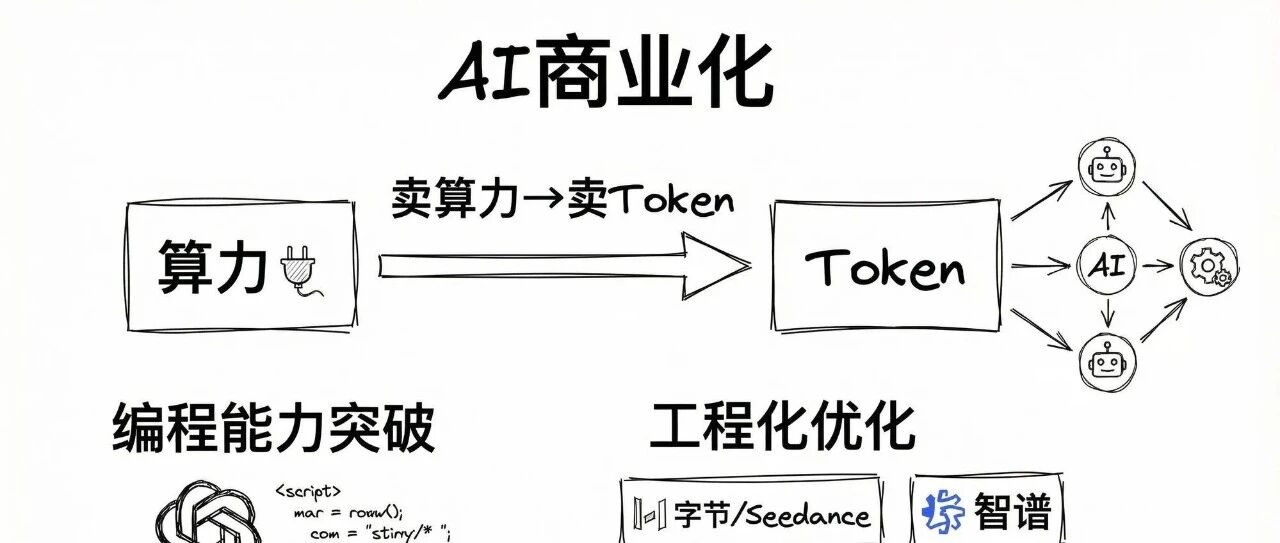
Robotics - The humanoid robot showcased at the 2026 CCTV Spring Festival has made significant advancements in hardware engineering, overall control, dynamic balance, and dexterous operation, but the highly choreographed nature of the program makes it difficult to assess true autonomous AI capabilities [3] - Goldman Sachs projects global humanoid robot shipments to reach 51,000 units in 2026 and 76,000 units in 2027, representing several times growth compared to 2025 [3] - The core driver for this growth is the commercial deployment in specific scenarios, which may boost sentiment for industry chain stocks in the short term; however, the long-term key to industry growth lies in the generalization capabilities of AI driven by data and model strategies, particularly the "world model" that will determine robots' ability to understand environments, make autonomous decisions, and perform causal reasoning [3] AI - During the holiday period, the trend of AI commercialization shifted from selling computing power to selling tokens, with notable advancements in model capabilities from Chinese AI companies [5] - The breakthrough in programming capabilities by Claude, particularly with Opus 4.5, highlights the commercial value of vertical scene deepening and indicates a replicable success path for the industry through engineering optimization and precise product imitation [8] - The strategy of "precise imitation + engineering optimization" significantly reduces R&D risks and accelerates product deployment compared to the high-risk approach of directly challenging OpenAI's GPT series [8] Memory - SK Hynix's entire HBM/memory capacity for 2026 is sold out, with a significant increase in capital expenditure planned to meet AI accelerator demand from companies like Nvidia [11] - Samsung plans to raise the price of its next-generation HBM4 chips by 20-30%, benefiting from strong AI demand, which has helped its stock reach an all-time high [11] - Goldman Sachs predicts that memory prices will rise throughout 2026, driven by strong demand from AI customers and limited supply growth due to constraints in cleanroom space [11] PCB - Goldman Sachs maintains a positive outlook on PCB, forecasting a net profit growth of 129% and 82% for Shenghong in 2026E and 2027E, respectively, driven by strong revenue growth and margin improvement [16] - The revenue share of AI server PCBs is expected to rise to 70% by 2027E, up from 29% in 2025E, with a maintained market share of 25-45% in global GPU AI server PCBs [16] - The global PCB market is projected to grow by 113% and 171% in 2026E and 2027E, respectively, driven by the ramp-up of global AI servers and the trend of PCB replacing copper cables [16]


国信证券晨会纪要-20260210
Guoxin Securities· 2026-02-10 01:00
Macro and Strategy - In the first week of February, net capital outflow from the market totaled 49.9 billion yuan, a decrease from the previous week's outflow of 151.2 billion yuan [7] - Short-term sentiment indicators are at a medium-high level since 2005, while long-term sentiment indicators are at a medium-low level [8] - The top three industries by trading volume in the past week were communication (99%), defense and military industry (98%), and semiconductors (98%) [8] Food and Beverage Industry - The food and beverage sector (A-shares and H-shares) rose by 4.48% this week, with A-share food and beverage outperforming the CSI 300 by approximately 5.77 percentage points [7] - The top five gainers in the food and beverage sector included Huangtai Liquor (13.50%), Haixin Food (11.90%), and others [9] - The performance of liquor is improving, with Moutai showing strong sales during the Spring Festival [9] - Investment recommendations include Moutai, Shanxi Fenjiu, and Luzhou Laojiao, with a focus on companies with strong product positioning and management capabilities [9] - The beverage sector is expected to see demand recovery, with a focus on leading companies like Yanjing Beer and Nongfu Spring [9][10] AI Agent Market - The release of the Opus 4.5 model by Anthropic has significantly boosted AWS cloud service revenues, indicating a shift in AI capabilities [11] - The demand for CPUs is expected to rise sharply due to the proliferation of AI agents, with a notable shift in server CPU configurations [11] - The CPU market is anticipated to enter a price increase cycle, with a 10% rise noted in February 2026 [11][12] Real Estate Industry - Some positive data has emerged since January 2026, with the China Construction Bank supporting the acquisition of second-hand housing in Shanghai for rental purposes [13] - The report suggests that while there are signs of recovery, the evidence for a bottom in the market remains insufficient [13] - Investment recommendations include companies like China Merchants Shekou and China Jinmao, with a cautious outlook on the market [13] Education Sector - China Oriental Education is a leading vocational education group, with a projected compound annual growth rate of 17% from 2025 to 2029 in the vocational education market [19][20] - The company is focusing on expanding its offerings in emerging fields such as beauty and pet care, which are expected to drive future growth [21] - Profitability is expected to improve as the company adjusts its operations and expands its vocational education parks [20][22] Coal Industry - The company is transitioning from a single coal producer to a comprehensive coal enterprise, with a focus on expanding its product range and regional presence [23] - The main coal mine has strong profitability, and new projects are expected to contribute significantly to revenue [24] - The company has plans to invest in non-coal mining projects, which are anticipated to add substantial profit margins [24][25]
AI Agent 专题:Opus 4.5 开启AI Agent拐点,CPU需求迎高增
Guoxin Securities· 2026-02-09 06:49
Investment Rating - The report maintains an "Outperform" rating for the industry [3] Core Insights - The release of the Claude Opus 4.5 model by Anthropic marks a significant turning point for AI agents, leading to a substantial increase in CPU demand as the model transitions from a "super intern" to a "senior architect" [4][12] - The report anticipates a surge in CPU demand driven by the proliferation of AI agents, with server CPU configurations evolving from 1:32 to 1:4, and even reaching 1:2 in advanced products [4][60] - The CPU market is expected to experience a price increase due to rising demand, precious metal material costs, and limited advanced process capacity, with a 10% price increase already observed as of February 2026 [4][66][69] - The report highlights the competitive landscape of the global CPU market, projecting Intel to hold approximately 55% and AMD around 40% of the server CPU market share by 2026 [4][72] Summary by Sections 01 Phenomenon of AI Agents - The report discusses the emergence of AI agents as a transformative event in the industry, emphasizing their capabilities in autonomous task execution and workflow automation [5][12] 02 Evolution of Opus 4.5 Model - Opus 4.5 introduces significant advancements in coding capabilities, enabling end-to-end autonomous software engineering and improving the model's performance in complex tasks [27][29] - The model's pricing strategy enhances cost-performance balance, allowing for efficient resource utilization and market competitiveness [28][29] 03 Explosion of CPU Demand Under AI Agents - The report outlines how AI agents necessitate a shift in CPU roles from auxiliary units to central execution hubs, significantly increasing CPU load due to complex task execution and high concurrency requirements [60][61] - The anticipated growth in server CPU configurations reflects the evolving demands of AI agents, with projections indicating a shift towards higher core counts and improved energy efficiency [60][64] Market Dynamics - The report analyzes the competitive dynamics between x86 and ARM architectures, noting the dominance of x86 in the server market while highlighting ARM's advantages in energy efficiency and specific ecosystems [80] - Future trends suggest a gradual market shift towards ARM ecosystems, particularly with the rise of companies like Nvidia and Apple [80]
堪比“ChatGPT”时刻!SemiAnalysis深度解读:Claude Code将是AI “智能体”的转折点
美股IPO· 2026-02-07 00:35
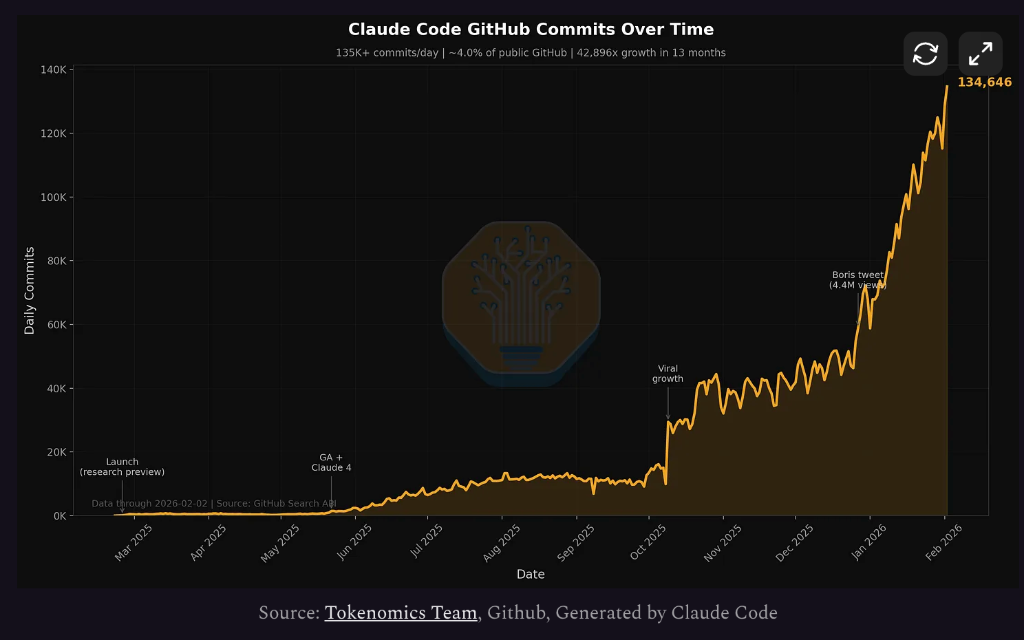
Core Insights - Claude Code has captured 4% of GitHub code submissions and is expected to exceed 20% by the end of 2026, marking a significant turning point for AI agent technology in commercial applications [4][6][20] - The emergence of AI agents like Claude Code is reshaping the $15 trillion information work market, with Anthropic's revenue growth surpassing that of OpenAI, indicating a structural shift in the competitive landscape [3][12][20] - Traditional software business models are facing fundamental challenges as AI agents transition from generating responses to delivering executable outcomes, emphasizing efficiency in real-world applications [1][7][22] Market Impact - The rise of Claude Code signifies a broader market transformation, affecting various sectors including finance, legal compliance, and strategic consulting, as AI agents extend beyond programming to automate high-value professional services [3][12][16] - Accenture's plan to train 30,000 professionals to use Claude Code highlights the growing adoption of AI in key industries, marking a shift towards large-scale information automation [3][16] - The cost structure of software engineering is undergoing a significant transformation, with AI tools like Claude Pro offering substantial cost advantages compared to traditional knowledge worker expenses [14][15] Technological Advancements - Claude Code operates as a command-line tool that autonomously plans and executes multi-step tasks, representing a paradigm shift from code generation to system-level operation [9][10] - The tool's ability to automate complex workflows, from data analysis to document processing, demonstrates its potential to redefine the nature of information work [12][17] - The rapid reduction in task processing times is unlocking new scalable application scenarios, with significant implications for the automation of repetitive workflows [13][17] Competitive Dynamics - Microsoft faces a strategic dilemma as it balances the growth of Azure with the need to protect its core Office 365 products from the disruptive impact of AI agents [5][18][19] - The competitive landscape is shifting, with external innovations like "Claude for Excel" challenging Microsoft's traditional software offerings, indicating a potential erosion of its market position [19] - Anthropic's growth trajectory is closely tied to its ability to scale computational resources, with its quarterly recurring revenue growth now surpassing that of OpenAI, reflecting a critical advancement in its commercialization efforts [20][22]


堪比“ChatGPT”时刻!SemiAnalysis深度解读:Claude Code将是AI “智能体”的转折点
Hua Er Jie Jian Wen· 2026-02-06 12:19
Core Insights - Claude Code, an AI programming tool by Anthropic, has captured 4% of public code submissions on GitHub and is projected to exceed 20% by the end of 2026, marking a pivotal moment for AI agents [1][3] - The emergence of Claude Code signifies a transformation in programming and indicates that AI agents will reshape the global information work market valued at approximately $15 trillion [3][9] - Anthropic's revenue growth, driven by Claude Code, has surpassed that of OpenAI, indicating a structural change in the competitive landscape of AI agents [3][16] Group 1: Impact on Programming and Workflows - Claude Code is redefining the role of programmers from code writers to task planners, showcasing its ability to autonomously execute complex tasks through a command-line interface [7][8] - The tool's effectiveness has led to a shift in the programming community, with notable figures acknowledging a decline in manual coding skills due to reliance on AI [8] - The introduction of Claude Code has initiated a broader automation trend across various sectors, extending its utility beyond programming to include document review and compliance tasks [9][12] Group 2: Economic Implications - The cost of AI tools like Claude Pro is significantly lower than traditional knowledge worker costs, creating strong economic incentives for large-scale deployment [11][12] - The rapid decline in intelligent costs is fundamentally reshaping the profit structure of the information industry, particularly impacting traditional SaaS models [11][12] - Companies are beginning to act on the cost-reduction potential of AI, with significant deployments in sectors like finance and life sciences [12] Group 3: Strategic Challenges for Tech Giants - Microsoft faces a strategic dilemma as it balances the growth of Azure, which supports AI companies, with the need to protect its core products like Office 365 from AI disruption [4][14] - The competitive landscape for AI products is intensifying, prompting Microsoft CEO Satya Nadella to become personally involved in AI product strategy [15] - The emergence of external innovations, such as "Claude for Excel," highlights the internal conflicts within Microsoft regarding its traditional software offerings [14][15] Group 4: Future of AI and Automation - The current phase of AI evolution is seen as a new critical point following the ChatGPT moment, with Claude Code representing a fundamental paradigm shift in AI capabilities [5][18] - The focus of AI competition is shifting from generating quality responses to delivering tangible outcomes, emphasizing task completion and system stability [18] - The automation capabilities of AI agents are expected to expand significantly, impacting various repetitive workflows across industries [12][10]
编程已死,键盘长草,Claude Code之父对谈Kaparthy,全程爆金句
3 6 Ke· 2026-02-04 08:46
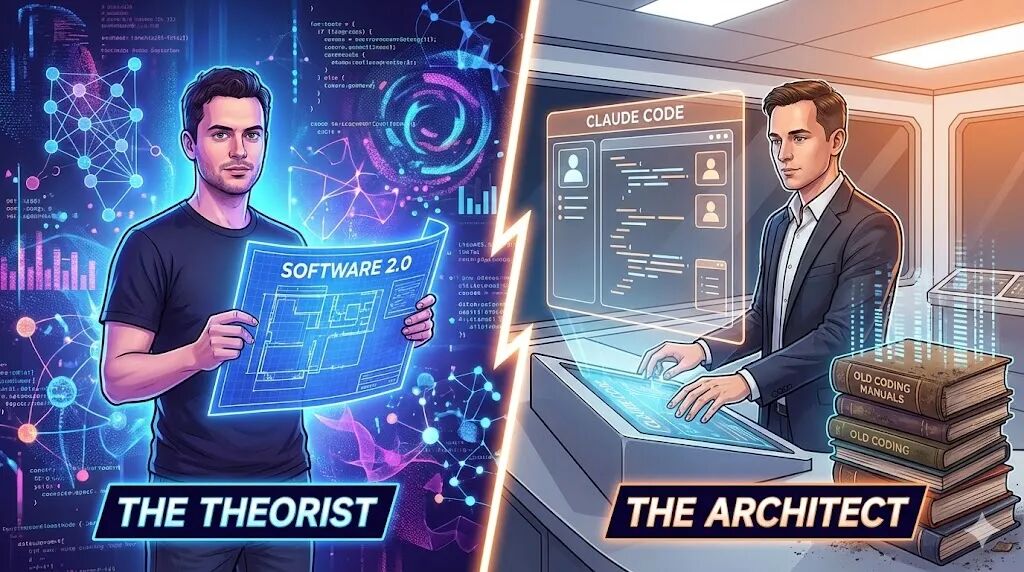
Core Insights - The discussion between Andrej Karpathy and Boris Cherny highlights the transformative shift in programming paradigms from "Software 2.0" to "Agentic Coding," emphasizing the evolution of programmers from manual coders to strategic overseers of AI-driven processes [1][3][8] Group 1: Paradigm Shift in Programming - The transition from "imperative programming" to "declarative intent" signifies a fundamental change in how programming is approached, where humans now primarily define success criteria while AI handles implementation details [8][9] - The concept of "Agentic Coding" represents a new era where AI not only writes code but also manages dependencies, refactors architecture, and creates test cases, showcasing its capabilities as a self-correcting "engineer" [9][10] Group 2: Impact on Programmer Roles - The role of programmers is being redefined, with a shift towards hiring "generalists" who can oversee broader aspects of product development rather than focusing solely on coding specifics [10][11] - The emergence of AI tools means that traditional skills, such as memorizing API details, are becoming less relevant, leading to a new definition of "10x engineers" who possess a macro perspective across various domains [10][11] Group 3: Concerns and Optimism - Karpathy expresses concerns about "brain atrophy," where reliance on AI for coding may diminish fundamental programming skills and understanding of underlying systems [12][13][16] - In contrast, Boris maintains a "technological optimism," suggesting that AI will be able to review and clean up its own generated code, potentially preventing a "Slopacolypse" of low-quality code [20][21] Group 4: Future of Programming - The year 2026 is identified as a pivotal moment for the industry, marking a phase shift in capabilities and the evolution of human roles from "builders" to "architects" in programming [21][22] - The essence of programming is shifting from syntax and algorithms to imagination and logic, as the limitations of coding become less about technical skills and more about conceptual understanding [24][25]
数据中心地产_AI 需求增长才刚刚起步-Data Center Real Estate_ The AI demand ramp is just getting started
2026-02-02 02:22
Summary of Data Center Infrastructure and AI Demand Industry Overview - The report focuses on the **Data Center Real Estate Investment Trusts (REITs)** and the broader **AI infrastructure landscape**. - Demand for data center capacity has surged, with **5.8GW** of capacity leased in North America in **4Q25**, leading to a total absorption of **15.6GW** for the year, more than double the **~7GW** in **2024** [2][45]. Key Demand Insights - The demand pipeline in the U.S. is projected at **~26GW**, driven by **11GW** of hyperscale self-build capacity currently in development [2]. - Major players like **Oracle**, **Meta**, and **AWS** are increasing their leasing activities, particularly in tertiary markets [2]. - Forward demand signals are positive, with significant AI infrastructure projects reaching operational capacity targets of **1GW** [3][21]. Supply Constraints - Supply constraints are becoming more acute, with grid interconnection queues extending to **6+ years** in most markets and data center vacancy rates at historic lows of **<2%** [4][60]. - The adoption of **Bring Your Own Generation (BYOG)** approaches is expected to increase, particularly for larger campus locations [4]. - Labor scarcity is a growing concern, with each **GW** build requiring **3-7K** workers, while the labor pool is only growing by **~24K** per year [4][9]. Data Center REITs Outlook - The report maintains a constructive outlook on data center REITs, particularly **Digital Realty (DLR)** and **Equinix (EQIX)**, due to tight industry conditions that are expected to drive pricing higher [5][9]. - **DLR** is projected to see **7.4%** growth in FFO/share for **2026E**, supported by hyperscale leasing and mark-to-market opportunities [8]. - **EQIX** is expected to achieve **8.6%** normalized recurring revenue growth in **2026E**, with shares trading at a discounted valuation [8]. AI Infrastructure Developments - The race to **Artificial General Intelligence (AGI)** is intensifying, with major AI infrastructure projects ramping up to meet the demands of new models [9][14]. - Upcoming releases of models trained on **Blackwell systems** and the rollout of **Rubin** in **2H26** are expected to significantly impact power density and data center designs [3][41]. - The current environment is characterized by the development of greenfield data center facilities to support higher power and compute-intensive workloads [9]. Financial Projections - Hyperscale capital expenditures are projected to reach **~$585B** in **2026**, a nearly **40%** increase from previous estimates [46]. - Incremental cloud revenues are expected to rise to **$106B** in **2026**, up from **$69B** in **2025** [50]. Conclusion - The data center market is experiencing unprecedented growth driven by AI demand, with significant investments and developments expected in the coming years. However, supply constraints and labor shortages pose challenges that could impact the pace of growth. The outlook for established data center REITs remains positive, supported by strong demand and pricing dynamics.