RTX6000D

Search documents
Nvidia Corporation (NVDA) Rated as ‘Overweight’ at KeyBanc amid Booming Business
Yahoo Finance· 2025-10-09 14:48
Group 1 - Nvidia Corporation is recognized as a high-growth semiconductor stock with profitability expected in 2025, receiving an 'Overweight' rating from KeyBanc with a price target of $250, reflecting confidence in the company's prospects due to strong hyperscaler demand [1][2] - KeyBanc anticipates Nvidia will benefit from increasing demand for GB200/300 products, projecting revenue of $56.3 billion and earnings per share of $1.28 for the upcoming results on November 19, surpassing consensus estimates of $54.5 billion and $1.24 [2] - The company is expected to ship 30,000 racks in 2023, with 10,500 in Q3 and 14,000 in Q4, and financial results are likely to improve due to renewed shipments of RTX6000D products to Chinese customers [3] Group 2 - Nvidia is a semiconductor giant specializing in accelerated computing products and platforms, primarily GPUs, serving key sectors such as data centers, gaming, professional visualization, and autonomous vehicles, and is a major provider of hardware and the CUDA software ecosystem that supports AI development [4]

“中国仅落后‘几纳秒’,我们必须参与竞争”
Guan Cha Zhe Wang· 2025-09-28 12:21
Core Viewpoint - The article discusses the ongoing challenges and developments in the semiconductor industry, particularly focusing on the competition between the U.S. and China, highlighting the potential of Chinese companies in the chip sector despite U.S. export restrictions [1][3]. Group 1: U.S. Export Restrictions and Responses - The U.S. government has implemented a series of export restrictions aimed at curbing the development of China's semiconductor industry [1]. - NVIDIA's CEO Jensen Huang stated that China is only "a few nanoseconds" behind the U.S. in chip technology, emphasizing the need for U.S. tech companies to compete in the Chinese market to enhance American influence [1][3]. - Huang believes that allowing U.S. technology firms to compete globally, including in China, would maximize economic success and geopolitical influence for the U.S. [1][3]. Group 2: Developments in Chinese Semiconductor Industry - In response to U.S. restrictions, Chinese companies are actively developing domestic alternatives to NVIDIA's AI chips, aiming to capture market share previously held by NVIDIA [3]. - Major Chinese tech firms such as Huawei, Alibaba, Tencent, and ByteDance are increasing their investments in chip research and design to gain greater control over their supply chains [3][4]. Group 3: Challenges Faced by NVIDIA - NVIDIA has faced declining demand for its specially designed "reduced-spec" AI chips for the Chinese market, with major Chinese clients refusing to place orders [4]. - The company is also under scrutiny for security vulnerabilities and potential antitrust violations, with Chinese authorities conducting investigations into NVIDIA's practices [5]. - Huang emphasized the importance of the Chinese market for the tech industry, stating that the U.S. should ensure access to AI technology globally, including in China [5].


Uncertainty Around NVDA Chips in China
Yahoo Finance· 2025-09-19 04:46
Group 1 - NVIDIA Corporation's newest AI chip for the Chinese market, the RTX6000D, is experiencing poor sales, with major tech companies in China opting not to place orders [1][2] - The RTX6000D is designed for AI inference tasks but is considered too expensive relative to its performance, which is reportedly inferior to the RTX5090 [2] - The RTX5090, although banned for use in China, is available through grey market channels at less than half the price of the RTX6000D [2] Group 2 - Chinese tech companies are awaiting clarity on the ability to order NVIDIA's H20 chip, which was recently allowed for sale, but shipments have not yet resumed [3] - There is hope among tech firms that NVIDIA's B30A chip, which is more powerful than the H20, will receive approval from U.S. authorities [3] - Analysts had previously expected strong demand for the RTX6000D, with forecasts of 1.5 million units to be produced in the second half of 2025 by JPMorgan and 2 million by Morgan Stanley [4] Group 3 - NVIDIA Corporation specializes in AI hardware and software, as well as high-performance computing solutions [4]
美企高管急跳脚:芯片是“对华仅存优势”,特朗普却…
Guan Cha Zhe Wang· 2025-09-18 01:08
Core Viewpoint - The dominance of the U.S. in the chip industry is seen as its only advantage over China, which needs to be protected, according to Dario Amodei, CEO of AI startup Anthropic [1][4]. Group 1: U.S.-China Chip Competition - The issue of chip acquisition has become a major friction point between the U.S. and China, the two largest economies in the world [1]. - Nvidia has launched "special versions" of chips for China, but demand is declining as major Chinese tech companies refuse to place orders [1][4]. - The U.S. government has halted the export of certain AI chips to China, citing national security interests, despite the fact that China has already developed a significant number of U.S.-designed chips [4][5]. Group 2: Perspectives from U.S. Officials - Amodei's stance has created tension with the Trump administration, which has been focused on restricting AI chip exports to China [2][4]. - Sriram Krishnan, a senior AI policy advisor at the White House, emphasized the need for a metric to measure success in the AI competition with China, suggesting that market share should be the standard [2][9]. - The Trump administration's "AI Action Plan" aims to ensure U.S. leadership in AI and facilitate rapid growth and scaling of American companies [6][7]. Group 3: Concerns Over Chinese AI Developments - The rise of Chinese AI company DeepSeek has raised concerns in the U.S., prompting calls for stricter controls on chip exports to China [5][6]. - The U.S. Secretary of Commerce has stated that allowing Chinese companies to use American technology aligns with U.S. interests, as it aims to maintain a technological edge [5]. - The Chinese government has expressed caution regarding the use of certain U.S. chips, citing security risks and environmental concerns [5][6].


纳指平开,英伟达跌超1%,百度涨近8%
Ge Long Hui· 2025-09-17 13:40
Core Viewpoint - The Federal Reserve is expected to lower interest rates by 25 basis points, impacting the stock market performance of major indices and specific companies [1] Group 1: Stock Market Performance - The Nasdaq opened flat, while the S&P 500 rose by 0.05% and the Dow Jones increased by 0.26% [1] Group 2: Company-Specific Developments - Nvidia's stock fell by 1.2% due to disappointing sales of its latest AI chip, the RTX6000D, tailored for the Chinese market [1] - Alibaba's stock rose by 2.3% following the unveiling of a new AI chip that surpasses Nvidia's A800 in key specifications and is comparable to the H20 [1] - Baidu's stock surged nearly 8% as recent advancements in AI attracted market attention, with Jefferies raising its target price to $157 [1] - Lyft's stock jumped over 13% after announcing a partnership with Waymo to launch an autonomous driving service in Nashville [1]



Nvidia's China Strategy In Shambles—Beijing Blocks Chips Amid Antitrust Probe
Benzinga· 2025-09-17 12:55
Core Insights - Nvidia's operations in China are facing significant challenges due to U.S. export limits and Chinese regulatory actions, including an antitrust probe and bans on its custom AI chips [1][2][3] - The Chinese market, valued at $7 billion for Nvidia, is becoming increasingly difficult to navigate, with domestic competitors gaining ground [3][4] - The geopolitical landscape is shifting, with Nvidia's relevance in China diminishing as local companies receive regulatory support [4][6] Regulatory Environment - Chinese regulators have halted testing and procurement of Nvidia's RTX6000D chip, indicating a move towards supporting domestic alternatives [1][2] - An antitrust investigation into Nvidia suggests that the Chinese government aims to undermine its position in the AI ecosystem rather than merely address market dominance [2][6] Market Dynamics - As Nvidia's presence in China weakens, competitors like Advanced Micro Devices Inc may benefit from the demand for high-performance GPUs that Nvidia can no longer fulfill [5][6] - Domestic chipmakers, including Huawei and Alibaba-backed startups, are positioned to gain from the regulatory shift towards self-reliance in AI semiconductors [6][7] Investor Implications - Nvidia's previous growth narrative in China is now viewed as a liability, raising concerns about its ability to maintain global AI dominance amid increasing restrictions [7]
越秀证券每日晨报-20250917
越秀证券· 2025-09-17 06:18
Market Performance - The Hang Seng Index closed at 26,438, down 0.03% for the day but up 31.80% year-to-date [1] - The Hang Seng Tech Index rose by 0.56% to 6,077, with a year-to-date increase of 36.02% [1] - The Shanghai Composite Index closed at 3,861, slightly up by 0.04% with a year-to-date increase of 15.22% [1] - The Dow Jones Index fell by 0.27% to 45,757, with a year-to-date increase of 7.55% [1] Currency and Commodity Trends - The Renminbi Index stood at 96.600, up 0.58% over the past month but down 2.47% over six months [2] - Brent crude oil prices increased by 2.92% to $67.130 per barrel, while gold prices rose by 10.94% to $3,695.66 per ounce [2] Company News - Huajian Medical and Renhe Pharmaceutical are collaborating to establish the first over-the-counter (OTC) RWA exchange in the U.S. [13] - Alibaba's logistics arm, Cainiao, has upgraded its global five-day cross-border delivery service, expanding to six key Eurasian countries by the end of the year [14] - Nvidia's new AI chip, RTX6000D, has received a lukewarm market response in China, with some tech companies opting not to place orders [15][16] - Shankai Holdings announced a stock repurchase plan of up to $100 million, intending to buy back shares at a price not exceeding HKD 17 each [17] - GCL-Poly Energy clarified that a director's statement regarding potential profitability in 2025 was not based on any revenue forecasts [18] Economic Indicators - Hong Kong's unemployment rate remained stable at 3.7%, with an increase in the underemployment rate to 1.6% [10][11] - The number of visitors to Hong Kong in August rose by 16% year-on-year to 5.15 million, marking a post-pandemic monthly high [12]
集体猛拉!光刻机概念板块,突然狂掀涨停潮
Zhong Guo Ji Jin Bao· 2025-09-17 03:33
Market Overview - On September 17, A-shares opened lower but showed signs of recovery, with the Shanghai Composite Index at 3857.79 points, down 0.11%, while the Shenzhen Component Index rose by 0.11% and the ChiNext Index increased by 0.23% [1] Sector Performance - The photolithography machine sector led the market with an increase of over 5%, with notable stocks such as Wave Optoelectronics and Yongxin Optical hitting the daily limit [4][6] - Other leading sectors included automotive parts, home appliances, and diversified finance, while precious metals and real estate sectors experienced significant pullbacks [3] Notable Stocks - Wave Optoelectronics saw a price increase of 20.01%, with a market capitalization of 10.2 billion [7] - Sanhua Intelligent Controls rose by 6.55%, with a market capitalization of 172.1 billion [14] - Zhongke Technology and other companies in the photolithography sector also showed strong performance, with Zhongke Technology increasing by 10.18% [6][7] Semiconductor Industry - Semiconductor manufacturer SMIC's A-shares rose by over 10%, while its Hong Kong shares increased by more than 6% [8] - Reports indicate that SMIC is testing a deep ultraviolet photolithography machine from a Shanghai startup, which may enhance its production capabilities [11] Robotics Sector - The humanoid robot sector saw a rise of 1.7%, with stocks like Zhongchen Technology and Aopu Optoelectronics reaching their daily limit [12][13] Central Enterprises - As of September 17, the total assets of central enterprises have exceeded 90 trillion yuan since the start of the 14th Five-Year Plan, indicating a strengthening of their overall capabilities [15]

24小时环球政经要闻全览 | 9月17日
Ge Long Hui· 2025-09-17 03:20
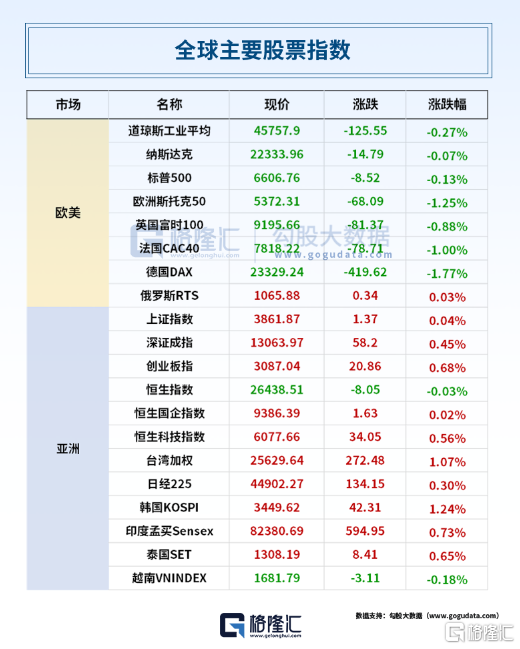
Market Overview - Major US indices showed a decline, with the Dow Jones down by 0.27% at 45757.9, and the S&P 500 down by 0.13% at 6606.76 [1] - European markets also faced losses, with the DAX down by 1.77% at 23329.24 [1] - Asian markets had mixed results, with the Taiwan Weighted Index up by 1.07% at 25629.64, while the Hang Seng Index was down by 0.03% at 26438.51 [1] US-India Trade Relations - The US and India have restarted negotiations for a bilateral trade agreement in New Delhi, signaling a positive development in their recently strained relations [2] US Automotive Tariffs - The US Department of Commerce is considering additional tariffs on imported auto parts based on national security concerns, following previous tariffs imposed by the Trump administration [3] Federal Reserve Appointment - Milan has been confirmed as a Federal Reserve Board member, allowing him to participate in the upcoming Federal Open Market Committee meeting [4][5] Retail Sales Data - US retail sales increased by 0.6% in August, surpassing market expectations of 0.2%, indicating robust consumer spending despite global economic uncertainties [5] EU-Indonesia Trade Agreement - The EU and Indonesia have concluded negotiations on a trade agreement, aiming to reduce reliance on the US, with plans to sign the agreement soon [5] Nvidia AI Chip Demand - Nvidia's custom AI chip for the Chinese market, the RTX6000D, is experiencing weak demand, with major tech companies not placing orders due to its less attractive price-performance ratio [6] US Tech Investment in the UK - Major US tech companies plan to invest over $40 billion in AI infrastructure in the UK, with Microsoft committing $30 billion by 2028 [6] Eli Lilly's Investment - Eli Lilly announced a $5 billion investment to build a manufacturing facility in Virginia, aimed at enhancing production of targeted cancer therapies [7] Google's Gemini App Success - Google's Gemini app has surpassed ChatGPT to become the top free app on the Apple App Store, following recent updates and new features [8]
突然,集体猛拉!狂掀涨停潮
中国基金报· 2025-09-17 03:13
Market Overview - A-shares opened lower but showed an upward trend, with major indices fluctuating. The Shanghai Composite Index reported 3857.79 points, down 0.11%, while the Shenzhen Component Index rose by 0.11% and the ChiNext Index increased by 0.23% [2][3]. Sector Performance - The photolithography machine concept sector experienced a strong rally, with the index rising over 5%. Notable stocks included Wave Optoelectronics, Yongxin Optical, and Fuzhijing Technology, all hitting the daily limit [6][7]. - Other leading sectors included automotive parts, home appliances, and diversified finance, while precious metals and real estate sectors showed significant pullbacks [4][5]. Key Stocks - Wave Optoelectronics surged by 20.01%, with a market cap of 10.2 billion, and has increased by 64.45% year-to-date. Other notable performers included Sanhuan Group, which rose by 11.44%, and Zhongshi Technology, which increased by 10.18% [10][9]. - The humanoid robot sector also saw gains, with the index up 1.7%. Key stocks included Zhongchen Technology and Aopu Optoelectronics, both hitting the daily limit [17][18]. Company News - Semiconductor manufacturer SMIC's A-shares rose over 10%, while its Hong Kong shares increased by more than 6%. Reports indicated that SMIC is testing a deep ultraviolet lithography machine developed by a Shanghai startup, which could potentially enhance its production capabilities [11][12][15]. - The demand for NVIDIA's new AI chip RTX6000D in the Chinese market has been weak, with some major tech companies opting not to place orders due to its high pricing and perceived low cost-performance ratio [15][16]. Central Enterprises - Since the start of the 14th Five-Year Plan, the total assets of central enterprises have exceeded 90 trillion yuan, indicating a significant enhancement in their overall strength [21][22][23].