SPDR Gold Shares(GLD)

Search documents
**黄金暴涨突破5000美元!三大推手曝光,普通人如何理性布局?**
Sou Hu Cai Jing· 2026-02-04 01:51
Group 1 - The core point of the article is the unprecedented surge in gold prices, which reached $5,093 per ounce on January 26, 2026, driven by various factors including geopolitical tensions, changes in U.S. Federal Reserve policies, and sustained central bank gold purchases [1][3][5][7]. Group 2 - Three main engines are driving the historic rise in gold prices: 1. Geopolitical "black swan" events, such as the Greenland sovereignty dispute and increased military tensions in the Middle East, have highlighted gold's safe-haven attributes. Historical data shows that a 1% increase in the global risk index (VIX) correlates with an average 0.3% rise in gold prices [3]. 2. Expectations of a shift in Federal Reserve policy due to a weakening U.S. labor market may lead to unexpected monetary easing, contributing to a 1.6% drop in the Bloomberg Dollar Index, the largest weekly decline in eight months, which in turn supports gold prices [5]. 3. Continued central bank gold purchases, with the People's Bank of China increasing its reserves for 14 consecutive months, and Poland's central bank planning to buy an additional 150 tons, are providing long-term support for gold prices [7]. Group 3 - Historical comparisons indicate that the current gold price surge is significantly different from the 2008 financial crisis, where gold prices only increased by 25%. In contrast, the cumulative increase from 2024 to 2026 has exceeded 150%. Additionally, the simultaneous decline of gold, U.S. Treasuries, and the dollar suggests a market re-evaluation of risk [9]. Group 4 - For ordinary investors, three types of participation strategies are suggested: 1. Physical gold is suitable for long-term allocation but requires consideration of storage costs and liquidity constraints. 2. Gold ETFs, such as SPDR Gold Shares (GLD), have seen a recent increase in holdings by 6.87 tons, making them suitable for medium-term holding. 3. Gold-related stocks in the A-share market have recently experienced a surge, but their volatility is at the 90th percentile historically, indicating potential for correction [10][12]. Group 5 - As Bank of America raises its gold price target to $6,000, it is essential to recognize that this market trend reflects a restructuring of the global economic order. Systemic risk premiums are being permanently factored into gold prices due to the U.S. potentially undermining its own trade rules [11].

黄金破5000美元后,交易员还在疯狂买入看涨期权?
Jin Shi Shu Ju· 2026-01-27 01:36
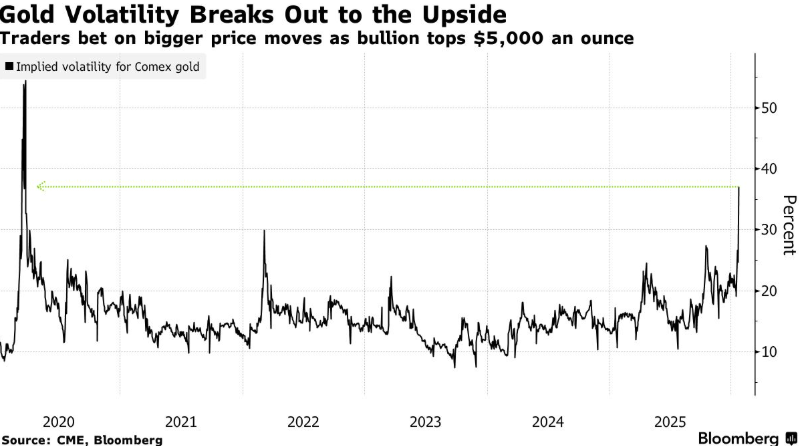
Group 1 - Gold prices have surged above $5,000 per ounce for the first time, prompting strong market reactions and bets from options traders that the upward trend will continue [1] - The increase in gold prices is attributed to a "currency devaluation trade," where investors are shifting from sovereign bonds and currencies to hard assets like gold and silver [1] - The volatility of gold futures on the New York Commodity Exchange (Comex) has reached its highest level since the peak of the pandemic in March 2020, with the SPDR Gold Shares ETF also experiencing significant volatility [1] Group 2 - A large number of bullish spread strategies have emerged in the options market, with significant trades in Comex gold futures, including nearly 5,000 contracts for a $5,500/$5,600 call spread [4] - As gold prices approach key strike levels, traders are rolling their positions upward, which may lead to a "gamma squeeze" driven by market makers needing to buy more futures contracts to balance their risk exposure [4] - Investors are also heavily buying call spread contracts for SPDR Gold Shares, with notable purchases of approximately 70,000 contracts for a $590/$595 call spread and 37,000 contracts for a $510/$515 call spread [7] Group 3 - The volatility and skew of call options in the silver market have also increased significantly, with over 35,000 contracts traded for a $125 call option expiring in May for the iShares Silver Trust [7] - The Comex silver futures market has seen trades of a 200-contract eagle spread for April with strike prices of $110, $120, $130, and $140 [7]
【首席观察】黄金强势涨破5000美元背后的新制度
经济观察报· 2026-01-26 05:20
Core Viewpoint - The article discusses the recent surge in gold prices, emphasizing that the driving factors are no longer solely related to interest rates but rather reflect a broader re-evaluation of risk premiums and market dynamics [3][7][11]. Group 1: Gold Price Dynamics - Gold reached a new high of $5,093 per ounce on January 26, 2026, with a significant two-digit increase over the month and limited pullbacks, indicating a shift in market sentiment [3][4]. - The gold-silver ratio fell below 50, reaching its lowest level since 2011, suggesting a divergence in the relative pricing of precious metals, which may lead to a mean reversion in a non-linear manner [3][4]. - The recent price movements of gold exhibit a "step-up" structure, characterized by continuous increases and limited retracements, prompting questions about what extreme prices are signaling [4][10]. Group 2: Market Behavior and Investment Trends - There has been a notable increase in gold ETF holdings, with SPDR Gold Shares adding 6.87 tons on January 23, 2026, indicating a trend of investors continuing to buy at high prices [4][6]. - The extreme behavior of the gold-silver ratio indicates that market pricing is becoming misaligned, with investment banks raising gold price targets to $5,000 per ounce, acknowledging an increase in risk premiums [4][11]. - The article highlights a shift in the driving forces behind precious metal prices from a single-factor focus on interest rates to a more complex interplay of risk premiums, institutional uncertainty, and funding structures [7][11]. Group 3: Geopolitical and Economic Factors - Denmark's pension fund plans to liquidate $100 million in U.S. Treasuries, while Poland's central bank approved the purchase of 150 tons of gold, reflecting a strategic shift towards gold as a secure asset amid geopolitical tensions [5][6]. - The International Monetary Fund's COFER data shows a decline in the dollar's reserve share to 56.92% in Q3 2025, indicating a trend towards "de-dollarization" and a re-evaluation of risk premiums [5][6]. - The article suggests that the current environment is characterized by a simultaneous occurrence of sovereign credit stress, central bank balance sheet issues, and a weakening of dollar hegemony, which are rare but impactful [13].
谁在爆买黄金?CME数据揭秘:散户正以史上最快速度冲进场
Jin Shi Shu Ju· 2025-10-21 03:40
Group 1 - Central bank demand has been a key driver for gold prices since the end of 2022, but recent trading data indicates that investment demand has become a new engine of momentum for the precious metal [1] - CME Group reported a record total trading volume of 2.829666 million metal contracts last Friday, surpassing the previous record of 2.14899 million contracts set two weeks prior [1] - Gold prices reached a historical high near $4,400 per ounce before significantly retreating, closing down nearly 2% last Friday [1] Group 2 - The trading volume for retail investors in small contracts also hit a record, with micro gold futures (one-tenth the size of a standard 100-ounce contract) achieving a daily volume of 1.267436 million contracts [1] - The electronic mini gold futures, which are half the size of standard contracts, set a record with 12,818 contracts traded [1] - The newly launched one-ounce gold futures recorded a trading volume of 199,928 contracts and an open interest record of 20,326 contracts [1] Group 3 - Global clients continue to use gold futures and options to hedge risks and seek opportunities in a complex environment, driven by both large institutions and retail traders [2] - The World Gold Council reported a significant inflow of 59.2 tons of gold into global gold-backed exchange-traded funds (ETFs) last week, marking the largest single-week increase since March 2020 [2] - Despite record demand, gold remains an under-allocated asset, with only 2.4% of current investment portfolios allocated to gold, according to Abrdn ETF strategy director Robert Minter [2]

黄金牛市势不可挡!摩根大通预言2026年金价突破4000美元大关
Sou Hu Cai Jing· 2025-04-27 05:25
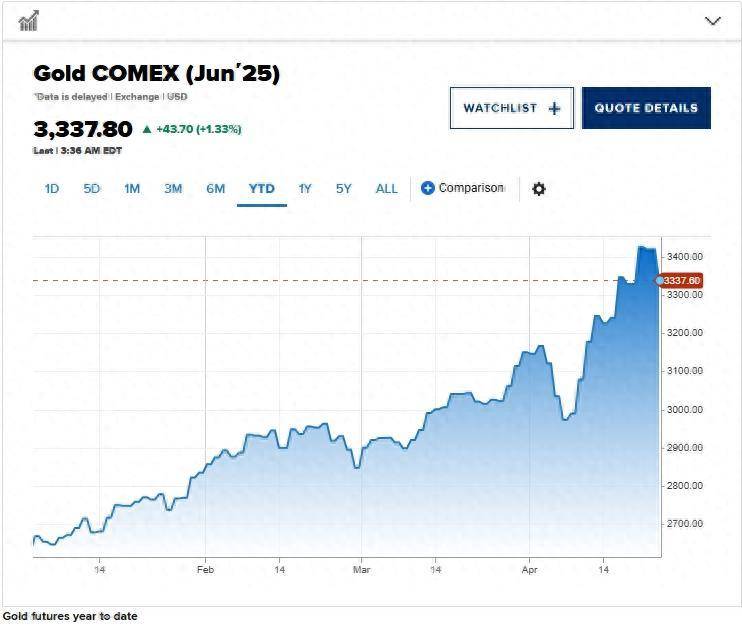
Core Viewpoint - Gold is experiencing unprecedented price increases as a traditional safe-haven asset amid growing global economic uncertainty, with JPMorgan forecasting prices to exceed $4,000 per ounce by Q2 2026 and an average price of $3,675 per ounce [1]. Group 1: Market Dynamics - Strong demand for gold is expected to drive prices higher, supported by risks of economic recession and stagflation due to U.S. tariff policies [1]. - As of April 2025, gold futures prices have risen nearly 29% year-to-date, significantly outperforming the S&P 500 index [1]. - On April 22, gold prices reached a historic high, surpassing $3,500 per ounce, while the SPDR Gold Shares ETF achieved its highest price since its inception in 2004, with a year-to-date increase of nearly 30% [1]. Group 2: Central Bank and Investor Behavior - Central banks have been increasing gold reserves to mitigate market volatility and uncertainty surrounding dollar assets, with global central bank purchases expected to reach 900 tons in 2025 [2]. - Individual investors are also increasingly entering the gold market, driven by potential economic recession and stagflation threats, with demand for gold expected to grow [2]. - Fluctuations in the Chinese yuan may further stimulate gold buying among Chinese investors, providing additional support for gold prices [2]. Group 3: Long-term Trends - The atypical rise in U.S. Treasury yields may lead foreign investors to reduce their holdings in U.S. debt and increase their gold investments [2]. - JPMorgan believes the current gold price surge is driven by structural factors rather than short-term speculation, indicating a long-term bullish trend for gold [2]. - The ongoing macroeconomic uncertainty suggests that the gold bull market may just be beginning, with various types of investors reassessing gold's role in their asset allocation [2].