
Trelegy Ellipta

Search documents
The Excruciating Failure That Could Prompt Theravance, Down 26%, To Sell Itself
Investors· 2026-03-03 21:15
Core Viewpoint - Theravance Biopharma is considering a sale following the unexpected failure of its Phase 3 clinical trial for ampreloxetine, a treatment for multiple system atrophy, leading to a significant drop in its stock price [1] Company Developments - The company's strategic review committee is accelerating its evaluation of alternatives to maximize shareholder value, which may include a potential sale of the company [1] - Following the trial failure, Theravance is restructuring to streamline costs and focus on its COPD treatment, Yupelri [1] - The restructuring aims to reduce operating costs by approximately 60% compared to 2025, with expected annualized cash flows of $60 million to $70 million starting in the third quarter [1] Financial Performance - Theravance's stock fell by 26.3%, closing at $13.96, marking its lowest point since August [1] - The company had $400 million in cash at the end of the first quarter and anticipates receiving a $100 million milestone related to its Trelegy Ellipta inhaler by year-end [1] - Despite the recent downturn, Theravance's stock had increased by over 80% in the past 10 months prior to the trial results [1] Market Position - Theravance's stock holds a strong IBD Digital Relative Strength Rating of 89, ranking it in the top 11% of all stocks based on 12-month performance [1] - The stock also has a Composite Rating of 91, placing it in the top 9% of all stocks across various industry groups [1]
Transpire Bio Strengthens its Leadership Team with Appointment of LaDuane Clifton as Chief Financial Officer
Globenewswire· 2026-02-24 20:42
Core Viewpoint - Transpire Bio Inc. has appointed R. LaDuane Clifton as Chief Financial Officer to support its transition from a clinical-stage to a commercial-stage biopharmaceutical company [1][2]. Group 1: Leadership Appointment - R. LaDuane Clifton brings extensive experience in public company finance, operations leadership, biopharmaceutical development, and commercialization [2]. - The appointment is part of the company's strategy to align its leadership structure for the next phase of growth [2]. Group 2: Company Background - Transpire Bio Inc. is a US-based, revenue-generating, clinical-stage biopharmaceutical company focused on inhaled therapeutics for pulmonary and systemic diseases [5]. - The company has developed proprietary inhalation technology platforms and is advancing a complex generic pipeline, being the first to file two Abbreviated New Drug Applications using Breo Ellipta and Trelegy Ellipta as reference drugs [5].


CRMD vs. TBPH: Which Small-Cap Biotech Stock Is the Better Bet?
ZACKS· 2026-02-24 14:06
Core Insights - CorMedix (CRMD) and Theravance Biopharma (TBPH) are small-cap biopharmaceutical companies with market caps under $1 billion, focusing on commercialization and expansion of key therapies, presenting high-risk but potential high-reward investment opportunities [1] CorMedix (CRMD) - CorMedix's lead product, DefenCath, received FDA approval in late 2023 as the first antimicrobial catheter lock solution in the U.S., aimed at reducing catheter-related bloodstream infections in kidney failure patients undergoing hemodialysis [2] - DefenCath is the first approved product in CorMedix's portfolio, launched in 2024, and has seen strong market adoption [5] - Preliminary fourth-quarter and full-year 2025 results show net revenues of approximately $127 million and $310 million, respectively, driven by DefenCath and early contributions from the Melinta portfolio [6] - CorMedix plans to diversify revenues through the $300 million acquisition of Melinta Therapeutics, adding seven approved therapies to its portfolio [6] - Management's guidance for 2026 revenue is $300-$320 million, with projected DefenCath revenues of $100-$140 million for 2027, indicating a conservative growth outlook [7] Theravance Biopharma (TBPH) - Theravance collaborates with Viatris to develop and commercialize Yupelri, a nebulized treatment for COPD, sharing profits where Theravance receives 35% [3][9] - Yupelri is recognized as a cornerstone of maintenance therapy for COPD, providing consistent lung function improvement [10] - Revenues from the Viatris collaboration rose 18.5% year-over-year in the first nine months of 2025, contributing positively to Theravance's financials [11] - Theravance's balance sheet was strengthened by a $225 million royalty sale of Trelegy, extending its cash runway for pipeline development [13] - The company is developing ampreloxetine for neurogenic orthostatic hypotension, with top-line data expected in Q1 2026 [12] Financial Estimates and Performance - The Zacks Consensus Estimate for CorMedix's 2025 sales implies a year-over-year increase of around 614%, but EPS estimates have trended downward [15] - Theravance's 2025 sales estimate implies a year-over-year increase of around 65%, with EPS currently pegged at 24 cents [15] - In the past six months, CRMD shares have declined by 48.9%, while TBPH shares have increased by 39.8%, outperforming the industry [20] - Theravance's shares trade at a higher price-to-book ratio of 4.19 compared to CorMedix's 1.48, indicating a more expensive valuation [23] Investment Outlook - Theravance Biopharma is viewed as a better investment option due to its balanced risk-reward profile, diversified revenue streams, and strengthened cash position following the royalty sale [24][27] - CorMedix's reliance on DefenCath and conservative growth outlook presents challenges, making it a less favorable option compared to Theravance [28]


GSK's Q4 Earnings & Sales Beat Estimates, Stock Up on '26 Outlook
ZACKS· 2026-02-04 14:36
Core Insights - GSK plc reported fourth-quarter 2025 core earnings of 68 cents per American depositary share (ADS), exceeding the Zacks Consensus Estimate of 64 cents, with a 10% year-over-year increase on a reported basis and 14% at a constant exchange rate (CER) [1][9] - Quarterly revenues rose 6% on a reported basis and 8% at CER to $11.46 billion (£8.62 billion), driven by increased sales of HIV, oncology, and respiratory medicines, surpassing the Zacks Consensus Estimate of $11.19 billion [2][9] Segment Performance - GSK operates under three segments: General Medicines, Specialty Medicines, and Vaccines. Specialty Medicines sales increased by 18%, while Vaccine sales rose by 4%. General Medicines sales fell by 1% [3] - Specialty Medicines drove top-line growth, with HIV sales up 11% due to increased demand for Dovato and long-acting medications like Apretude and Cabenuva [4][5] - Oncology sales surged by 42%, primarily due to strong demand for Jemperli and Ojjaara/Omjjara, with Jemperli sales increasing by 79% following label expansion [6][7] - Respiratory drug Nucala sales rose by 19%, driven by strong performance in the U.S. market, while Benlysta sales increased by 26% [8] Vaccine Sales - GSK's vaccine sales growth was driven by increased uptake of meningitis, RSV, and shingles vaccines in ex-U.S. markets, with Shingrix sales rising by 20% [10] - Established vaccine sales declined by 13% due to divested brands and lower sales for Rotarix and Synflorix [11] General Medicines - General Medicines showed stable performance with Trelegy Ellipta sales up 14%, while Anoro Ellipta and Relvar/Breo Ellipta sales fell by 10% and 16%, respectively [12][13] Operating Expenses and Guidance - Core selling, general, and administration costs rose by 2% to £2.68 billion, while core research and development expenses increased by 18% to £2.12 billion [14] - GSK expects sales growth of 3-5% in 2026, with specialty medicines projected to grow by a low double-digit percentage at CER [15] Future Outlook - GSK has a total of 58 assets in clinical development, with two major product approvals expected this year [21][22] - The company aims to generate sales of more than £40 billion by 2031, reflecting a positive long-term outlook [18]


美国医保首次大规模药价谈判:15种药物平均降价44%
Hua Er Jie Jian Wen· 2025-11-26 16:04
Core Insights - The U.S. Centers for Medicare & Medicaid Services (CMS) has completed its first large-scale drug price negotiation, achieving an average price reduction of 44% on 15 drugs, expected to save the Medicare system $12 billion [1][2] - Notably, Novo Nordisk's GLP-1 weight loss drugs Ozempic and Wegovy saw a price drop of 71%, making them the most significant outcome of this negotiation [1][2] - The negotiation targets high-spending drugs for Medicare Part D, used to treat chronic diseases such as cancer and diabetes [1] Drug Price Reductions - Significant price reductions were achieved, including a 50% decrease for Pfizer's breast cancer drug Ibrance, a 48% reduction for prostate cancer drug Xtandi, and a 73% drop for GSK's Trelegy Ellipta [2] - By combining this year's negotiations with last year's, the total number of drugs subject to price negotiations will expand to 25 by January 1, 2026, further broadening the policy's impact [2] Government Strategy and Industry Response - Health and Human Services Secretary Robert F. Kennedy emphasized the commitment to lowering healthcare costs, aligning with President Trump's vision of making healthcare affordable for seniors [3] - Pharmaceutical companies are adjusting their market strategies in response to the government-led pricing mechanism, with Novo Nordisk expressing serious concerns while strategically adjusting prices to maintain competitiveness [3] Political Context - The announcement from CMS marks a significant acceleration in the Trump administration's efforts to lower prescription drug prices and improve Medicare affordability [4] - With rising budget pressures on low-income families, healthcare and living costs have become focal issues in the midterm election cycle, indicating a strategic timing for the drug price negotiation results to enhance the government's image in economic and social welfare [4]
从“减肥神药”覆盖到抗癌药!“美国版集采”来势汹汹 将削减36%支出
Zhi Tong Cai Jing· 2025-11-26 08:37
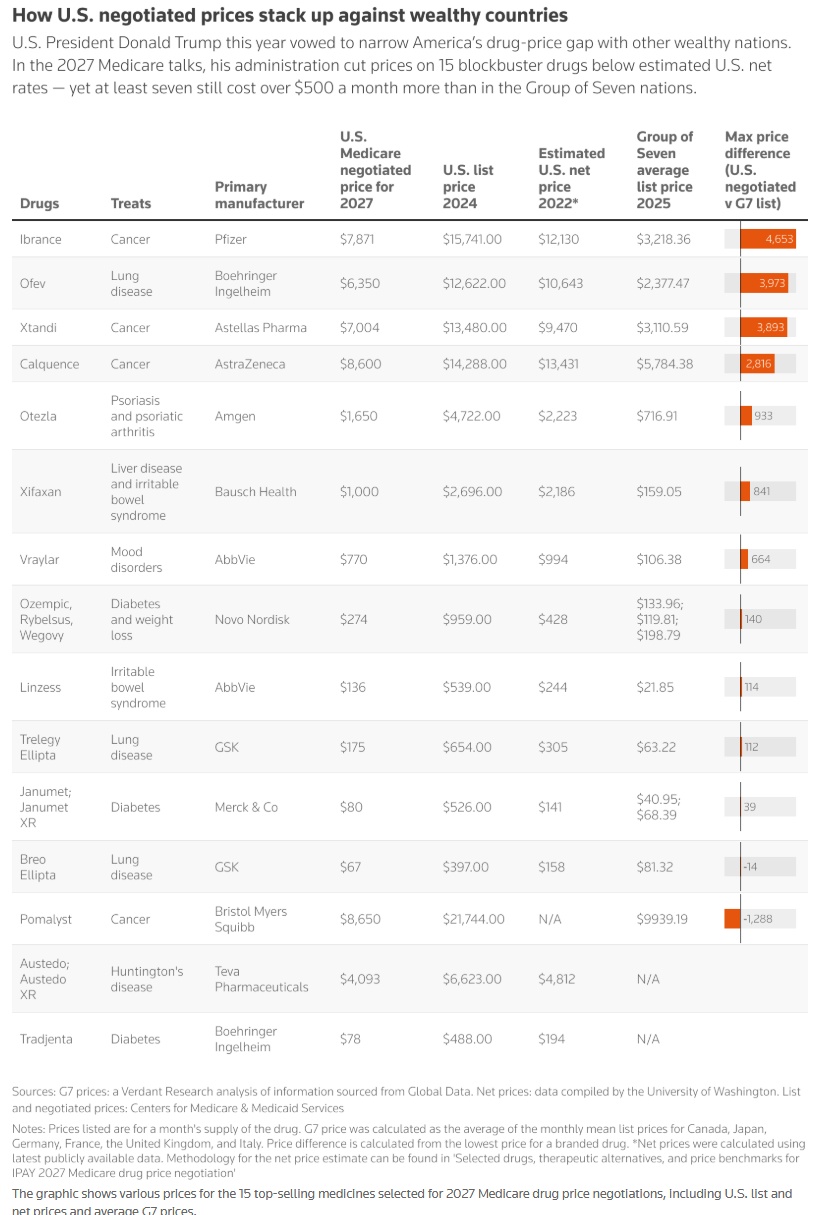
Core Insights - The recent Medicare negotiations are expected to save approximately 36% on the prices of 15 high-cost drugs, translating to around $8.5 billion in net reimbursement costs [1][3][10] - The new prices will take effect in 2027, with significant reductions for popular drugs like semaglutide, which will drop over 70% to about $274 per month [1][4] - The negotiations are part of the Inflation Reduction Act signed by President Biden in 2022, which allows Medicare to negotiate drug prices for the first time [2][11] Drug Price Reductions - The estimated net prices for drugs like Calquence, Ofev, and Ibrance have been reduced by over $4,000 each in the latest negotiations [2][4] - The new pricing for other drugs includes Trelegy Ellipta at $175 (down from $654) and Linzess at $136 (down from $539) [4][10] - The average negotiated prices for these drugs are still higher than those in the Group of Seven (G7) nations, with some drugs costing over $500 more than their G7 counterparts [7][11] Comparison with Previous Negotiations - The 36% savings in the current negotiations surpasses the 22% savings achieved in the previous year's negotiations for 10 different drugs [3][10] - The pricing strategy has become more efficient, with newer products potentially having greater flexibility in pricing [4][10] Industry Response - The pharmaceutical industry has expressed strong opposition to government price negotiations, arguing that such policies are detrimental [5][10] - Industry representatives claim that government pricing policies like the Inflation Reduction Act and the Most-Favored-Nation pricing are misguided [5][12] Future Implications - The Medicare negotiations are expected to influence other payers to seek similar pricing from drug manufacturers [10] - Future negotiations will include an additional 15 drugs, with discussions set to begin in February [12]


美国医保宣布下调15种药品价格,司美格鲁肽大砍71%
Hua Er Jie Jian Wen· 2025-11-26 05:47
Core Points - The U.S. Centers for Medicare and Medicaid Services (CMS) announced new price agreements for prescription drugs, including a significant price reduction for Novo Nordisk's popular diabetes and weight loss drug Ozempic [1][2] - The price of Ozempic and Wegovy will be reduced by 71% to $274 per month starting in 2027, as part of the second round of drug price negotiations authorized by the Inflation Reduction Act [1][3] - The negotiation covers 15 drugs that account for 15% of Medicare Part D spending in 2024, totaling $42.5 billion, with estimated savings of $12 billion for taxpayers and $685 million for beneficiaries by 2027 [2][3] Drug Price Reductions - The negotiated prices for Ozempic and Wegovy are significantly lower than their current list prices, with Ozempic's price dropping from $959 to $274 [3] - Other drugs also face substantial price reductions, such as GSK's Trelegy Ellipta, which will see a 73% decrease from $654 to $175, and Pfizer's Ibrance, which will drop 50% from $15,741 to $7,871 [3][4] - The discounts range from 38% to 85%, with the negotiated prices reflecting what Medicare pays to manufacturers rather than what patients pay directly [3][4] Market Reaction - Despite the significant price cuts, the stock prices of Novo Nordisk and Pfizer remained stable, indicating that the market had largely anticipated these outcomes [4] - Analysts noted that the new price for Ozempic aligns closely with previously assumed net price levels, suggesting limited impact on the actual revenue received by the companies [4] Industry Response - Novo Nordisk appears to be adjusting its strategy by offering Ozempic and Wegovy directly to consumers at a price of $349 per month to compete with Eli Lilly [5] - The pharmaceutical industry, including Novo Nordisk, has expressed strong opposition to government price-setting, with ongoing legal challenges against the implementation of these price negotiations [6] - The current negotiation mechanism, while rooted in Biden-era legislation, is being utilized by the Trump administration as part of its health agenda, highlighting the ongoing political dynamics in U.S. healthcare policy [2][6]
2026-2032年吸入制剂行业全产业结构深度分析及投资战略可行性评估预测报告-中金企信发布
Sou Hu Cai Jing· 2025-11-10 01:17
Core Insights - The article discusses the inhalation formulation industry, highlighting its advantages over traditional drug delivery methods, particularly in treating respiratory diseases such as asthma and COPD [9][10][12] - It emphasizes the growing interest in inhalation formulations within the pharmaceutical industry due to their rapid absorption and improved patient compliance [10][12] Inhalation Formulation Overview - Inhalation formulations are defined as drug preparations delivered in aerosol form to the respiratory tract, offering local or systemic effects [9] - The physiological characteristics of the lungs facilitate quick drug absorption and efficacy, avoiding hepatic first-pass metabolism [9][10] Classification of Inhalation Formulations - The main categories of inhalation formulations include corticosteroids, β2-agonists, anticholinergics, and combination formulations [10][11] - Combination therapies are becoming increasingly popular, with the FDA approving the first triple-combination inhalation formulation for COPD treatment in 2017 [12] Inhalation Device Types - Inhalation devices are categorized into dry powder inhalers (DPI), metered-dose inhalers (MDI), nebulizers, soft mist inhalers (SMI), and nasal sprays [12] - Each device type has distinct advantages and disadvantages regarding drug delivery efficiency and ease of use [13] Market Landscape - The inhalation formulation market is characterized by high concentration, with five products generating over $1 billion in global sales in 2022 [12] - The leading inhalation products include Symbicort, Trelegy Ellipta, and Spiriva, with significant sales figures indicating a competitive landscape [12] Industry Development Trends - The inhalation formulation industry is expected to grow significantly from 2020 to 2025, driven by increasing demand for effective respiratory therapies [14][15] - The article outlines the supply chain dynamics, competitive landscape, and economic indicators affecting the inhalation formulation market [14][15][17]

CRMD vs. TBPH: Which Small-Cap Biotech Stock Is the Better Buy?
ZACKS· 2025-10-30 19:06
Core Insights - CorMedix (CRMD) and Theravance Biopharma (TBPH) are small-cap biotechnology companies with market caps under $1 billion, operating in niche therapeutic markets and characterized by limited product portfolios and high volatility potential for investors [1][5] CorMedix (CRMD) - CorMedix's lead product, DefenCath, received FDA approval in late 2023 as the first antimicrobial catheter lock solution in the U.S., aimed at reducing catheter-related bloodstream infections in adult patients undergoing hemodialysis [2] - DefenCath generated $78.8 million in net revenues in the first half of 2025, with expectations for strong year-over-year growth in the third quarter [7] - The company plans to expand DefenCath's label into total parenteral nutrition, enhancing its customer base [8] - CorMedix acquired Melinta Therapeutics for $300 million, adding seven approved therapies to its portfolio and diversifying its revenue streams [9] - Preliminary third-quarter 2025 results showed net revenues exceeding $125 million, prompting an increase in full-year revenue guidance to at least $375 million [12] - The Zacks Consensus Estimate for CorMedix's 2025 sales and EPS indicates year-over-year increases of approximately 488% and 717%, respectively [19] Theravance Biopharma (TBPH) - Theravance collaborates with Viatris to commercialize Yupelri, a nebulized treatment for COPD, sharing profits with Viatris receiving 65% and Theravance 35% [13] - Revenues from the Viatris collaboration rose 19% year-over-year to $34.1 million in the first half of 2025 [15] - Theravance is developing ampreloxetine for neurogenic orthostatic hypotension, with top-line data expected in Q1 2026 [16] - The company sold its remaining royalty interest in Trelegy Ellipta to GSK for $225 million, strengthening its balance sheet [17] - The Zacks Consensus Estimate for Theravance's 2025 sales implies an 88% year-over-year increase, with a projected 75% narrowing of loss per share [19] Comparative Analysis - CorMedix's strategy focuses on immediate revenue generation through DefenCath, while Theravance relies on a partnership for revenue and is dependent on the success of its late-stage drug program [4][31] - CorMedix's diversified portfolio and strong commercial execution position it favorably compared to Theravance, which faces higher risks due to its limited pipeline and reliance on a single collaboration [31] - Year-to-date, CRMD shares have gained 39.6%, while TBPH shares have increased by 50.5%, outperforming the industry average of 10.7% [24]

GSK's Q3 Earnings & Sales Beat Estimates, Stock Up on Raised '25 View
ZACKS· 2025-10-29 16:50
Core Insights - GSK plc reported third-quarter 2025 core earnings of $1.48 per American depositary share (ADS), exceeding the Zacks Consensus Estimate of $1.26, with core earnings increasing 11% year over year on a reported basis and 14% at a constant exchange rate (CER) [1][10] - Quarterly revenues rose 7% on a reported basis and 8% at CER to $11.52 billion (£8.55 billion), driven by rising sales across all business segments, particularly in HIV, oncology, and respiratory medicines, surpassing the Zacks Consensus Estimate of $11.16 billion [2][10] Segment Performance - GSK operates under three segments: General Medicines, Specialty Medicines, and Vaccines. Specialty Medicines sales increased by 16%, General Medicines rose by 4%, and Vaccine sales were up by 2% [3] - HIV sales rose 12% during the quarter, driven by increased demand for Dovato and long-acting medications like Apretude and Cabenuva, with Dovato sales increasing by 24% [4][5] - Oncology sales surged by 39%, led by strong demand for Jemperli, which saw a 79% increase due to expanded treatment indications [6][7] - Respiratory drug Nucala sales increased by 14%, while Benlysta sales rose by 17%, reflecting strong demand across markets [9] Financial Guidance - GSK raised its 2025 guidance, now expecting sales growth of 6-7%, up from a previous forecast of 3-5%, and core EPS growth of 10-12% [10][17][19] - Specialty Medicines are now expected to grow at a mid-teens percentage at CER, while General Medicines are anticipated to remain stable [18] - The company reiterated its guidance for R&D and SG&A expenses, with R&D expected to grow slightly faster than sales [20] Long-term Strategy - GSK is focusing on HIV, immunology/respiratory, and oncology therapeutic areas, with 80 assets in clinical development, including 16 in late-stage development or under regulatory review [24] - The company plans to launch five new products/line extensions this year, with four already approved by the FDA [25] - GSK aims to launch 15 new drugs between 2025 and 2031, each with peak sales potential exceeding £2 billion [26]
