
XR芯片

Search documents
TCL电子20260125
2026-01-26 02:49
Summary of TCL and Sony Joint Venture Conference Call Industry and Company Involved - **Industry**: Television Manufacturing - **Companies**: TCL Electronics and Sony Corporation Core Points and Arguments 1. **Sony's Strategic Shift**: Sony has injected its television business into a joint venture with TCL to leverage Chinese supply chain resources and address competition from domestic manufacturers in Mini LED technology. This move may indicate a gradual exit from the television market or a continuation of the BRAVIA brand [2][3][4] 2. **Sony's Challenges**: Sony's television business has faced significant profit declines since 2021, primarily due to a prolonged price war with Chinese and Korean brands. The company aims to transform into an entertainment-focused entity, which necessitated the sale of its television business [3][4] 3. **Technology Sharing Limitations**: Despite the joint venture, the likelihood of Sony's chip technology being transferred to TCL is low, as historical precedents show barriers to technology sharing in similar partnerships [2][10] 4. **Market Positioning**: Sony's collaboration with TCL could enhance its product competitiveness by utilizing TCL's supply chain capabilities, potentially reversing its declining market position [4][14] 5. **Color Science and Signal Processing**: Sony maintains a long-standing advantage in color science and signal processing, which contributes to superior image quality despite declining global sales. This expertise is crucial for maintaining competitiveness in high-end markets [6][8] 6. **Hardware Impact on Picture Quality**: The quality of television hardware components—panels, backlighting, and chips—affects picture quality differently across product tiers. Chinese manufacturers are focusing on Mini LED technology to enhance LCD picture quality [9][22] 7. **Future of OLED Technology**: Sony is not planning to enter the OLED market in the short term, focusing instead on RGB Mini LED technology due to high costs and limited profitability associated with OLED panel procurement [19][20] 8. **Joint Venture Dynamics**: The joint venture's success will depend on how well both companies coordinate their resources. The location of the joint venture (Japan vs. China) will influence control over R&D and product management [14][15][16] 9. **Sales Performance**: Sony's global television sales have been underwhelming, with a significant decline in market share. Collaborating with TCL could help improve sales through enhanced distribution channels [24][25] Other Important but Possibly Overlooked Content 1. **Internal Resistance**: There has been internal resistance within Sony regarding the sale of its television business, particularly from former executives who value the historical significance of the brand [13][14] 2. **AI Applications in TVs**: AI is being integrated into televisions for enhancing image quality, providing interactive features, and optimizing OLED material research [23] 3. **TCL's Experience**: TCL has prior experience in OEM production for Western brands, which could enhance operational efficiency and quality in the joint venture with Sony [18]

索尼“断臂求生”简史
Ge Long Hui· 2026-01-24 05:07
Core Insights - Sony's decision to transfer control of its television business to TCL marks the end of an era for the Japanese electronics industry, which once dominated the global market but has now retreated after decades of decline [1][2] - The partnership with TCL, where TCL holds a 51% stake, signifies Sony's shift towards a "light asset" model, retaining only brand and core technology rights while offloading manufacturing and supply chain responsibilities [12][13] - This move reflects a broader trend in the global television market, transitioning from Japanese dominance to a competitive landscape led by Chinese and Korean manufacturers [1][16] Company Transformation - Sony's transformation has been a gradual process over 20 years, involving the sale of over 20 business units and generating more than $10 billion in cash to reshape its business landscape [2][15] - The company's strategic evolution has included a shift from hardware dependency to a focus on high-value ecosystems, emphasizing the importance of innovation and adaptability in the face of technological change [3][15] - Key milestones in this transformation include the sale of its PC business and the restructuring of its music division, which has now become a leading player in the global music industry [7][22] Strategic Decisions - Sony's initial divestitures were reactive, aimed at stemming losses without a cohesive long-term strategy, leading to significant financial challenges [4][5] - The appointment of CEO Kazuo Hirai marked a turning point, as he implemented the "One Sony" strategy, focusing on core businesses and enhancing collaboration across divisions [6][10] - The sale of the VAIO computer business and the exit from the battery sector were pivotal decisions that allowed Sony to concentrate resources on more profitable areas like gaming and imaging [7][9] Financial Performance - By 2025, Sony's financial performance showed significant improvement, with operating profit reaching 801.72 billion yen and net profit at 609.65 billion yen, indicating a successful turnaround [31] - The financial services division, which was spun off, has become a stable cash generator, contributing over 120 billion yen in net profit, showcasing the effectiveness of strategic asset optimization [21][12] Industry Context - The decline of Sony's television business illustrates the broader challenges faced by Japanese electronics firms, which have struggled to maintain competitiveness against aggressive investment and innovation from South Korean and Chinese companies [16][20] - The shift in the television market dynamics, with TCL and Samsung leading, highlights the importance of upstream control over components like display panels, which significantly impact profitability [19][20] - Sony's focus on high-margin products, such as its CMOS sensors and premium audio devices, reflects a strategic pivot towards areas with higher profit potential and technological barriers [18][27] Future Outlook - Looking ahead, Sony aims to maximize the value of its intellectual properties and expand into emerging fields like AI and automotive sensors, with plans to invest 1.8 trillion yen in R&D from 2024 to 2026 [31][32] - The collaboration with TCL is expected to enhance Sony's brand value and technology licensing revenue, positioning the company for sustainable growth in a rapidly evolving market [12][13] - The ongoing transformation emphasizes the need for traditional companies to embrace change and focus on core competencies to thrive in a competitive landscape [34][26]
群智咨询:全球电视市场品牌竞争格局或重塑 2027年TCL电子与Sony的合并市占率有望夺得全球第一
Zhi Tong Cai Jing· 2026-01-21 02:47
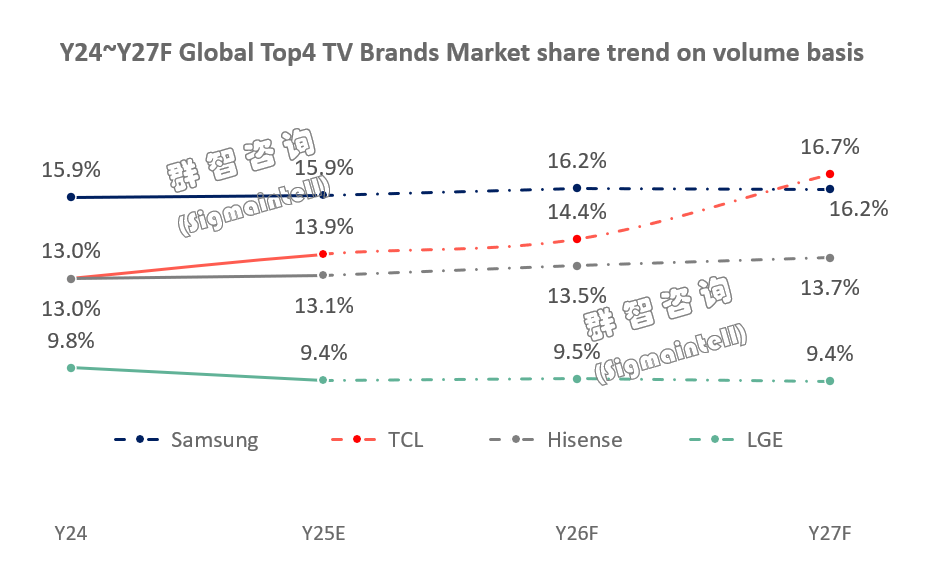
Core Viewpoint - TCL Electronics and Sony Corporation have signed a memorandum of understanding to potentially establish a joint venture that could reshape the global television market, aiming for a combined market share of 16.7% by 2027, surpassing Samsung's 16.2% and marking a significant milestone for Chinese brands in the global television sector [1][3]. Group 1: Joint Venture Details - The joint venture will focus on Sony's home entertainment business, covering integrated operations from product development to customer service, with TCL holding a 51% stake and Sony 49% [1]. - The joint venture is contingent upon signing contracts and obtaining necessary regulatory approvals, with operations expected to commence in April 2027 [1]. Group 2: Market Impact - If the joint venture proceeds successfully, it will be one of the few mergers between leading global television brands in the last two decades, significantly impacting the global television market [2]. - Sony has been a key player in the global television market for over 60 years but has seen a decline in shipment volumes, with a projected 410 million units shipped in 2025, down 13.3% year-on-year [2]. - In contrast, TCL is experiencing growth, with a projected shipment of 30.7 million units in 2025, up 6.4% year-on-year, indicating a strong market expansion strategy [2]. Group 3: Competitive Advantages - The collaboration is expected to enhance TCL's competitiveness in the high-end television market through Sony's brand prestige and advanced technology, potentially increasing TCL's sales and brand strength [5]. - The joint venture will retain Sony's high-end brands, providing TCL with significant brand premium advantages [6]. - The partnership will enrich TCL's high-end product line, particularly in OLED technology, complementing its focus on LCD televisions [7]. Group 4: Supply Chain Dynamics - Sony's panel supply chain may shift towards TCL's Huaxing, potentially leading to a restructuring of the LCD TV panel supply chain in the coming years [8]. - Currently, TCL sources nearly 60% of its TV panels from Huaxing, while Sony primarily relies on BOE, indicating a potential realignment of supply chain relationships [8]. Group 5: Strategic Considerations for Sony - For Sony, the merger represents a strategic move to maintain brand competitiveness amid declining shipment volumes and profitability in hardware, leveraging TCL's supply chain advantages [9]. - The merger is still in the memorandum stage, with uncertainties regarding multi-brand operational synergy and achieving a mutually beneficial outcome [9].

Qualcomm (QCOM) Conference Transcript
2025-06-11 08:00
Qualcomm Conference Call Summary Industry Overview - Qualcomm is focusing on expanding its presence beyond handsets into various edge devices, including automotive, industrial, augmented reality (AR), virtual reality (VR), and robotics [3][4][5] - The company aims for a revenue split of approximately 50% from handsets and 50% from non-handsets by the end of the decade [5] Key Areas of Focus Automotive Market - The automotive industry is undergoing a significant transformation, with a shift towards connected cars and advanced driver-assistance systems (ADAS) [16][18] - Qualcomm is experiencing growth in automotive silicon, with an annual growth rate exceeding 15-20% due to increased digitization [18] - The company has established a strong position in wireless connectivity and digital cockpit technologies [19] - Qualcomm has set a financial target of approximately $8 billion in automotive revenue by fiscal 2029 [23] Data Center Market - Qualcomm is entering the data center market with a focus on AI and low-power, high-performance computing [6][7][9] - The acquisition of AlphaWave is aimed at enhancing Qualcomm's technology portfolio with wired connectivity solutions [9][10] - The company believes in a hybrid AI model that combines device and cloud computing [7][13] Industrial Market - Qualcomm targets $4 billion in revenue from the industrial market, which is expected to transition from microcontrollers to AI and wireless connectivity [49] - The company sees significant opportunities in robotics and AI applications within industrial settings [55] PC Market - Qualcomm holds approximately 9% market share in the consumer PC market in the U.S. and Western Europe, with a target of 12% share in the next few years [32][33] - The company believes the transition to ARM architecture will benefit its position in the PC market [32] Augmented and Virtual Reality - Qualcomm is a leader in the chip market for AR and VR devices, collaborating with major OEMs [40] - The company envisions AR glasses becoming personal computing devices that integrate AI capabilities [48] Handset Market Dynamics - Despite a mature handset market, Qualcomm has seen growth due to a shift towards more expensive devices and increased gaming usage [61][62] - The Android ecosystem is gaining market share against Apple, which is beneficial for Qualcomm [63] - The company remains confident in its competitive position against Samsung and other players, emphasizing the importance of product performance [66][67] Competitive Landscape - Qualcomm has maintained its leadership position in the chip market, with only two major merchant chip companies remaining: Qualcomm and MediaTek [66] - The company is focused on delivering superior products to sustain its competitive edge [67] Conclusion - Qualcomm is strategically positioned to capitalize on growth opportunities across various sectors, including automotive, data centers, industrial applications, and augmented reality, while maintaining a strong presence in the handset market. The company's focus on innovation and technology integration will be key to its future success.
