Shen Zhen Shang Bao

Search documents
“快速发展”变“稳定发展”!欣兴工具招股书为何换了说法?
Shen Zhen Shang Bao· 2026-01-17 04:34
Group 1 - The company faced skepticism regarding its claim of "rapid development in downstream markets" amidst a projected steel production growth rate of only 1% in 2024 and a decline in crude steel production and sales [1] - The company acknowledged the lack of rigor in its previous statement and revised it to "sustained stable development," while emphasizing that steel production reflects raw material supply rather than direct demand for tools [1] - Despite presenting growth data for downstream industries, the company's global market share for its core product, steel plate drills, is only 13.09%, and a significant drop in sales to a major Indian client raises concerns about market dependency risks [1] Group 2 - The company reported that 70% of its R&D investment, approximately 0.2 billion, was allocated to the solid drilling series, which only accounts for about 5% of its revenue [2] - The company attributed this discrepancy to capacity constraints rather than R&D failures, with an overall capacity utilization rate of 94.81% [2] - The revenue compound annual growth rate (CAGR) for the solid drilling series is 19.76%, but the limited production increase despite a doubling of product specifications indicates challenges in market conversion [2] Group 3 - The company clarified that the higher gross margin of the trading model compared to the direct sales model is due to product structure differences, particularly the higher margin from its largest trading customer [3] Group 4 - Concerns were raised about the company's inventory impairment policy, which uses a "5-7 year sales forecast" for raw materials and inventory over 2 years old, questioning its adherence to industry norms [4] - The company defended its approach by stating that the raw materials used in the tool industry are special steels with stable physical properties, allowing for long-term storage [4] Group 5 - The company reported a significant increase in pending installation equipment, which rose by 63% to 46.99 million by June 2025, prompting questions about potential profit manipulation through delayed asset capitalization [5] - The company provided a list of major equipment and clarified that the eight unverified units are still being adjusted due to "parameter non-compliance," with expectations for completion in Q1 2026 [5]


最高或套现6亿元!领益智造60岁女实控人拟减持3600万股
Shen Zhen Shang Bao· 2026-01-17 02:36
Core Viewpoint - The company Lingyi iTech (领益智造) announced a share reduction plan by shareholder Ms. Zeng Fangqin, who intends to sell up to 36 million shares over a three-month period due to personal financial needs, representing 0.49% of the company's total share capital excluding repurchased shares [1][2]. Group 1: Shareholder Information - Ms. Zeng Fangqin plans to reduce her holdings from February 7, 2026, to May 6, 2026, through block trading [1]. - As of now, Ms. Zeng holds 144.54 million shares, accounting for 1.98% of the total share capital, while her associated entity, Lingsheng Investment (Jiangsu) Co., Ltd., holds 4139.52 million shares, representing 56.74% [2]. Group 2: Company Background - Lingyi iTech's business includes AI smartphones, foldable phones, AIPC, tablets, imaging displays, materials, battery power, thermal management, AI glasses, XR wearable devices, premium assembly, sensors, and robotics [2]. - Ms. Zeng, born in 1965 and a graduate of Wuhan University, founded Lingsheng Electronics Technology, the predecessor of Lingyi iTech, in 2006 and led the company into the Apple supply chain [2]. Group 3: Financial Performance - The company's revenue from 2021 to 2024 was 30.38 billion, 34.49 billion, 34.12 billion, and 44.21 billion yuan, respectively, with net profits of 1.18 billion, 1.60 billion, 2.05 billion, and 1.75 billion yuan [3]. - For the first three quarters of 2025, the company reported total revenue of 37.59 billion yuan, a year-on-year increase of 19.25%, and a net profit of 1.94 billion yuan, up 37.66% [4]. Group 4: Market Activity - On November 20, 2025, Lingyi iTech submitted an application for a Hong Kong stock listing, aiming for a dual listing in both A-share and H-share markets, marking its second attempt to list on the Hong Kong Stock Exchange [5].


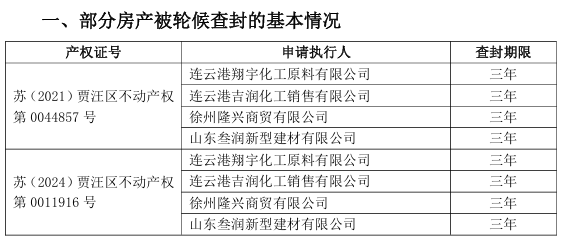
房产被查封+停产,金浦钛业又摊上事了
Shen Zhen Shang Bao· 2026-01-17 00:17
Core Viewpoint - The company faces significant challenges due to a contract dispute leading to asset seizure and ongoing production issues, which may adversely affect its financial performance and operational capacity [1][3][4]. Group 1: Asset Seizure and Financial Impact - The company's subsidiary, Xuzhou Titanium White Chemical Co., is facing a contract dispute with a supplier, resulting in the seizure of properties valued at 146 million yuan, which represents 10.45% of the company's audited net assets for 2024 [1][3]. - The seized properties are under a three-year freeze and have been pledged as collateral for loans from three banks [2]. - If the seized assets are disposed of, it could lead to further negative impacts on the company's financial health [3]. Group 2: Production and Financial Performance - The company announced a production halt for Xuzhou Titanium White due to intensified market competition and declining prices of titanium dioxide, which has led to continuous losses [4]. - The production capacity of Xuzhou Titanium White is 80,000 tons, accounting for 50% of the company's total titanium dioxide production capacity, and the halt is expected to significantly impact revenue in 2026 [4]. - The company has reported consecutive losses from 2022 to 2024, with revenues of 2.51 billion yuan, 2.27 billion yuan, and 2.13 billion yuan, and net losses of 145 million yuan, 175 million yuan, and 244 million yuan respectively, totaling approximately 560 million yuan in losses over three years [5]. - In the first three quarters of 2025, the company achieved revenue of 1.24 billion yuan, a year-on-year decrease of 23.68%, with a net loss of approximately 233 million yuan, marking a staggering year-on-year decline of 325.09% [6]. Group 3: Market Performance - As of January 16, the company's stock price fell by 2.88%, closing at 3.04 yuan per share, with a total market capitalization of 3 billion yuan [7].

*ST铖昌部分投资者被暂停交易!周五股价“地天板”
Shen Zhen Shang Bao· 2026-01-17 00:13
*ST铖昌股价自2025年12月1日以来大幅拉升,一个多月累计涨幅达190.89%,被市场称为近期商业航天板块大牛股。 公开资料显示,*ST铖昌主营业务是微波毫米波相控阵T/R芯片的研发、生产、销售和技术服务。 1月15日晚,*ST铖昌公告核查完毕,股票将自1月16日开市起复牌。1月16日,*ST铖昌开盘跌停,随后直线拉升,快速涨停,上演"地天板",截至收盘, 该股报128.98元/股,成交额7.65亿元。值得一提的是,该股近12个交易日已收获11个涨停板。 *ST铖昌1月15日晚公告称,公司前期披露的信息不存在需要更正、补充之处;公司未发现近期公共传媒报道了可能或已经对公司股票交易价格产生较大 影响的未公开重大信息;公司目前经营情况正常,内外部经营环境未发生重大变化。 1月12日晚,*ST铖昌公告称,公司股票交易连续10个交易日内4次出现同向股票交易异常波动情形,属于股票交易严重异常波动的情况。为维护投资者利 益,公司申请自1月13日开市起停牌,待核查结束并披露相关公告后复牌。 深交所出手! 深交所1月16日消息,近期"*ST铖昌(001270)"股价出现严重异常波动,公司停牌核查并发布风险提示公告,1月1 ...
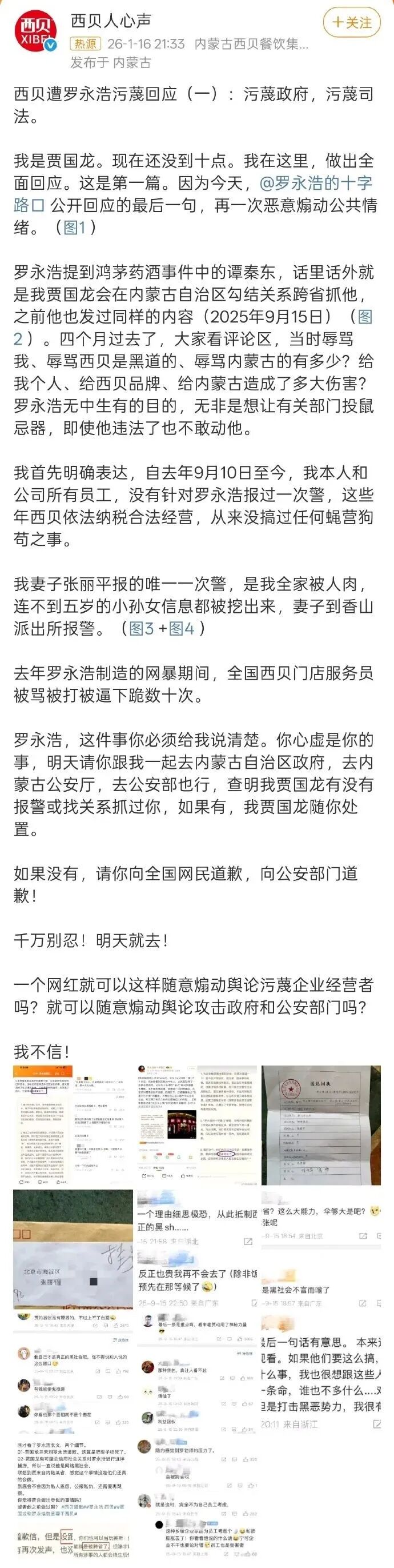
贾国龙罗永浩账号被禁言!西贝半年亏损6亿元
Shen Zhen Shang Bao· 2026-01-16 15:34
贾国龙表示,罗永浩在公开回应中恶意煽动公共情绪,无端指责其会勾结内蒙古自治区政府和公安部门 抓人,这与2025年9月15日罗永浩的类似言论如出一辙。 我妻子张丽平报的唯一一次警,是我全家被人肉, 连不到五岁的小孙女信息都被挖出来,妻子到香山 派出所报警。 (图3+图4) 去年罗永浩制造的网暴期间,全国西贝门店服务员 被骂被打被逼下跪数十次。 罗永浩,这件事你必须给我说清楚。你心虚是你的 事,明天请你跟我一起去内蒙古自治区政府,去内 蒙古公安厅,去公安部也行,查明我贾国龙有没有 报警或找关系抓过你,如果有,我贾国龙随你处 置。 1月16日,西贝餐饮创始人贾国龙通过社交媒体回应罗永浩。 如果没有,请你向全国网民道歉,向公安部门道 敷! 千万别忍!明天就去! 一个网红就可以这样随意煽动舆论污蔑企业经营者 吗? 就可以随意煽动舆论攻击政府和公安部门吗? 据新黄河报道,21时50分许,记者从罗永浩方面有关人士确认,@罗永浩的十字路口 以及@西贝贾国 龙 两个账号均被禁言。 我不信! 贾国龙日前接受上海证券报记者采访时表示,预计2025年9月至2026年3月,西贝累计亏损将超6亿元。 西贝将在一季度陆续关闭全国102家门 ...
违规拆借6600万元只收回1000万出头!梦洁股份内控漏洞令人触目惊心
Shen Zhen Shang Bao· 2026-01-16 15:24
1月16日晚间,湖南梦洁家纺股份有限公司(002397.SZ)披露整改公告,回应湖南证监局2025年10月20日下发的行政监管措施决定书。公告显示,公司2022 年至2024年存在多项财务核算违规问题,同时子公司大方睡眠长期向自然人提供6000余万元财务资助,凸显其内部控制体系存在严重漏洞。 根据《决定书》,梦洁股份(002397)主要存在两大问题。一是财务核算不规范:2022年~2024年间,公司直营专柜及子公司大方睡眠的直销业务收入和 成本存在跨期确认,销售返利跨期冲减营业收入,职工薪酬及社保也存在跨期计提情形。二是资金管理失当:大方睡眠通过往来款方式向叶某峰提供财务 资助,截至2021年末拆借资金余额达6602.73万元,截至2025年9月末仍为6337.63万元,且公司长期怠于追偿。 针对财务核算问题,梦洁股份表示已进行会计差错更正,对2022年~2024年度财务报表进行追溯调整,并制定了《重大会计核算事项管理制度》,明确收 入确认时点及费用核算原则。公司称该问题已完成整改。 编辑吴怡漪责编李耿光校审宋华 在资金占用问题上,公司已累计追回1036.24万元。具体措施包括:2022年6月与叶某峰签订还款 ...

从“王一博概念股”到资本弃子?乐华娱乐遭原始股东密集减持
Shen Zhen Shang Bao· 2026-01-16 14:43
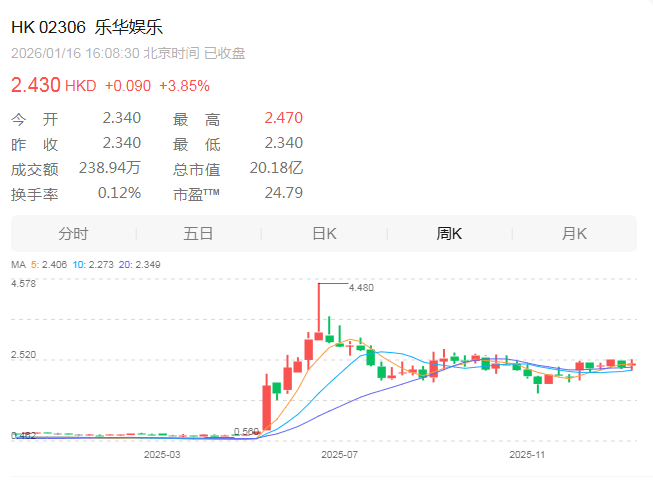
Core Viewpoint - The recent shareholding changes at Lehua Entertainment indicate a significant decline in investor confidence, particularly due to the company's heavy reliance on a single artist, Wang Yibo, whose future involvement remains uncertain [1][2]. Group 1: Shareholder Activity - On January 7, shareholder Li Ruigang reduced his stake in Lehua Entertainment by selling 40 million shares at an average price of HKD 2.48, raising approximately HKD 99.2 million, and his ownership dropped from 8.64% to 4.05%, exiting the top ten shareholders [1]. - Since the second half of last year, Lehua Entertainment has faced continuous shareholder sell-offs, with its stock price declining over 40% during this period [1][3]. - In September 2022, Alibaba and Brilliant Spark Holdings Limited also reduced their stakes in Lehua Entertainment, with Alibaba selling 2.328 million shares, lowering its stake to 11.99%, and Brilliant Spark selling 410,000 shares for approximately HKD 1.0584 million [1]. Group 2: Company Performance and Artist Dependency - Lehua Entertainment, established in 2009 and listed on the Hong Kong Stock Exchange on January 19, 2023, is a leading artist management and cultural entertainment platform in China, with its main business segments including artist management, music IP production, and pan-entertainment [1]. - Wang Yibo has historically contributed significantly to the company's revenue, accounting for over 60% of total revenue in 2024, but his reduced public engagements since 2025 have raised concerns about the company's future performance [2]. - The 2025 interim report notably omitted any mention of Wang Yibo, contrasting with previous reports, which has led to speculation about the company's reliance on him and the potential impact of his contract expiration in October 2026 on the company's valuation [2].
突发!康佳集团董事、总裁辞职
Shen Zhen Shang Bao· 2026-01-16 14:28
新年伊始,康佳集团突发重大人事变动。 1月16日晚间,康佳集团股份有限公司关于公司董事、总裁辞任的公告,公司及其董事会于2026年1月16日收到曹士平递交的书面《辞职报告》,曹士平因 工作安排原因,请求辞去公司第十一届董事会董事、董事会战略与投资委员会委员及公司总裁的职务。 辞去上述职务后,曹士平将继续在公司任职。根据《公司法》《深圳证券交易所股票上市规则》《康佳集团股份有限公司章程》等相关规定,曹士平的辞 任自《辞职报告》送达公司及其董事会之日起生效。 截至本公告披露日,曹士平未持有公司股份,并确认与公司董事会及管理层不存在意见分歧。曹士平的辞任不会导致公司董事会成员低于法定人数,不会 影响公司董事会的正常运作和公司的日常经营。公司董事会将按照法定程序尽快完成董事补选及总裁聘任工作。 公开资料显示,曹士平1978年生,拥有南开大学工商管理硕士学位,2001年便进入康佳工作,曾任康佳集团多媒体锦州分公司和天津分公司总经理,多媒 体事业部客户合作部总经理,多媒体营销事业部副总经理,多媒体事业本部副总经理兼营销中心总经理,多媒体事业本部总经理,互联网事业部总经理, 康佳集团副总裁、常务副总裁等职务,2024年8月 ...

连续4年财报信披不真实、不准确,海正药业遭警示!
Shen Zhen Shang Bao· 2026-01-16 11:57
Core Viewpoint - Recently, Haizheng Pharmaceutical received a warning letter from the Zhejiang Securities Regulatory Bureau due to inaccuracies in financial disclosures from 2021 to 2024, which included corrections to revenue, costs, and investment income [1][2]. Financial Discrepancies - The company corrected its financial statements, resulting in a total reduction of 949 million yuan in revenue and 930 million yuan in costs for the years 2021 to 2023, while investment income was adjusted upwards by 18.8 million yuan [2]. - For 2024, the company reported an increase in revenue of 405 million yuan and costs of 395 million yuan, but a decrease in investment income of 10.3 million yuan [2]. Company Performance - For the first three quarters of 2025, Haizheng Pharmaceutical achieved a revenue of 7.923 billion yuan, reflecting a year-on-year growth of 0.61%, while net profit attributable to shareholders decreased by 10.55% to 461 million yuan [3]. - As of September 30, 2025, the company's debt-to-asset ratio was 42.84%, a decrease of 10.26% year-on-year, and accounts receivable amounted to 1.753 billion yuan, down 9.76% year-on-year [3]. Market Reaction - As of January 16, the company's stock price fell by 1.04%, closing at 10.50 yuan per share, with a total market capitalization of 12.59 billion yuan [4].

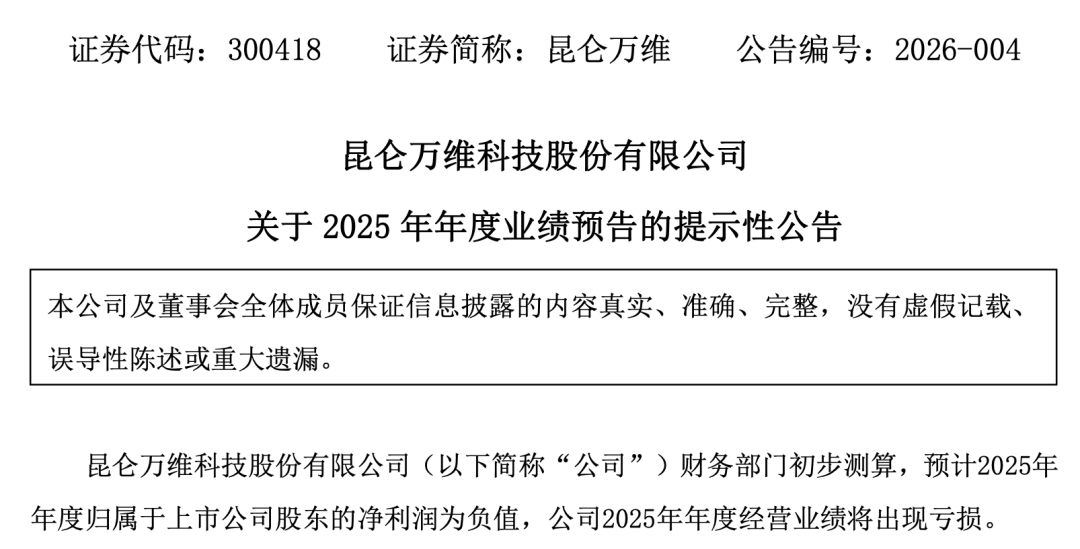
又亏损一年,“All in AI”给昆仑万维带来了什么?
Shen Zhen Shang Bao· 2026-01-16 08:37
Group 1 - The core viewpoint of the news is that Kunlun Wanwei is transitioning from a gaming company to an AI-focused company, but this shift has led to significant financial losses, marking the first loss since its listing in 2015 [3][4]. - In 2024, Kunlun Wanwei reported total revenue of 5.66 billion CNY, a year-on-year increase of 15.2%, but incurred a net loss attributable to shareholders of 1.595 billion CNY, indicating a shift from profit to loss [3]. - For the first three quarters of 2025, the company achieved total revenue of 5.805 billion CNY, a year-on-year increase of 51.63%, but reported a net loss of 666 million CNY, slightly higher than the previous year's loss of 627 million CNY [3][4]. Group 2 - The company's sales expenses for the first three quarters of 2025 reached 2.89 billion CNY, a year-on-year increase of 105.75%, primarily due to increased marketing and recharge channel costs [3]. - Research and development expenses for the same period amounted to 1.211 billion CNY, accounting for 20.86% of total revenue [3]. - Total operating costs for the first three quarters of 2025 rose to 6.828 billion CNY, a year-on-year increase of 57.08%, outpacing revenue growth [4]. Group 3 - Kunlun Wanwei is focusing on short video content, launching several AI-driven video models throughout 2025, including the SkyReels series, which aims to enhance AI short film creation capabilities [5]. - As of January 16, 2025, Kunlun Wanwei's stock price fell by 10.51% to 55.76 CNY per share, with a total market capitalization of approximately 69.999 billion CNY [5].