
Guo Ji Jin Rong Bao

Search documents
全方位创建供求适配机制 引发更强消费增长势能
Guo Ji Jin Rong Bao· 2025-12-19 17:32
Group 1 - The central economic work conference emphasizes the importance of boosting consumption as a primary support for expanding domestic demand, with a plan to create three trillion-level consumption sectors and ten hundred-billion-level consumption hotspots by 2027 [1] - The trillion-level sectors include elderly products, smart connected vehicles, and consumer electronics, while the hundred-billion-level hotspots cover baby products, smart wearables, cosmetics, fitness equipment, outdoor products, pet food, civilian drones, trendy toys, jewelry, and domestic fashion [1] - By 2030, the goal is to establish a high-quality development pattern characterized by a virtuous interaction between supply and consumption [1] Group 2 - The latest data from the National Bureau of Statistics shows that the total retail sales of consumer goods in the first three quarters of 2025 increased by 4.5% year-on-year, contributing 53.5% to economic growth, which is a 9% increase compared to the previous year [3] - There is a noticeable trend towards quality and personalized consumption among residents, shifting from "universal functionality" to "spiritual recognition" [3] Group 3 - The supply side is adjusting in terms of both quantity and quality, with over 230 million types of consumer goods available, and a significant increase in the supply of innovative products such as smart home devices and drones [5] - Despite improvements, there remains a mismatch between supply and demand, particularly in terms of personalized and high-end products, leading to a situation where desired products are not available [6] Group 4 - The current mismatch in supply and demand is characterized by three main issues: standardized products failing to meet personalized demands, a lack of high-end quality supply, and insufficient supply in emerging hotspots [6] - The new plan aims to address these mismatches by enhancing product variety, quality, and responsiveness, marking a shift from passive adaptation to proactive leadership in policy [6] Group 5 - The plan promotes flexible manufacturing and customization, encouraging the establishment of a digital system that connects user demand with intelligent design and flexible production across various industries [9] - The integration of artificial intelligence is highlighted as a key factor in reducing supply-demand mismatches and enhancing consumer experience [10] Group 6 - The plan emphasizes the importance of diversifying and personalizing supply in emerging sectors, particularly in rural areas, where there is a growing demand for high-quality products [12] - Innovations in leisure, sports, and health products are identified as new consumption opportunities, with a focus on multi-functional smart fitness equipment and health management products [13] Group 7 - The plan also aims to enhance the influence of traditional culture by promoting historical classic products and supporting the development of local specialty foods and traditional crafts [14] - New consumer interests in areas such as pets, anime, and trendy products are addressed, with strategies for expanding low-altitude tourism and automotive-related consumption [15]
购置税退坡在即!车企奋力“兜底”,难挽年末市场降温……
Guo Ji Jin Rong Bao· 2025-12-19 17:28
Core Viewpoint - The exemption policy for new energy vehicle purchase tax, in place for ten years, will end on December 31, 2025, transitioning to a 50% tax reduction starting January 1, 2026, with the maximum exemption amount decreasing from 30,000 yuan to 15,000 yuan [1] Group 1: Policy Changes - The new purchase tax rate for new energy vehicles will be 5% after the adjustment, down from full exemption [1] - For vehicles priced at 300,000 yuan, the tax payable will be 15,000 yuan, while for those priced at 500,000 yuan, the tax will be 35,000 yuan after applying the maximum exemption [1] Group 2: Industry Response - Over twenty car manufacturers, including Li Auto, NIO, Chery, and others, have introduced "purchase tax guarantee" subsidy plans to mitigate consumer hesitation due to the policy change [4] - Xiaomi Auto has launched a year-end purchase tax subsidy plan, promising up to 15,000 yuan for users who lock in orders by November 30, 2023, if delivery is delayed to 2026 [4] - GAC Group and XPeng have also announced similar subsidy plans, with varying deadlines and subsidy amounts [4] Group 3: Market Trends - Despite the introduction of subsidy plans, the expected surge in market activity has not materialized, with a reported 8.1% year-on-year decline in retail sales of passenger vehicles in November [8] - The retail sales of fuel vehicles dropped by 22%, while pure electric vehicle sales increased by 9.2% [8] - Sales personnel have noted a general slowdown in consumer activity, attributing it to the cessation of national subsidies and a wait-and-see attitude regarding future policies [8] Group 4: Sales Performance - Some manufacturers are facing challenges in meeting their sales targets, with companies like NIO and Li Auto showing low completion rates of 62.6% and 56.6%, respectively [10] - In contrast, XPeng has met its annual sales target, while other companies like Leap Motor and BYD have exceeded 90% of their targets [10]


停止接受多项新业务!安心财险收罚单 5人遭禁业
Guo Ji Jin Rong Bao· 2025-12-19 16:20
Regulatory Actions - The China Banking and Insurance Regulatory Commission (CBIRC) has imposed strict penalties on Anxin Property Insurance Co., Ltd. for multiple violations, including failure to use approved insurance terms and rates, and submitting false claims data [1] - Anxin Insurance is prohibited from accepting new credit guarantee insurance business for 36 months, short-term health insurance for 24 months, and vehicle insurance for 6 months [1] - A total of 14 individuals received warnings and fines amounting to 770,000 yuan, with several individuals banned from the insurance industry for periods ranging from 6 to 11 years [1] Financial Performance - Anxin Insurance's business income from 2016 to 2021 showed significant fluctuations, with net losses recorded each year, culminating in a loss of 276 million yuan in 2021 [2] - The company has faced stagnation in business development, with negative insurance income reported in 2022, 2023, and the first three quarters of 2024 [2] - As of the end of Q3 2024, Anxin Insurance reported a net asset value of -735 million yuan and a solvency ratio of -871.59%, indicating severe financial distress [2] Corporate Changes - In March 2024, Anxin Insurance relocated its registered office from Beijing to Suzhou, Jiangsu Province, amid speculation of potential state-owned enterprise involvement [2] - In September 2024, the CBIRC approved the establishment of Suzhou Dongwu Property Insurance Co., Ltd., which is believed to be related to the risk management efforts concerning Anxin Insurance [3] - Dongwu Insurance has a registered capital of 2 billion yuan and will operate under the supervision of the Jiangsu Financial Regulatory Bureau, with a broad range of insurance services planned [3]
停止接受多项新业务!安心财险收罚单,5人遭禁业
Guo Ji Jin Rong Bao· 2025-12-19 16:11
Regulatory Actions - The Financial Regulatory Bureau has imposed penalties on Anxin Property Insurance Co., Ltd. for multiple violations, including failure to use approved insurance terms and rates, and submitting false claims data [1] - Anxin Insurance is prohibited from accepting new credit guarantee insurance business for 36 months, short-term health insurance for 24 months, and vehicle insurance for 6 months [1] - A total of 14 individuals received warnings and fines totaling 770,000 yuan, with several individuals banned from the insurance industry for periods ranging from 6 to 11 years [1] Company Performance - Anxin Insurance has experienced stagnation in business development, with insurance revenue and net losses fluctuating significantly from 2016 to 2021, culminating in a net loss of 276 million yuan in 2021 [2] - In recent years, the company reported negative insurance revenues and continued net losses, with figures of -17.86 million yuan in 2022, -4.3 million yuan in 2023, and -0.134 million yuan in the first three quarters of 2024 [2] - As of the end of Q3 2024, Anxin Insurance's net assets were -735 million yuan, with a core solvency ratio of -871.59%, indicating severe insolvency [2] Corporate Restructuring - In March 2024, Anxin Insurance relocated its registered office from Beijing to Suzhou, with market speculation about potential state-owned capital involvement [2] - In September 2024, the Financial Regulatory Bureau approved the establishment of Suzhou Dongwu Property Insurance Co., Ltd., which is believed to be related to the risk management of Anxin Insurance [3] - Dongwu Insurance has a registered capital of 2 billion yuan and is set to operate under the supervision of the Jiangsu Financial Regulatory Bureau, with a wide range of insurance services planned [3]
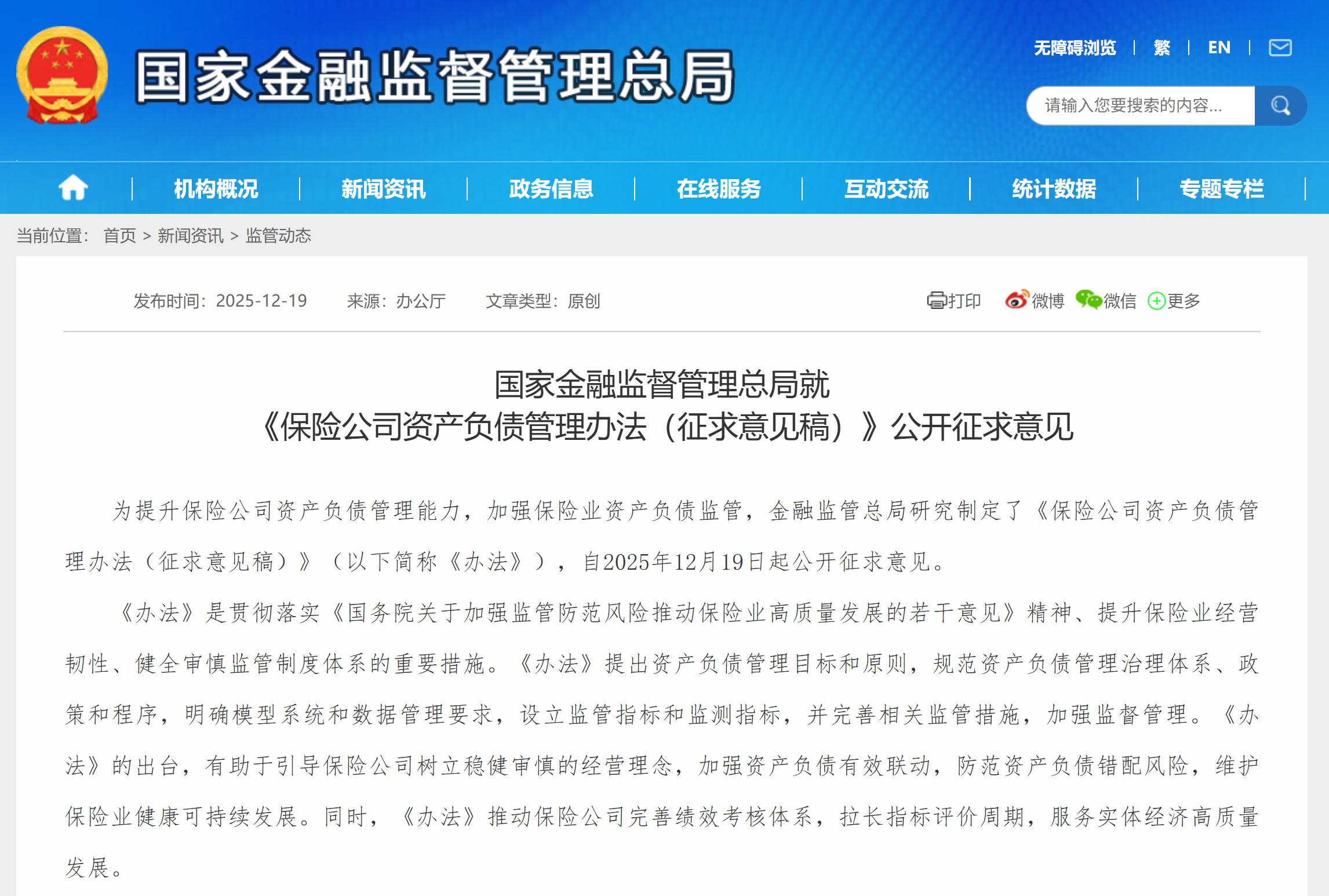
明确监管指标和指标阈值!保险公司资产负债管理办法征求意见
Guo Ji Jin Rong Bao· 2025-12-19 16:11
Core Viewpoint - The Financial Regulatory Bureau is seeking public opinion on the draft "Insurance Company Asset-Liability Management Measures" to enhance asset-liability management capabilities and regulatory oversight in the insurance industry [1]. Group 1: Asset-Liability Management Goals and Principles - Insurance companies must assume primary responsibility for asset-liability management, adhering to principles of comprehensive coverage, reasonable matching, prudent stability, and coordinated management to effectively prevent asset-liability mismatch risks [5]. Group 2: Governance Structure - The governance structure for asset-liability management should include a board of directors with ultimate responsibility, senior management leading directly, and a coordinating department for asset-liability management, with functional departments collaborating and internal audit overseeing [5]. Group 3: Policies and Procedures - Insurance companies are required to develop asset-liability management plans that enhance linkage across business planning, product development, pricing, insurance management, asset allocation policies, and major investments, including conducting stress tests and back-testing [5]. Group 4: Regulatory and Monitoring Indicators - New regulatory indicators will be established, including effective duration gap, comprehensive investment yield coverage ratio, net investment yield coverage ratio, and liquidity coverage ratio under stress scenarios, with clear threshold values [7]. Group 5: Supervision and Management - The measures will enhance supervision by clarifying information reporting, third-party audits, and capability assessments, allowing regulators to take necessary actions or impose administrative penalties as needed [5][7]. Group 6: Changes Compared to Previous Regulations - The new measures integrate previous regulations into a more complete regulatory framework, addressing the evolving external environment and internal conditions of the insurance industry, with new accounting standards set to be implemented by 2026 [6].
华夏久盈资产被罚70万元,1人遭10年禁业处罚
Guo Ji Jin Rong Bao· 2025-12-19 16:11
Group 1 - The China Banking and Insurance Regulatory Commission (CBIRC) has imposed a fine of 700,000 yuan on Huaxia Jiuying Asset Management Co., Ltd. for illegal activities related to the use of insurance company funds, and Chen Shucui has been banned from the insurance industry for 10 years [1] - This is not the first penalty for Huaxia Jiuying Asset in 2023; in June, the company was fined a total of 2.66 million yuan for false reporting and significant omissions in related party disclosures, among other violations [1] - A total of 25 responsible personnel received warnings, and several key individuals were banned from the insurance industry for varying periods, with some facing lifetime bans [1] Group 2 - Huaxia Jiuying Asset was established in May 2015 and is the 21st insurance asset management company approved by the former China Insurance Regulatory Commission [1] - In July 2020, the former CBIRC took over four insurance institutions, including Huaxia Life Insurance, for a one-year period, which was later extended for another year [2] - Huaxia Life Insurance is the largest among the four institutions under supervision, and its risk management has been closely monitored by the market [3] - In November 2023, Ruizhong Life Insurance was approved to acquire Huaxia Life's insurance business and related assets, marking the end of Huaxia Life's risk management phase [3] - Following the acquisition, Huaxia Jiuying Asset's ownership changed, with Ruizhong Life holding 99% of the shares, and the company has postponed its 2024 annual report due to ongoing risk management [3]
从2025年产业年会看游戏行业:出海与AI仍是“黄金之路”
Guo Ji Jin Rong Bao· 2025-12-19 16:07
Core Insights - The 2025 China Game Industry Conference highlighted that the domestic game market is projected to achieve actual sales revenue of 350.79 billion yuan, a year-on-year increase of 7.68%, with a user base of 683 million, reflecting a growth of 1.35% [1] - The growth in market revenue and user base is attributed to several factors, including improved quality of mobile games, successful performance of long-standing titles, strong growth in mini-program games, and cross-platform product compatibility [1] - The industry is entering a new phase driven by policy and market collaboration, with positive signals from the government regarding the game industry as a key carrier of cultural and technological integration [1] Market Performance - The actual sales revenue from self-developed games is expected to reach 291.1 billion yuan in 2025, marking an 11.64% year-on-year increase [2] - Revenue from self-developed games in overseas markets is projected to be approximately 20.46 billion USD (about 144.06 billion yuan), with a year-on-year growth of 10.2% [2] - The overseas revenue from self-developed mobile games is estimated at 18.48 billion USD, reflecting a growth of 13.16% [2] Global Expansion Strategies - Major game companies are focusing on "premiumization" and "globalization" strategies, actively exploring overseas markets while integrating AI technologies to enhance production efficiency and content quality [2][3] - Successful examples include adapting game narratives and content to fit local cultural preferences, as demonstrated by the success of titles like "Diablo Immortal" and "Yanyun Sixteen Sounds" in international markets [3] AI Integration in Gaming - The integration of AI technologies is becoming a focal point for innovation within the gaming industry, with expectations for AI-native games to reach a revenue scale exceeding 30 billion yuan by 2027 [4] - AI tools are being utilized to enhance content development and localization processes, significantly improving translation efficiency and cultural expression [5] - The gaming industry is positioned as a leading application area for advanced technologies, fostering a reciprocal relationship between AI advancements and game product innovation [5]
险企年末密集“补血” 永续债为何成新主力?
Guo Ji Jin Rong Bao· 2025-12-19 15:44
Core Viewpoint - The issuance of perpetual bonds by insurance companies is increasing as they seek to strengthen their capital base and meet regulatory requirements, particularly in light of the upcoming end of the transition period for the new solvency regulations. Group 1: Bond Issuance Details - On December 18, Great Wall Life successfully issued 1 billion yuan of perpetual bonds with a coupon rate of 2.70% [1] - In December, several insurance companies, including Ping An Life and Dongwu Life, have issued perpetual bonds or capital supplement bonds, totaling 23.5 billion yuan [1] - The issuance of bonds is primarily aimed at enhancing the solvency levels of these companies and supporting their ongoing business development [3] Group 2: Regulatory and Market Context - The acceleration in bond issuance is attributed to the approaching end of the transition period for the "Solvency II" regulations, which has led to a concentrated release of previously accumulated capital needs [4] - The new accounting standards have increased the volatility of solvency ratios, prompting companies to issue bonds to quickly replenish capital and stabilize regulatory metrics [4] Group 3: Strategic Importance of Capital - The issuance of bonds is seen as a way to prepare for the next year's business operations and to reserve capital for long-term growth needs [4] - As the industry shifts towards protection-oriented and long-term savings products, sufficient capital is necessary to support business expansion and strategic investments [5] Group 4: Trends in Perpetual Bonds - Perpetual bonds have emerged as a key tool for insurance companies to supplement their capital, with a total issuance of 514.7 billion yuan by 12 companies since 2025 [6] - The supply of perpetual bonds is concentrated among large and medium-sized insurance institutions, as they meet the higher issuance criteria compared to smaller firms [7] Group 5: Long-term Capital Strategies - While bond issuance provides short-term capital relief, the long-term solution lies in enhancing the internal capital generation capabilities of insurance companies [8] - Companies are encouraged to focus on high-quality development, optimize their business structures, and improve operational efficiency to achieve sustainable growth [8][9]


购置税退坡在即!车企奋力“兜底” 难挽年末市场降温……
Guo Ji Jin Rong Bao· 2025-12-19 15:41
Core Viewpoint - The exemption policy for new energy vehicle (NEV) purchase tax, in place for ten years, will end on December 31, 2025, transitioning to a 50% tax reduction starting January 1, 2026, with the maximum exemption amount decreasing from 30,000 yuan to 15,000 yuan [1] Group 1: Policy Changes - The new purchase tax rate for NEVs will be 5% after the reduction, with specific calculations indicating that a 300,000 yuan vehicle will incur a tax of 15,000 yuan, while a 500,000 yuan vehicle will incur a tax of 35,000 yuan after the maximum deduction [1] - Major NEV manufacturers are introducing "purchase tax guarantee" solutions to mitigate consumer hesitation due to the policy change, with over twenty companies, including Li Auto, NIO, and Chery, launching such subsidy programs [1] Group 2: Company Responses - Xiaomi Auto has announced a year-end purchase tax subsidy plan, offering up to 15,000 yuan for users who lock in orders by November 30, 2025, with similar commitments from GAC Group and XPeng [2] - The core framework of these subsidy plans is consistent across manufacturers, focusing on compensating consumers for tax differences if vehicle delivery is delayed into 2026 due to manufacturer issues [2] Group 3: Market Trends - Despite the introduction of tax guarantee policies, the expected market boost has not materialized, with November retail sales of passenger vehicles dropping by 8.1% year-on-year, and fuel vehicle sales declining by 22% [4] - Sales personnel report a general market slowdown, attributing it to consumer hesitation stemming from the cessation of national subsidies and uncertainty regarding future policies [4] Group 4: Sales Performance - A review of sales targets for the first eleven months of the year shows varying completion rates among manufacturers, with XPeng achieving its annual target, while NIO and Li Auto are significantly behind at 62.6% and 56.6% completion rates, respectively [5] - The overall sales target completion rate for Changan Auto stands at 88.6%, indicating pressure on several manufacturers to meet their goals as the year-end approaches [5]
险企年末密集“补血”,永续债为何成新主力?
Guo Ji Jin Rong Bao· 2025-12-19 15:40
Core Viewpoint - The issuance of perpetual bonds by insurance companies is accelerating as they seek to strengthen their capital base in response to regulatory requirements and market conditions [1][2][4]. Group 1: Recent Bond Issuances - On December 18, Great Wall Life successfully issued 1 billion yuan of perpetual bonds with a coupon rate of 2.70% [1]. - In December, several insurance companies, including Ping An Life and Dongwu Life, issued perpetual bonds or capital supplement bonds, totaling 23.5 billion yuan [1][3]. - The issuance of bonds is primarily aimed at enhancing the solvency levels of these companies and supporting sustainable business development [3][4]. Group 2: Factors Driving Bond Issuance - The acceleration in bond issuance is attributed to multiple factors, including the end of the transition period for the "Solvency II" regulations, which has increased the urgency for capital replenishment [2][4]. - New accounting standards have intensified the volatility of solvency ratios, prompting companies to issue bonds to stabilize regulatory metrics [4]. - The need to reserve capital for business development and to support growth in the following year is also a significant internal demand [4][5]. Group 3: The Role of Perpetual Bonds - Perpetual bonds have emerged as a key financing tool for insurance companies, with a total issuance of 35.77 billion yuan in 2023 [6]. - The issuance of perpetual bonds is concentrated among large and medium-sized insurance firms, as they meet the higher issuance criteria compared to smaller companies [7]. - Insurance companies must meet specific conditions to issue perpetual bonds, including maintaining a solvency ratio of at least 100% and ensuring that the balance of perpetual bonds does not exceed 30% of core capital [7]. Group 4: Long-term Capital Strategies - While bond issuance provides short-term capital relief, the insurance industry must focus on enhancing its internal capital generation capabilities for sustainable growth [8]. - Companies are encouraged to optimize their business structures, improve operational efficiency, and manage assets and liabilities effectively to achieve long-term stability [8][9]. - Emphasizing high-value protection and long-term savings products, along with prudent investment strategies, is essential for improving core profitability and ensuring a solid foundation for future growth [8][9].