新能源汽车购置税政策

Search documents
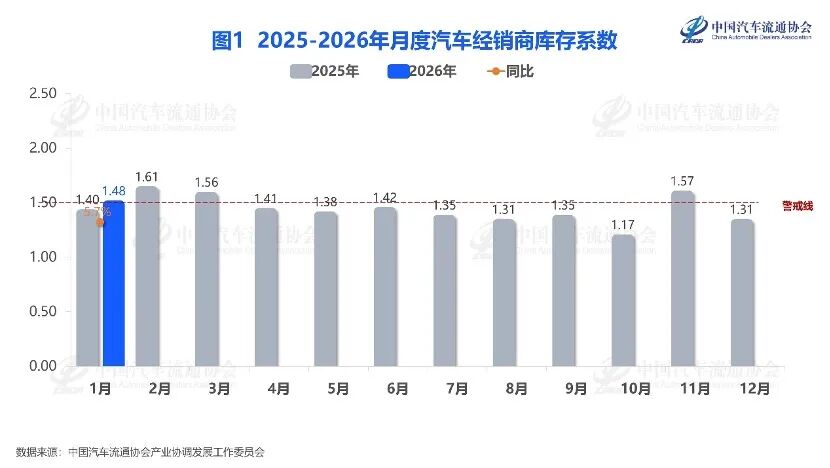
中国汽车流通协会:1月汽车经销商综合库存系数为1.48 同比上升5.7%
智通财经网· 2026-02-13 03:13
Core Viewpoint - In January 2026, the comprehensive inventory coefficient for automotive dealers in China increased, indicating a rise in inventory levels due to various market factors and policy changes [1][3]. Group 1: Inventory Coefficient Trends - The inventory coefficient for January was reported at 1.48, reflecting a month-on-month increase of 13.0% and a year-on-year increase of 5.7% [1]. - The inventory coefficient for high-end luxury and imported brands decreased to 1.04, down 23.0% month-on-month, entering a reasonable range [6]. - Conversely, the inventory coefficient for joint venture brands rose to 1.48, up 5.7% month-on-month, while the coefficient for domestic brands increased to 1.56, up 23.8% month-on-month, exceeding the warning line [6]. Group 2: Market Conditions and Consumer Behavior - The adjustment of the new energy vehicle purchase tax from "exemption" to "half exemption," along with the optimization of the "two new" policies, contributed to a heightened consumer wait-and-see sentiment, leading to underperformance in the automotive market in January [3]. - The China Automobile Dealers Association decided not to disclose brands with high inventory levels this month due to the complex market environment and significant short-term factors affecting inventory coefficients [7]. - The association will issue letters to manufacturers for brands with inventory coefficients exceeding two months, urging them to monitor dealer inventory closely and optimize production and sales rhythms [7]. Group 3: Future Market Expectations - The automotive market is expected to enter a traditional off-season in February due to the Spring Festival holiday, with ongoing consumer hesitation stemming from policy changes [8]. - The China Automobile Dealers Association recommends that dealers rationally estimate market demand based on actual conditions and manage inventory levels accordingly [8]. - There is an emphasis on promoting "trade-in and scrapping renewal policies" and ensuring consumer service during the holiday period [8].

平稳开局!1月我国汽车销量超234万辆
Mei Ri Jing Ji Xin Wen· 2026-02-13 01:13
Core Insights - In January, China's automotive production and sales reached 2.45 million and 2.346 million units respectively, with production increasing by 0.01% year-on-year and sales decreasing by 3.2% year-on-year [1] - The decline in market sales is attributed to three main factors: the adjustment of the new energy vehicle purchase tax policy, the transition of local car purchase subsidy policies, and the early release of some consumer demand in 2025 [1] - The overall automotive market is considered stable despite the policy changes, with a positive outlook for demand recovery due to new government policies aimed at supporting the economy [1] Passenger Vehicle Market - In January, passenger vehicle production and sales were 2.062 million and 1.988 million units respectively, showing year-on-year declines of 4.1% and 6.8% [2] - The A00-level new energy passenger vehicles saw a significant sales drop of 73.4%, while A-level new energy vehicles experienced a 24.4% decline [2] - The majority of sales for traditional fuel passenger vehicles were concentrated in the 100,000 to 150,000 yuan price range, with a total of 356,000 units sold, down 11.3% year-on-year [3] Commercial Vehicle Market - The commercial vehicle sector continued its growth trend, with production and sales reaching 388,000 and 359,000 units respectively, marking year-on-year increases of 29.9% and 23.5% [3] - The industry anticipates a strong performance in the commercial vehicle market for the first quarter of the year [3] New Energy Vehicle Market - In January, new energy vehicle production and sales were 1.041 million and 945,000 units respectively, with year-on-year growth of 2.5% and 0.1% [5] - Domestic sales of new energy vehicles decreased by 18.9%, while exports surged, with 302,000 units exported, representing a year-on-year increase of 100% [5] - The export of pure electric vehicles reached 202,000 units, doubling year-on-year, while plug-in hybrid vehicle exports also saw significant growth [5][6] Export Trends - In January, total vehicle exports reached 681,000 units, a year-on-year increase of 44.9%, with nine out of the top ten exporting companies achieving positive growth [6] - The forecast for 2026 suggests that total vehicle exports could reach 7.4 million units, reflecting a year-on-year growth of 4.3% [6]
1月我国汽车行业总体运行平稳
Zhong Guo Zheng Quan Bao· 2026-02-11 20:23
Group 1 - The overall operation of China's automotive industry remained stable in January, with a decline in the passenger car market and a positive trend in the commercial vehicle market, while the new energy vehicle market operated steadily [1] - In January, the production and sales of automobiles reached 2.45 million and 2.346 million units, respectively, with production increasing by 0.01% year-on-year and sales decreasing by 3.2% year-on-year, and month-on-month declines of 25.7% and 28.3% [1] - The decline in overall vehicle sales in January was attributed to three main factors: the adjustment of the new energy vehicle purchase tax policy, the transition of local car purchase subsidy policies, and the early release of some consumer demand in 2025 [1] Group 2 - In the passenger car market, production and sales were 2.062 million and 1.988 million units, respectively, with year-on-year declines of 4.1% and 6.8%, and month-on-month declines of 28.4% and 30.2% [1] - Sales of Chinese brand passenger cars reached 1.329 million units, down 8.9% year-on-year, maintaining a market share of 66.9% [1] - The commercial vehicle market continued to show positive trends, with production and sales of 388,000 and 359,000 units, respectively, reflecting year-on-year growth of 29.9% and 23.5%, and month-on-month declines of 6.8% and 15.6% [1] Group 3 - The new energy vehicle market remained stable, with production and sales of 1.041 million and 945,000 units, respectively, showing year-on-year growth of 2.5% and 0.1%, and accounting for 40.3% of total new car sales [2] - Among the main types of new energy vehicles, production and sales of all three categories showed varying degrees of decline compared to the previous month; however, compared to the same period in 2025, production and sales of pure electric vehicles saw slight growth, while plug-in hybrid vehicles experienced minor production increases and sales declines [2]
1月份汽车行业总体运行平稳
Zhong Guo Jing Ji Wang· 2026-02-11 07:48
Core Insights - The overall performance of the automotive industry in January was stable, with a decline in the passenger vehicle market, a positive trend in the commercial vehicle market, stable operation in the new energy vehicle market, and continued growth in automotive exports [1] Group 1: Automotive Production and Sales - In January, automotive production and sales reached 2.45 million and 2.346 million units, respectively, representing month-on-month declines of 25.7% and 28.3%, while production saw a year-on-year increase of 0.01% and sales a year-on-year decrease of 3.2% [1] - The commercial vehicle market continued its positive trend, with production and sales of 388,000 and 359,000 units in January, reflecting year-on-year growth of 29.9% and 23.5% respectively [1] - In the commercial vehicle segment, both truck and bus production and sales experienced varying degrees of decline compared to the previous month, while showing rapid growth compared to the same month last year [1] Group 2: New Energy Vehicles - The new energy vehicle market remained stable, with production and sales of 1.041 million and 945,000 units in January, marking year-on-year increases of 2.5% and 0.1% respectively [1] - New energy vehicles accounted for 40.3% of total new vehicle sales, indicating a significant market share [1] - Among the main types of new energy vehicles, production and sales of pure electric vehicles saw slight growth, while plug-in hybrid vehicles experienced a minor increase in production but a slight decrease in sales, and fuel cell vehicles showed varying degrees of decline [1] Group 3: Market Analysis and Policy Impact - Factors contributing to the market decline include the transition of new energy vehicle purchase tax policies, the annual transition of local vehicle purchase subsidy policies, and the early release of some consumer demand in 2025 [2] - In January 2026, the government introduced a series of policies aimed at benefiting the public and enterprises, which are expected to stimulate market vitality [2] - The automotive industry is in a critical window for high-quality transformation during the "15th Five-Year Plan" period, necessitating a focus on maintaining stable market operations while enhancing quality and efficiency [2]
产业运行 | 2026年1月汽车工业产销情况
中汽协会数据· 2026-02-11 06:17
Core Viewpoint - The automotive industry in China is experiencing a mixed performance in January, with a decline in passenger vehicle sales, a positive trend in commercial vehicles, stable operations in the new energy vehicle (NEV) market, and continued growth in exports [1][6][11]. Group 1: Overall Automotive Production and Sales - In January, total automotive production and sales reached 2.45 million and 2.346 million units, respectively, with production increasing by 0.01% year-on-year and sales decreasing by 3.2% year-on-year [6][8]. - The domestic sales of automobiles amounted to 1.665 million units, reflecting a year-on-year decline of 14.8% and a month-on-month decline of 33.9% [8][28]. Group 2: Passenger Vehicle Market - Passenger vehicle production and sales in January were 2.062 million and 1.988 million units, showing year-on-year declines of 4.1% and 6.8%, respectively [16]. - The market share of Chinese brand passenger vehicles was 66.9%, a decrease of 1.5 percentage points compared to the same period last year [21]. - The sales of traditional fuel passenger vehicles reached 1.022 million units, with a year-on-year decline of 11.9% [8][28]. Group 3: Commercial Vehicle Market - Commercial vehicle production and sales in January were 388,000 and 359,000 units, respectively, with year-on-year increases of 29.9% and 23.5% [37]. - The sales of heavy-duty trucks reached 105,000 units, marking a year-on-year growth of 46% [38]. Group 4: New Energy Vehicle Market - NEV production and sales in January were 1.041 million and 1.286 million units, respectively, with year-on-year growth of 2.5% and 0.1% [50]. - NEV domestic sales accounted for 38.6% of total domestic sales, with NEV passenger vehicles making up 41.7% of passenger vehicle sales [57]. - NEV exports reached 302,000 units, doubling year-on-year, with passenger vehicle exports at 295,000 units, also showing significant growth [59][63]. Group 5: Export Performance - Total automotive exports in January were 681,000 units, reflecting a year-on-year increase of 44.9% [11][45]. - The top ten automotive exporters saw positive growth, with Chery exporting 119,000 units, a year-on-year increase of 47.2% [73].
易错小贴士|涉税服务人员信用码怎么领取?操作步骤
蓝色柳林财税室· 2026-01-21 01:31
Core Viewpoint - The article focuses on providing guidance for small and micro enterprises and individual businesses regarding common tax-related errors and operational difficulties, specifically addressing how to obtain the tax service personnel credit code [1]. Group 1: Tax Service Personnel Credit Code - Tax service personnel can obtain their credit code by logging into the electronic tax bureau through the "Natural Person Business" section. There are two operational paths: 1. Select "I want to query" -> "Tax-related information query" -> "Credit information query for tax professional service institutions (personnel)" and click "Apply for credit code" [2]. 2. Select "I want to handle tax" -> "Tax professional services" -> "Tax service personnel credit code" and click to apply for the credit code [2]. Group 2: Previous Issues and Recommendations - Previous articles in the series have addressed various topics, including the impact of tax credit evaluation results on new company registrations, how to issue tax credit evaluation information forms, and how tax professional service institutions can collect agreement element information [3].

卖房买房省一笔!个税退税攻略请查收
蓝色柳林财税室· 2026-01-21 01:31
Group 1 - The article discusses the tax refund process for individuals selling their existing homes and purchasing new ones, detailing the calculation of the refund amount based on the transfer price and personal income tax paid [3] - It specifies that the transfer price of the existing home is based on the market transaction price, and for new homes, the purchase amount is determined by the price stated in the housing contract [3] - The article outlines the procedure for determining the timing of the sale and purchase of homes, indicating that the tax payment time for the sale of the existing home is the reference point [3] Group 2 - The article mentions the exemption of vehicle purchase tax for new energy vehicles purchased between January 1, 2024, and December 31, 2025, with a maximum exemption of 30,000 yuan per vehicle [10] - It also states that for new energy vehicles purchased between January 1, 2026, and December 31, 2027, the vehicle purchase tax will be halved, with a maximum reduction of 15,000 yuan per vehicle [10] Group 3 - The article provides context for the implementation of the VAT law and its regulations, emphasizing the need for clear management of general taxpayer registration [13] - It references the announcement by the State Taxation Administration regarding the management of general taxpayer registration, which aims to clarify related administrative matters [13]

增值税法系列宣传丨一般纳税人登记政策问答(一到二)
蓝色柳林财税室· 2026-01-21 01:31
Core Viewpoint - The article discusses the implementation of the general taxpayer registration management for VAT in accordance with the requirements of the VAT Law and its implementation regulations, emphasizing the conditions under which taxpayers must register as general taxpayers and the implications of exceeding the sales threshold [27]. Group 1: General Taxpayer Registration - Taxpayers whose annual VAT sales exceed the stipulated threshold must register as general taxpayers unless they meet specific exceptions [9]. - The annual VAT sales amount is defined as the cumulative VAT sales within a continuous period of up to 12 months or four quarters [11]. - Taxpayers who previously qualified as small-scale taxpayers but no longer meet the criteria must register as general taxpayers if their sales exceed the threshold [5][6]. Group 2: Small-Scale Taxpayer Provisions - Small-scale taxpayers can choose to register as such if their annual VAT sales do not exceed 500 million yuan, provided they maintain accurate accounting records [4]. - Taxpayers who occasionally sell intangible assets or transfer real estate do not include those sales in their annual VAT sales calculations [14]. - Taxpayers must submit a statement to the tax authority if they wish to continue as small-scale taxpayers despite exceeding the sales threshold [7]. Group 3: Implementation Timeline and Examples - A bank taxpayer (B) applied for general taxpayer registration effective from April 1, 2026, and must handle tax declarations accordingly [4]. - A non-enterprise unit (C) that exceeded the sales threshold for the first time in the 2024 third quarter to 2025 second quarter must include its sales in the annual VAT sales calculation starting January 2026 [5]. - The article provides examples of how taxpayers should adjust their registrations and declarations based on their sales performance and compliance with the new regulations [4][5].

“未见车,先付全款?”极氪车主声讨车企税补“变脸”
第一财经· 2026-01-12 09:55
Core Viewpoint - The article discusses the disputes arising from the tax subsidy policy for electric vehicle purchases by Zeekr, highlighting consumer frustrations regarding payment and delivery processes [3][4][6]. Group 1: Tax Subsidy Policy Disputes - Consumers, like Wang Li, are facing issues with Zeekr's tax subsidy policy, which was supposed to cover the difference in purchase tax due to policy changes starting January 1, 2026 [3][6]. - Many consumers believe that the requirement to pay the final amount before vehicle delivery is unreasonable, as they are entitled to inspect the vehicle first [4][7]. - A group of over 240 consumers has formed to address these disputes, indicating a widespread issue among Zeekr customers [4]. Group 2: Company Response and Compensation - Zeekr has stated that the responsibility for payment issues lies with consumers, claiming that delays in payment were due to consumer actions rather than company faults [6][10]. - The company has introduced a "pay first, inspect later" service to expedite the delivery process, but this has led to confusion among consumers regarding the terms of the subsidy [9][10]. - Compensation offers vary widely among consumers, with some receiving points equivalent to cash, while others are offered different solutions, including reordering or signing confidentiality agreements [10]. Group 3: Changes in Tax Subsidy Amounts - The tax subsidy for vehicles purchased in 2026 has decreased significantly, with maximum subsidies dropping from 15,000 yuan in 2025 to between 7,000 and 12,000 yuan in 2026 [10]. - Zeekr is actively working to resolve disputes for orders placed in 2025 that were not delivered by the end of the year, ensuring these orders still qualify for the tax subsidy [10].

元旦新能源车市:购置税正式开收,车企花式“兜底”
第一财经· 2026-01-05 08:26
Core Viewpoint - The article discusses the impact of the new electric vehicle (EV) purchase tax policy and subsidy changes in 2026, highlighting how these changes are prompting car manufacturers to increase promotions to attract buyers during the New Year period [3]. Group 1: Policy Changes - Starting in 2026, the EV purchase tax incentive has been reduced from full exemption to a 50% reduction (5% tax rate) [3][5]. - The "Two New" policy has shifted from fixed subsidies to a percentage-based subsidy based on vehicle price, although the maximum subsidy remains unchanged [3][5]. - The new purchase tax policy is expected to increase the cost of purchasing EVs, with the tax for a vehicle priced at 31.98 million yuan being approximately 14,200 yuan [11]. Group 2: Market Response - Car manufacturers are ramping up promotions to attract hesitant buyers, with many offering cash discounts and trade-in subsidies [5][6]. - For example, Xiaopeng Motors is offering a cash discount of 3,000 yuan and a trade-in subsidy of 3,000 yuan, totaling around 6,000 yuan in discounts [5]. - Li Auto has different discount policies for various models, with the L6 model seeing a price drop of 38,000 yuan [6]. Group 3: Consumer Behavior - There has been an increase in consumer inquiries and test drives during the New Year period, indicating heightened interest due to the policy changes [4][5]. - Many consumers are still in a wait-and-see mode, comparing different brands' promotions before making a purchase decision [6][8]. - Despite the increased costs from the new tax, many consumers are still purchasing vehicles, as seen in the sales performance of brands like NIO and Hongmeng Zhixing [8][11]. Group 4: Sales Performance - NIO's sales during the New Year period were robust, with reports of high foot traffic and test drive requests [7][8]. - In Guangzhou, a store sold over 10 units of the new Aion model in a single day, demonstrating strong demand despite the new tax [11]. - Overall, the article indicates that while the new tax has raised costs, many brands are successfully maintaining sales momentum through strategic promotions and consumer engagement [9][11].