
Guo Ji Jin Rong Bao

Search documents
印度开启34年来最大规模结构性改革
Guo Ji Jin Rong Bao· 2025-11-25 10:08
Core Points - The Indian government is set to implement significant labor reforms by the end of 2025, marking the largest structural reform since the economic liberalization in 1991 [1] - The reforms will introduce four labor codes that define gig economy, platform economy, and aggregators, impacting various worker categories including gig workers, regular employees, and women [1][2] - The labor market in India is vast, with 825 million people, but over 90% are in informal employment, earning an average wage of 83 rupees per hour [1] Labor Codes Overview - The new labor codes will cover wages, labor relations, social security, and worker safety, consolidating 29 existing labor laws that are outdated [1][2] - Regular contract workers will receive the same benefits as formal employees, including leave, medical, and social security, with reduced eligibility for bonuses from five years to one year [2] - All workers, including gig and platform workers, will be entitled to social security benefits, with aggregators required to contribute a percentage of their annual turnover [2] Gender and Youth Provisions - The reforms prohibit gender discrimination and ensure equal pay for equal work, allowing women to work night shifts under certain conditions [2] - All workers will receive minimum wage protection and labor contracts to promote social security and formal employment [3] - The transition aims to benefit the formal sector through regulatory simplification while providing greater security and fairness for workers [3] Implementation Challenges - Despite the promising legal framework, analysts highlight potential challenges in enforcement, as states must independently formulate and implement rules, which may lead to uneven policy execution [3] - Specific measures, such as mandatory canteens and night shift facilities, may be difficult to implement universally, particularly in the informal sector and manufacturing [3]
服务体育强国战略,华润置地护航十五运
Guo Ji Jin Rong Bao· 2025-11-25 10:08
Core Insights - The 15th National Games held in Shenzhen served as a comprehensive test of regional collaboration, urban governance, and event organization capabilities in the Guangdong-Hong Kong-Macao Greater Bay Area [1] Group 1: Event Preparation and Venue Upgrades - Eight major venues in Shenzhen underwent high-quality renovations within a tight schedule, with a focus on green upgrades [2] - The Shenzhen Bay Sports Center completed a 3,500 square meter display screen upgrade in 60 days, including the world's largest holographic screen [8] - Systematic upgrades included nearly 50 accessibility features, approximately 20,000 new seats, and the deployment of smart event systems such as 5G networks and intelligent sound systems [4] Group 2: Event Operations and Support - A total of 612 professionals from China Resources Sports participated in the organization of 143 competitions across four major venues [7] - The opening and closing ceremonies required complex logistics, with the stage dismantling and material removal completed 36 hours ahead of schedule [11] - Catering and accommodation services were provided for 6,900 athletes and 2,100 technical officials across 28 hotels [13] Group 3: Post-Event Integration and Urban Services - China Resources Lifestyle managed the operational support for five venues, ensuring stable operations during high-density events [14] - The experience and systems developed during the National Games will continue to serve the city, transforming into shared sports resources for citizens [16] - The event showcased the multifaceted role of strong enterprises in urban construction and public service, highlighting their capabilities in event organization and sustainable operation [16][17]



富淼科技:永卓控股持股比例增至30.65%
Guo Ji Jin Rong Bao· 2025-11-25 09:38
Core Viewpoint - The announcement from Fumiao Technology indicates a reduction in share capital due to the repurchase and cancellation of shares under the employee stock ownership plan for 2022, resulting in an increase in the shareholding percentage of Yongzhuo Holdings to 30.65% [1] Group 1 - The shareholding of Yongzhuo Holdings in Fumiao Technology remains unchanged in terms of the number of shares held [1] - The controlling shareholder and actual controllers of the company have not changed [1] - Yongzhuo Holdings and its controlling shareholders, Wu Yaofang, Wu Huifang, and Wu Huijing, collectively hold 70% of the equity in Yongyuan Holdings and have signed a concerted action agreement [1]

询价转让不能从根本解决股东减持问题
Guo Ji Jin Rong Bao· 2025-11-25 08:35
Core Viewpoint - The recent inquiry by Huang Shilin, co-founder and third-largest shareholder of CATL, to transfer 1% of his shares has drawn significant market attention, highlighting the "inquiry transfer" method of share reduction, which allows for a substantial cash-out without causing severe stock price fluctuations [1] Group 1: Inquiry Transfer Mechanism - Huang Shilin plans to transfer 45.6324 million shares at an estimated price of 376.12 yuan per share, potentially cashing out nearly 17.2 billion yuan, setting a new record for inquiry transfers in the A-share market [1] - Since the introduction of the inquiry transfer mechanism, 223 companies have completed 322 transactions, with a cumulative market value exceeding 170 billion yuan, and 147 companies have executed 162 transactions this year alone, amounting to 99.879 billion yuan [1] - The inquiry transfer mechanism was initially piloted on the Sci-Tech Innovation Board in 2020 to attract institutional funds for original shareholders' reductions, thereby mitigating the impact of large sell-offs on market stability [1] Group 2: Market Impact and Limitations - Following the announcement of Huang Shilin's share transfer, CATL's stock price only dropped by 2.76% on the next trading day, with subsequent declines of 3.3% and 1.48%, indicating that the inquiry transfer helped stabilize the stock price compared to traditional reduction methods [1] - Despite the positive reception of the inquiry transfer, it does not eliminate the underlying issue of share reductions in the A-share market, as it merely postpones the selling pressure due to a six-month lock-up period for the acquired shares [2] - To fundamentally address the challenges of share reductions, it is suggested to optimize the equity structure by limiting major shareholders' holdings to below 30% and controlling the total amount of locked shares to 50%, along with upgrading reduction rules to prevent selling under adverse conditions [2]

时隔6个月快速迭代,荣耀推出500系列
Guo Ji Jin Rong Bao· 2025-11-25 06:30
Core Insights - Honor officially launched the new Honor 500 series on November 24, featuring the new MagicOS 10 operating system and two versions: the standard version with Snapdragon 8s Gen4 and the Pro version with Snapdragon 8 Elite, priced at 2699 yuan and 3599 yuan respectively [1][2] Company Overview - Honor, established in 2013 as a sub-brand of Huawei, initially targeted the young consumer market with smartphones priced below 3000 yuan. After becoming independent in November 2020, Honor has developed a comprehensive product matrix covering all price segments, including various series such as Play, X, Power, Digital, GT, V Purse, Magic, and foldable products [1] Market Position - The digital series is positioned as a "light flagship" and has historically been a strong sales performer. The recently launched Honor 400 series achieved over 6 million units shipped globally prior to the 500 series launch. The 500 series aims to set a new user experience standard in its price segment [2] Industry Context - The price range of 2000 to 4000 yuan is highly competitive in the Chinese smartphone market. According to IDC, global smartphone shipments reached 322.7 million units in Q3, with a year-on-year growth of only 2.6%. In China, shipments were approximately 68.4 million units, reflecting a 0.5% decline. Honor ranked fifth with a shipment of 9.9 million units and a market share of 14.4% [2] Competitive Landscape - IDC's research manager noted that rising cost structures are expected to exert significant pressure on global smartphone manufacturers. In the high-end market, consumers show less price sensitivity if products demonstrate sufficient technological breakthroughs and innovative experiences. Conversely, in the mass market, price factors heavily influence consumer decisions, leading to increased challenges for brands in this price segment [2] Product Expansion - In addition to the 500 series, Honor introduced two new wearable products: the Honor Watch X5 and the Honor Ear Clip Headphones 2 Pro, enhancing its smart ecosystem. The headphones are priced at 549 yuan (effectively 466.65 yuan after subsidies), while the watch is priced at 449 yuan (effectively 381.65 yuan after subsidies) [3]
特朗普的“创世纪计划”有什么
Guo Ji Jin Rong Bao· 2025-11-25 06:03
Core Points - The "Genesis Project" aims to significantly enhance AI research, development, and scientific applications in the U.S., comparable in importance to the space race during the Cold War [1][2][3] Group 1: Research Acceleration - The initiative seeks to transform scientific research methodologies and accelerate the pace of scientific discoveries, particularly in new drug approvals, which have stagnated or declined over recent decades [2] - The Department of Energy will establish a closed-loop AI experimental platform to integrate supercomputers and data assets, generating foundational scientific models [2][3] - The project will involve collaboration with private sector innovators, including companies like Nvidia, Dell, HPE, and AMD, to enhance the capabilities of national laboratories [3][4] Group 2: Federal R&D Efficiency - The Trump administration plans to significantly improve the efficiency and impact of federal R&D over the next decade through the "Genesis Project" [3] - The initiative is described as the largest mobilization of federal scientific resources since the Apollo program [3] - The project will utilize existing supercomputers at 17 national laboratories and plans to construct additional supercomputers [7] Group 3: Energy and Infrastructure - Concerns have been raised about the energy demands of AI development and the potential strain on the U.S. power grid [7] - The project aims to address rising energy costs by increasing energy supply and improving grid efficiency, which could alleviate public frustration over rising prices [7] - The initiative builds upon the existing National AI Research Resource (NAIRR), which was established to accelerate AI-driven discoveries and innovations [6]

百亿私募狂冲87%仓位 创185周新高
Guo Ji Jin Rong Bao· 2025-11-25 03:32
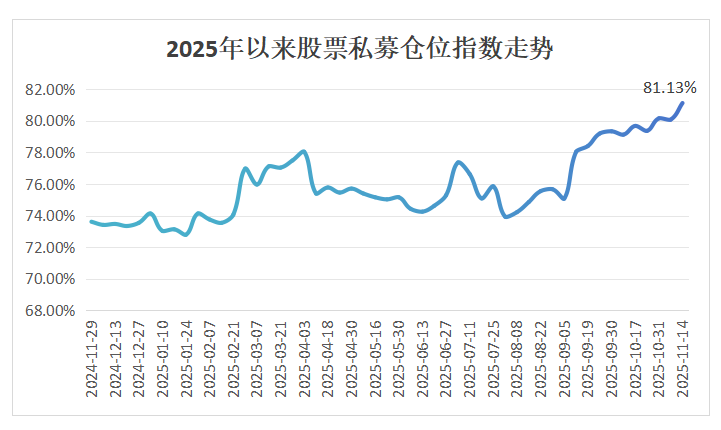
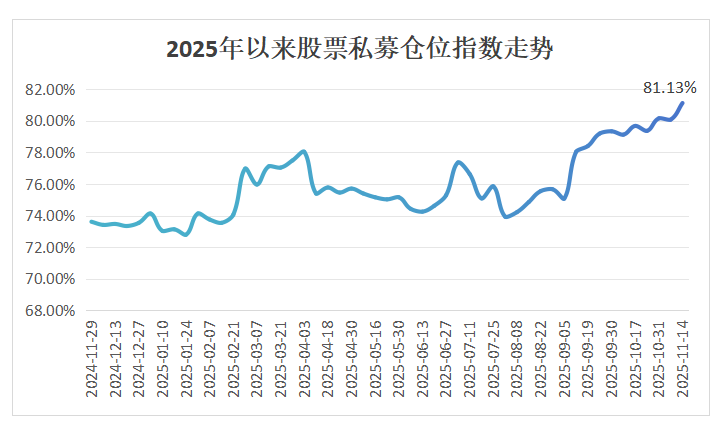
Core Insights - The stock private equity position index has reached a new high of 81.13% as of November 14, 2025, marking a significant increase of 1.05% from the previous week and achieving a peak not seen in 112 weeks [1] - The surge in the index is primarily driven by a concentration of medium-position private equity funds moving towards full positions, with full-position private equity funds now accounting for 65.9% [1] Position Structure - The breakdown of private equity positions shows that full-position private equity funds have increased significantly, while medium-position funds have decreased to 18.97%. Low and empty-position funds account for 10.37% and 4.76%, respectively [1] - As of November 14, 2025, the position indices for different scales of private equity funds are as follows: over 100 billion at 87.07%, 50-100 billion at 83.56%, 20-50 billion at 78.67%, 10-20 billion at 80.48%, 5-10 billion at 80.86%, and 0-5 billion at 80.09% [3] Market Dynamics - The increase in positions is attributed to the continuous upward trend in the A-share market since August, which has improved the performance of private equity products and provided confidence for institutions to increase their positions [6] - Policy support for the long-term healthy development of the capital market and the ongoing trend of asset allocation towards equity markets have further strengthened the consensus on the long-term value of A-shares [6] - Billion-level private equity funds are showing a more aggressive stance in increasing positions, with a notable rise in full positions to 73.41%, while medium-position funds have dropped to 18.47% [2][4]
百亿私募狂冲87%仓位,创185周新高
Guo Ji Jin Rong Bao· 2025-11-25 03:25
Core Insights - The stock private equity position index has reached a new high of 81.13% as of November 14, 2025, marking a significant increase of 1.05% from the previous week and achieving a peak not seen in 112 weeks [1] - The surge in the index is primarily driven by a concentration of medium-position private equity funds increasing their holdings, with full-position private equity now accounting for 65.9% [1] Group 1: Private Equity Position Statistics - As of November 14, 2025, the position index for different scales of stock private equity shows significant variation, with the following percentages: over 100 billion at 87.07%, 50-100 billion at 83.56%, 20-50 billion at 78.67%, 10-20 billion at 80.48%, 5-10 billion at 80.86%, and 0-5 billion at 80.09% [2][3] - The proportion of full-position private equity funds over 100 billion has increased to 73.41%, while the medium-position funds have decreased to 18.47% [2] Group 2: Market Dynamics and Trends - The continuous rise in private equity positions is attributed to the sustained upward trend in the A-share market since August, which has improved performance and provided confidence for institutional investors to increase their holdings [6] - Policy support for the long-term healthy development of the capital market and the ongoing trend of asset allocation towards equity markets have reinforced the consensus on the long-term value of A-shares [6] - Large private equity firms are leveraging their research capabilities in emerging industries like technology and innovative pharmaceuticals to capture structural opportunities, which has led to an overall increase in industry positions [6]
发行降温!权益类新基发行占比不足60%
Guo Ji Jin Rong Bao· 2025-11-25 03:25
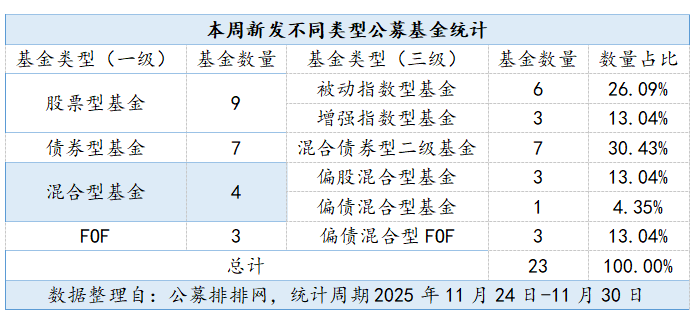
Group 1 - The core viewpoint of the article indicates a significant decline in the issuance of new public funds, with a 32.35% decrease in the number of new funds launched compared to the previous week, and an increase in the average subscription period to 23.65 days [1][3] - The total number of new funds launched this week is 23, with 12 being equity products, which is 52.17% of the total, marking a rare occurrence of being below 60% [3][4] - The bond fund issuance has shown a counter-trend recovery, with 7 new bond funds launched, maintaining the peak level of the past 11 weeks [3] Group 2 - The FOF (Fund of Funds) category has remained active, with 3 new FOF funds launched this week, marking the 8th consecutive week of new fund issuance, and the total number of new FOF funds this year has reached 76, more than double the total from last year [3][4] - The recent cooling in the fund issuance market is primarily attributed to the weak performance of the equity market, which has significantly dampened investor enthusiasm for equity assets [3][4] - Market volatility has weakened the risk appetite of investors, leading to a decrease in the willingness of public fund institutions to launch new equity products [4]
特朗普签署行政令:启动“创世纪计划”
Guo Ji Jin Rong Bao· 2025-11-25 00:57
Core Viewpoint - The U.S. government has launched a new national initiative called the "Genesis Project" aimed at transforming scientific research through artificial intelligence (AI) and accelerating scientific discoveries [1] Group 1: Initiative Overview - The initiative is initiated by an executive order signed by President Trump on November 24 [1] - The Department of Energy is tasked with creating an AI experimental platform that integrates U.S. supercomputers and unique data assets [1] - The goal is to generate scientific foundational models and support robotic laboratories [1] Group 2: Coordination and Collaboration - The executive order directs the Assistant to the President for Science and Technology (APST) to coordinate the national initiative [1] - It emphasizes the integration of data and infrastructure across various federal government departments [1] - Collaboration will occur between the Department of Energy, the APST, and private sector innovators, as well as academia [1]