Guo Ji Jin Rong Bao

Search documents
五大航司通知:涉日本机票可免费退改
Guo Ji Jin Rong Bao· 2025-11-15 14:02
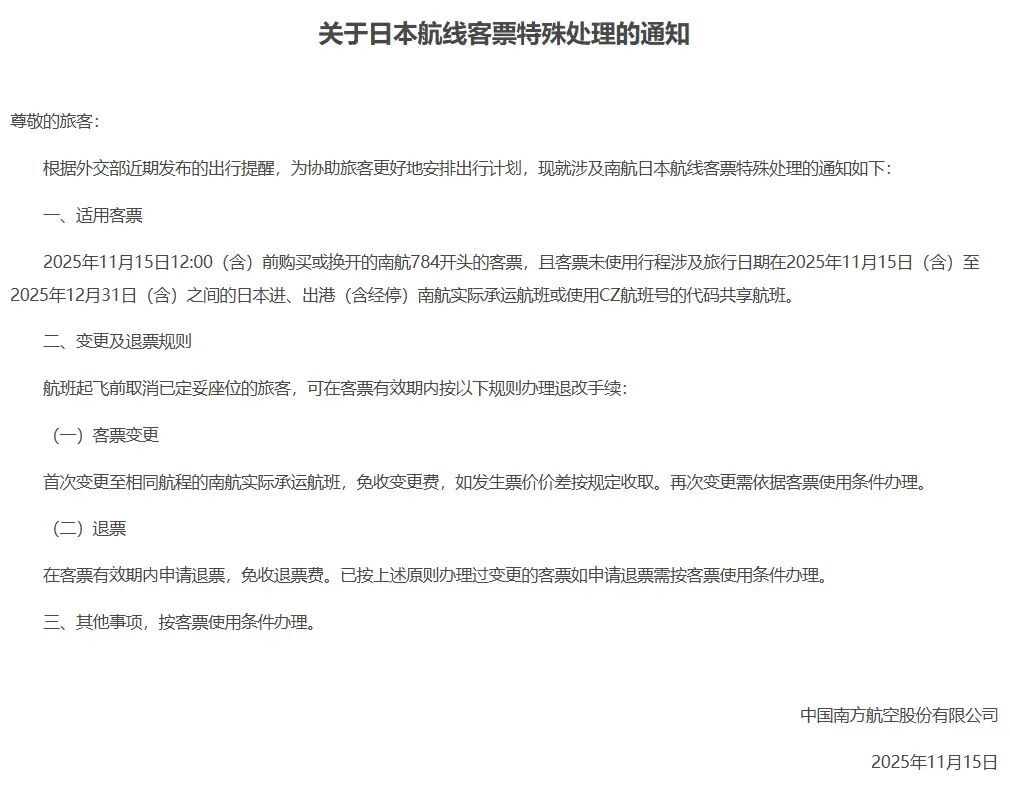
Group 1 - China Southern Airlines, Air China, and China Eastern Airlines have announced special handling procedures for tickets related to flights to Japan due to recent travel advisories from the Ministry of Foreign Affairs [1][29] - The applicable tickets for China Southern Airlines are those purchased or exchanged before November 15, 2025, with travel dates between November 15, 2025, and December 31, 2025, involving flights to and from Japan [2][3] - For ticket changes, China Southern Airlines allows the first change to the same itinerary without a fee, while subsequent changes will follow the ticket usage conditions [2][3] Group 2 - Air China's special handling applies to tickets purchased or exchanged before November 15, 2025, for flights to specific Japanese cities during the same travel window [7][8] - Air China offers a fee waiver for the first change of ticket, but additional fees may apply for fare differences [10][11] - The notification for Air China will take effect from November 15, 2025 [13] Group 3 - China Eastern Airlines has issued similar guidelines for tickets involving flights to various Japanese cities, with the same purchase and travel date conditions [16][18] - Changes to tickets with China Eastern Airlines can be made without a fee for the first change if it is within three days of the original flight [19][20] - The policy for China Eastern Airlines also emphasizes the need to cancel any pre-booked services before making changes [23] Group 4 - Hainan Airlines has set similar rules for tickets purchased before November 15, 2025, for flights to Japan, allowing for fee-free changes and cancellations under specific conditions [25] - Sichuan Airlines has also announced special handling for tickets issued before November 15, 2025, with similar rules for changes and cancellations [27] - All airlines emphasize the importance of adhering to the specified timelines for cancellations and changes to ensure compliance with the new policies [25][27]




金洽会“园区行”走进普陀,金融“智囊团”精准赋能
Guo Ji Jin Rong Bao· 2025-11-15 12:56
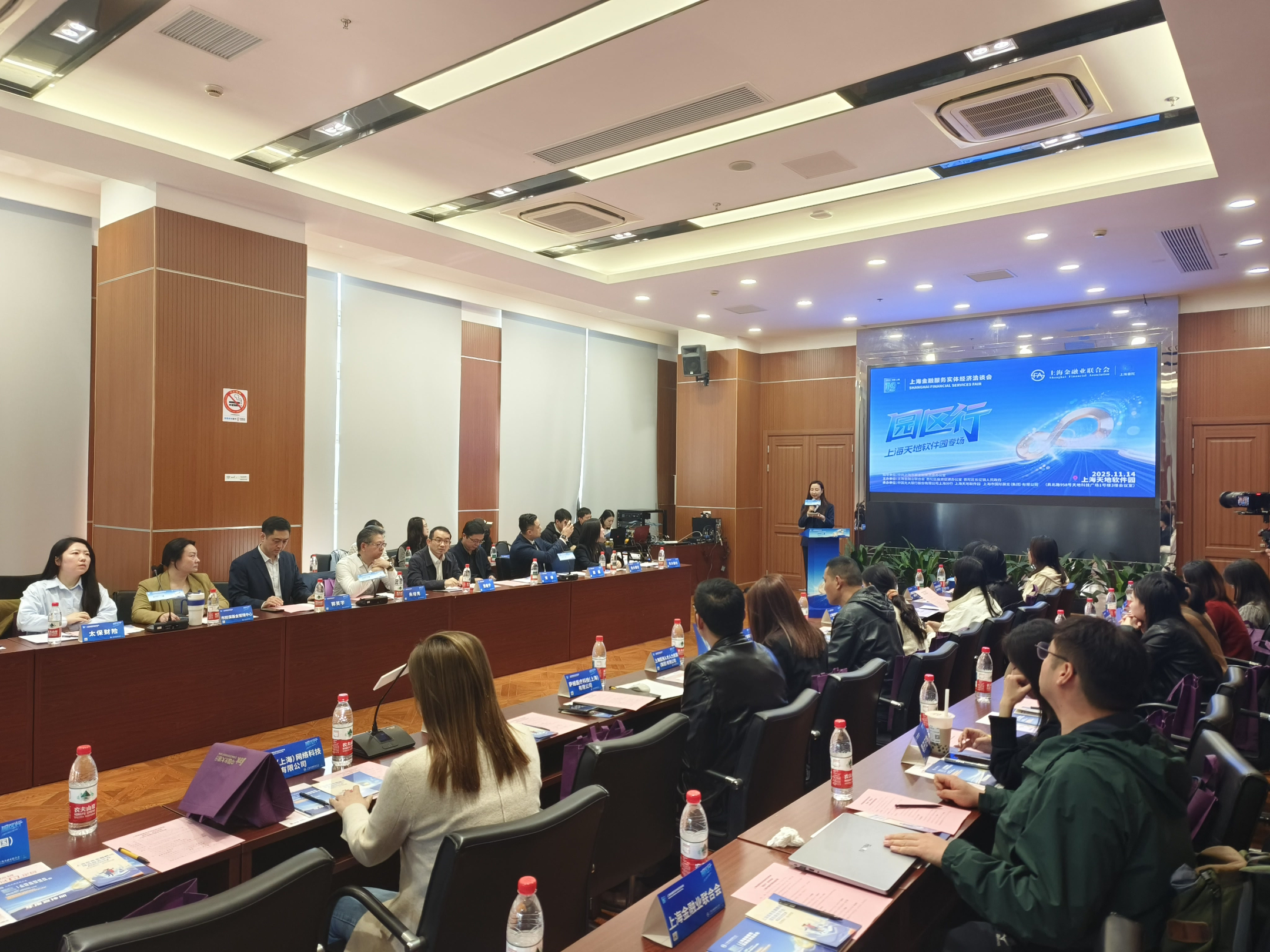
Core Insights - The 19th Golden Fair's "Park Tour" event at the Putuo Shanghai Tiandi Software Park successfully showcased the integration of financial resources with emerging industries, emphasizing the importance of financial empowerment for the real economy [1][3]. Group 1: Event Overview - The event is part of the Golden Fair's initiative to connect financial resources with new industrial parks and enhance service linkages [1]. - The Tiandi Software Park, established in 2004 by the Putuo District government, focuses on high-tech industries such as cultural creativity, software, and information services [3]. Group 2: Financial Support for SMEs - Representatives from companies like Shanghai Xinbaishi Intelligent Technology Co., Ltd. and SAYA Medical Technology (Shanghai) Co., Ltd. engaged in discussions about financing and financial support [3]. - Financial advisors from institutions such as the Municipal Guarantee Fund Management Center and Everbright Bank provided targeted and actionable solutions to common concerns of SMEs regarding financial support [3][4]. Group 3: Diverse Financial Services - Non-bank financial institutions offer a range of support services, including comprehensive risk protection from insurance companies and full-cycle financial services from securities firms [4]. - For SMEs listed on the New Third Board, securities firms can provide guidance for listing on the Beijing Stock Exchange and facilitate industry mergers and acquisitions [4]. Group 4: Future Initiatives - The Golden Fair, which began on September 29, will host over ten specialized "Park Tour" events by the end of the year, with an online exhibition running until September 2026 [4]. - The fair aims to enhance the quality of service by facilitating connections between financial institutions and real enterprises, reinforcing the commitment of Shanghai's financial sector to support the real economy [4].
关税大消息,39%降至15%!特朗普签署行政令:将部分农产品移出“对等关税”清单
Guo Ji Jin Rong Bao· 2025-11-15 01:27
Core Points - The U.S. White House announced an executive order signed by President Trump on November 14, adjusting the scope of "reciprocal tariffs" by excluding certain agricultural products from additional tariffs previously imposed under the "Reciprocal Tariff Executive Order" [1] - The executive order states that the adjustments are based on assessments of domestic product demand and capacity, as well as recommendations from government agencies, in response to the "national emergency" declared in the original order [1] - The updated tariff exemption list and potential adjustments for "allied partners" will take effect on November 13, 2025, at 12:01 AM Eastern Time [1] - The order also mandates modifications to the "U.S. Harmonized Tariff Schedule" and the processing of potential tariff refunds [1] - On the same day, the Swiss Federal Council announced a reduction in U.S. tariffs on Swiss products from 39% to 15% following trade negotiations [1] - The negotiations, led by Swiss Federal Councillor and Minister of Economic Affairs Parmelin, aimed to lower the current 39% import tariff on numerous Swiss goods, which has been in effect since August 7, 2025 [1]

“你倒!直接抓了!”开发商“碰瓷”业主?华润置地回应了
Guo Ji Jin Rong Bao· 2025-11-14 15:04
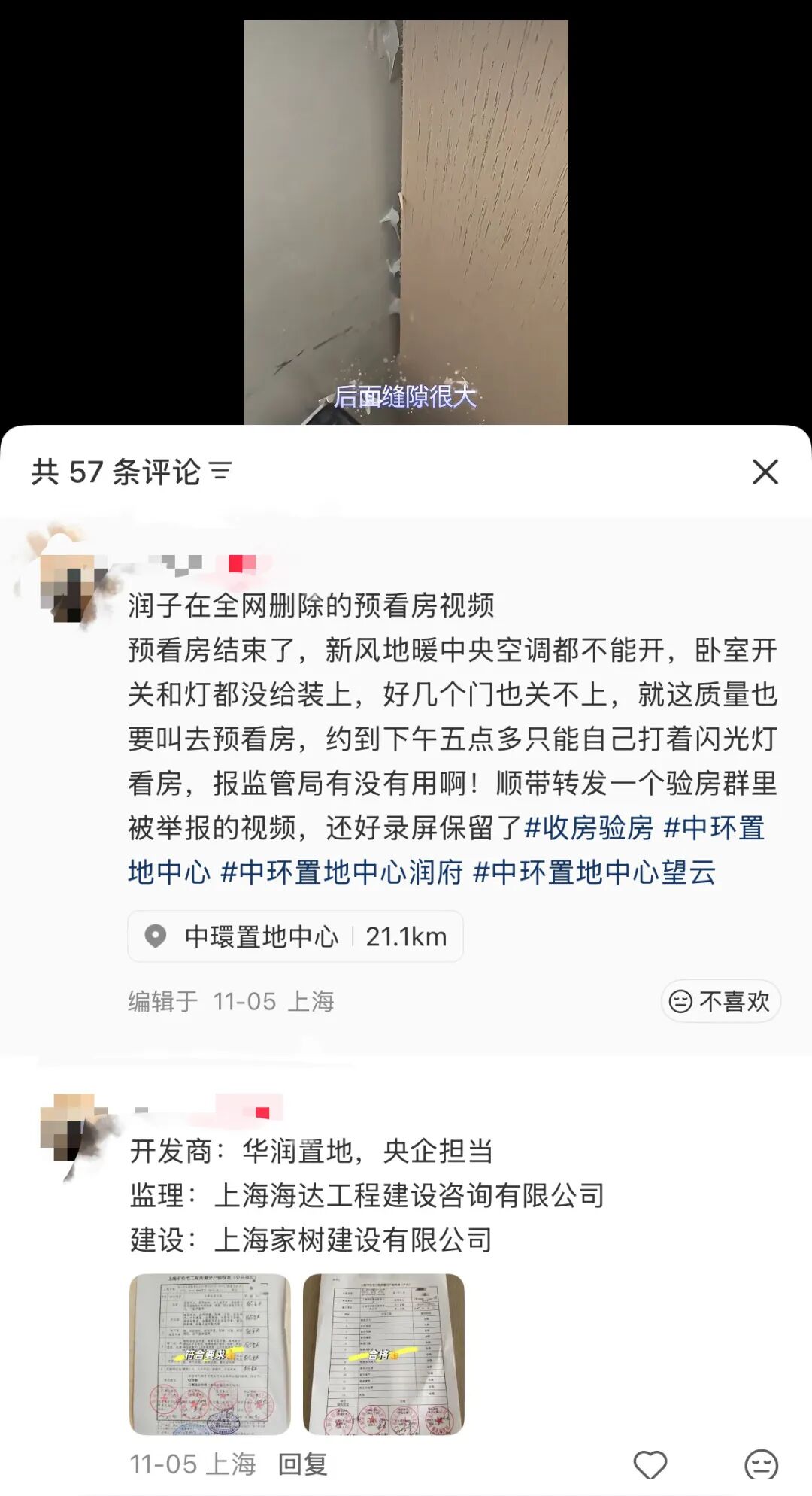
Core Viewpoint - The recent communication meeting between the developer China Resources Land and homeowners at the popular Shanghai project, Zhonghuan Zhidi Center, revealed serious concerns about quality issues, leading to allegations of the developer attempting to stage a conflict with homeowners [1][2]. Group 1: Developer's Response - Shanghai Runbo Real Estate Co., Ltd. stated that the project is still under construction and has not yet been delivered, emphasizing ongoing communication and supervision with homeowners [2]. - The company expressed that it takes the inappropriate comments made by individual employees seriously and has initiated strict criticism and education, promising a thorough investigation [2]. Group 2: Project Details - Zhonghuan Zhidi Center is a significant TOD project located in the southern Daban area of Baoshan District, Shanghai [2]. - In October 2023, China Resources Land acquired a plot in Baoshan District, quickly publicizing project plans for a shopping center, Grade A office space, and quality residential areas, positioning it as a benchmark project for the region [2]. - Since its initial launch in March of last year, the project has seen seven sales events, with total sales exceeding 10 billion, and over 1,300 units sold out [2]. - The average purchase price for homes during the communication meeting was approximately 70,000 yuan per square meter, with total prices ranging from 6 million to 14 million yuan [2]. Group 3: Homeowner Concerns - Homeowners have reported various issues with the project, including non-functional ventilation and heating systems, missing switches, doors that do not close properly, and problems with bathroom windows and control panels [2].

皓宸医疗:汇垠澳丰无实际控制人 上市公司亦无实际控制人
Guo Ji Jin Rong Bao· 2025-11-14 14:26
Core Viewpoint - The announcement from Haocen Medical indicates a change in control due to the termination of a cooperation agreement between Huyin Aofeng and Beijing Shoutuo Ronghui, resulting in no actual controller for the listed company [1] Group 1 - Huyin Aofeng, through Huyin Rifeng, indirectly controls 23.81% of the voting rights of the listed company [1] - Huyin Aofeng's shareholders have balanced shareholding ratios and no concerted action arrangements, leading to the absence of an actual controller [1] - The change in equity will not adversely affect the normal production and operation of the company [1]

推进工业互联网发展加速网络强国进程
Guo Ji Jin Rong Bao· 2025-11-14 14:25
Core Insights - The "Industrial Internet Innovation Development Project" is a key initiative in China's 15th Five-Year Plan, aiming to integrate industrialization and informatization to create internationally competitive digital industry clusters and accelerate the country's progress towards becoming a network power [1][12]. Industrial Internet Overview - The Industrial Internet serves as an intelligent carrier for massive industrial data collection, transmission, storage, computation, analysis, and application, driven by advancements in 5G, big data, and artificial intelligence [3][6]. - It consists of five main functional components: network, identification, platform, data, and security, with a focus on ubiquitous connectivity across various industrial entities [3][4]. Application and Value Creation - The Industrial Internet enables diverse and complex application scenarios, facilitating digital transformation across industries, with a collaborative development process that extends from leading enterprises to the entire supply chain [4][6]. - It reshapes business models and value creation methods, emphasizing collaborative value generation among platforms, customers, and service providers [4][6]. Impact on Production and Industry - The Industrial Internet is a cornerstone of the Fourth Industrial Revolution, transforming production modes from scale economies to range economies and enhancing the role of data as a core production factor [6][7]. - It optimizes production processes, improves supply chain intelligence, and enhances resource utilization efficiency, with significant economic spillover effects [8][9]. Technological Innovation and Ecosystem Development - The Industrial Internet accelerates technological innovation by providing vast data for AI and big data applications, fostering cross-domain collaborative research and development [9][10]. - In China, the initiative has seen the establishment of over 340 industrial internet platforms, connecting more than 100 million devices, and creating a robust infrastructure for its implementation [13][12]. Future Directions and Policy Support - The project requires strategic planning and policy guidance, with a focus on enhancing network infrastructure, advancing key technologies, and fostering a diverse industrial ecosystem [14][15][16]. - Emphasis is placed on cultivating market entities, supporting software development, and enhancing talent training to drive the growth of the "5G + Industrial Internet" sector [17][18][19].
私募年内平均收益超24%,量化多头大赚36.76%
Guo Ji Jin Rong Bao· 2025-11-14 13:53
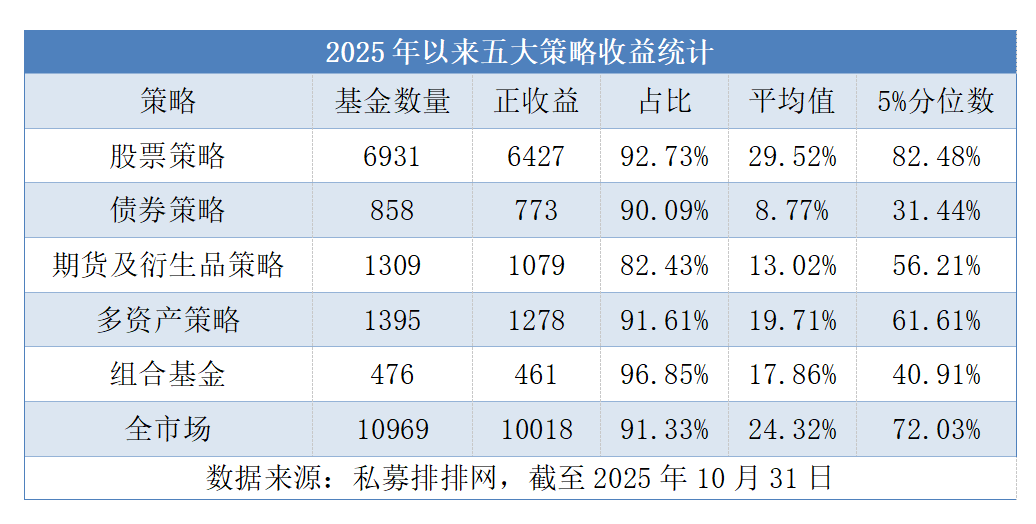
Core Insights - As of October 31, 2025, 91.33% of the 10,969 private equity funds achieved positive returns, with an average return rate of 24.32% [1][3] - The top 5% of funds yielded an impressive return of 72.03%, indicating a strong performance across the market [1][3] Strategy Performance - **Equity Strategy**: Leading with an average return of 29.52%, 92.73% of equity funds reported positive returns. Among 6,931 funds, 6,427 were profitable, with the top 5% achieving a return of 82.48% [1][3] - **Multi-Asset Strategy**: Ranked second with an average return of 19.71% and a positive return rate of 91.61%. This strategy effectively captured equity market gains while diversifying risks through bonds and commodities [1][3] - **Combination Funds**: Showed strong stability with 96.85% of funds in positive territory, although the average return of 17.86% was slightly lower than that of multi-asset strategies [1][3] - **Bond Strategy**: Maintained a conservative approach with an average return of 8.77%, but 90.09% of funds achieved positive returns, highlighting its risk-averse nature [2][3] - **Futures and Derivatives Strategy**: Experienced moderate performance with an average return of 13.02% and 82.43% of funds in positive territory, affected by volatile commodity prices [2][3] Sub-Strategy Insights - **Quantitative Long Strategy**: Emerged as the top performer within equity strategies, boasting an average return of 36.76% and a positive return rate of 96.52%, significantly outperforming subjective long strategies [3][5] - **Subjective Long Strategy**: Achieved a return of 29.72%, with a notable 5% percentile return of 86.45%, indicating strong performance in specific sectors like technology [4][5] - **Market Neutral and Long-Short Strategies**: Reported lower average returns of 9.22% and 18.29%, respectively, due to their hedging mechanisms limiting upside potential [4][5] Market Dynamics - The performance of quantitative strategies has been attributed to several factors, including rapid sector rotation in technology and high trading volumes in the A-share market, which support high-frequency trading [6]
年末静安高端消费“大秀”开场!品牌、商圈齐“整活”
Guo Ji Jin Rong Bao· 2025-11-14 13:48
Core Insights - The article highlights the revitalization of high-end consumption in Jing'an District, driven by innovative events and collaborations among brands, shopping malls, and the local government [1][3][10] Brand Resonance - The "Louis Vuitton Extraordinary Journey" and "HOME TO LUXURY" events exemplify successful brand collaborations, showcasing numerous luxury brands and launching hundreds of new and limited-edition products, creating a synergistic effect among brands [5][11] - The strategy includes attracting younger consumers by integrating trendy brands and local high-end offerings, leading to steady sales growth at key venues like Hang Lung Plaza [5][11] Shopping Mall Collaboration - The district's efforts to enhance commercial synergy include the development of the "Nanjing West Road Fashion Consumption Corridor," promoting complementary functions among various commercial entities [7][11] - Events like "Jing'an Fashion Consumption Season" and the introduction of new retail concepts have contributed to a vibrant shopping atmosphere, with extended operating hours and themed markets enhancing consumer engagement [7][8] Market Vitality through Business Model Innovation - Jing'an District is transitioning from short-term promotional activities to a sustainable consumption ecosystem, focusing on integrating "first-release economy" and "experience economy" [10][11] - The district's approach emphasizes the importance of a resilient commercial environment, with high-end consumption showing consistent growth despite market pressures [11][12] Mechanism Innovation and Ecosystem Building - The successful model in Jing'an is characterized by a collaborative mechanism involving government support, joint efforts among commercial entities, and mutual benefits for brands [11][12] - The district's strategy fosters deep trust and shared goals among stakeholders, enhancing the overall competitiveness of the commercial landscape [11][12]


“你倒!直接抓了!”开发商“碰瓷”业主?华润置地回应了.......
Guo Ji Jin Rong Bao· 2025-11-14 13:44
Core Viewpoint - A recent incident involving China Resources Land's property project in Shanghai has raised concerns among homeowners regarding quality issues and alleged misconduct by the developer during a communication meeting [2][3]. Group 1: Incident Overview - Homeowners at the "Zhonghuan Zhidi Center·Runfu" project expressed concerns about quality issues during a preview event, leading to a communication meeting with the developer on November 12 [2]. - During the meeting, a conversation was leaked where a customer service employee appeared to receive instructions to stage a conflict with homeowners, which caused outrage among the attendees [2]. - Although there was a reported altercation, the situation was eventually calmed down without escalating into a more serious conflict [2]. Group 2: Developer's Response - Shanghai Runbo Real Estate Co., Ltd., the project company, stated that the project is still under construction and has not yet been delivered, emphasizing their commitment to maintaining communication and quality standards [3]. - The company acknowledged the inappropriate comments made by some employees and indicated that they would conduct a serious investigation into the matter [3]. Group 3: Project Details - The "Zhonghuan Zhidi Center·Runfu" is a significant TOD project located in the southern area of Baoshan District, Shanghai, and was recently acquired by China Resources Land [3]. - Since its initial launch in March of last year, the project has seen over 100 billion in sales, with more than 1,300 units sold by October [3]. - The average price for homes in the project is approximately 70,000 yuan per square meter, with total prices ranging from 6 million to 14 million yuan [3].
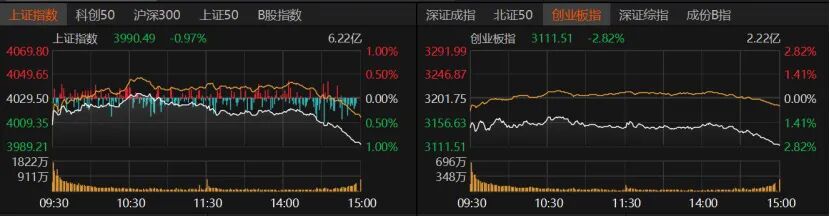
A股下周能上攻吗?
Guo Ji Jin Rong Bao· 2025-11-14 13:40
Core Viewpoint - The A-share market experienced a significant pullback on November 14, with major indices declining and trading volume dropping below 2 trillion yuan, indicating a clear profit-taking effect among investors [1][2][9]. Market Performance - The Shanghai Composite Index fell nearly 1%, closing below the 4000-point mark, while the ChiNext Index and other innovation indices dropped nearly 3% [1][2]. - Only 1961 stocks rose, highlighting the widespread losses in the market [1]. Sector Performance - Technology stocks were the primary targets of selling, with significant declines in sectors such as AI chips, storage chips, and communication equipment [4][10]. - The Eastmoney concept index and various industry indices showed declines, with the semiconductor sector down by 4.91% and communication equipment down by 3.61% [3]. Trading Volume and Leverage - The trading volume for the day fell to 1.98 trillion yuan, reflecting a decrease in market activity [2]. - Margin trading balances increased to 2.51 trillion yuan as of November 13, indicating continued leverage in the market despite the pullback [2]. Investor Sentiment and Market Dynamics - Analysts suggest that the current market adjustment is a normal "washout" process rather than a trend reversal, with short-term pullbacks seen as opportunities for re-entry [1][11]. - The pullback is attributed to profit-taking by investors, particularly in the technology sector, following a period of strong performance [9][10]. Future Outlook - Analysts expect the A-share market to remain in a consolidation phase, with support around the 3950 to 4000-point range [13][14]. - There is a focus on identifying strong stocks within the technology sector that have solid fundamentals and align with national development strategies, such as AI and semiconductor industries [12][15].