
进口关税

Search documents
罗氏董事长:仍预计诊断产品将受到美国关税的冲击
Xin Lang Cai Jing· 2026-03-07 14:06
Core Viewpoint - Roche expects its agreement with the U.S. government to exempt its pharmaceuticals from current import tariffs, but its diagnostics division may face risks of new tariffs after the initial 150-day period [1][5]. Group 1: Agreement with U.S. Government - Roche is one of nine major pharmaceutical companies that reached an agreement with President Trump in December to lower drug prices in exchange for a three-year suspension of tariff threats [1][5]. - The company believes the agreement is binding and will continue to be exempt from drug import tariffs [1][5]. Group 2: Diagnostics Division Impact - The diagnostics division is projected to generate nearly 14 billion Swiss francs in sales by 2025, with most tests and instruments exported from Switzerland and other European countries to the U.S. [1][5]. - Roche also produces diagnostic products in the U.S. [2][6]. Group 3: Future Tariff Risks - After the 150-day tariff period, the company anticipates that the U.S. government may impose import tariffs again based on different legal grounds [3][7]. - Roche has no plans to split its diagnostics division, stating that it is not a topic of discussion and the company will continue to maintain it [4][8].

罗氏董事长仍预计诊断产品将受到美国关税的冲击
Xin Lang Cai Jing· 2026-03-07 09:37
Core Viewpoint - Roche Group anticipates that its agreement with the U.S. government will protect its pharmaceuticals from the current round of import tariffs, but its diagnostics division may still face risks after the initial 150-day period due to potential new tariffs [1] Group 1 - Roche's diagnostics division is projected to generate sales close to 14 billion Swiss francs in 2025 [1] - A significant portion of Roche's tests and instruments are exported to the U.S. from Switzerland and other European countries [1]
白宫公布10%临时进口关税细则 特朗普暗示违法关税不予退还
Zhong Guo Qi Che Bao Wang· 2026-02-25 09:34
Core Viewpoint - The U.S. government is implementing a temporary 10% import tariff on global goods for 150 days, replacing a previously deemed illegal tariff measure, following a Supreme Court ruling that found the prior tariffs lacked legal authority [1] Group 1: Tariff Implementation - President Trump announced the signing of an executive order to impose a 10% temporary import tariff on global goods [1] - The new tariff will be in effect for 150 days and aims to address international payment issues [1] - The total amount involved in the previously illegal tariffs exceeded $175 billion [1] Group 2: Legal Context - The U.S. Supreme Court ruled that the tariffs imposed under the International Emergency Economic Powers Act were illegal due to lack of legal authorization [1] - Trump criticized the Supreme Court's decision as "flawed" and indicated that previously collected illegal tariffs would not be refunded, suggesting potential litigation could last 2 to 5 years [1] Group 3: International Response - The Chairman of the European Parliament's International Trade Committee, Bernd Lange, stated that the Supreme Court's ruling has created a legal barrier, potentially ending the era of unrestricted and arbitrary tariff imposition by the President [1]
国际新闻早知道丨特朗普称“全球进口关税”将提高至15% 日元购买力创新低
Xin Lang Cai Jing· 2026-02-21 23:22
Group 1 - President Trump announced an increase in the "global import tariff" from 10% to 15% on goods imported into the United States [2][5][3] - Hundreds of companies, including major retailers like Costco, have filed lawsuits seeking refunds for payments made under tariffs deemed "excessive" by the U.S. Supreme Court [5][7] - German Chancellor Merz plans to coordinate the EU's stance before discussing U.S. tariff policies with President Trump [7] Group 2 - The Japanese yen's purchasing power has reached a record low, with the effective exchange rate index hitting a 53-year low due to prolonged economic stagnation [13] - Iran has designated the naval and air forces of all EU countries as "terrorist organizations" in response to the EU's classification of Iran's Islamic Revolutionary Guard Corps [7] - Ukrainian President Zelensky signed a decree imposing sanctions on Russia's "shadow fleet" and military enterprises, targeting 225 individuals involved in the export of Russian oil products [9]

最新!关税政策被判违法后,特朗普称:将加征10%全球进口关税
Sou Hu Cai Jing· 2026-02-21 03:50
Core Viewpoint - President Trump announced a new 10% import tariff on global goods for 150 days, replacing previously deemed illegal emergency tariffs by the U.S. Supreme Court [1][3] Group 1: Tariff Announcement - The new tariff will be implemented through an executive order based on Section 122 of the Trade Act of 1974 [3] - This tariff can only last for 150 days unless Congress approves an extension [3] Group 2: Legal Context - The Supreme Court ruled that the International Emergency Economic Powers Act does not authorize the President to impose large-scale tariffs, marking a significant setback for the Trump administration's tariff policy [3] - Trump indicated that the ruling could lead to prolonged legal battles regarding the potential refund of billions in tariffs to U.S. businesses, which may take up to five years to resolve [3] Group 3: Future Trade Actions - The Trump administration plans to initiate investigations into "unfair trade practices" under Section 301 of the Trade Act of 1974 to protect the U.S. from unfair trade actions by other countries and companies [3] - All tariffs imposed under the guise of "national security" and those under the Trade Expansion Act of 1962 and Section 301 of the Trade Act of 1974 will remain in effect [3]
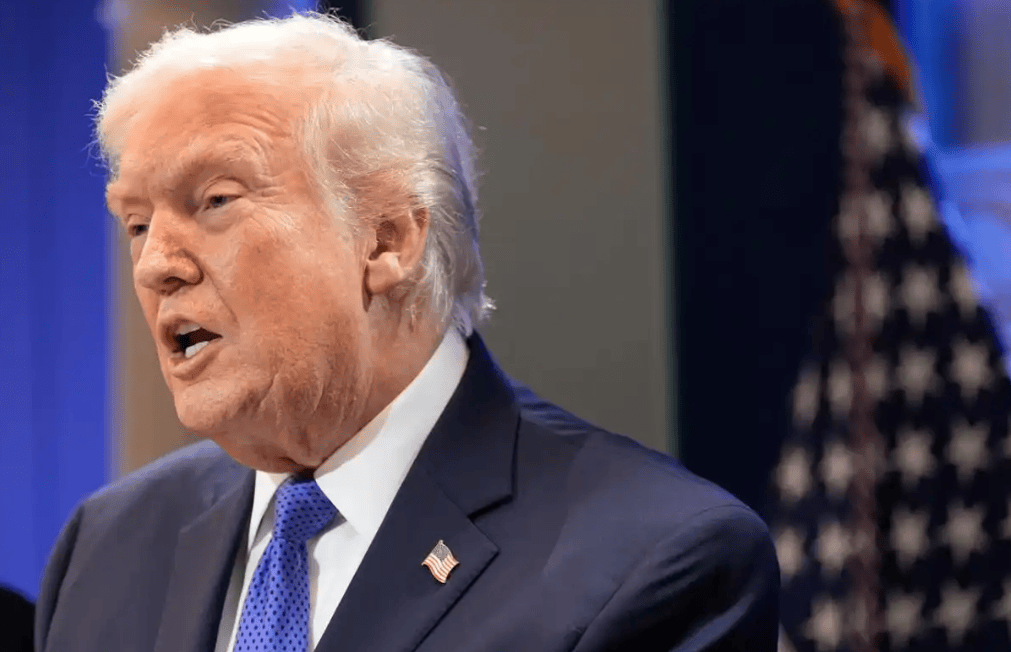
特朗普宣布签署行政令加征10%全球进口关税
Xin Hua Cai Jing· 2026-02-21 00:28
Core Viewpoint - The article reports that U.S. President Trump has signed an executive order imposing a 10% global tariff on all countries, which will take effect almost immediately [1] Group 1 - The executive order was announced via social media by President Trump [1] - The global tariff rate is set at 10% [1] - The implementation of the tariff is described as "almost immediate" [1]
特朗普回应1750亿美元关税收入是否退还
Xin Lang Cai Jing· 2026-02-20 23:49
Core Viewpoint - The article discusses President Trump's announcement of a new executive order to impose a 10% import tariff on global goods, replacing previously illegal tariffs identified by the Supreme Court [1] Group 1: Tariff Changes - President Trump plans to sign an executive order to impose a 10% import tariff on global goods [1] - This new tariff is intended to replace the large-scale tariffs that were deemed illegal by the U.S. Supreme Court [1] Group 2: Supreme Court Ruling - Trump criticized the Supreme Court's ruling as flawed, stating it prevents him from collecting even $1 in tariffs under the International Emergency Economic Powers Act [1] - He expressed frustration that while he cannot impose tariffs, he is allowed to sever all trade relations with a country or implement devastating sanctions [1] Group 3: Legal Implications - Trump suggested that the issue regarding the approximately $175 billion in tariff revenue could lead to legal battles for the next two to five years [1] - He did not clarify whether the revenue from the previous tariffs would be retained or returned [1]
关税压力与电车弱需双重打击 本田汽车(HMC.US)Q3营业利润猛降61%不及预期
Zhi Tong Cai Jing· 2026-02-10 08:08
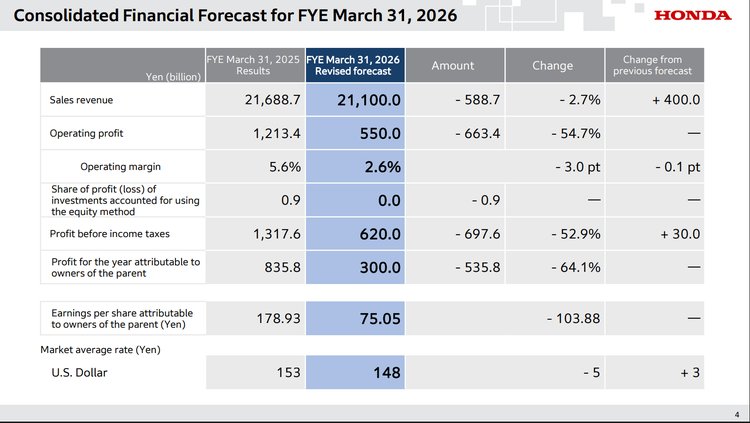
Core Insights - Honda Motor Co. reported a 61.4% year-on-year decline in operating profit for Q3, marking the fourth consecutive quarter of decline, primarily due to U.S. import tariffs and weak electric vehicle demand [1] - The company's Q3 operating profit was 153.4 billion yen (approximately $987.07 million), falling short of analysts' expectations of 174.5 billion yen [1] - Honda maintained its operating profit guidance for the fiscal year ending March 2026 at 550 billion yen, significantly lower than the previous fiscal year's 1.21 trillion yen [1] Financial Performance - Q3 revenue decreased by 3.4% to 5.34 trillion yen [1] - For the fiscal year ending March 31, 2026, Honda revised its sales revenue forecast to 21.1 trillion yen, a decrease of 588.7 billion yen or 2.7% from the previous forecast [2] - Operating profit for the same fiscal year is projected at 550 billion yen, down 663.4 billion yen or 54.7% from the previous year [2] Market Dynamics - Honda's automotive business has faced challenges, including weak sales and high tariffs in the U.S., along with increasing competition from China [1] - Despite these challenges, strong demand for hybrid vehicles and profitable motorcycle operations have somewhat mitigated the decline [1] - The company expects a total sales revenue of 21.1 trillion yen for the year, an increase from the earlier estimate of 20.7 trillion yen [1]

Toyota supplier Denso slashes full-year operating profit forecast on higher costs
Reuters· 2026-02-03 02:30
Core Viewpoint - Denso, a significant auto parts supplier to Toyota, has reduced its full-year operating profit forecast by nearly 20% primarily due to U.S. import tariffs and increasing material costs [1] Company Summary - Denso has cut its operating profit forecast for the full year by almost 20% [1] - The reduction in profit forecast is attributed mainly to the impact of U.S. import tariffs [1] - Rising material costs have also contributed to the downward revision of the profit outlook [1] Industry Summary - The auto parts industry is facing challenges from U.S. import tariffs, which are affecting profit margins [1] - Increasing material costs are a significant concern for suppliers in the automotive sector [1]

伦敦期铜区间震荡,美国铜库存攀升至纪录高位
Wen Hua Cai Jing· 2026-01-22 05:31
Group 1 - The core viewpoint of the article highlights the fluctuations in copper prices and the significant increase in copper inventory at the COMEX, driven by concerns over potential import tariffs and supply disruptions [1][3][6] Group 2 - As of January 20, COMEX copper inventory reached 554,904 short tons (approximately 50.34 million tons), marking a 1.3% increase from January 16 [3] - LME three-month copper prices rose by 0.2% to $12,833 per ton, while the Shanghai copper futures contract (2603) closed up by 120 yuan, or 0.12%, at 100,540 yuan per ton [1][2] - Analysts from Sucden Financials noted that the rising LME copper prices have led to a shift in the market dynamics, with supply and demand moving towards a more balanced state, reducing the urgency for price increases [5] - Other base metals also experienced price changes, with Shanghai aluminum, zinc, nickel, and tin contracts showing slight increases, while lead prices declined [6]