
Huan Qiu Wang Zi Xun

Search documents
首次实施!我国这一技术取得新突破
Huan Qiu Wang Zi Xun· 2025-11-15 13:50
Core Viewpoint - The successful landing of the Shenzhou-21 manned spacecraft marks a significant advancement in China's re-entry and return technology, achieving a new level of system reliability with a reduced return time of over 3 hours compared to previous missions [1] Group 1: Re-entry Control - The re-entry control of the spacecraft is managed by the Guidance, Navigation, and Control (GNC) system, which acts as the "intelligent driver" for the spacecraft, overseeing the entire flight control process from launch to return [2] - The re-entry control involves two main aspects: orbital departure control and atmospheric re-entry control, with the latter focusing on lift control within the atmosphere [2] Group 2: Transition from 5 Orbits to 3 Orbits - The transition from a 5-orbit to a 3-orbit return strategy was designed to enhance the efficiency and emergency response capabilities of the Shenzhou spacecraft, with the key change being the shift from ground-based to onboard computer calculations for departure control parameters [3] - Multiple rounds of verification and recalculation were conducted to ensure the accuracy of the onboard calculations, confirming the feasibility of the new return strategy [3] Group 3: Significance of 3-Orbit Autonomous Quick Return - The implementation of the 3-orbit autonomous quick return significantly improves the spacecraft's ability to handle major faults during autonomous flight and docking phases, demonstrating the stability and reliability of China's re-entry technology [4] - The evolution of re-entry technology from the standard ballistic adaptive guidance of Shenzhou-1 to the adaptive predictive guidance of Shenzhou-12, culminating in the 3-orbit quick return of Shenzhou-21, showcases over 30 years of unique development in this field [4]
苹果“天价袜子”上架即售罄!1299元起售,除了贵还有啥?
Huan Qiu Wang Zi Xun· 2025-11-15 11:27
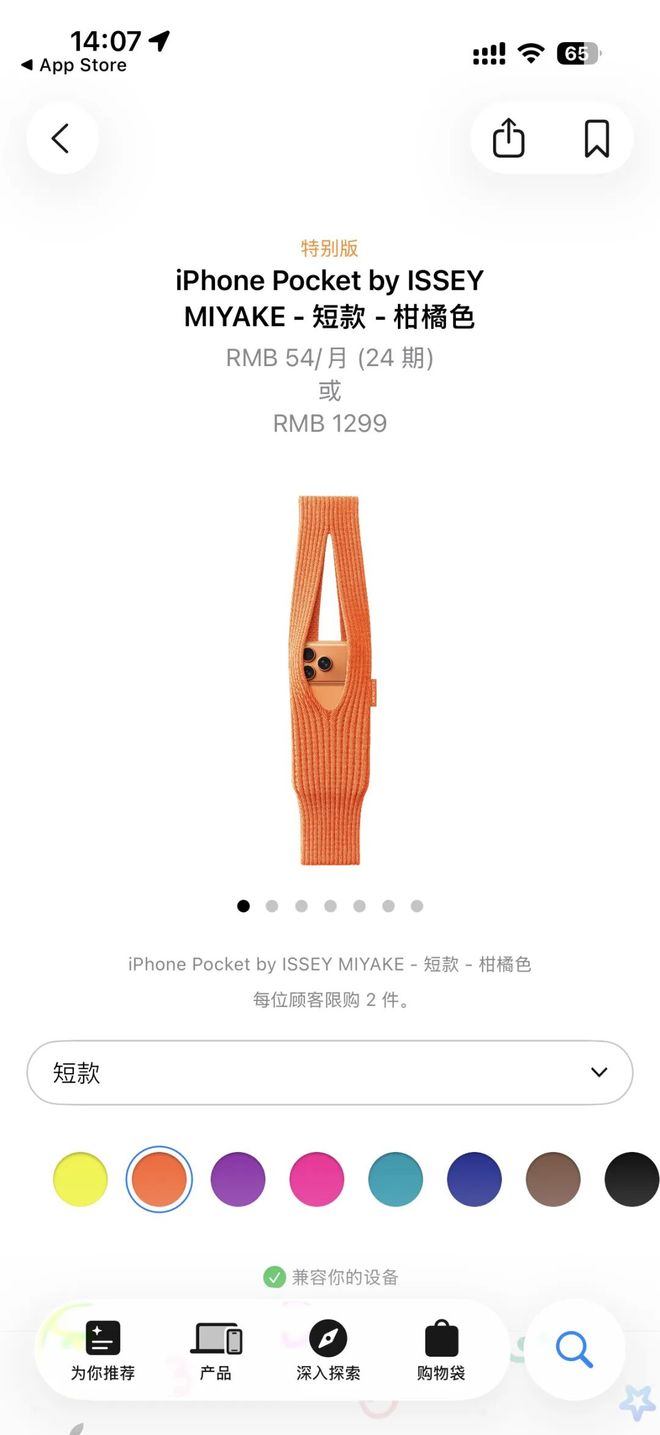
Core Viewpoint - Apple has launched the iPhone Pocket in collaboration with Japanese fashion brand Issey Miyake, which quickly sold out, sparking market discussions about its pricing and design [1][3]. Group 1: Product Details - The iPhone Pocket weighs only 38 grams and is available in eight fashionable colors, utilizing a 3D knitted one-piece technology inspired by Issey Miyake's "one piece of cloth" concept [3]. - The product is priced at 1,299 yuan for the short version and 1,899 yuan for the long version, leading to a rapid sell-out on the release day [1]. Group 2: Market Reaction - On second-hand platforms, the iPhone Pocket has seen a price premium of up to 500 yuan, particularly for the cinnamon-colored long version, while e-commerce platforms have introduced cheaper alternatives priced between 20 to 80 yuan [7]. - Social media has seen a surge in DIY trends, with users creatively replicating the design using socks and yarn, humorously critiquing the original product [7]. Group 3: Pricing Strategy and Brand Loyalty - The pricing strategy of the iPhone Pocket focuses on "form, brand, and uniqueness" rather than functionality, indicating Apple's testing of brand loyalty limits among consumers [9]. - Apple's history of high-priced accessories, such as the iPod Socks and Hermes Apple Watch bands, shows a trend of expanding the price boundaries of accessory products, often leading to these items becoming collectibles post-discontinuation [9][10]. - The phenomenon of high-priced ordinary products in the luxury sector is noted, with examples from other luxury brands, suggesting that Apple's strategy transcends mere accessory functionality to enhance brand premium [9]. Group 4: Consumer Behavior and Future Considerations - Despite ongoing controversies, the immediate market performance with price premiums indicates a significant consumer willingness to pay for design, brand, and sentiment [10]. - However, the potential for consumer fatigue and the risk of overextending brand loyalty due to high pricing of similar products remain long-term challenges for Apple [10].


为什么北京也能看到极光?专家解答
Huan Qiu Wang Zi Xun· 2025-11-15 10:02
Core Viewpoint - A rare aurora phenomenon has been observed in several northern regions of China, including Beijing and Inner Mongolia, attributed to recent coronal mass ejections causing geomagnetic storms [1] Group 1: Aurora Phenomenon - The aurora has been reported in northern areas such as Heilongjiang, Inner Mongolia, and Xinjiang, with opportunities to witness it continuing until November 15 [1] - Experts explain that the visibility of auroras in Beijing is due to its relatively northern location and lower light pollution [1] Group 2: Solar Activity - The current solar activity cycle is expected to peak in 2024 and 2025, increasing the likelihood of auroras during this period [1] - The geomagnetic storms resulting from coronal mass ejections are the primary cause of the auroras being visible in regions not typically known for such phenomena [1]
联播一瞬丨“太空出差”203天 神舟二十号航天员乘组做了啥?
Huan Qiu Wang Zi Xun· 2025-11-15 09:28
Core Points - The Shenzhou-20 astronaut crew has successfully completed 4 extravehicular activities and 7 payload operations, contributing to research in space life sciences, microgravity fundamental physics, and space materials science [1] - The crew has achieved significant results in their research and has successfully maintained the health of the space station's zebrafish and vegetable garden [1]
快闪店呈现体验式触达 亚马逊海外购开启黑五线下新实验
Huan Qiu Wang Zi Xun· 2025-11-15 07:56
Core Insights - Amazon Global Store has launched its Black Friday global shopping season in Shanghai, marking a significant step in its localization strategy in China [1] - The introduction of a pop-up store aims to enhance consumer engagement through experiential marketing, reflecting a shift from online shopping to interactive brand experiences [2][4] Group 1: Localization Strategy - The pop-up store's location in Shanghai is strategic, as the city is a trendsetter for consumer behavior and a hub for young, globalized lifestyles [2] - The store features four themed areas focusing on outdoor living, home care, kitchen products, and trendy toys, showcasing international brands with strong design and reputation [2] - Interactive elements like discount discovery zones and social sharing opportunities are designed to foster emotional connections between consumers and brands [2][4] Group 2: Operational Model - The pop-up store does not sell products directly but uses QR codes to guide customers to the Amazon shopping app for purchases, emphasizing a synergy between offline engagement and online conversion [4] - The focus of the offline experience is on building trust with consumers rather than immediate sales, as providing comprehensive product information and after-sales service is crucial for cross-border shopping decisions [4] Group 3: Consumer Trends and Service Upgrades - There is a structural shift in Chinese consumers' preferences, moving from price sensitivity to value recognition, with a focus on products that match personal interests and usage scenarios [6] - The introduction of the "Black Friday Price" mechanism aims to simplify the purchasing process by integrating cross-border taxes, shipping fees, and discounts into a clear final price [6] - The logistics system is being enhanced, with the expansion of the Ningbo bonded warehouse and improved delivery times, aiming for "fastest 2-day delivery" for popular categories [6] Group 4: Competitive Strategy - Amazon Global Store emphasizes its global selection capability and service quality to differentiate itself in the competitive Chinese e-commerce market [7] - The company leverages social media and automation tools to identify potential brands and respond to consumer trends, enhancing its product offerings [7] - The focus is on building long-term consumer trust through reliable service and product transparency, rather than just short-term sales [7]

苹果重拳出击:App Store新规严打山寨应用,严重者将永久移出苹果开发者计划
Huan Qiu Wang Zi Xun· 2025-11-15 05:18
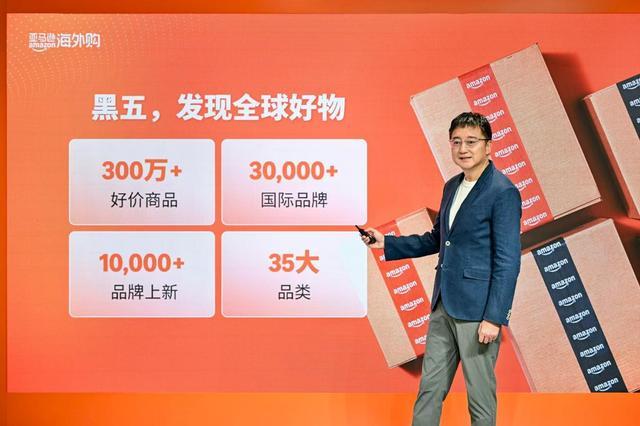
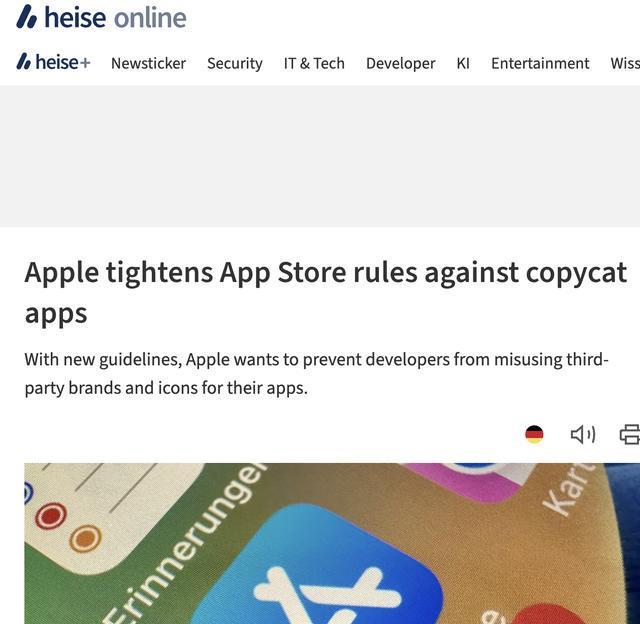
Core Points - Apple has updated its App Store Review Guidelines to combat plagiarism and counterfeit applications, emphasizing intellectual property protection and stricter regulations on loan applications, AI data sharing, and content management for minors [1][5] Group 1: Policy Changes - The update includes nine revised clauses aimed at enhancing platform ecosystem health and user rights [5] - Apple reinforces its anti-plagiarism policy, mandating developers to create original content and prohibiting any form of imitation or impersonation [5] Group 2: Enforcement and Background - Violators of the new guidelines face risks of app removal and potential permanent expulsion from the Apple Developer Program [5] - The tightening of policies is likely in response to a surge of counterfeit applications in October, particularly following the release of OpenAI's Sora-2 app, which saw many imitation apps emerge [5]
中国研究团队开发出新型AI医疗诊断系统
Huan Qiu Wang Zi Xun· 2025-11-15 05:18
资料显示,胸片是临床常用的影像学检查手段之一,但人工判读耗时且依赖专家经验。传统AI系统在 一些任务上能够媲美专家,却依赖大量人工标注数据,难以应对新发疾病或不同医院之间的数据差异, 导致模型泛化能力有限,无法满足复杂临床环境下精准诊断的需求。 据悉,该研究团队提出了多模态双流协同增强的新思路,构建了无需额外标注数据即可实现零样本高精 度诊断的胸片智能分析系统。该系统能够同时处理图像与文字信息,并利用大语言模型和放射科专家知 识优化病灶描述,实现图像与语言的深度融合。这一成果让AI在未见疾病中也能"看懂"胸片,其思考逻 辑更趋近于专业医生的水平。 【环球网科技综合报道】11月15日消息,据《Information Processing and Management》报道,中国科学 院合肥物质科学研究院研究团队于近日开发出新型AI医疗诊断系统MultiXpert。该系统能够在"零样 本"条件下对胸片进行智能诊断,无需任何标注数据,甚至可识别出从未见过的疾病,使AI具备更接近 医生诊断思维的能力。 来源:环球网 在图像分支中,通过引入病灶感知掩码机制,MultiXpert能够在无显式标注情况下提升对潜在病灶的特 ...

车企购置税补贴成标配,年底车市“翘尾”行情预期降温
Huan Qiu Wang Zi Xun· 2025-11-15 03:57
来源:环球网 【环球网消费综合报道】随着新能源汽车购置税减免政策进入退坡倒计时,市场迎来了新的变化。自9 月以来,理想、蔚来、极氪等十余家主流新能源车企陆续推出购置税兜底政策,承诺在今年底前锁单的 消费者,即便车辆在明年交付,也能享受2025年的免税待遇,差额部分由车企承担。这一普遍性的市场 行为,在为消费者提供保障的同时,也使得业内对年底传统"翘尾"行情的预期趋于谨慎。 根据相关政策,2025年是免征新能源汽车购置税的最后一年,2026年和2027年将减半征收。这意味着, 明年购买一辆20万元左右的新能源车,消费者将额外承担近万元的购置税。面对政策变化可能带来的成 本上升,车企主动承担了这部分差额,以维持市场吸引力。这些兜底政策大多以11月底或12月底为锁单 截止日期,补贴上限普遍为1.5万元,部分品牌如长安启源和小米汽车甚至覆盖全系车型,显示出企业 稳定市场预期的决心。 东方IC 新能源车普遍存在的"期车"销售模式,进一步平滑了年底的销量波动。许多热门车型的交付周期长达数 月,这意味着,即便消费者在11月锁单,车辆交付也要等到明年,销量自然被计入明年数据,无法对今 年的车市形成集中式的拉动效应。 从更深层 ...

互联网平台反垄断合规指引发布,八大场景成监管焦点
Huan Qiu Wang Zi Xun· 2025-11-15 03:50
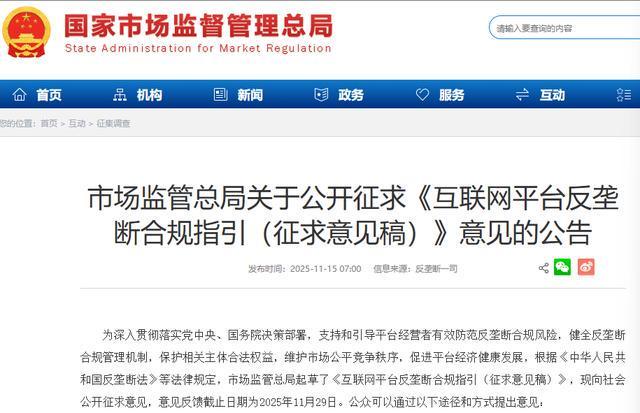
Core Viewpoint - The article discusses the release of the "Antitrust Compliance Guidelines for Internet Platforms (Draft for Comments)" by the State Administration for Market Regulation, aimed at addressing new monopolistic risks in the platform economy and providing clear compliance pathways for platform operators [1][4]. Summary by Sections Introduction of Guidelines - The guidelines are a significant regulatory document in China's platform economy, focusing on problem-oriented approaches to new monopolistic risks [1][4]. High-Risk Scenarios - The guidelines identify eight high-risk scenarios, including algorithm collusion, unfair pricing, and discriminatory treatment, which cover critical aspects of platform operations such as data transmission and service pricing [3][4]. Compliance Principles - The guidelines emphasize four principles for compliance: targeted, comprehensive, penetrating, and continuous, requiring platforms to establish a full-chain compliance mechanism [3][4]. Nature and Purpose of Guidelines - The guidelines are characterized as non-binding compliance directives aimed at helping platforms proactively identify and mitigate risks, thereby reducing uncertainty costs and stabilizing market expectations [4][5]. Impact on Platform Economy - The ultimate goal of the guidelines is to foster innovation and healthy development in the platform economy by promoting fair competition and encouraging platforms to focus on high-quality research and service enhancement [5].
英媒感叹:中国电池领先太多了
Huan Qiu Wang Zi Xun· 2025-11-14 23:09
Core Insights - China has become an indispensable leader in the global battery industry, producing over 75% of the world's lithium batteries and housing six of the top ten battery manufacturers [1][2] Group 1: Factors Contributing to China's Battery Industry Success - The rapid rise of China's electric vehicle battery industry is attributed to a combination of factors, including strong government policy support and the ability of Chinese companies to achieve large-scale production and cost control [1] - Leading Chinese battery manufacturers like CATL and BYD utilize a "vertical integration" business model, allowing them to own or partially own their suppliers, which helps control costs and ensure supply chain security [1][2] Group 2: Innovation and Workforce - Continuous innovation is a key factor for Chinese battery manufacturers to maintain their leading position, supported by a large pool of battery engineers trained through targeted education and vocational training systems [2] - Chinese companies employ highly skilled research personnel who are practical engineers, adept at production processes and market demands, which is crucial for reducing battery production costs [2] Group 3: Challenges for Competitors - Experts believe that it is extremely difficult for other countries to challenge China's dominance in current battery technology due to factors like industrial clustering and vertical supply chain integration that are hard to replicate [2] - The scale of production in China makes it challenging for other nations to catch up, not necessarily in terms of technology but in achieving commercial success with that technology [2][3]

