
Chang Jiang Ri Bao

Search documents
第三届全国人力资源服务业发展大会将在武汉举行
Chang Jiang Ri Bao· 2025-10-31 00:41
Core Points - The third National Human Resources Service Industry Development Conference will be held in Wuhan, focusing on "shaping modern human resources to promote high-quality and full employment" [1] - The conference will feature discussions on key topics such as AI recruitment and senior talent, providing insights and practical experiences for industry professionals [1] - The event aims to facilitate a two-way connection between talent, enterprises, technology, and regional development [1] Group 1 - The conference is organized by the Ministry of Human Resources and Social Security, Hubei Provincial Human Resources and Social Security Department, and Wuhan Municipal Government, featuring four main segments: research, meetings, talent, and recruitment [1] - A comprehensive agenda will include high-quality development discussions, supply-demand negotiations, talent attraction from Hong Kong and Macau, and specialized recruitment sessions for key industries [1] - The event will create a platform for face-to-face interactions, allowing companies to post job openings and job seekers to showcase their skills effectively [1] Group 2 - The official conference website has launched, offering features for information dissemination and resource matching, including a talent recruitment section [2] - Online registration will open in early November, allowing participants to secure their spots in advance [2] - The conference represents a significant opportunity for the human resources service industry to showcase innovative products and technologies while facilitating collaboration between key employers and research institutions [2]
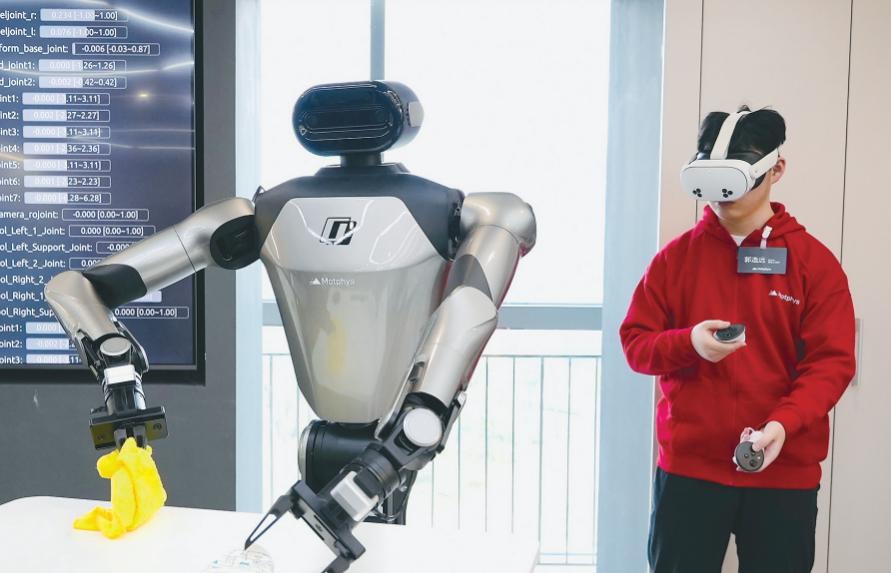
手把手教叠衣服擦桌子 机器人在武汉上“职校”
Chang Jiang Ri Bao· 2025-10-31 00:41
Core Viewpoint - The 20th Central Committee's Fourth Plenary Session emphasizes the importance of advancing China's modernization and economic development, with a focus on implementing the session's spirit at all levels of society [1]. Group 1: Event Overview - The signing ceremony marks the public debut of Wuhan's "robot school," which aims to establish a comprehensive autonomous and controllable robot simulation training ground [2]. - The event showcases robots in various training scenarios, including household tasks, highlighting the integration of VR technology for training purposes [3][6]. Group 2: Technological Development - The simulation training ground is described as a "school" for robots, replicating complex environments to enhance their learning and reduce development cycles [4][9]. - The CEO of Moxianfei, Cui Hanqing, emphasizes the significance of simulation training in robot evolution, noting that achieving human-like intelligence requires approximately 100 billion hours of multimodal data [4][7]. Group 3: Data Generation and Challenges - Real machine data collection is costly and inefficient, while simulation data generation offers a solution but relies heavily on physical engine technology, which is currently dominated by international tech giants [7]. - Moxianfei has developed a fully autonomous physical engine platform, MotrixLab, achieving 100% domestic production from hardware to software [9]. Group 4: Strategic Location and Resources - Moxianfei plans to establish its Central China headquarters and R&D center in Wuhan, citing the city's strong educational resources and talent pool as key factors for this decision [10]. - The presence of logistics companies in the area provides ample application scenarios for robotic technology, enhancing the training environment for robots [11]. Group 5: Industry Impact and Future Directions - Wuhan has established itself as a hub for humanoid robot enterprises, with various applications in industrial manufacturing, healthcare, and special operations [11][12]. - Experts suggest that the humanoid robot industry in Wuhan is beginning to show results, and there is a need to bridge gaps between upstream and downstream sectors to maximize innovation benefits [12].


武汉三部民生条例明年起同步施行
Chang Jiang Ri Bao· 2025-10-31 00:41
Core Points - The introduction of three local regulations in Wuhan, effective from January 1, 2026, aims to enhance residential quality, optimize community governance, and manage dog ownership in response to public concerns [1][5] Group 1: Elevator Installation - The new regulation on elevator installation allows for a single household application to initiate the process, significantly lowering the threshold for starting the installation in old residential buildings [2] - A multi-faceted funding support scheme is proposed, including shared costs among residents, the use of housing provident funds, and increased government subsidies, alongside encouraging social capital participation [2] - An efficient approval mechanism will be established to streamline the process, reducing the time required for approvals and minimizing bureaucratic hurdles for residents [2] Group 2: Property Management - The revised property management regulation emphasizes the importance of party leadership and establishes a collaborative mechanism involving community committees, homeowners' associations, and property service companies [3] - Public revenue management will be transparent, requiring separate accounts for public income and biannual disclosures of financial status to ensure homeowners' rights to information and oversight [3] - The introduction of an electronic voting system for homeowners aims to improve decision-making efficiency and address challenges in convening traditional homeowners' meetings [3] Group 3: Dog Management - The updated dog management regulation implements a zoning system, categorizing areas into key management zones and general management zones, with specific restrictions on dog ownership in certain areas [4] - A one-stop service for dog vaccination and registration will be introduced, eliminating fees previously required for dog management services [4] - Clear guidelines for responsible dog ownership behaviors are established, including leash requirements and immediate waste cleanup, with a mechanism for rapid response to complaints about violations [4]
武汉这场特别的会,传递出什么信号
Chang Jiang Ri Bao· 2025-10-31 00:41
Core Viewpoint - The first work exchange meeting for street (town) party committee secretaries in Wuhan aims to enhance communication and collaboration among grassroots organizations to improve local governance and economic development [2][6]. Group 1: Economic Contributions - Wuhan has 160 streets (towns) that play a crucial role in connecting residents and facilitating local services, impacting daily life and economic activities [2]. - The Jiang'an District's Siwei Street, despite its small area of less than 1 square kilometer, contributes 20% of the district's tax revenue, highlighting the significance of grassroots economic activity [3]. - The Fruit Lake Street in Wuchang District contributes over one-third of its district's tax revenue, showcasing the importance of building economies around local enterprises [4]. Group 2: Challenges and Innovations - Street (town) committee secretaries face complex challenges in balancing various demands while striving for economic growth and community welfare [4]. - The Shanshan Street in Jiangxia District has seen a nearly threefold increase in fixed asset investment and a 50% increase in tax revenue over three years, demonstrating the potential for growth through focused efforts [4]. - The East Lake High-tech Zone's Guandong Street has implemented a "community partner" mechanism to foster innovation and collaborative governance, indicating a shift towards modern governance models [5]. Group 3: Future Initiatives - Wuhan plans to establish a regular exchange mechanism for street (town) party committee secretaries, meeting quarterly to foster a spirit of competition and excellence among grassroots leaders [6]. - The city aims to become a national economic center, a hub for technological innovation, and a center for commerce and logistics, necessitating coordinated efforts from all levels of governance [6].
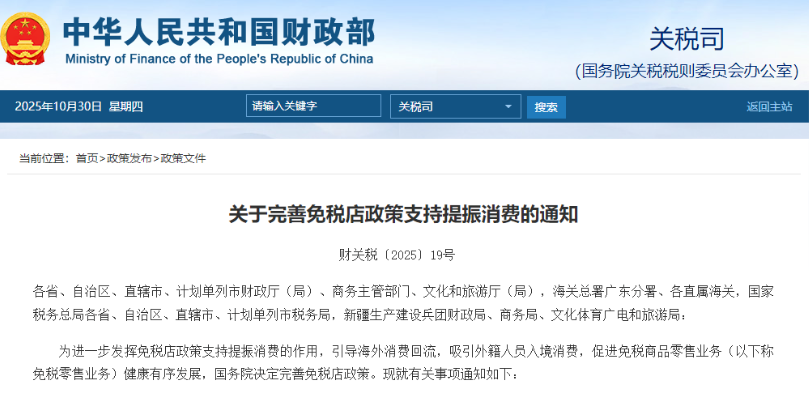
11月1日起施行,事关免税店
Chang Jiang Ri Bao· 2025-10-30 15:07
Core Viewpoint - The Ministry of Finance, Ministry of Commerce, Ministry of Culture and Tourism, General Administration of Customs, and State Taxation Administration have issued a notification to improve the duty-free shop policy, effective from November 1, 2025, aimed at boosting consumption, attracting foreign visitors, and promoting the healthy development of duty-free retail business [1][4]. Group 1: Policy Improvements - The notification outlines four main areas for enhancing the duty-free shop policy: optimizing domestic product tax refund management, expanding the range of products sold in duty-free shops, relaxing approval authority for duty-free shops, and improving convenience and regulatory measures for duty-free shopping [3][4]. - Domestic product sales in duty-free shops will be treated as exports, allowing for tax refunds on value-added tax and consumption tax [4][5]. Group 2: Product Range Expansion - The range of products available in duty-free shops will be expanded to include more portable consumer goods such as mobile phones, drones, sports equipment, health foods, over-the-counter drugs, and pet foods [7][8]. - Authorities will optimize the regulatory approach for imported duty-free goods to accelerate the availability of popular overseas products in domestic duty-free shops [8]. Group 3: Approval and Layout Optimization - Approval authority for establishing and changing the operating entities of duty-free shops will be delegated to local governments, allowing for tailored integration and optimization of duty-free shop layouts based on regional conditions [9][12]. - The layout and operational area of duty-free shops will be determined through negotiations between the bidding party and the operating entity, ensuring compliance with customs regulations [12]. Group 4: Enhancing Shopping Experience - Duty-free shops will offer online reservation services, allowing travelers to pre-order products based on their travel itineraries [13][14]. - Travelers will have the option to pick up pre-ordered items at designated duty-free shops upon arrival, enhancing the convenience of the shopping experience [15]. Group 5: Implementation and Coordination - The Ministry of Finance will coordinate with relevant departments to ensure the effective implementation of the new policies, while local governments will be responsible for supervising and managing duty-free shops in their regions [16].
向上向新向优向好 武汉前三季度活力升腾
Chang Jiang Ri Bao· 2025-10-30 00:48
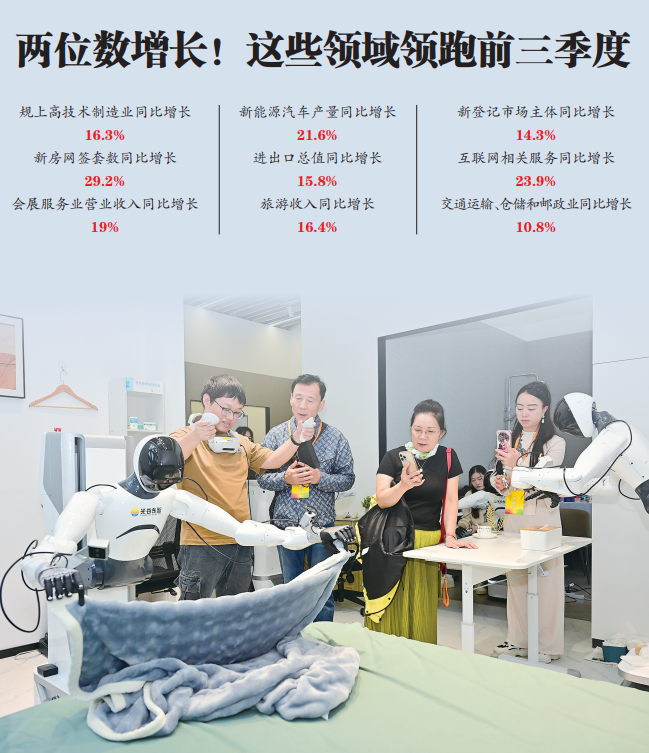
Economic Growth - Wuhan's GDP growth rates for the first quarter, first half, and first three quarters of the year are 5.4%, 5.5%, and 5.6% respectively, maintaining a leading position among sub-provincial cities [1] - The city's economic growth has been steady for five consecutive quarters, with no significant fluctuations [4] Industrial Performance - The production of industrial robots in Wuhan surged by 70.4% in the first three quarters [3][5] - High-tech manufacturing value added increased by 16.3%, contributing over 60% to industrial growth [5] - The total fixed asset investment in Wuhan reached 6,656.38 billion yuan, with a growth rate of 2%, ranking first among sub-provincial cities [5] Business Environment - The number of newly registered businesses in Wuhan increased by 14.3% in the first three quarters, with over 250,000 new enterprises, a growth of 37.23% [6][7] - The city attracted 884 investment projects, with nearly half in the industrial sector, indicating a strong investment climate [7] Consumer and Living Standards - The per capita disposable income for residents in Wuhan reached 46,107 yuan, a year-on-year increase of 4.8% [8] - The consumer price index (CPI) in Wuhan rose by 0.3%, indicating overall price stability [8] Innovation and Development - Wuhan is focusing on becoming a national hub for technological innovation, with significant investments in high-tech sectors [5][9] - The city has seen the emergence of new enterprises, with four new companies listed and nine recognized as top AI technology firms [5]
中亚班列(武汉)开行量同比增3倍
Chang Jiang Ri Bao· 2025-10-30 00:35
Core Insights - The transportation, warehousing, and postal industry in Wuhan experienced a value-added growth of 10.8% in the first three quarters of this year [1] - The Central Asia freight train service from Wuhan has successfully launched its 100th train, marking a significant milestone in its operations [1] Group 1: Central Asia Freight Train Operations - The Hubei Railway Group has actively expanded its Central Asia freight train services, characterized by "fast efficiency, low cost, and superior service," supporting industries such as photovoltaics, machinery, and chemicals in building cross-border supply chains [3] - Since the regular operation began on April 12, the comprehensive logistics costs have decreased by 30% through a multimodal transport model, attracting goods from the Yangtze River Delta and Pearl River Delta to consolidate in Wuhan [3] - The number of Central Asia trains operated from Wuhan has increased by 339% year-on-year, with a monthly operation scale reaching one train every two days, peaking at a record 20 trains in September [3] Group 2: Central Europe Freight Train Developments - On October 15, a Central Europe freight train from Wuhan departed for Germany, marking the extension of the logistics network to Northern Europe, with goods reaching Denmark for the first time [3] - The Central Europe freight train service from Wuhan has established 59 stable cross-border transport routes, covering 40 countries and 120 cities across the Eurasian continent [3]
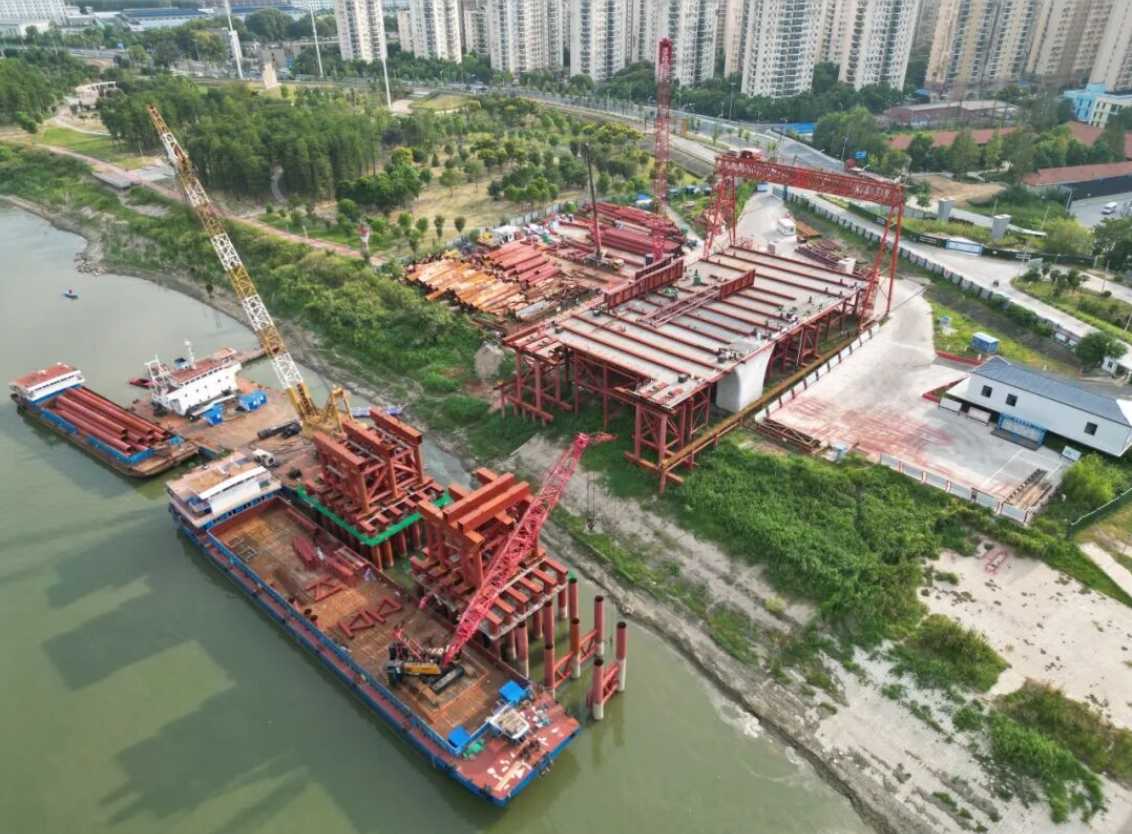
架起首段骨架,江汉十桥预计2027年通车
Chang Jiang Ri Bao· 2025-10-30 00:35
Core Points - The Jianghan No. 10 Bridge project has completed the first segment of the 66-meter box girder pouring, marking a significant milestone in the construction of the bridge's main structure [1] - The bridge is part of the Wuhan Urban Master Plan (2017-2035) and is designed to optimize the city's cross-river traffic [3][8] - The project is expected to be completed by July 2027 and will enhance transportation conditions in the Qiaokou and Huangjinkou areas, alleviating traffic pressure on existing bridges [8] Project Overview - Jianghan No. 10 Bridge is the 11th road bridge across the Han River in Wuhan, with a total length of approximately 4,123 meters, connecting key areas such as Caidian, Hanyang, and Qiaokou [5] - The main bridge spans 855 meters and features a design theme of "Light Feather Rainbow," incorporating elements of feather shape, rainbow culture, and water scenery [5] - The bridge construction is divided into three sections, with the main bridge crossing significant urban infrastructure [5] Construction Details - The bridge is notable for being the first 380-meter single-span steel box arch bridge in Hubei Province, with the second-largest span in the country [12] - The construction employs a "first beam, then arch" method, with a total lifting weight of 4,500 tons and a height of 37 meters, the highest in Central China [12] - The project utilizes 48 walking robots for the top-push construction method, with plans for seven rounds of top-push to complete the bridge [12] Engineering Challenges - The construction of the elevated connection bridge is complex due to the presence of various underground utilities and high-voltage lines, requiring real-time adjustments to design plans [15] - The elevated connection bridge is divided into four construction units, with the first segment already completed [14][15]
盛阅春会见中国科学院控股有限公司董事长杨建华
Chang Jiang Ri Bao· 2025-10-30 00:26
Core Insights - The meeting between the Mayor of Wuhan and the Chairman of China National Science Holdings highlights the strategic importance of Wuhan in the national development framework, emphasizing the city's role in the Yangtze River middle reaches urban agglomeration [1][2] - The focus is on enhancing collaboration in areas such as industrial fund investment, core technology breakthroughs, and the transformation of scientific achievements to establish Wuhan as a national technology innovation hub [1][2] Group 1 - The Mayor of Wuhan expressed the city's commitment to accelerate the construction of a national central city and to develop five key centers, aligning with national directives for regional coordinated development [1] - China National Science Holdings recognizes Wuhan's advantages in education, transportation, industrial foundation, and ecological environment, indicating strong potential for high-quality development [2] - The collaboration aims to support the establishment of a nationally influential technology innovation center in Wuhan, with a focus on strategic emerging industries and future industries [2]
武汉2025年前三季度GDP公布
Chang Jiang Ri Bao· 2025-10-29 12:36
Economic Overview - The GDP of Wuhan for the first three quarters reached 15,537.82 billion yuan, with a year-on-year growth of 5.6% [2] - The primary industry added value was 370.81 billion yuan, growing by 3.7%; the secondary industry added value was 5,068.39 billion yuan, growing by 4.8%; and the tertiary industry added value was 10,098.62 billion yuan, growing by 6.0% [2] Agricultural Sector - The total output value of agriculture, forestry, animal husbandry, and fishery was 608.38 billion yuan, with a year-on-year increase of 3.9% [3] - Major agricultural products showed growth, with summer grain and early rice production totaling 120,500 tons, an increase of 0.6% compared to last year [3] Industrial Sector - The industrial added value for large-scale enterprises grew by 5.4%, accelerating by 0.3 percentage points compared to the first half of the year [4] - High-tech manufacturing saw a significant increase of 16.3%, accounting for 25.2% of the industrial added value [4] Service Sector - The service sector's added value increased by 6.0%, with transportation, warehousing, and postal services growing by 10.8% [6] - The revenue of large-scale service enterprises rose by 11.6% from January to August [6] Investment Trends - Fixed asset investment grew by 2.0%, with industrial investment increasing by 12.0% [7] - High-tech industry investment rose by 2.9%, with high-tech service and manufacturing investments growing by 13.2% and 0.4%, respectively [7] Consumer Market - The total retail sales of consumer goods reached 6,299.74 billion yuan, with a year-on-year growth of 5.5% [8] - The "old-for-new" policy positively impacted retail sales, particularly in home appliances and building materials, which grew by 28.6% and 21.0%, respectively [8] Trade and Finance - The total import and export volume was 3,369.6 billion yuan, with exports growing by 18.1% [9] - By the end of September, the balance of deposits in financial institutions was 42,864.83 billion yuan, reflecting a year-on-year growth of 5.1% [9] Income and Prices - The per capita disposable income reached 46,107 yuan, with urban and rural incomes growing by 4.6% and 5.9%, respectively [11] - The consumer price index increased by 0.3% year-on-year, with food prices decreasing by 0.5% [11] Conclusion - Overall, Wuhan's economy showed stable growth in the first three quarters, with a focus on maintaining progress amid external uncertainties [12]