
Jin Rong Shi Bao

Search documents
国开行、工行、农行、中行、建行、交行、邮储银行等迅速响应!
Jin Rong Shi Bao· 2025-12-26 04:46
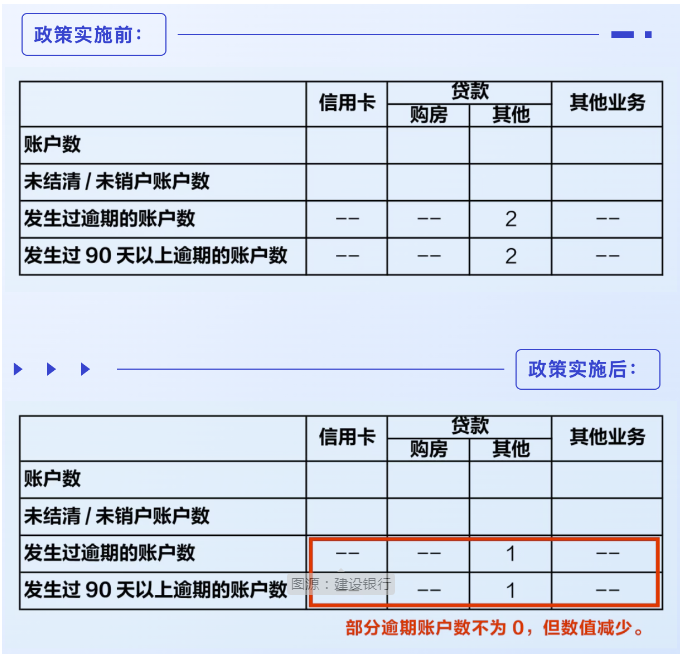
Core Viewpoint - The People's Bank of China has announced a one-time credit repair policy that allows individuals with overdue debts of up to 10,000 RMB to have their overdue information removed from the credit reporting system if they repay their debts in full by March 31, 2026 [1] Group 1: Policy Details - The policy applies to all types of personal credit, including credit cards, housing loans, and consumer loans, as long as they meet the specified conditions [1] - Individuals must fully repay overdue debts, including principal, interest, and penalties, and make timely payments for the current month to qualify for the credit repair [2] - The overdue information in credit reports will be adjusted, changing the repayment status from overdue to normal and the overdue amount from a non-zero value to zero [3][4] Group 2: Implementation and Support - Banks, including major institutions like Industrial and Commercial Bank of China and Agricultural Bank of China, are actively preparing to implement the policy and provide guidance to the public [6][7] - The central bank will offer an additional two free credit report inquiries in the first half of 2026 to accommodate increased demand for credit report checks following the policy implementation [5] - The policy is not to be viewed as a means of "credit washing," but rather as a special arrangement to address public concerns while maintaining the principle of punishing dishonesty [7]






增强人民群众的“信用获得感”
Jin Rong Shi Bao· 2025-12-26 04:04
Core Viewpoint - The establishment of a "specific credit relief mechanism" in Suzhou, Anhui Province, aims to balance strict adherence to regulations with the need to provide opportunities for individuals and businesses facing minor credit issues due to non-intentional reasons [1][2][3]. Group 1: Mechanism Overview - The "specific credit relief mechanism" will be piloted starting April 2024, focusing on cases of minor credit defaults that are not due to intentional wrongdoing [1][2]. - The mechanism combines legal enforcement with moral guidance, creating a governance model that balances strictness and compassion [2][3]. Group 2: Case Study - A case involving a restaurant employee, Mr. Ling, illustrates the mechanism's effectiveness, where he received timely loan support after his credit issues were verified as non-intentional due to a serious illness [2]. - The bank's response included not only financial assistance but also credit law education, emphasizing the importance of legal compliance and trustworthiness [2][3]. Group 3: Legal and Ethical Framework - The People's Bank of China in Suzhou emphasizes compliance with laws while providing relief, ensuring that fraudulent behaviors are excluded from the relief process [3]. - A negative list is established to prevent the inclusion of fraudulent or malicious debt evasion cases, ensuring accountability and transparency in the relief process [3]. Group 4: Community Engagement and Education - The initiative promotes legal education within communities, aiming to instill a culture of compliance and trust, with activities reaching out to both urban and rural areas [3][4]. - The efficiency of the relief process has improved significantly, reducing the resolution time from 30 days to 7 working days, and resolving over 1,200 disputes, thereby meeting reasonable financing needs of nearly 300 million [3]. Group 5: Future Outlook - The focus will continue to be on integrating legal and ethical practices to enhance credit services, ultimately benefiting the public and fostering a culture of integrity [4].
“三黄一红”田园画卷在这里展开
Jin Rong Shi Bao· 2025-12-26 04:04
Core Viewpoint - The financial services in Datong are significantly enhancing the development of local特色产业, particularly the "Three Yellow and One Red" agricultural products, through innovative credit and insurance solutions [1][2][3]. Group 1: Financial Support and Innovation - Datong Sanli Group Agricultural Co., Ltd. has received 130 million yuan in credit support, benefiting around 6,000 flower growers through an integrated operation model [1]. - Banks have introduced innovative medium- and long-term credit products like "Huanghua Loan" and "Huangqi Loan" to match the long investment cycles of these industries, alleviating operational pressures [2]. - By the end of November 2025, banks in Datong are expected to provide over 2.5 billion yuan in credit support for the "Three Yellow and One Red" industries [3]. Group 2: Insurance Products and Risk Management - Customized insurance products such as complete cost insurance for Huangqi and weather index insurance for millet have been developed to mitigate risks for farmers [2]. - The insurance sector has provided risk coverage amounting to 3 billion yuan, benefiting over 12,000 operating entities [3]. - A cost-sharing mechanism involving fiscal subsidies and farmer contributions has been established to lower industry risks [2]. Group 3: Industry Development and Future Outlook - The transformation of the Huanghua industry into a diversified product matrix is projected to achieve a total industrial chain output value exceeding 4 billion yuan by 2025 [1]. - The recognition of local products like Hengshan Huangqi and Guangling Huangxiaomi as "National Geographical Indication Protected Products" enhances the brand value of Datong as "China's Huanghua Capital" [3]. - The focus on high-quality development and the cultivation of new business models aims to shift farmers from relying on natural conditions to informed agricultural practices [3].
力挺这条大通道,银行业怎么发力→
Jin Rong Shi Bao· 2025-12-26 03:45
Core Viewpoint - The People's Bank of China and other departments have jointly issued opinions to enhance financial support for the construction of the Western Land-Sea New Corridor, which has become a national strategy since the overall plan was released in August 2019 [1] Financial Support and Economic Impact - By the third quarter of 2025, the import and export volume through the Western Land-Sea New Corridor reached 611.5 billion yuan, a year-on-year increase of 19.3%, contributing 3.4 percentage points to the overall foreign trade growth in the western region [1] - The banking sector has integrated into the construction of the corridor by providing credit support for various infrastructure and logistics projects, transforming plans into reality [1] Financing and Settlement Functions - The dual drive of "financing" and "settlement" will activate the industrial chain and create a financial ecosystem for internal and external circulation, upgrading the geographical corridor into a "golden channel" for global resource allocation [2] - Financing should focus on nurturing endogenous power rather than merely providing funds, requiring banks to align their services with the industrial clusters derived from the corridor [2] - The settlement function aims to enhance the efficiency of cross-border trade by integrating China's payment and settlement systems into broader trade networks [2] Innovation in Cross-Border Financial Services - The opinions emphasize the need for banks to innovate cross-border financial services, including facilitating cross-border trade settlements and supporting new trade formats [3] - Banks are encouraged to promote the use of the renminbi in cross-border trade and investment to reduce exchange rate risks for enterprises [3] - A multi-layered risk prevention system should be established, utilizing financial technology for real-time monitoring of cross-border fund flows and abnormal transactions [3] Future Outlook - As the measures outlined in the opinions are implemented, financial resources will be more precisely directed to various fields of the Western Land-Sea New Corridor construction, positioning it as a "golden channel" for integrating and allocating global resources [3]
金融领域“黑灰产”专项打击工作成效显著
Jin Rong Shi Bao· 2025-12-26 03:30
Core Viewpoint - The Ministry of Public Security and the Financial Regulatory Administration have launched a joint initiative to combat illegal activities in the financial sector, resulting in significant enforcement actions and case resolutions [1] Group 1: Enforcement Actions - From June to November, nearly 60 operations were conducted nationwide, leading to the investigation of over 1,500 cases related to illegal financial activities [1] - More than 200 organized crime groups were dismantled, with a total amount involved in these cases reaching nearly 30 billion [1] Group 2: Regulatory Collaboration - The Financial Regulatory Administration has transferred over 4,500 leads to law enforcement, involving amounts exceeding 21 billion, and has guided financial institutions in reporting over 1,700 cases totaling more than 17 billion [1] - A new regulation for transferring suspected criminal cases was established in March, enhancing collaboration between financial regulators and law enforcement [1] Group 3: Future Directions - By 2026, the Financial Regulatory Administration aims to continue strengthening regulatory measures, promoting high-quality development, and enhancing market order through various initiatives [1] - There will be an emphasis on risk prevention, stringent regulation, and improved collaboration across departments to further combat illegal financial activities [1]
非银机构差异化发展稳健前行
Jin Rong Shi Bao· 2025-12-26 02:37
Core Insights - The non-banking financial institutions (NBFIs) have achieved a record asset scale of 32.43 trillion yuan, contributing long-term funds to industrial chain finance and pension security as the "14th Five-Year Plan" approaches its conclusion [1] - The consumer finance sector has surpassed 1 trillion yuan in loan balances, providing inclusive financial services to over 80 million rural customers [1] - The financing leasing market for high-end equipment manufacturing has exceeded 20 trillion yuan, indicating steady growth in emerging leasing business scenarios [1] Group 1: Industry Development - NBFIs are focusing on their core businesses during the "14th Five-Year Plan" period, with financial companies targeting internal capital flow for enterprises, consumer finance stimulating domestic consumption, and leasing companies addressing equipment financing challenges [2] - Financial leasing companies are introducing flexible financing solutions for manufacturing equipment, while financial companies are providing precise funding for key projects through centralized capital management [2] Group 2: Consumer and Social Impact - Consumer finance companies are embedding services in various consumption scenarios, offering small loans with low interest rates to activate consumer potential [3] - Trust companies are innovating in areas such as pension security and charitable trusts, with the number of registered charitable trusts reaching 2,676 and total assets surpassing 10.632 billion yuan [3] Group 3: Risk Management and Compliance - Compliance and risk management are emphasized as key components of NBFIs' development, with a focus on establishing comprehensive mechanisms for credit issuance, related transactions, and liquidity management [4] - NBFIs are leveraging technology to enhance risk control, with various systems developed to predict and identify fraud and other risks [4] Group 4: Future Directions - NBFIs are aligning with national strategies and trends to better serve the real economy, focusing on optimizing traditional industries and fostering new and future industries [6] - The consumer finance sector is adapting to new consumer demands, while financial leasing is deepening its involvement in sectors like aviation and renewable energy [6] Group 5: Policy Support - Recent policies have been introduced to strengthen business development and risk control, including fiscal subsidies for consumer finance and revised regulations for trust companies [7] - The new management measures for financial leasing companies outline specific requirements for due diligence and risk assessment [7]

金融监管总局发布《银行保险机构资产管理 产品信息披露管理办法》
Jin Rong Shi Bao· 2025-12-26 02:37
Core Viewpoint - The Financial Regulatory Administration has issued the "Management Measures for Information Disclosure of Asset Management Products by Banking and Insurance Institutions" to standardize information disclosure practices for asset management trust products, wealth management products, and insurance asset management products, thereby enhancing investor protection [1]. Group 1: Regulatory Framework - The current lack of a dedicated information disclosure regulatory system for asset management trust products, wealth management products, and insurance asset management products necessitates the establishment of a unified disclosure framework [1]. - The new measures aim to create a consistent regulatory standard across these three types of asset management products, addressing inconsistencies in existing regulations [1]. Group 2: Disclosure Requirements - The measures define basic principles, responsibilities, common content, and internal management requirements for information disclosure related to the three product categories [1]. - Institutions are urged to fulfill their fiduciary duties and ensure that investors' rights to information and choice are adequately protected [1]. Group 3: Performance Benchmarking - To maintain the consistency of product performance benchmarks, the measures stipulate that product managers should not adjust performance benchmarks without following strict internal approval processes [1]. - Any necessary adjustments to performance benchmarks must be disclosed in periodic reports and updated product descriptions, detailing all previous adjustments [1]. Group 4: Implementation Guidance - The Financial Regulatory Administration will guide banking and insurance institutions in the implementation of these new measures [1].
公安部与金融监管总局联合通报:金融领域“黑灰产”专项打击工作成效显著
Jin Rong Shi Bao· 2025-12-26 02:37
Core Insights - The Ministry of Public Security and the Financial Regulatory Administration have launched a joint initiative to combat illegal activities in the financial sector, resulting in significant enforcement actions and case resolutions [1] Group 1: Enforcement Actions - From June to November, nearly 60 operations were conducted nationwide, leading to over 1,500 cases of financial-related illegal activities being investigated [1] - More than 200 organized crime groups were dismantled, with a total amount involved in these cases reaching nearly 30 billion yuan [1] Group 2: Regulatory Collaboration - The Financial Regulatory Administration has transferred over 4,500 leads to law enforcement, involving amounts exceeding 21 billion yuan, and has guided over 1,700 reports from financial institutions, totaling over 17 billion yuan [1] Group 3: Future Regulatory Focus - By 2026, the Financial Regulatory Administration aims to enhance risk prevention, strengthen regulation, and promote high-quality development, with a focus on improving regulatory effectiveness and continuing to intensify enforcement efforts [1]
中国人民银行举行新闻发布会:协同发力 赋能西部陆海新通道高质量发展
Jin Rong Shi Bao· 2025-12-26 02:37
Core Viewpoint - The People's Bank of China and several government departments have jointly issued guidelines to financially support the construction of the Western Land-Sea New Corridor, which is crucial for the Belt and Road Initiative, aiming to enhance financial cooperation and resource allocation between China and related countries [1][2]. Group 1: Financial Support and Policy Implementation - The issuance of the guidelines represents a significant step in promoting high-level opening-up in inland regions, including Chongqing, by providing robust financial support for the development of the Western Land-Sea New Corridor [2]. - The guidelines outline six main tasks, including improving financial organization collaboration, constructing a high-quality financial resource allocation system, and promoting institutional reforms to facilitate cross-border trade and investment [4][5]. - The guidelines emphasize the importance of regional collaborative development and institutional innovation to provide efficient settlement and financing services for enterprises [5]. Group 2: Achievements and Future Directions - The People's Bank of China has reported several achievements in supporting the corridor's construction, including the establishment of a financial service center and the development of over 30 innovative financial products, with financing balances exceeding 730 billion yuan [3]. - Future efforts will focus on creating more landmark financial achievements and enhancing the financial service ecosystem for the corridor [3]. Group 3: Capital Market Support - The China Securities Regulatory Commission is committed to strengthening multi-level capital market construction, supporting various financing channels such as stock issuance, corporate bonds, and asset-backed securities to aid the corridor's development [7]. - As of November, over 650 A-share listed companies are located along the corridor, with significant fundraising activities reported, including nearly 7 billion yuan from bond issuances [7]. Group 4: Cross-Border Financial Services - The guidelines propose measures to enhance cross-border trade settlement and investment facilitation, including encouraging enterprises to participate in high-level cross-border trade pilot programs and simplifying foreign investment processes [8][9]. - The establishment of a cross-border financial service platform is highlighted as a key initiative to support the corridor's high-quality development, with successful applications already reported in several provinces [9]. Group 5: Inter-Departmental Collaboration - The People's Bank of China plans to establish a collaborative mechanism among various departments and regions to ensure the effective implementation of the guidelines, focusing on policy sharing and financial service coordination [10][11]. - Emphasis is placed on enhancing cooperation between financial institutions and local governments to mobilize resources effectively and support key areas of development within the corridor [11].
国寿、太保宣布:撤销监事会
Jin Rong Shi Bao· 2025-12-26 02:14
Group 1 - The core point of the article is the significant shift in the governance structure of the insurance industry in China, with multiple companies, including China Life and China Pacific Insurance, announcing the abolition of their supervisory boards [1][2][3] - As of December 25, 2023, a total of 13 insurance companies have announced the dissolution of their supervisory boards, indicating a profound transformation in the long-standing "three meetings and one layer" governance framework [1][2] - The trend of abolishing supervisory boards began with Japan's insurance company in April 2023 and has been rapidly adopted by state-owned insurance groups, expanding from group companies to specialized subsidiaries [1][2] Group 2 - The new policy guidance is driven by the upcoming implementation of the revised Company Law in July 2024, which allows wholly state-owned companies to replace supervisory boards with audit committees [3] - The decision to abolish supervisory boards is motivated by the need to reduce costs and improve efficiency, addressing the weaknesses of traditional supervisory functions [3] - Experts believe that the abolition of supervisory boards represents an exploration of modern financial governance, with a focus on enhancing compliance and risk management capabilities within the insurance industry [3]

