
Jin Rong Shi Bao

Search documents
中国金融市场的整体实力 和影响力不断增强
Jin Rong Shi Bao· 2025-12-10 02:05
Core Viewpoint - The Financial Stability Board (FSB) has released the 2025 Global Systemically Important Banks (G-SIB) list, highlighting the increasing significance of Chinese banks in the global financial system [1][2]. Group 1: G-SIB List Overview - Five Chinese banks, including Industrial and Commercial Bank of China (ICBC), Agricultural Bank of China, Bank of China, China Construction Bank, and Bank of Communications, are included in the G-SIB list for 2025, consistent with 2024 [1]. - ICBC has moved into the third group for the first time, while Agricultural Bank, Bank of China, and China Construction Bank remain in the second group, and Bank of Communications stays in the first group [1]. - The G-SIB list consists of five groups, with no banks in the highest fifth group, only JPMorgan in the fourth group, and a total of 29 banks listed, unchanged from 2024 [1][2]. Group 2: Performance Metrics - The total scores for the Chinese banks have increased compared to the previous year, with ICBC up by 33 points, Agricultural Bank by 15 points, Bank of China by 32 points, China Construction Bank by 10 points, and Bank of Communications by 9 points [2]. - The increase in scores indicates that factors beyond size are now more significant in determining the rankings of these banks [2]. Group 3: Implications and Requirements - The adjustments in the G-SIB list reflect the evolving business activities of banks, emphasizing quality over size, aligning with the goals of building a stronger financial nation [2]. - Banks on the G-SIB list face higher capital regulatory requirements, including additional capital and Total Loss-Absorbing Capacity (TLAC) requirements, with varying standards from 1% to 3.5% across the groups [2]. - ICBC, having moved up a group, will now encounter higher capital buffer requirements, which signifies both recognition of its strength and a challenge for future development [3].





产融协同强主业 跨境服务筑桥梁 访中油财务有限责任公司党委副书记、总经理闫宏
Jin Rong Shi Bao· 2025-12-10 02:05
Core Viewpoint - The energy industry in China is undergoing a comprehensive transformation during the "14th Five-Year Plan" period, with a focus on renewable energy investment and the role of financial services in supporting this transition [1][2]. Group 1: Financial Support for Energy Transition - The company emphasizes high-quality service to support the main responsibilities of the group, focusing on the needs of member enterprises and enhancing centralized fund management [1][2]. - Over the past five years, the company has issued over 650 billion yuan in loans to support major projects related to oil and gas production and the cultivation of new productive forces [2]. - The company has developed specialized financial products such as "Gas Storage Loan" and "Oil Product Benefits" to enhance its service offerings [2][4]. Group 2: Internationalization and Global Financial Services - The company has established a global financial service network with a focus on Hong Kong, Dubai, and Singapore, enhancing collaboration across these regions [2][3]. - It has participated in financing over 30 overseas projects, covering 85 countries and regions, and has developed innovative products that combine credit and hedging [3][6]. Group 3: Green Development Initiatives - The company actively promotes green development by offering green loans for renewable energy projects, having issued over 50 billion yuan for projects like photovoltaic and wind power [5][6]. - A strategic partnership has been formed with Longqing Oilfield for financing geothermal heating projects, marking a significant step in the geothermal sector [5]. Group 4: Future Plans and Strategic Goals - The company aims to enhance its capabilities in financial management, service provision, financial technology, risk compliance, and brand influence during the "15th Five-Year Plan" [6][7]. - Key focus areas include improving internal financial service quality, deepening international business development, and advancing digital transformation initiatives [6][7].

创新金融工具 写好科技金融“答卷” 访北银理财总裁郭振涛
Jin Rong Shi Bao· 2025-12-10 02:05
科技金融作为金融"五篇大文章"之首,不仅彰显了科技创新在推进我国现代化建设中的重要地位,还指 明了金融服务实体经济的关键路径。 当前,我国科技创新进入攻坚突破的关键阶段,现代化产业体系加速构建,金融机构如何精准对接科技 企业全生命周期融资需求,成为推动科技与金融深度融合的关键课题。 作为北京银行的全资子公司,北银理财紧跟北京银行"专精特新第一行"战略导向,从创新投资工具、突 出业务特色、储备投放资源等方面持续提升科技金融领域服务质效,以实际行动助力科技强国、金融强 国建设。截至2025年9月末,北银理财投放科技金融领域资产余额约194亿元,服务战略性新兴产业、高 技术服务业、高技术制造业等企业超600家。 近日,北银理财总裁郭振涛接受了《金融时报》记者专访,通过分享北银理财在科技金融领域的实践探 索,探讨银行理财行业如何更好地赋能科技创新发展。 《金融时报》记者:支持科技创新、推动新质生产力发展,需要金融机构不断提升科技金融服务能力与 水平。北银理财主要通过哪些途径和方式为科技创新企业提供金融服务? 郭振涛:近年来,北银理财充分运用外汇、衍生品等牌照优势,打造债权与股权相衔接、境内与境外相 结合的投资能力,从 ...
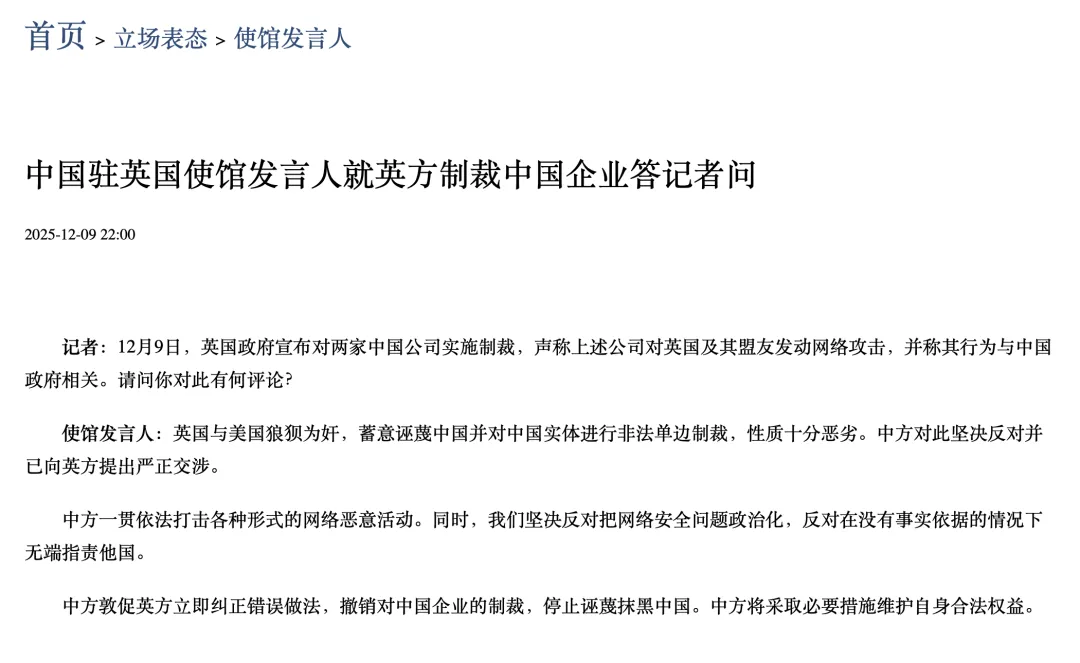
英方制裁中国企业,中方回应!
Jin Rong Shi Bao· 2025-12-10 02:05
据中国驻英国大使馆12月9日晚消息,驻英使馆发言人就英方制裁中国企业答记者问。 记者:12月9日,英国政府宣布对两家中国公司实施制裁,声称上述公司对英国及其盟友发动网络攻击,并称其行为与中国政府相关。请问你对此有何评 论? 使馆发言人:英国与美国狼狈为奸,蓄意诬蔑中国并对中国实体进行非法单边制裁,性质十分恶劣。中方对此坚决反对并已向英方提出严正交涉。 中方一贯依法打击各种形式的网络恶意活动。同时,我们坚决反对把网络安全问题政治化,反对在没有事实依据的情况下无端指责他国。 中方敦促英方立即纠正错误做法,撤销对中国企业的制裁,停止诬蔑抹黑中国。中方将采取必要措施维护自身合法权益。 ...

让每一栋房屋 “有人盯、有人管、有人跟进” 中国人保为湖南超3.6万栋房屋筑起安全屏障
Jin Rong Shi Bao· 2025-12-10 02:03
Core Viewpoint - A transformative initiative led by China Pacific Insurance (601319) is addressing housing safety issues in Hunan Province through a combination of technology, insurance, and inspection services, significantly improving the safety of over 36,000 buildings and enhancing residents' peace of mind [1] Group 1: Innovation in Housing Safety Management - The traditional housing safety management in China has been reactive, often addressing issues only after severe damage occurs, leading to potential loss of life and property [2] - China Pacific Insurance's "Insurance + Technology + Inspection Services" model creates a comprehensive safety assurance system that shifts from passive compensation to proactive risk prevention [2] - Since 2025, this model has been implemented in nine cities, covering 18,000 non-commercial self-built houses and 16,000 commercial self-built houses, along with 2,183 external walls, thus addressing various housing scenarios [2] Group 2: Effective Implementation and Results - In specific towns like Fulin and Chunhua, timely repairs and reinforcements were conducted on 32 identified unsafe buildings, effectively mitigating risks at an early stage [3] - A dedicated team of nearly 200 professionals has conducted inspections on 23,600 buildings since 2025, ensuring ongoing monitoring and management of housing safety [3] Group 3: Technological Empowerment in Inspections - The diverse geography of Hunan necessitates a sophisticated inspection approach, as traditional methods are inefficient and prone to oversight [4] - China Pacific Insurance has developed a "drone + inspection device + manual inspection" system, enhancing the efficiency and accuracy of housing safety assessments [4] - Drones equipped with advanced imaging technologies create aerial digital records of buildings, while ground-based smart devices identify hidden risks, revolutionizing the inspection process [4] Group 4: Positive Social Impact and Future Plans - The integration of technology and innovative models has led to significant social benefits, including the reinforcement or demolition of nearly 100 old dangerous buildings, preventing potential economic losses of nearly 100 million yuan [5] - The initiative has also increased public awareness of housing safety, with around 1,000 homeowners opting for advanced inspection services [5] - Future plans include expanding the service scope to cover urban high-rise buildings and historical structures, enhancing the safety net provided by the "technology + insurance" model [5]

从“规模扩张”到“价值创造” 保险业进入深度转型攻坚期
Jin Rong Shi Bao· 2025-12-10 02:03
Core Viewpoint - The 20th Central Committee's Fourth Plenary Session has approved the "Proposal on Formulating the 15th Five-Year Plan for National Economic and Social Development," which emphasizes the strategic role of the insurance industry in China's modernization process, transitioning from scale expansion to value creation [1][3]. Group 1: Strategic Positioning - The insurance industry is positioned as a core supporter of the social security system, evolving from a supplementary role to a co-builder of the system, addressing both basic social security gaps and personalized insurance needs [2]. - Insurance is expected to play a significant role in major national initiatives such as rural revitalization, technological innovation, and green development, serving as a financial tool and risk barrier [2]. - The industry is recognized as a risk manager for economic and social stability, addressing both traditional and emerging risks, including cybersecurity and data security [2]. Group 2: Historical Missions - The insurance industry has three historical missions during the 15th Five-Year period: safeguarding public welfare and promoting common prosperity, empowering the real economy, and enhancing risk governance to ensure national security [3]. - The focus on improving the insurance sector's role in reducing wealth disparities and supporting high-quality economic development is emphasized [3]. Group 3: Development Opportunities - The proposal outlines five key growth areas for the insurance industry: technology finance, green finance, inclusive finance, pension finance, and digital finance, presenting unprecedented development opportunities [4][5][6][7]. - Technology finance will create new risk protection demands and innovative insurance products, while green finance will expand the insurance product system to meet the needs of the green transition [4][5]. - Inclusive finance will tap into the potential of underserved markets, particularly in agricultural and health insurance, while pension finance will address the growing demand for retirement solutions amid an aging population [6]. - Digital finance will drive efficiency through technology, enhancing customer experience and enabling the development of customized insurance products [6]. Group 4: Challenges and Transformation - The insurance industry faces challenges such as product homogeneity, supply-demand mismatches, and a concentration of market power among leading firms, which hinder sustainable development [8]. - To transform challenges into development momentum, the industry must shift from scale-oriented to value-oriented growth, focusing on core protection functions and optimizing business structures [9][10]. - The industry should also transition from product competition to ecosystem competition, integrating services and resources to provide comprehensive solutions [10]. - Emphasizing technology-driven approaches will enhance product innovation and operational efficiency, while global collaboration will expand international business opportunities [10][11]. - A proactive risk management model is essential, focusing on prevention, control, and compensation to strengthen the overall risk management framework [11].
保障、投保、理赔全解答
Jin Rong Shi Bao· 2025-12-10 02:03
Core Viewpoint - The article provides a practical guide to understanding inclusive home property insurance (普惠家财险), highlighting its coverage, eligibility, and key considerations for consumers. Group 1: Coverage of Inclusive Home Property Insurance - Inclusive home property insurance generally covers both homeowners and renters, protecting against risks such as fire, explosion, water leakage, theft, and damage from pipe bursts [2] - Coverage includes family property losses and family liability for third-party injuries or property damage caused by incidents like fire or negligence [2] - Some products extend coverage to include responsibilities for falling objects, children's actions, accidents involving domestic workers, pet liabilities, and income loss insurance for new urban residents like delivery workers [2] Group 2: Eligibility and Purchase Guidelines - There are no residency restrictions for purchasing inclusive home property insurance; both owned and rented residential properties are eligible, provided they meet local housing regulations [3] - The insurance is limited to residential properties constructed with specific materials, excluding commercial properties and those made of bamboo, wood, or mixed materials [3] - Multiple policies can be purchased for the same property, with limits varying by region; for example, Shenzhen allows up to five policies while Henan permits three [4] Group 3: Policy Management and Consumer Considerations - Policyholders can cancel their insurance before the coverage starts and request a refund; however, post-coverage cancellation may incur fees [5] - Consumers can access value-added services through official channels, with variations in services offered across different regions [6] - Important considerations for consumers include carefully reading policy terms, focusing on compensation ratios, limits, deductibles, and any special requirements related to property characteristics [7]
居民养老“知易行难” 保险机构应精准供给
Jin Rong Shi Bao· 2025-12-10 02:03
Core Insights - The 2025 Retirement Preparedness Index for Chinese residents is 5.49, showing a slight increase from 5.34 in 2024, but remains in a low to moderate range [1][2] Group 1: Retirement Preparedness Index - The index evaluates six dimensions: awareness of retirement responsibility, financial planning knowledge, understanding of financial issues, completeness of retirement plans, adequacy of retirement savings, and confidence in achieving expected income [2] - Awareness of retirement responsibility increased significantly from 6.53 to 7.45, and financial planning knowledge rose from 6.89 to 7.36, indicating improved understanding of personal retirement responsibilities [2] - Financial issue understanding improved slightly from 5.83 to 6.06, but there are still limitations in risk identification and long-term financial planning [2] - Completeness of retirement plans decreased to 3.82, and adequacy of retirement savings fell to 3.78, indicating a gap between increased awareness and actual planning actions [2] Group 2: Investment Preferences - Low-risk investment products account for 37% of residents' preferences, indicating a strong inclination towards capital safety and stable returns [4] - Life insurance, commercial pension insurance, and health insurance each represent 27%, reflecting a core demand for protection [4] - Mid to high-risk investment products are chosen by only 21% of residents, showing a conservative risk appetite [4] Group 3: Role of Insurance - Insurance plays a crucial role in retirement preparation, with a recommendation for insurance providers to offer a diverse range of products tailored to different demographic needs [5] - High retirement preparedness groups prefer pension insurance for long-term certainty, while lower preparedness groups favor simpler, safer savings products [5] - The report suggests enhancing post-sale services to help residents understand product value and encourage long-term holding behaviors [5] Group 4: Focus on Long-term Care - There is a rising concern among residents regarding long-term care, chronic disease management, and longevity risks, prompting a need for improved health insurance and long-term care products [6] - Insurance providers are encouraged to collaborate with healthcare and eldercare services to offer continuous support to insured individuals [6] - The report emphasizes the importance of consumer education and risk awareness to improve retirement preparation quality [6]
风险因子下调鼓励险资“买得进”“拿得住”
Jin Rong Shi Bao· 2025-12-10 02:03
Core Viewpoint - The adjustment of risk factors by the regulatory authority is a significant step in implementing the "long money, long investment" system, aimed at encouraging long-term and value investments in the market [1][7]. Group 1: Regulatory Changes - The Financial Regulatory Bureau issued a notice adjusting the risk factors for insurance companies investing in the CSI 300 index, the CSI Dividend Low Volatility 100 index, and stocks listed on the Sci-Tech Innovation Board [1][6]. - The risk factor for stocks held for over three years in the CSI 300 and CSI Dividend Low Volatility 100 indices has been reduced from 0.3 to 0.27, while for stocks held for over two years on the Sci-Tech Innovation Board, it has been reduced from 0.4 to 0.36 [2][4]. Group 2: Impact on Insurance Companies - The adjustment allows insurance companies to allocate more capital to stock investments, as lower risk factors mean less capital is required to cover potential risks [2][4]. - Analysts estimate that if the minimum capital is fully allocated to the CSI 300 stocks, it could release approximately 108.6 billion yuan [4]. Group 3: Long-term Investment Encouragement - The primary intention behind the notice is to guide insurance capital towards long-term holding rather than merely providing short-term capital relief [4][6]. - The regulatory authority aims to encourage insurance funds to not only invest but also hold onto their investments for longer periods, thereby reducing market volatility [4][7]. Group 4: Growth of Insurance Capital - As of September 2025, the total investment balance of insurance companies exceeded 37 trillion yuan, with stock and securities fund investments reaching 5.59 trillion yuan, accounting for 14.92% of total investments, up from 12.8% the previous year [7]. - The role of insurance capital in the capital market is expected to become increasingly significant, with projections indicating that new equity investments from insurance funds could remain around one trillion yuan in 2026 [7].
多地竞逐险资“活水”
Jin Rong Shi Bao· 2025-12-10 02:03
保险资金凭借规模大、期限长、来源稳的显著优势,被视为天然的耐心资本,在服务国家战略、支 持实体经济和保障国计民生中,正发挥着日益关键的作用。 进入四季度以来,一场关于"险资引入"的竞速赛在全国多地拉开帷幕。从西部边疆到内陆腹地,多 地政府部门发布政策文件,将吸引保险资金作为激发区域经济活力、推动高质量发展的重要抓手,力求 通过政策"筑巢",引来险资这只"金凤"。 地方政策频出推动"险资入地" 近期,地方政府及金融监管部门主动对接险资的力度不断加大,通过出台专项政策、搭建对接平 台、开展交流活动等多项举措,推动保险资金服务地方经济高质量发展。 例如,12月1日,西藏自治区人民政府印发《西藏自治区进一步激发经营主体活力推动投资促进高 质量发展的若干措施》,明确提出开展险资入藏(投藏)行动,探索与央企国企、大型民企合作,引导 长期耐心资本投资当地重点产业和项目。 11月26日,陕西省委金融办会同陕西省证监局、省科技厅、省工业和信息化厅、省国资委印发《关 于深化资本市场改革助力陕西高质量发展的若干措施》,明确提出"建立健全险资入陕机制,支持保险 资金参与设立私募创投基金"。政策发布后不久,随即举办的2025年陕西省" ...
