Jin Rong Shi Bao

Search documents
“融资+融物”之桥铺就科创通途
Jin Rong Shi Bao· 2025-12-03 02:05
Core Viewpoint - The financing leasing industry is leveraging its unique advantages of "financing + physical assets" to support industrial renewal and corporate transformation, with a focus on technology as the core engine for industrial upgrading and the cultivation of new productive forces [1] Group 1: Industry Characteristics - Characteristic One: New Scenarios as Highlights - Financial leasing companies are innovating financial products and services to expand into new business areas such as energy storage, intelligent computing centers, and low-altitude aircraft, providing strong financial support for the transformation and innovative development of the real economy [2] - The focus has shifted from traditional manufacturing to emerging industries, particularly in sectors like computing infrastructure, energy storage, low-altitude economy, biomedicine, industrial robots, semiconductor equipment, and new materials [2] - Emphasis is placed on "adaptation" and "deep cultivation" rather than merely copying existing models, with personalized financing solutions being developed for specific scenarios in the tech sector [2] Group 2: Business Growth and Investment - Financial leasing companies like交银金租 have successfully entered new business scenarios such as cold chain storage, new drug development, integrated circuits, and GPU chip computing, achieving over 60 billion yuan in technology leasing business over the past three years, involving more than 300 tech enterprises [3] - The industry is increasingly penetrating emerging fields, with new projects being launched in renewable energy and information technology, such as国银金租's recent announcement to purchase photovoltaic power station equipment for 1.22 billion yuan [3] Group 3: Ecosystem Support - Characteristic Two: Good Ecosystem as Guarantee - The development of tech leasing in the financing leasing industry requires not only deep engagement from enterprises but also supportive policies, market collaboration, and risk-sharing mechanisms [5] - The establishment of the "New Quality Production and Financing Ecosystem Alliance" by industry associations, commercial banks, and financial leasing companies aims to create a comprehensive support system for financing leasing institutions and tech enterprises [5] Group 4: Risk Management - Characteristic Three: Strict Risk Control as Bottom Line - The complexity and uncertainty of risks in the tech finance sector necessitate an urgent upgrade of risk control systems, especially given the rapid technological iterations and asset-light characteristics of tech enterprises [6][7] - Financing leasing institutions are encouraged to establish a risk management system centered on leased assets and enhance their management capabilities through technology [7] - A shift from "passive compliance" to "active management" is recommended, integrating compliance into all business processes to build trust and secure low-cost funding [7] Group 5: Future Outlook - The industry anticipates the establishment of a more robust, resilient, and collaborative ecosystem for tech leasing, aiming to provide a full-cycle funding bridge for tech enterprises from R&D to industrialization, thereby injecting lasting momentum into the cultivation of new productive forces [8]
从高端保障走向普惠支撑
Jin Rong Shi Bao· 2025-12-03 02:05
Core Insights - The Chinese government is prioritizing the development of the elderly care industry and financial support for aging populations, with significant policy initiatives aimed at addressing the challenges of "Chinese-style elderly care" [2][3][7] Group 1: Policy and Market Trends - By 2035, the population aged 60 and above in China is expected to exceed 400 million, accounting for over 30% of the total population, highlighting the urgency of addressing elderly care issues [2] - The 2023 Central Financial Work Conference included elderly finance as one of the key areas for high-quality financial development, indicating a strong governmental focus on this sector [2] - The shift in elderly needs from basic care ("老有所养") to quality living ("老有所享") reflects a growing demand for personalized and high-quality elderly services [4][7] Group 2: Trust Services and Innovations - Trusts are increasingly being utilized by high-net-worth families for wealth management and elderly care, with examples like a family trust of 50.4 million yuan designed to ensure long-term financial security for aging family members [3][4] - The trust industry is innovating by creating integrated service models that combine insurance, trust, and elderly care services, enhancing the overall elderly care ecosystem [4] - Trusts are being positioned as a solution for both affluent and underprivileged groups, with initiatives aimed at providing customized financial products for those with special needs [5][6] Group 3: Social Responsibility and Accessibility - The trust industry is expanding its role in social responsibility by addressing the needs of vulnerable populations, including the elderly, disabled, and children in difficult circumstances [6][7] - New real estate trust services are being developed to help elderly individuals secure housing and manage their living expenses, demonstrating the industry's adaptability to meet diverse needs [6] - The goal of establishing a comprehensive elderly finance system by 2028 emphasizes the importance of innovation and collaboration within the trust sector to ensure that all elderly individuals can enjoy a secure and dignified life [7]


锚定金融强国目标 以证券力量护航“十五五”高质量发展 访中信建投证券股份有限公司党委副书记、总经理金剑华
Jin Rong Shi Bao· 2025-12-03 02:02
"十五五"时期是基本实现社会主义现代化的关键时期。随着党的二十届四中全会审议通过"十五五"规划 建议,清晰的战略路径已然铺就。在这一历史进程中,金融血脉如何更精准地服务实体经济,资本市场 如何更高效地赋能新质生产力,成为关系全局的重要议题。 在战略方向上,"十五五"规划建议提出"加快建设金融强国",证券行业需立足资本市场枢纽定位,推动 科技、资本与产业高效循环,为实体经济提供更加精准有效的金融服务。 "截至2025年10月末,中信建投(601066)证券累计服务国家级专精特新及制造业单项冠军企业超2100 家,'小巨人'IPO保荐数量稳居市场前列,北交所IPO保荐数量及承销金额持续领先。未来,我们还将继 续加大投入,为新质生产力发展贡献更大力量。"正值中信建投证券股份有限公司(以下简称"中信建投 证券")成立20周年之际,《金融时报》独家专访了中信建投证券股份有限公司党委副书记、总经理金 剑华。这份服务科技创新的高质量"成绩单",是中信建投证券过往成果的总概括,也是未来继续深耕科 创金融、服务国家战略决心的体现。 在功能定位上,"十五五"规划建议提出"积极发展股权、债券等直接融资,稳步发展期货、衍生品和资 产 ...

坚守普惠金融初心 服务消费提质升级 访兴业消费金融股份公司董事长戴叙贤
Jin Rong Shi Bao· 2025-12-03 02:01
Core Viewpoint - The average contribution rate of final consumption to China's economic growth reached 56.2% over the past four years, an increase of 8.6 percentage points compared to the "13th Five-Year Plan" period, indicating a strong focus on consumption-driven growth in the "14th Five-Year Plan" [2] Group 1: Strategic Positioning and Development - The company is adopting a differentiated and market-oriented development strategy during the "14th Five-Year Plan," focusing on inclusive service, collaborative development, and innovative breakthroughs [3] - Emphasis on party leadership in financial work is seen as essential for ensuring the correct direction of financial services and maintaining systemic risk control [3] Group 2: Service to Underrepresented Groups - The company aims to provide modern consumer finance services to underserved groups such as individual businesses, self-employed individuals, and urban-rural residents, addressing issues like information asymmetry and incomplete credit records [3] - As of June 2025, the company has served over 28 million customers, primarily from demographics traditionally underserved by financial services [3] Group 3: Digital Transformation and Risk Management - The company is shifting its strategy from offline to a hybrid online-offline model to better adapt to external changes and enhance consumer service [4] - A comprehensive risk management system has been established, covering all processes and stages of lending, including risk identification, early warning, and handling [4][5] Group 4: Product and Service Strategy Adjustments - The company has implemented strategic adjustments to balance the coverage of inclusive finance and service quality, achieving a positive cycle between the two [4] - Key initiatives include the "Xingcai Plan" to alleviate financial pressure on students, deep exploration of regional characteristics to match consumer needs, and expansion of digital inclusive finance offerings [4] Group 5: Future Outlook and Goals - The company plans to strengthen digital governance and talent development while ensuring compliance in data usage, aiming for comprehensive integration of financial technology across all lending processes [6] - The focus will remain on inclusive finance, adapting to market changes, and contributing to economic growth through innovative measures and enhanced consumer protection mechanisms [6]
制度升级 产品丰富 吸引力仍待增强
Jin Rong Shi Bao· 2025-12-03 02:01
Core Insights - The personal pension system in China has been implemented for three years, with significant achievements in promoting investment-oriented retirement savings among residents [2][3] - The system has expanded from 36 pilot cities to nationwide implementation, with over 150 million accounts opened and a diverse range of products available [1][2] Group 1: System Design and Implementation - The personal pension system is a government-supported, voluntary, market-driven supplementary pension scheme, with an annual contribution limit of 12,000 yuan [2] - The product range has expanded to include five main categories: savings deposits, financial products, pension insurance, public funds, and savings bonds [2][4] - The management and service aspects of the system have become more flexible, allowing participants to change their pension fund account bank twice a year starting December 2024 [2][4] Group 2: Product Supply and Market Dynamics - As of now, there are 1,245 personal pension products available, with significant growth in fund performance, where 96% of pension funds have positive returns [4][5] - There is a mismatch between product supply and market demand, particularly for low to medium-risk products, which are currently limited [4][6] - The introduction of electronic savings bonds into the pension product range is expected to enhance the diversity of offerings [4][5] Group 3: Enhancing Participation and Accessibility - Despite the high number of opened accounts, the actual contribution and product allocation rates remain low, indicating a need for improved attractiveness of the system [6][7] - Recommendations include tax incentives, increasing the contribution limit to attract more investors, and enhancing product offerings to meet diverse investor needs [6][7] - Long-term strategies involve creating a comprehensive retirement ecosystem that integrates financial services with healthcare and community support [7]
中国人民银行上海总部发文升级自贸区自由贸易账户功能
Jin Rong Shi Bao· 2025-12-03 01:59
Core Viewpoint - The People's Bank of China has approved the implementation of the "Implementation Measures for the Upgrade of Free Trade Accounts in the Shanghai Free Trade Zone," which aims to facilitate cross-border fund transfers and support the development of the Shanghai International Financial Center and International Trade Center. The measures will take effect on December 5, 2025 [1]. Group 1 - The new measures allow banks to directly handle fund transfers between upgraded free trade accounts and various types of foreign and offshore accounts based on payment instructions from pilot enterprises, significantly relaxing restrictions on cross-border fund transfers [2]. - Pilot enterprises will no longer be subject to limits and approvals related to foreign debt and cross-border financing for capital account businesses, simplifying the cross-border fund operation process and enhancing efficiency [2]. - The upgraded accounts will not allow foreign currency transfers to domestic non-free trade accounts, but RMB transfers will be managed under macro-prudential limits, aligning with similar accounts in Hainan and Zhuhai [2]. Group 2 - Banks can open upgraded accounts for pilot enterprises within their accounting units, and existing free trade accounts must be upgraded or closed, with a limit of one upgraded account per enterprise during the initial phase [3].
信托破题中国式养老:从高端保障走向普惠支撑
Jin Rong Shi Bao· 2025-12-03 01:58
Core Viewpoint - The Chinese government is increasingly prioritizing the development of the elderly care industry and financial support for aging populations, with significant policy initiatives aimed at addressing the challenges of "Chinese-style elderly care" [2][6]. Group 1: Policy and Market Trends - The "14th Five-Year Plan" emphasizes the need to actively respond to population aging and improve the policy mechanisms for the coordinated development of elderly care and industry [2]. - By 2035, the population aged 60 and above in China is expected to exceed 400 million, accounting for over 30% of the total population, highlighting the urgency of addressing elderly care issues [2]. - The 2023 Central Financial Work Conference identified elderly finance as one of the key areas for high-quality financial development, indicating a strong governmental focus on this sector [2]. Group 2: Trust Services and Wealth Management - High-net-worth individuals, like Ms. Zhang, are increasingly using family trusts to address concerns about wealth distribution and ensure long-term financial security for their retirement [3]. - Ms. Zhang's trust, with an initial scale of 50.4 million yuan, is expected to generate cash flow of approximately 110 million yuan in the future, demonstrating the financial potential of structured trusts for retirement planning [3]. - Trusts are evolving from being perceived as exclusive to the wealthy to becoming accessible for ordinary individuals, thereby enhancing their social responsibility in addressing elderly care needs [5]. Group 3: Innovative Trust Products - The demand for personalized and high-quality elderly care services is rising, shifting from basic care to a focus on health management, cultural engagement, and overall life quality [4]. - Companies like Ping An Trust are innovating by creating a comprehensive elderly care service ecosystem that integrates insurance, trust, and care services [4]. - The introduction of special needs trusts aims to provide tailored financial solutions for individuals with unique requirements, ensuring dignity and security in their later years [6]. Group 4: Real Estate Trusts and Broader Impact - Real estate trusts are being utilized to secure housing and financial support for the elderly, as seen in the case of Ms. Liu, who established a real estate trust for her retirement needs [7]. - The trust industry is responding to the "Chinese-style elderly care" challenge by developing diverse financial products that cater to both high-end and inclusive markets, aligning with the goal of establishing a multi-tiered elderly finance system by 2028 [7].

坚守普惠金融初心 服务消费提质升级
Jin Rong Shi Bao· 2025-12-03 01:58
Core Viewpoint - The average contribution rate of final consumption to China's economic growth over the past four years has reached 56.2%, an increase of 8.6 percentage points compared to the "13th Five-Year Plan" period, indicating a strong focus on high-quality development in the consumption finance sector during the "14th Five-Year Plan" period [2]. Group 1: Strategic Positioning and Development - The company is adopting a differentiated and market-oriented development strategy, focusing on inclusive service, collaborative development, and innovative breakthroughs [3]. - The company emphasizes the importance of party leadership in financial work to ensure the correct direction of financial services and to mitigate systemic risks [3]. - The company aims to serve underrepresented customer groups, such as individual businesses and new citizens, by providing modern consumption finance services, having served over 28 million customers by June 2025 [3]. Group 2: Digital Transformation and Risk Management - The company is shifting its strategy from offline to a hybrid online-offline approach to better align with external changes and enhance consumer services [4]. - A comprehensive risk management system has been established to cover all stages of the lending process, addressing common risks such as credit and data risks [6]. - The company is leveraging advanced technologies like AI and big data to enhance its risk management capabilities, creating a data-driven decision-making model [7]. Group 3: Product Design and Service Quality - The company believes that it is possible to achieve a balance between inclusive coverage and service quality through strategic adjustments, creating a positive feedback loop [5]. - Key strategies include the "Xingcai Plan" to alleviate financial pressure on students, matching regional characteristics with consumer needs, and expanding digital inclusive finance offerings [5]. Group 4: Future Outlook and Goals - The company plans to deepen its understanding of regional economic structures and consumer characteristics to optimize customer segmentation and enhance service precision [8]. - Emphasizing technology as a core driver for high-quality development, the company will strengthen digital governance and ensure compliance in data usage [8]. - The company aims to maintain its commitment to inclusive finance while adapting to market changes and contributing to the promotion of consumption and high-quality industry development [8].
中国建设银行以实干担当书写内涵式高质量发展新篇章
Jin Rong Shi Bao· 2025-12-03 01:48
Core Viewpoint - The China Construction Bank (CCB) emphasizes high-quality development as its primary task during the "14th Five-Year Plan" period, focusing on enhancing its capabilities in serving national construction, preventing financial risks, and participating in international competition [1][11]. Group 1: Financial Performance - As of September 2025, CCB's total assets exceeded 45 trillion yuan, a 61% increase from the end of 2020, while total liabilities surpassed 41 trillion yuan, growing by 62% [1]. - The bank's technology loans reached a balance of 5.26 trillion yuan, serving over 300,000 enterprises, establishing itself as a reliable financial partner for technological innovation [7]. - CCB's inclusive finance loan balance reached 3.81 trillion yuan, 2.63 times higher than at the end of 2020, serving 3.7 million loan customers [8]. Group 2: Governance and Leadership - CCB integrates the leadership of the Communist Party into its management processes, ensuring that political advantages are transformed into effective financial governance [2]. - The bank has improved its corporate governance structure, enhancing decision-making quality and efficiency through a dual-entry and cross-appointment leadership system [2]. Group 3: Risk Management - CCB has established a comprehensive risk management system to prevent systemic financial risks, focusing on early identification and resolution of risks in key areas such as real estate and local government debt [12]. - The bank has implemented the "Blue Core" project, a self-developed risk management system, to enhance its risk control capabilities across all business processes [12]. Group 4: Talent Development - CCB has made significant progress in talent development, adhering to the principle of party leadership in talent management and implementing a mechanism for selecting and appointing cadres [4]. - The bank has launched a program to cultivate outstanding young and middle-aged cadres, fostering a high-quality professional talent pool [4]. Group 5: Innovation and Services - CCB is advancing its "Five Major Articles" strategy, focusing on technology finance, green finance, inclusive finance, pension finance, and digital finance to provide high-quality financial services [7][8][9]. - The bank has developed a diversified service system for green finance, with a green loan balance of 5.89 trillion yuan and over 250 billion yuan invested in green projects [7]. Group 6: International Competitiveness - CCB is enhancing its international competitiveness by supporting the Belt and Road Initiative and providing comprehensive financial services for cross-border projects [12]. - The bank has organized over 440 cross-border matchmaking events, serving more than 27,000 domestic and foreign enterprises [12]. Group 7: Reform and Development - CCB is committed to deepening reforms to enhance its operational efficiency and service quality, aligning with national development strategies [15][16]. - The bank has established a unified management framework to optimize its internal systems and improve customer service [16][17]. Group 8: Future Outlook - CCB plans to align its strategies with the "15th Five-Year Plan," focusing on high-quality development and contributing to the modernization of China's economy [18].


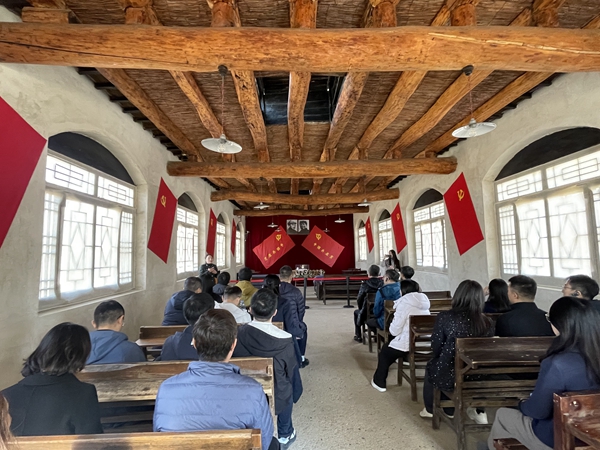
从西柏坡到信托一线:红色精神激励信托业写好转型“赶考”新答卷
Jin Rong Shi Bao· 2025-12-03 01:36
初冬的清晨,在河北省石家庄市平山县西柏坡纪念馆外的广场上,中粮信托公司的干部员工从这里 踏上了红色精神的寻根之路。 正风肃纪、清风正气、凝聚合力,正是他们一行40余人来到这里的目的。 "我们想在这片红色土地上,感悟'转折时期的战略智慧',汲取'攻坚阶段的精神力量',找到'突破 瓶颈的实践方法'。"中粮信托有关负责人说。 走进西柏坡纪念馆,一个个镌刻初心的细节、一段段凝结担当的往事,共产党人在关键历史节点上 的清醒与坚韧,令大家深受触动。 从"要我做"到"我要做"的转变,正是红色精神内化于心的体现。黄文俊说:"农粮产业链覆盖范围 广、客户需求差异大、产业细分场景多,既要通过产业特色措施控制风险,又要考虑模式可复制可推 广,哪个都是难啃的'硬骨头'。""只有真刀真枪打拼,多当几回'热锅上的蚂蚁',才有机会打出产融特 色。"有了革命精神的激励,他对未来工作的热情和信心更足了。 党的二十届四中全会提出"激发干部队伍内生动力和整体活力""统筹推进各领域基层党组织建 设""把党的领导贯穿经济社会发展各方面全过程",为信托行业党建工作锚定航向。 "中国共产党经过28年艰苦卓绝的斗争,1949年3月从西柏坡出发'进京赶考'… ...