
Jin Rong Shi Bao

Search documents
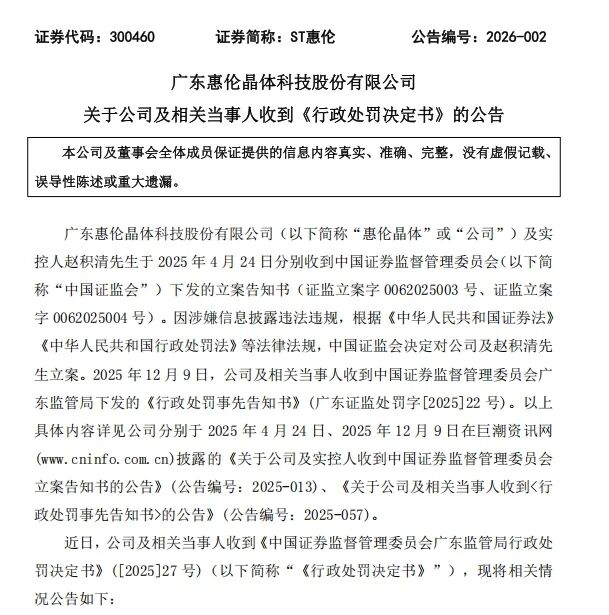
以财务造假掩盖资金占用?监管开出千万级罚单→
Jin Rong Shi Bao· 2026-01-14 02:50
Core Viewpoint - Huineng Crystal Technology Co., Ltd. has been fined a total of 11.4 million yuan due to significant financial misconduct, including fund misappropriation and financial fraud [1][7]. Group 1: Financial Misconduct - The company transferred 28.33 million yuan to related parties under the guise of procurement in 2020, which constituted 5.12% of its net assets, and failed to disclose this in its annual report, leading to a major omission [3][5]. - To cover up the fund misappropriation, Huineng Crystal engaged in financial fraud from 2021 to 2022, inflating revenue by 25.49 million yuan in 2021 and 62.33 million yuan in 2022 [6]. Group 2: Regulatory Actions - The Guangdong Securities Regulatory Bureau imposed a fine of 3 million yuan on Huineng Crystal and penalized its executives, including a 4 million yuan fine on the chairman [7]. - The company acknowledged that the violations identified in the administrative penalty decision were consistent with those in the prior notice, and these violations did not trigger mandatory delisting conditions [7]. Group 3: Company Performance - Huineng Crystal reported a 4.7% year-on-year decline in revenue and a net loss of 76.12 million yuan in the third quarter of 2025, indicating a significant worsening of financial performance [7].

推动农业保险 高质量发展
Jin Rong Shi Bao· 2026-01-14 02:47
Core Viewpoint - The Financial Regulatory Administration has responded to various proposals from the National People's Congress and the Chinese People's Political Consultative Conference, outlining directions for enhancing the quality of agricultural insurance development, including revisions to the Agricultural Insurance Regulations, integration of agricultural data, and the promotion of green agricultural insurance [1][2][3][4][5][6]. Group 1: Agricultural Insurance Regulation Revisions - The Financial Regulatory Administration acknowledges the importance of revising the Agricultural Insurance Regulations to adapt to changing conditions and improve the agricultural insurance system, which has been in place since March 1, 2013, and was revised in 2016 [2]. - The existing legal framework for agricultural insurance is deemed relatively complete and has proven effective in stabilizing farmers' incomes and supporting modern agricultural development [2]. Group 2: Integration of Agricultural Data - The administration is focused on enhancing the technological capabilities of agricultural insurance through the integration of various data sources, including big data, satellite remote sensing, and GPS technology, to improve underwriting and claims processes [3]. - Future efforts will involve collaboration with relevant departments to strengthen the national agricultural insurance information management platform, promoting data sharing and optimizing risk management services [3]. Group 3: Green Agricultural Insurance - The Financial Regulatory Administration is promoting the establishment of a green agricultural insurance service system aimed at supporting sustainable agricultural development and mitigating ecological risks [4]. - Insurance companies are encouraged to collaborate with research institutions to develop risk assessment models based on big data and remote sensing technology, enhancing the precision of risk evaluations [4]. Group 4: Agricultural Employment Insurance - The administration is guiding insurance companies to develop products that address employment risks, including various employer liability insurances, to support flexible employment in the agricultural sector [5][6]. - The focus is on providing better insurance coverage for flexible workers in agriculture, ensuring that insurance products are designed to meet the specific needs of different industries and job types [6].
“确诊即赔”被拒 重疾险“二次限定”条款引争议
Jin Rong Shi Bao· 2026-01-14 02:37
"确诊即赔"是很多重疾险产品宣传时吸引消费者的承诺。然而,不少消费者在真正确诊重大疾病后 却遭遇拒赔,原因往往隐藏在保险合同冗长的免责条款或疾病的"二次限定"条件之中。由于重疾险的高 度专业性,相关争议时有发生。近期,北京市西城区人民法院(以下简称"西城区法院")发布一起典型 案例。 针对此类问题,法官建议多方协同共治。西城区法院金融街人民法庭副庭长苏畅表示,保险公司要 严格合规经营,严格规范销售全流程,全面提升理赔服务质量,发挥风险保障最大效能;保险行业协会 要重视自律管理,牵头更新示范条款,发挥行业自律惩戒职能,激发合规展业内生动力;消费者也要提 高自身法律意识,认真阅读保险条款,从正规渠道购买保险,依法维护自身权益;监管司法更要联动作 为,建立常态化信息共享机制,在多元纠纷调解机制上深入合作,发挥行业治理最强合力。 责任编辑:袁浩 贾某申请理赔后,保险公司以"未出现角膜色素环、未进行肝脏活检"为由拒赔,认为未达到合同约 定的严重程度。贾某提交的病历显示,患儿K-F环呈阴性,但该指标并非衡量病情严重程度的依据;未 进行肝活检,是因为该检查非必需项目。患儿基因检测及肝功能等指标已能明确诊断。贾某遂向法院提 ...
2025年前11个月广东保险业 原保险保费收入同比增长7.03%
Jin Rong Shi Bao· 2026-01-14 02:37
Core Insights - The financial regulatory authority in Guangdong has released key regulatory indicators for the insurance industry, showing significant growth in assets and premium income [1] Group 1: Asset Growth - As of November 2025, the total assets of the insurance industry in the region reached 1.97 trillion yuan, representing an increase of 11.03% from the beginning of the year [1] - Property insurance companies reported assets of 133.95 billion yuan, up by 6.61% year-to-date [1] - Life insurance companies held assets of 1.84 trillion yuan, reflecting a growth of 11.37% since the start of the year [1] Group 2: Premium Income and Claims - In the first eleven months of 2025, the insurance industry achieved original premium income of 535.12 billion yuan, marking a year-on-year increase of 7.03% and ranking second nationally [1] - Claims and benefit payments amounted to 198.91 billion yuan, which is an increase of 8.48% compared to the previous year [1] - The underwriting profit for insurance companies was reported at 7.03 billion yuan [1]
一场跨越万里的救援
Jin Rong Shi Bao· 2026-01-14 02:37
"我摔伤了……想回家。" 日前,一通从瑞士打来的援助电话,打破了中国平安服务网络的日常运转。电话那头,是因疼痛与 无助导致声音微微颤抖的陈女士。一场跨越万里、争分夺秒的守护行动,自此迅速展开。 这场本应充满欢笑的瑞士之旅,在2025年12月4日骤然改变。陈女士因路滑不慎摔倒,致左脚骨 折。剧痛之外,语言障碍与陌生的就医流程,更让身处异国他乡的陈女士倍感焦虑,于是她拨通了一串 并不熟悉的号码——平安24小时全球急难援助热线。 责任编辑:袁浩 从意外发生时的茫然无助,到最终安然归国接受治疗,陈女士的感慨真挚而朴素:"在异国他乡意 外受伤,语言还不通,心里特别着急。没想到仅仅是一个求助电话,平安就派来了专业的守护团队,不 仅关心我的伤势,更如同家人般陪伴全程,令我非常感动。" 此次万里救援是中国平安庞大应急救援网络与专业服务能力的一个缩影。面对全球范围内客户突发 的急难险重事件,中国平安的响应机制总能快速激活。 美国时间2025年5月1日晚,美国黄石国家公园附近发生重大交通事故,造成中国公民5死8伤。中国 平安启动紧急预案,在72小时内完成跨越太平洋的急救协调,协助遇险客户医疗救治与平安返程。2025 年7月30日 ...

2026年险资举牌热度能否延续?
Jin Rong Shi Bao· 2026-01-14 02:37
Core Viewpoint - In 2025, insurance capital's shareholding activities reached a record high of 35 times, driven by regulatory encouragement, the pursuit of higher returns in a low-interest environment, and new accounting standards that help smooth profit fluctuations [1][4]. Group 1: Characteristics of Insurance Capital Shareholding - The number of shareholding activities by insurance capital in 2025 significantly exceeded the average level of recent years, marking the most active year since 2015 [2]. - A total of 14 insurance institutions participated in shareholding activities, including major listed insurance companies, bank-affiliated insurers, and Sino-foreign joint ventures, with Ping An Life being the most active, conducting 12 shareholdings [2]. - Approximately 80% of the shareholding activities were executed through the Hong Kong Stock Connect or continuous purchases in the secondary market, with other methods including agreement transfers and passive shareholding due to mergers [2]. Group 2: Strategic Logic Behind Shareholding - Insurance capital's shareholding activities were not random but followed a clear strategic logic, with a preference for the financial sector, which saw 15 shareholdings involving six banks and two insurance institutions [3]. - Other favored sectors included public utilities, transportation, and environmental protection, indicating a focus on stable, cash-generating industries [3]. - The core demand of insurance capital is for long-term, stable returns, leading to an increased allocation to equity assets as traditional fixed-income returns fail to cover liability costs [3]. Group 3: Factors Driving Shareholding Activities - Regulatory policies have encouraged long-term capital to enter the market, with measures such as increasing the investment limit for insurance companies in equity assets to 50% [4]. - Insurance institutions are responding to downward pressure on interest rates by increasing their allocation to equity assets to enhance long-term investment returns [4]. - New accounting standards impose higher requirements for asset-liability matching, allowing insurance companies to reduce the impact of market value fluctuations on current profits through shareholding [5][6]. Group 4: Future Outlook for Insurance Capital Shareholding - There is optimism that insurance capital will continue to increase equity asset allocations in 2026, with expectations of maintaining high shareholding activity levels [8]. - Analysts suggest that insurance capital's shareholding motivations will focus on stable dividend cash flows and high return on equity (ROE) targets, particularly in sectors aligned with national strategic directions such as high-end manufacturing and technological innovation [8].

广东发布全国首个省域系统性支持保险业高质量发展文件
Jin Rong Shi Bao· 2026-01-14 02:37
Core Viewpoint - The insurance industry in Guangdong is set to play a crucial role in supporting economic and social development as outlined in the newly released "Guiding Opinions" aimed at promoting high-quality development in the sector, marking a shift from growth-driven to quality-driven development [1][10]. Group 1: High-Quality Development Framework - The "Guiding Opinions" is the first systematic support document for high-quality development of the insurance industry at the provincial level in China, focusing on six key areas: technological innovation, modern industrial systems, social welfare, social governance, investment of insurance funds, and high-level openness [1][2]. - The document aims to transform the insurance industry's development momentum into an advantage for Guangdong, potentially providing a model for other regions in China [1][2]. Group 2: Technological Insurance System - The document emphasizes the creation of a "full-chain, multi-level, and sustainable" technological insurance system to address the unique characteristics of technology enterprises, such as high intangible asset ratios and significant R&D risks [2][3]. - It proposes the development of insurance products tailored to technology innovation, covering areas like R&D losses, equipment losses, patent protection, and cybersecurity [2][3]. Group 3: Support for Modern Industrial Systems - The "Guiding Opinions" details insurance services for key industries, focusing on manufacturing and emerging sectors such as new energy, new materials, and commercial aerospace [4][5]. - It highlights the need for insurance products that support low-altitude and marine economies, including comprehensive coverage for low-altitude flight infrastructure and marine projects [4][5]. Group 4: Social Welfare and Healthcare - The document addresses the need for enhanced social welfare, particularly for vulnerable groups such as gig economy workers, ensuring 100% insurance coverage for low-income populations [6][7]. - It encourages the development of innovative insurance products that integrate retirement, health, and caregiving services, promoting a "insurance + service" model [7][8]. Group 5: High-Level Openness and Cross-Border Integration - The "Guiding Opinions" promotes the integration of financial regulations between Guangdong and the Greater Bay Area, facilitating cross-border insurance services and enhancing the convenience of insurance transactions [8][9]. - It supports the participation of Hong Kong and Macau insurance institutions in Guangdong's market, aiming to develop health and pension products tailored for residents of these regions [8][9]. Group 6: Competitive Landscape - The shift towards high-quality development presents both challenges and opportunities for insurance companies, emphasizing the need for innovation in product development, risk pricing, and data management capabilities [9][10]. - Companies that can effectively address these challenges are likely to gain a competitive edge in the evolving insurance landscape [9][10].
开年“瘦身”步履不停 险企渠道转型聚焦精细化服务
Jin Rong Shi Bao· 2026-01-14 02:37
Core Viewpoint - The insurance industry is undergoing a significant transformation characterized by the continuous withdrawal of branch offices, reflecting a shift from extensive expansion to a focus on value and efficiency [5][6]. Group 1: Branch Withdrawals - In early 2026, multiple insurance companies, including China Life and Sunshine Insurance, have received approval to withdraw branch offices, continuing a trend observed in recent years [1]. - Over the past six years, more than 13,000 branch offices have been closed, with the number of withdrawals increasing from 971 in 2020 to over 3,100 in 2025, marking a new high [2]. - The majority of the withdrawn branches are located in third and fourth-tier cities, with over 70% of the closures in 2025 being marketing service departments [2][3]. Group 2: Factors Driving Closures - The closures are driven by three main factors: regulatory policies, changing market conditions, and technological advancements [4]. - Regulatory bodies have pushed for the elimination of "empty" and "inefficient" branches, particularly following the implementation of the "reporting and operation integration" policy [4]. - The competitive insurance market and rising operational costs have made it essential for companies to optimize branch structures and eliminate low-efficiency outlets [4]. Group 3: Industry Transformation - The ongoing withdrawal of branch offices is seen as a necessary process for the industry to abandon extensive expansion and reconstruct channel value [5]. - The industry is at a critical juncture, focusing on high-quality transformation while addressing challenges such as customer service continuity and talent retention [7]. - Companies are shifting from a traditional sales model to a service-oriented approach, integrating insurance products with health management and other value-added services to enhance customer loyalty [8]. Group 4: Future Outlook - The future of insurance branch offices will not be a complete replacement by online channels but rather a transformation of their functions to enhance customer experience and provide specialized services [8]. - The new channel structure will consist of comprehensive service points in major cities, grid-based service units in lower-tier markets, and a blend of online and offline services [8].

2025年险企增资共性诉求:提升偿付能力水平
Jin Rong Shi Bao· 2026-01-14 02:37
1月8日,汇丰人寿发布公告称,拟增资5.56亿元,增资资金由该公司唯一股东——汇丰保险(亚 洲)有限公司全额出资。增资后,注册资本将由26.76亿元增至32.32亿元。 这是自2022年汇丰人寿正式成为汇丰保险(亚洲)全资控股的外资独资寿险公司后,第四次增资。 增资的背后,是业务扩张带来的资本需求与战略布局的持续深化。此次增资将直接提升汇丰人寿的偿付 能力水平,进一步增强其资本实力以支持业务扩展和风险管理需求。 据《金融时报》记者不完全统计,2025年,23家保险公司披露增资计划、增资获批公告,合计规模 近470亿元。 人身险公司增资需求更高 从公司类型来看,人身险公司增资需求最旺盛,12家公司拟增资或增资已获监管部门批准,且增资 金额较高。比如,平安人寿以近200亿元增资领跑,注册资本提升至360亿元;中邮人寿紧随其后,中邮 集团、友邦保险联合增资39.8亿元,注册资本升至326.43亿元;国联人寿、中信保诚增资也达到20亿 元。 财产险公司方面,7家公司合计增资超75亿元。其中,众安在线以增资21.5亿元领跑,此次增资采 用在香港联合交易所主板新增发行H股股票的方式。 另外,3家养老险公司也在2025年披 ...
以“双精准”撬动农业保险高质量发展
Jin Rong Shi Bao· 2026-01-14 02:26
Core Viewpoint - The recent Central Rural Work Conference emphasizes the importance of strengthening agriculture for national security, highlighting the need for a robust income guarantee mechanism for grain farmers, with agricultural insurance playing a crucial role in risk management and stability [1]. Group 1: Agricultural Insurance Development - China's agricultural insurance is transitioning from "expanding coverage and increasing products" to "improving quality and efficiency," with a focus on enhancing the product system and extending coverage from traditional farming to the entire industry chain [1]. - The shift from "cost protection" to "income protection" in insurance products aligns with the modern agricultural development needs, significantly supporting farmers' income stability [1]. - Despite the expansion of agricultural insurance, there remains a gap between its effectiveness and farmers' expectations, with issues such as mismatched coverage and arbitrary loss assessments undermining credibility [1]. Group 2: Precision Insurance Initiatives - By the end of 2024, a joint notice from the Financial Regulatory Bureau and the Ministry of Finance will promote "dual precision" in agricultural insurance, focusing on accurate underwriting and claims, marking a shift in governance philosophy from mere availability to quality [2]. Group 3: Technological Empowerment - The core of precise underwriting and claims lies in the authenticity and timeliness of data, necessitating technological empowerment to break down information barriers and enhance efficiency [3]. - The development of a national agricultural insurance information management platform and the implementation of digital operations in various regions demonstrate the potential of technology to improve accuracy and reduce moral hazards [3]. - It is essential to balance digital tools with offline services to accommodate the aging farming population and ensure accessibility [3]. Group 4: Product Innovation and Collaboration - To address diverse needs of new agricultural entities, there is a need for multi-layered insurance products that upgrade protection levels towards income assurance [4]. - Cross-departmental collaboration, particularly the integration of meteorological data, is crucial for precise pricing and risk assessment in agricultural insurance [4]. Group 5: Risk Diversification Mechanisms - Given the high dependency of agriculture on natural conditions, establishing a multi-layered risk diversification mechanism is vital for sustainable agricultural insurance development [5]. - Implementing a disaster risk diversification mechanism involving fiscal support and shared risk among multiple parties will enhance the resilience of insurance institutions and stabilize market expectations [5]. Group 6: Implementation and Impact - Following the Central Rural Work Conference's guidance, the implementation of "dual precision," product innovation, and technological empowerment will create a standardized, precise, and efficient agricultural insurance service system, contributing to food security and farmers' income [6].