Qian Zhan Wang

Search documents
2025年中国商业遥感卫星行业发展现状 产业链上游环节逐步完善【组图】
Qian Zhan Wang· 2025-06-19 04:13
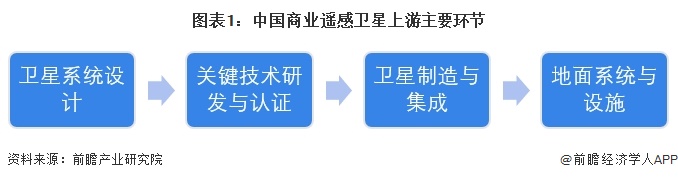
Core Insights - The article discusses the development and competitive landscape of China's commercial remote sensing satellite industry, highlighting the key players, market trends, and technological advancements [1][3][5]. Industry Overview - The upstream segment of China's commercial remote sensing satellites includes satellite system design, key technology research and certification, satellite manufacturing and integration, and ground systems and facilities [1]. - The manufacturing and launch of commercial remote sensing satellites involve significant capital expenditure, with government participation providing a funding advantage [3]. - The industry is moving towards standardization, openness, and modularization to meet the flexible and universal needs of space missions [3]. Satellite Classification and Trends - Satellites are categorized based on weight into large, medium, micro, nano, pico, and small satellites, with a focus on small satellites weighing under 1,000 kg [4]. - The trend in the aerospace sector is shifting towards small satellite constellations replacing larger satellites, driven by the capabilities of companies like China Satellite [4]. Competitive Landscape - The commercial satellite industry in China is poised for significant growth, with launch prices for micro-satellites ranging from $15,000 to $20,000 per kilogram, compared to $30,000 to $50,000 internationally [5]. - Key players in satellite manufacturing and launch include China Aerospace and China Dongfanghong Satellite, which have strong capabilities in both areas [5][7]. - Private companies like Chongqing Zero One Space and Yuanxin Satellite are also emerging as competitors in the micro-satellite launch market [5]. Ground Station Market - Remote sensing satellite ground stations are crucial for receiving, processing, archiving, and distributing satellite data, with the market growing alongside advancements in remote sensing technology [6][10]. - The ground station infrastructure in China is extensive, with a network of stations capable of real-time data reception covering all of China and 70% of Asia's land area [11]. Construction and Demand - The demand for high-quality remote sensing data is increasing across various sectors, including agriculture, forestry, and environmental monitoring, driving the need for ground stations [10]. - The rise of commercial remote sensing satellites is stimulating the construction of ground stations, with many countries investing in this infrastructure [10]. Operational System - China's ground station network consists of five main stations, equipped with advanced data reception technology and capable of handling large volumes of satellite data [11].


预见2025:《2025年中国演唱会行业全景图谱》(附市场现状和发展趋势等)
Qian Zhan Wang· 2025-06-19 03:10
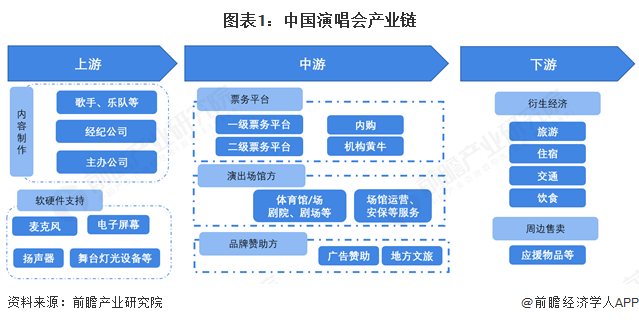
Industry Overview - The concert industry in China has a well-defined structure involving content production, hardware support, ticketing platforms, venue management, and brand sponsorship [1][2] - The concert industry chain includes upstream content creators, midstream ticketing and venue operators, and downstream economic derivatives such as tourism and merchandise sales [1] Industry Development - The concert market in China has shown a recovery post-pandemic, with ticket revenue reaching 29.636 billion yuan in 2023, a year-on-year increase of 66.53% [7] - In 2024, large-scale concerts are expected to generate over 26 billion yuan in ticket sales, reflecting a 78.1% increase year-on-year [8] - The number of artists hosting large concerts has increased by 29.5% in 2024, with 79.7% of these being tour projects [14] Competitive Landscape - CMCLive is identified as a leading concert organizer in China, with significant artist resources and experience [17] - Major ticketing platforms include Damai, Maoyan Entertainment, and Motianlun, which are commonly used by consumers for ticket purchases [17] - The distribution of concert-related enterprises is concentrated in economically developed regions, with Guangdong having over 50,000 companies [20] Future Trends - The concert industry is expected to continue expanding due to policy support, rising consumer demand, and technological innovation [22] - Digital technology will increasingly integrate into various aspects of concerts, with a focus on quality content creation and industry consolidation [22]
【全网最全】2025年中国纺织行业上市公司全方位对比(附业务布局汇总、业绩对比、业务规划等)
Qian Zhan Wang· 2025-06-19 03:09
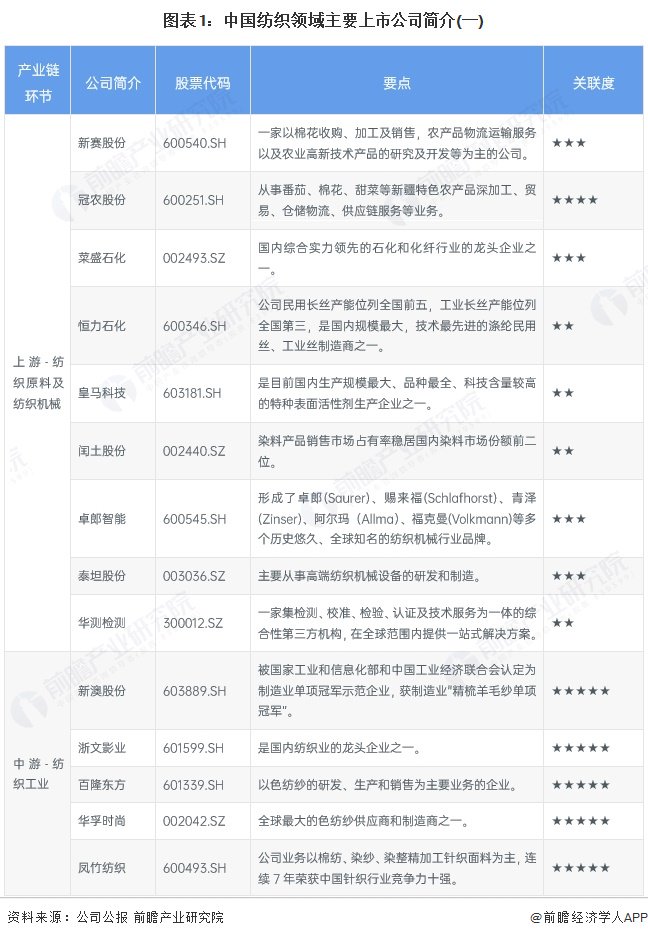
Group 1 - The textile industry in China is characterized by a comprehensive supply chain, including upstream raw material suppliers, midstream textile manufacturers, and downstream apparel producers [1][6] - Key players in the textile industry include companies like Xin'ao Co., Hengli Petrochemical, and Zhejiang Wenyi, which are involved in various segments of the textile supply chain [1][2] - The industry is concentrated in regions such as Zhejiang, Jiangsu, Guangdong, Fujian, and Shandong, which are known for their large-scale production bases and competitive advantages in trade and talent [6] Group 2 - In terms of business performance, companies like Xin'ao Co. and Zhejiang Wenyi focus on domestic markets, while others like Bailong Dongfang and Huasheng Co. have significant international operations [7][9] - The textile business of Xin'ao Co. accounts for 99.34% of its operations, indicating a strong focus on the textile sector [9] - Companies are planning for capacity expansion and technological advancements to address challenges such as insufficient consumer demand and intense market competition [11][13] Group 3 - Xin'ao Co. is expanding its production capacity with a new facility in Vietnam, aiming for a total annual production capacity of 6,500 tons of fine wool yarn by 2027 [13] - Bailong Dongfang is cautiously expanding its production capacity in Vietnam, with plans for additional workshops [13] - Companies are also investing in smart and green technologies to enhance operational efficiency and reduce costs [11][13]


刘强东:京东外卖商业模式将彻底解决食品安全问题,布局外卖靠供应链赚钱【附外卖行业市场分析】
Qian Zhan Wang· 2025-06-18 11:08
Group 1 - JD's business model is entirely centered around the supply chain, including its new food delivery service, which aims to address food safety issues and provide high-quality, cost-effective food options [2] - JD's founder Liu Qiangdong plans to differentiate JD's food delivery service from Meituan's, focusing on the underlying fresh supply chain rather than just competing in the meal delivery market [2] - JD aims to capture one-third of the food delivery market by offering better products, lower prices, and superior service, thus alleviating the "choose one" dilemma for restaurants [2] Group 2 - As of June 2025, JD's food delivery service has expanded to 142 cities and partnered with over 450,000 quality dining restaurants, with full-time delivery riders exceeding 120,000 [3] - The food delivery market in China is dominated by Meituan and Ele.me, which together hold over 90% of the market share, with Meituan at 68.2% and Ele.me at 25.4% as of mid-2020 [3] - The Chinese food delivery market reached a scale of 1.1 trillion yuan in 2022, with a compound annual growth rate exceeding 20% from 2018 to 2022, and the user base growing by 26.83% during the same period [4] Group 3 - The food delivery sector has evolved into a comprehensive ecosystem, encompassing various stakeholders such as restaurant brands, packaging companies, raw material suppliers, and shared mobility services [5]



2025年中国无人驾驶物流车行业企业产品发展现状:产品性能稳步提升
Qian Zhan Wang· 2025-06-18 08:57
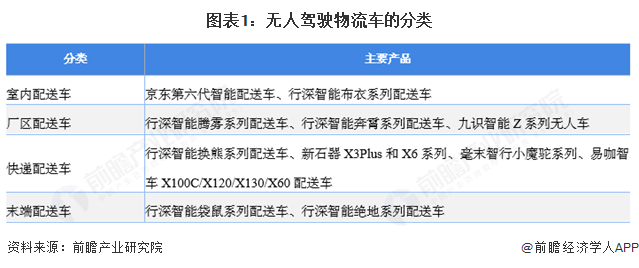
Core Viewpoint - The article discusses the rapid development and commercialization of autonomous logistics vehicles, highlighting their transformative impact on the traditional logistics industry through advanced technologies and diverse applications in various delivery scenarios [1][4]. Group 1: Product Categories of Autonomous Logistics Vehicles - Autonomous logistics vehicles are categorized into several types based on their application scenarios, including indoor delivery, factory delivery, express delivery, and last-mile delivery [1]. - The average volume of autonomous logistics vehicles in China has exceeded 4 cubic meters, with an average load capacity of over 1 ton, indicating their capability to meet existing logistics transportation demands [3]. Group 2: Company Product Analysis - JD Logistics has introduced its sixth-generation intelligent delivery vehicle, which has a cargo volume of 4 cubic meters and a maximum load of 1000 kg, featuring modular design and a range of advanced technologies for L4 level autonomous driving [4]. - New Stone Technology focuses on developing and manufacturing cargo-type autonomous vehicles, targeting urban delivery markets with a transportation radius extending from 5 km to 50 km, and pricing between 40,000 to 50,000 yuan per unit [6]. - Xing Shen Intelligent's autonomous vehicles are designed for various end-use scenarios, with payload capacities ranging from 400 kg to 3 tons and volume options from 1 to 22 cubic meters, showcasing a diverse product lineup [9]. Group 3: Performance and Specifications - New Stone Technology's models include the X3 and X6, with cargo spaces of 3 m³ and 6 m³, maximum speeds of 50 km/h and 60 km/h, and prices ranging from 40,000 to 50,000 yuan per unit [7]. - Xing Shen Intelligent's vehicles have various models with cargo spaces from 1 m³ to 22 m³, maximum speeds of 25 km/h to 40 km/h, and payloads from 400 kg to 3 tons, catering to different logistics needs [10]. - Nine Sense Intelligent's vehicles, such as the Z2 and Z10, offer payloads up to 1,650 kg and cargo spaces up to 10 m³, suitable for industrial logistics and long-distance transportation [12].



【行业深度】洞察2025:中国口腔种植行业竞争格局(附竞争梯队、企业竞争力评价等)
Qian Zhan Wang· 2025-06-18 08:12
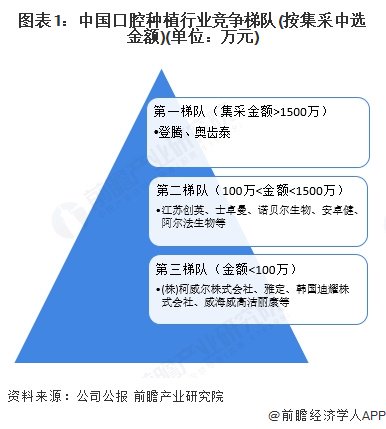
Group 1 - The core viewpoint of the article highlights the competitive landscape of the Chinese dental implant industry, focusing on market concentration and the positioning of key players [1][4][10] - The first tier of the competitive hierarchy includes Dentsply Sirona and Osstem Implant, with procurement amounts exceeding 15 million yuan, significantly surpassing other companies [1][4] - The market share of foreign brands, particularly mid-range Korean brands, is substantial, while domestic brands have a lower overall market share [4][10] Group 2 - The market concentration in the dental implant sector is high, with a CR2 of 45.78% and a CR5 of 69.94%, indicating a strong presence of leading mid-range Korean and high-end European brands [5][10] - The competitive environment is characterized by numerous players, including public dental hospitals and large chain dental institutions, which have advantages in brand recognition and technology [10][11] - The entry barriers in the dental implant industry are significant due to the need for specialized talent, advanced equipment, and time-consuming brand building [11][12] Group 3 - The regional layout of key listed companies shows that most operate primarily within China, with specific companies focusing on particular provinces, such as Keren Dental in Shandong and Blue Sky Dental in Guangxi [6][9] - Revenue from dental implant services is notably high for companies like Tongce Medical, Yaboshi, and Reer Group, indicating strong market performance [6][9] - The article emphasizes the increasing preference for dental implants over traditional dentures, as patients seek better functionality and aesthetics [11][12]


称霸欧美!国产机器人正在疯狂割老外的“草”,可自动避障、厘米级定位【附园艺机具行业市场分析】
Qian Zhan Wang· 2025-06-18 04:10
Group 1 - The core viewpoint is that domestic lawn mowing robots are gaining popularity in overseas markets due to their technological advantages and cost-effectiveness, becoming essential tools for garden maintenance in European and American households [2][4]. - Companies such as Ninebot, Ecovacs, Greebo, and Daye Co. have experienced rapid growth in performance this year, with overseas sales of smart lawn mowing robots emerging as a new highlight [2]. - The products feature advanced technologies such as automatic obstacle avoidance, centimeter-level positioning, and efficient path planning, significantly enhancing performance and user experience [2]. Group 2 - The acceleration of domestic production of key components like laser radar has reduced overall costs, leading to lower product prices and increased market competitiveness [2][3]. - In countries like the U.S. and Germany, traditional lawn mowers have environmental and efficiency shortcomings, which the smart lawn mowing robots effectively address, resulting in widespread consumer approval [2]. - Ecovacs has established a stable after-sales system in the German market, providing comprehensive service guarantees and designing products that cater to European user habits [2]. Group 3 - The global lawn mowing robot market was valued at approximately $7.12 billion in 2022 and is expected to exceed $15 billion by 2030, indicating significant market potential for domestic lawn mowing robots [4]. - The complete industrial chain and strong supporting capabilities of Chinese companies provide solid support for overseas expansion, ensuring production efficiency and product quality while lowering costs [3].



前瞻全球产业早报:我国磁悬浮技术突破,百公里加速不到1秒
Qian Zhan Wang· 2025-06-17 23:12
Group 1 - China's magnetic levitation technology has achieved a breakthrough, accelerating a 1.1-ton test vehicle to 650 km/h within 1 second over a distance of 1000 meters [2] - The Summer Davos Forum in Tianjin will focus on five major themes, including global economic interpretation and new energy materials, with around 1800 attendees from over 90 countries [3] - The Henan provincial government is promoting state-owned enterprise investment, enhancing collaboration with central and private enterprises, and expanding government fund scales to support long-term investors [4] Group 2 - Tencent's Yuanbao has launched an AI programming mode, significantly improving coding efficiency with a dual-column interface for real-time code generation and preview [5] - Meituan's CEO Wang Xing has reduced his stake in Li Auto by selling 5.737 million shares, resulting in a decrease from 20.94% to 20.61% of his holdings [6] - Rokid has announced the world's first payment-enabled smart glasses, integrating Alipay for secure transactions without needing a mobile device [7] Group 3 - The successful zero-height escape flight test of the Dream Chaser manned spacecraft marks a significant advancement in China's lunar exploration program [8] - The Civil Aviation Administration of China has issued a management regulation for civil unmanned aerial vehicle incidents, effective from July 1, detailing emergency and non-emergency reporting processes [9] - Guoxin Technology has successfully tested its new quantum-resistant password card, which combines quantum algorithms with traditional encryption methods [10] Group 4 - Baidu is enhancing its digital influencer strategy by launching the "Dream Butterfly" plan to increase the number of digital influencers and providing significant operational support [11] - Four Chinese cities have been ranked in the top ten for global esports city influence, reflecting China's strong engagement with esports [12] - Shanghai has introduced a "tap to refund" service for departing tourists, enhancing the efficiency of tax refunds through collaboration with Alipay and Bank of China [13] Group 5 - Tmall's 618 sales event saw over 6900 new products achieving sales of over one million, with a 153% increase in overall sales during the event [14][15] - Nvidia will participate in the upcoming Chain Expo, showcasing new products and innovations in the supply chain sector [16] - OpenAI has secured a $200 million contract with the U.S. Department of Defense to explore AI applications in various administrative and security tasks [16] Group 6 - The world's largest car carrier, "Anji Hongsheng," has set sail from Taicang Port, carrying over 8000 Chinese cars to Europe, marking a record in shipping capacity [17] - Faraday Future executives have signed a 10b5-1 stock purchase plan, indicating a new round of insider buying [18] - Volvo and Daimler are forming a joint venture to develop software-defined vehicles, aiming to reduce costs and reliance on suppliers [18] Group 7 - The International Energy Agency forecasts that global oil demand will reach an average of 103.8 million barrels per day by 2025 [19] - LG Display plans to invest 1.2 trillion KRW (approximately 8.8 billion RMB) to enhance its OLED technology competitiveness by mid-2027 [20] - Eli Lilly is in advanced talks to acquire gene-editing company Verve Therapeutics for up to $1.3 billion, aiming to strengthen its drug pipeline [21]

定位高性能豪华SUV,7月上市!雷军:小米YU7留资量是SU7三倍,很多用户都在期待【附新能源汽车行业市场分析】
Qian Zhan Wang· 2025-06-17 10:35
Core Insights - Xiaomi's upcoming electric vehicle, the YU7, has generated significant user interest, with pre-registration numbers three times that of the SU7 during its tech release [2][3] - The YU7 is positioned as a high-end electric SUV, featuring advanced technology and luxurious configurations, and is expected to be priced competitively against models like the Tesla Model Y [3][4] - Since its entry into the electric vehicle market in 2021, Xiaomi has rapidly established itself, achieving a cumulative order volume of 248,000 vehicles within nine months of launching its automotive business [4] Market Position and Strategy - Xiaomi's automotive strategy involves a comprehensive approach, including investments in startups, in-house research and development, and deep collaborations with suppliers to build a complete ecosystem for smart vehicles [4] - The company has invested 105 billion yuan in its automotive venture, with plans to increase this to over 30 billion yuan by 2025, emphasizing the importance of substantial investment in technology and product development [8] Industry Context - The Chinese electric vehicle market is experiencing unprecedented growth, with production reaching 12.888 million units in 2024, a year-on-year increase of 34.4% [5] - The overall automotive market in China is expected to show steady progress, with the penetration of electric vehicles in both passenger and commercial segments becoming more normalized [8]


2025年中国铝型材上游产业发展现状分析:我国铝工业四大核心产业产量稳居世界前列
Qian Zhan Wang· 2025-06-17 09:12
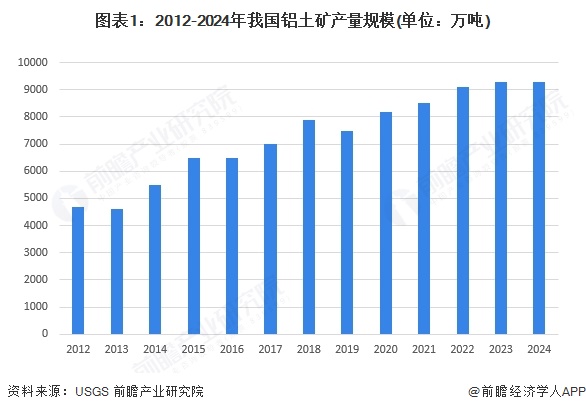
Group 1 - In 2024, China's bauxite production is expected to be approximately 93 million tons, remaining stable compared to 2023 due to environmental regulations and mining restrictions [1] - China's alumina production is projected to reach about 85.52 million tons in 2024, reflecting a year-on-year growth of 3.9% [2] - The output of electrolytic aluminum in China is estimated to be around 44.01 million tons in 2024, showing a year-on-year increase of 4.6% [4] Group 2 - China's recycled aluminum production is anticipated to be about 10.5 million tons in 2024, continuing its growth trend despite previous slowdowns [5][8] - The production of aluminum processing materials in China is expected to be around 64.6 million tons in 2024, with a year-on-year growth of 4.2%, accounting for 67.15% of the global total [9]