
Guo Jia Tong Ji Ju

Search documents
2025年居民收入和消费支出情况
Guo Jia Tong Ji Ju· 2026-01-19 02:01
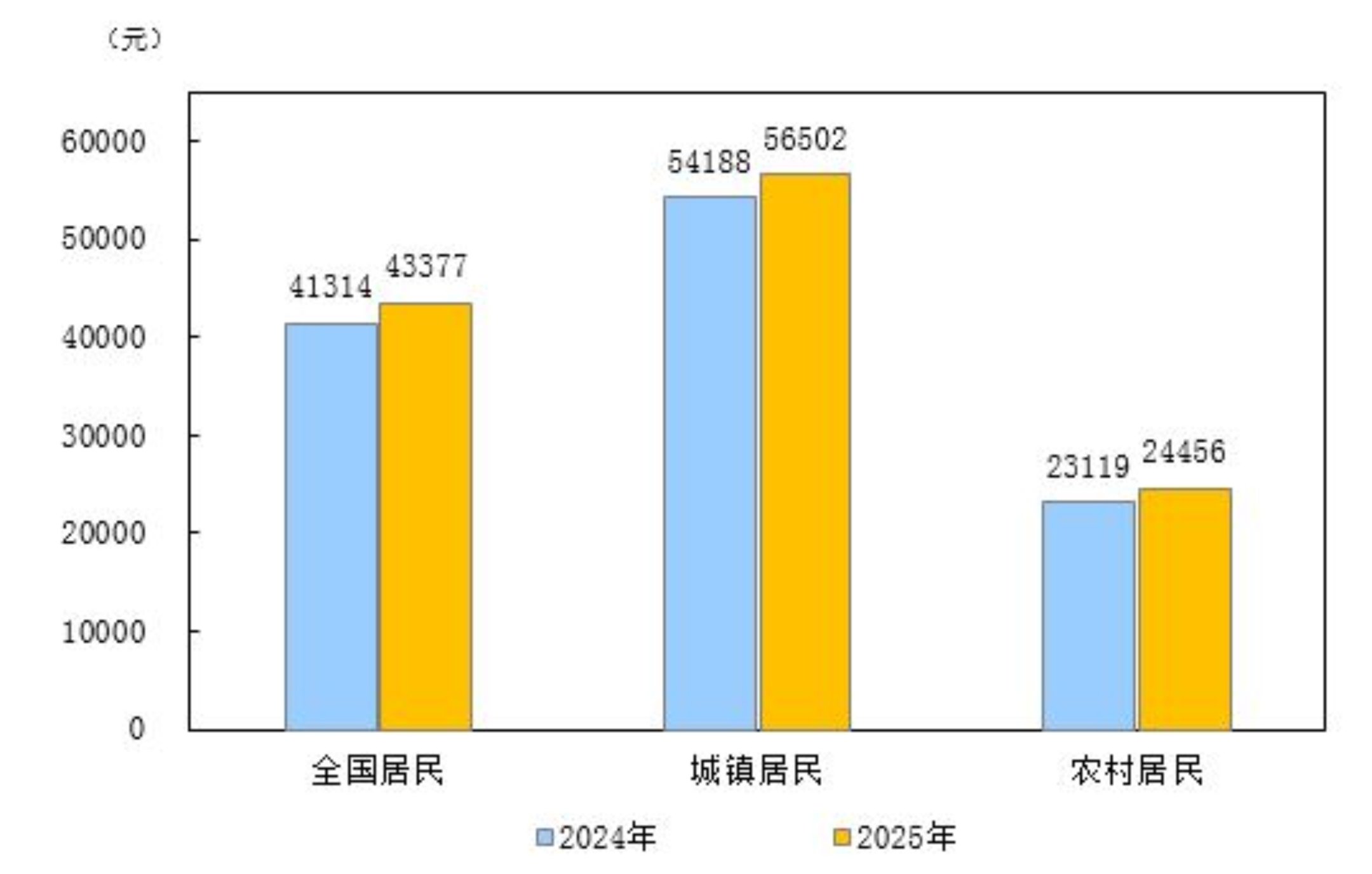
一、居民收入情况 2025年,全国居民人均可支配收入43377元,比上年名义增长5.0%,扣除价格因素,实际增长5.0%。分城乡看,城镇居民人均可支配收入56502元,增长 (以下如无特别说明,均为同比名义增长)4.3%,扣除价格因素,实际增长4.2%;农村居民人均可支配收入24456元,增长5.8%,扣除价格因素,实际增长 6.0%。 按收入来源分,2025年,全国居民人均工资性收入24555元,增长5.3%,占人均可支配收入的比重为56.6%;人均经营净收入7252元,增长5.0%,占人均可 支配收入的比重为16.7%;人均财产净收入3490元,增长1.6%,占人均可支配收入的比重为8.0%;人均转移净收入8080元,增长5.7%,占人均可支配收入的 比重为18.6%。 2025年,全国居民人均可支配收入中位数36231元,增长4.4%,中位数是平均数的83.5%。其中,城镇居民人均可支配收入中位数51115元,增长3.7%,中位 数是平均数的90.5%;农村居民人均可支配收入中位数20711元,增长5.6%,中位数是平均数的84.7%。 图1 2025年全国及分城乡居民人均可支配收入 二、居民消费支出情 ...

2025年全国固定资产投资基本情况
Guo Jia Tong Ji Ju· 2026-01-19 02:01
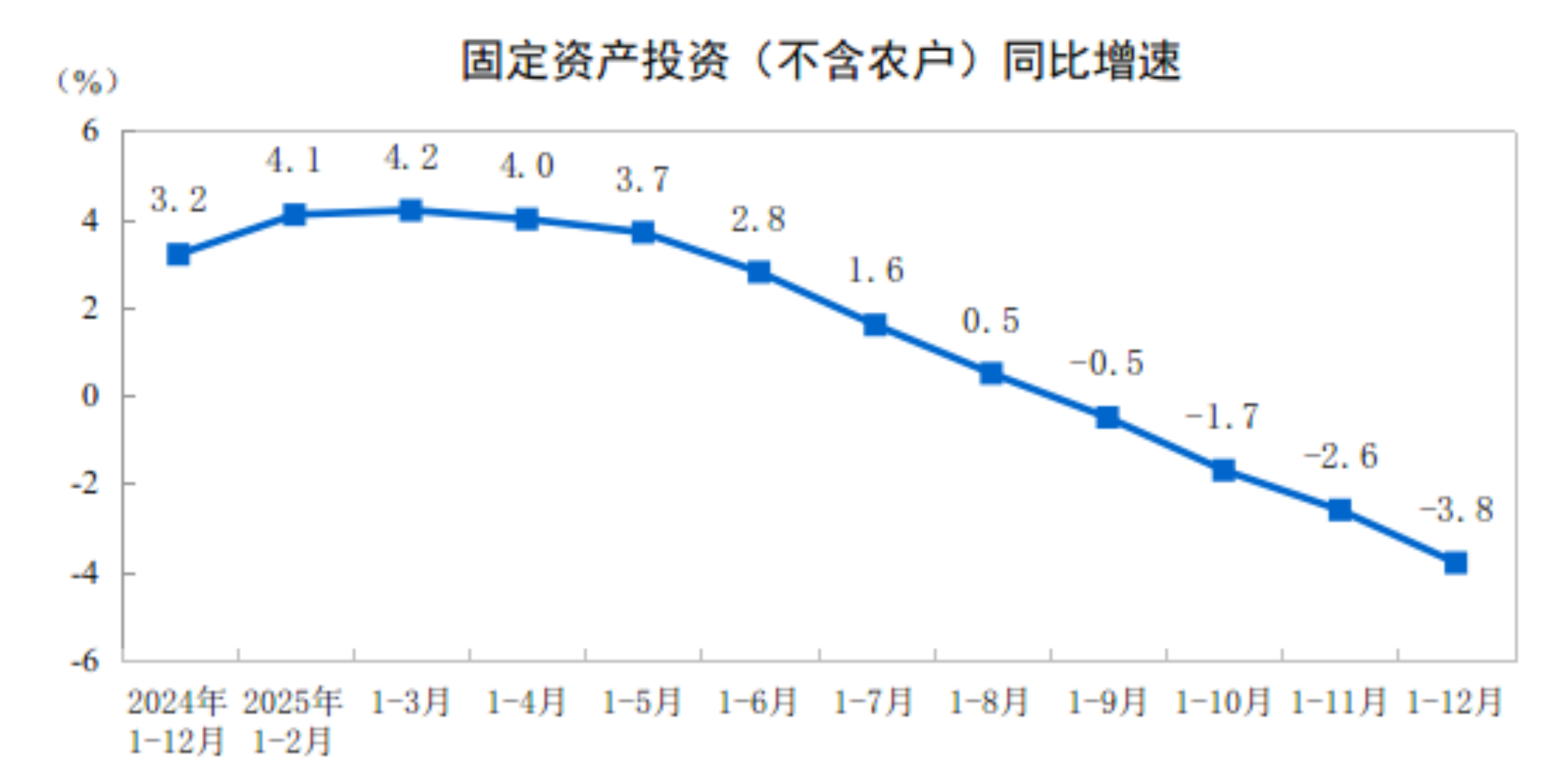
Core Insights - In 2025, China's fixed asset investment (excluding rural households) reached 48,518.6 billion yuan, a decrease of 3.8% compared to the previous year, with private fixed asset investment declining by 6.4% [1][6] Investment by Industry - Investment in the primary industry was 957 billion yuan, showing a growth of 2.3% year-on-year [3] - Investment in the secondary industry totaled 177,368 billion yuan, with a growth of 2.5% [3] - The tertiary industry saw a decline in investment, amounting to 298,248 billion yuan, down by 7.4% [3] Secondary Industry Breakdown - Within the secondary industry, industrial investment grew by 2.6% year-on-year [4] - Mining investment increased by 2.5%, while manufacturing investment grew by 0.6% [4] - Investment in the electricity, heat, gas, and water production and supply industry rose significantly by 9.1% [4] Infrastructure and Regional Investment - Infrastructure investment (excluding electricity, heat, gas, and water production and supply) decreased by 2.2% [4] - Investment in pipeline transportation surged by 36.0%, while multimodal transport and logistics saw a growth of 22.9% [4] - Investment trends varied by region, with the eastern region experiencing an 8.4% decline, the central region down by 2.7%, the western region down by 1.3%, and the northeastern region down by 15.5% [4] Investment by Registration Type - Domestic enterprises' fixed asset investment fell by 3.8%, while investment from Hong Kong, Macau, and Taiwan enterprises decreased by 2.2% [5] - Foreign enterprises saw a significant decline in fixed asset investment, down by 13.8% [5]
2025年12月份社会消费品零售总额增长0.9%
Guo Jia Tong Ji Ju· 2026-01-19 02:01
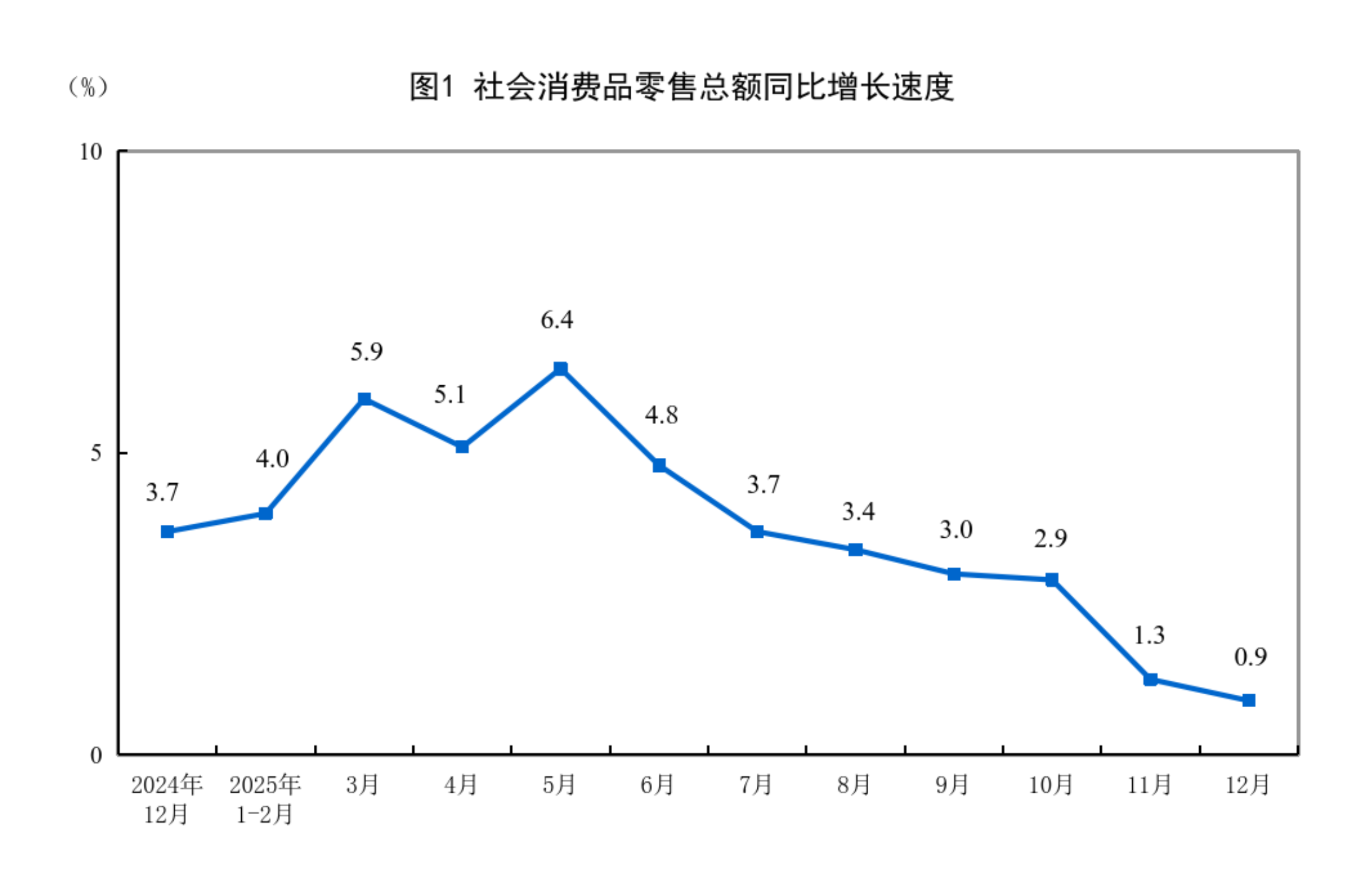
12月份,社会消费品零售总额45136亿元,同比增长0.9%。其中,除汽车以外的消费品零售额39654亿元,增长1.7%。2025年,社会消费品零售总额501202 亿元,比上年增长3.7%。其中,除汽车以外的消费品零售额451413亿元,增长4.4%。 按经营单位所在地分,12月份,城镇消费品零售额38429亿元,同比增长0.7%;乡村消费品零售额6707亿元,增长1.7%。2025年,城镇消费品零售额432972 亿元,比上年增长3.6%;乡村消费品零售额68230亿元,增长4.1%。 按消费类型分,12月份,商品零售额39398亿元,同比增长0.7%;餐饮收入5738亿元,增长2.2%。2025年,商品零售额443220亿元,比上年增长3.8%;餐饮 收入57982亿元,增长3.2%。 按零售业态分,2025年,限额以上零售业单位中便利店、超市、百货店、专业店零售额比上年分别增长5.5%、4.3%、0.1%、2.6%;品牌专卖店零售额下降 0.6%。 2025年,全国网上零售额159722亿元,比上年增长8.6%。其中,实物商品网上零售额130923亿元,增长5.2%,占社会消费品零售总额的比重为26. ...
国家统计局:12月70大中城市房价出炉
Guo Jia Tong Ji Ju· 2026-01-19 01:37
Core Insights - The data presents a comprehensive overview of the housing market across various cities, highlighting month-on-month (MoM) and year-on-year (YoY) changes in property prices for different categories of residential properties [1][4][7]. Group 1: Price Trends - The average price index for newly built residential properties in cities shows a slight decline, with many cities reporting MoM indices below 100, indicating a decrease in prices compared to the previous month [1][4]. - For properties measuring 90m² and below, the average price index is 99.3, reflecting a YoY decrease of 4.2% [7]. - Cities like Beijing and Shanghai show a MoM index of 99.6 and 98.7 respectively, indicating a downward trend in property prices [4][8]. Group 2: City-Specific Data - In Beijing, the price index for newly built residential properties is 99.6, with a YoY decrease of 3.7% [4]. - Shanghai's index stands at 98.7, showing a YoY decline of 5.3% [8]. - Cities such as Zhengzhou and Wuhan report indices of 99.4 and 99.8 respectively, indicating relative stability in their property markets [6][8]. Group 3: Comparative Analysis - The data indicates that cities like Hangzhou and Nanjing have maintained higher price indices compared to others, with Hangzhou at 99.4 and Nanjing at 100.2, suggesting a more resilient market [6][7]. - The overall trend across the 70 cities surveyed shows a general decline in property prices, with many cities experiencing significant YoY decreases [1][4][7]. - The average price index for properties larger than 144m² is 99.5, indicating a slight decrease compared to previous periods [7].

国家统计局:12月份一线城市新建商品住宅销售价格环比下降0.3% 降幅比上月收窄0.1个百分点
Guo Jia Tong Ji Ju· 2026-01-19 01:36
Core Viewpoint - The data from the National Bureau of Statistics indicates a decline in residential property sales prices across 70 major cities in December 2025, with a widening year-on-year decrease. Group 1: New Residential Property Prices - In December, first-tier cities saw a month-on-month decline of 0.3% in new residential property prices, with the decline narrowing by 0.1 percentage points compared to the previous month [1] - Shanghai experienced a price increase of 0.2%, while Beijing, Guangzhou, and Shenzhen saw declines of 0.4%, 0.6%, and 0.5% respectively [1] - Second-tier cities experienced a month-on-month decline of 0.4% in new residential property prices, with the decline widening by 0.1 percentage points [1] - Third-tier cities also saw a month-on-month decline of 0.4% in new residential property prices, with the decline remaining the same as the previous month [1] Group 2: Second-hand Residential Property Prices - In December, first-tier cities recorded a month-on-month decline of 0.9% in second-hand residential property prices, with the decline narrowing by 0.2 percentage points compared to the previous month [1] - The declines in second-hand residential property prices for Beijing, Shanghai, Guangzhou, and Shenzhen were 1.3%, 0.6%, 1.0%, and 0.6% respectively [1] - Second and third-tier cities both experienced a month-on-month decline of 0.7% in second-hand residential property prices, with the decline widening by 0.1 percentage points [1]
2025年12月份70个大中城市商品住宅销售价格变动情况
Guo Jia Tong Ji Ju· 2026-01-19 01:33
Group 1 - The article presents data on the month-on-month and year-on-year changes in housing prices across various cities in China, indicating a general trend of slight declines in residential property prices in many urban areas [1][2][3][4][5][6][7][8][9][10][11][12][13][14][15][16][17][18] - Beijing's housing price index shows a month-on-month decrease of 0.4% and a year-on-year decrease of 2.4%, with an average index of 96.6 for the year [7] - Cities like Shanghai and Hangzhou exhibit more stable prices, with Shanghai showing a month-on-month increase of 0.3% and a year-on-year increase of 3.9% [15][16] Group 2 - The data indicates that cities such as Tianjin and Tangshan also experienced declines, with Tianjin's index at 99.1 (down 0.9% month-on-month) and Tangshan at 99.2 (down 0.8% month-on-month) [7][8] - The average price index for the year across various cities shows a mixed performance, with some cities like Shenzhen and Guangzhou maintaining relatively stable prices compared to others [4][5][6] - The overall trend suggests a cautious outlook for the real estate market, with many cities experiencing downward pressure on housing prices [1][2][3][4][5][6][7][8][9][10][11][12][13][14][15][16][17][18]
国家统计局:12月各线城市商品住宅销售价格总体下降
Guo Jia Tong Ji Ju· 2026-01-19 01:32
Group 1 - In December 2025, the sales prices of commercial residential properties in 70 large and medium-sized cities showed a month-on-month decline, with an expanded year-on-year decrease [1][2] - In first-tier cities, new commercial residential property prices decreased by 0.3% month-on-month, with Shanghai increasing by 0.2% while Beijing, Guangzhou, and Shenzhen saw declines of 0.4%, 0.6%, and 0.5% respectively [1] - Second-tier cities experienced a month-on-month decline of 0.4% in new commercial residential property prices, while third-tier cities also saw a 0.4% decline [1] Group 2 - Year-on-year, first-tier cities' new commercial residential property prices fell by 1.7%, with the decline expanding by 0.5 percentage points compared to the previous month [1] - In December, second-tier cities' new commercial residential property prices decreased by 2.5% year-on-year, while third-tier cities saw a 3.7% decline, both with expanded year-on-year decreases [1] Group 3 - The second-hand residential property prices in first-tier cities dropped by 0.9% month-on-month, with Beijing, Shanghai, Guangzhou, and Shenzhen experiencing declines of 1.3%, 0.6%, 1.0%, and 0.6% respectively [1][2] - Year-on-year, second-hand residential property prices in first-tier cities fell by 7.0%, with the decline expanding by 1.2 percentage points compared to the previous month [2] - Second and third-tier cities' second-hand residential property prices both decreased by 6.0% year-on-year, with expanded declines of 0.4 and 0.2 percentage points respectively [2]
国家统计局:12月份各线城市商品住宅销售价格总体下降
Guo Jia Tong Ji Ju· 2026-01-19 01:31
Core Viewpoint - The National Bureau of Statistics reports a general decline in commodity residential sales prices across various cities in December [1] Group 1: Price Trends - In December, the sales prices of commodity residential properties in first-tier cities showed a downward trend [1] - Second-tier cities also experienced a decrease in residential property prices, indicating a broader market decline [1] - The overall trend suggests a cooling real estate market, which may impact investment strategies in the sector [1]
国家统计局:1月上旬3类煤炭价格下降
Guo Jia Tong Ji Ju· 2026-01-15 03:05
Core Viewpoint - The National Bureau of Statistics released the price changes of important production materials in the circulation field for early January 2026, indicating a mixed trend with 27 products increasing in price, 20 decreasing, and 3 remaining stable [1]. Group 1: Price Changes Overview - In early January 2026, 27 out of 50 monitored important production materials saw price increases compared to late December 2025 [1]. - Conversely, 20 products experienced price declines, while 3 products maintained stable prices [1]. Group 2: Coal Price Trends - The price of anthracite coal (washed middle block) is reported at 863.0 yuan per ton, reflecting a decrease of 2.8% from the previous period [1]. - Shanxi blended coal (5500 kcal) is priced at 694.2 yuan per ton, showing a decline of 0.5% compared to the last period [1]. - Coking coal (main coking coal) is priced at 1475.0 yuan per ton, which is a decrease of 1.7% from the previous period [1].
1月上旬全国流通市场钢材价格涨跌互现
Guo Jia Tong Ji Ju· 2026-01-15 02:17
Core Viewpoint - The national statistics indicate mixed trends in steel prices in the circulating market from late December 2025 to early January 2026, with some products experiencing price increases while others saw declines [1] Price Summary - Rebar (Φ20mm, HRB400E) price is 3191.6 CNY/ton, up by 7.0 CNY/ton, an increase of 0.2% compared to the previous period [1] - Wire rod (Φ8-10mm, HPB300) price is 3385.9 CNY/ton, up by 6.8 CNY/ton, an increase of 0.2% compared to the previous period [1] - Ordinary medium plate (20mm, Q235) price is 3341.7 CNY/ton, down by 10.6 CNY/ton, a decrease of 0.3% compared to the previous period [1] - Hot-rolled ordinary coil (4.75-11.5mm, Q235) price is 3275.3 CNY/ton, up by 2.2 CNY/ton, an increase of 0.1% compared to the previous period [1] - Seamless steel pipe (219*6, 20) price is 4051.3 CNY/ton, down by 13.7 CNY/ton, a decrease of 0.3% compared to the previous period [1] - Angle steel (5) price is 3410.5 CNY/ton, down by 10.3 CNY/ton, a decrease of 0.3% compared to the previous period [1]