
实物商品

Search documents
电商发展见顶了吗?
Ren Min Ri Bao Hai Wai Ban· 2026-02-09 22:48
Core Viewpoint - The article discusses the current state and future trends of e-commerce in China, highlighting a shift from rapid growth to a more stable development phase, with a focus on service consumption and competition for existing users [4][10]. Group 1: E-commerce Growth and Trends - The online retail sales in China are projected to reach nearly 16 trillion yuan by 2025, representing an 8.6% increase from the previous year [5]. - The proportion of physical goods online retail sales to total social retail sales peaked in 2023 at 27.6% but is expected to decline to 26.1% by 2025 [5][6]. - The growth of service consumption is becoming a significant factor, with online service consumption expected to grow by 22% by 2025, indicating a shift in consumer spending habits [12][13]. Group 2: Market Dynamics and Competition - The competition in the e-commerce market is intensifying, with a focus on acquiring existing users rather than expanding the user base, as the online shopping penetration rate has reached 86.9% [9]. - The cost of acquiring new customers has increased significantly, making it more challenging for businesses to attract new users [9][10]. - Experts suggest that the e-commerce sector is transitioning from a phase of rapid expansion to one of quality competition, emphasizing the need for businesses to focus on quality, experience, and service rather than just price [10][13]. Group 3: Service Consumption and E-commerce Transformation - The article highlights the growing importance of service consumption in the e-commerce landscape, with platforms increasingly offering services alongside traditional goods [12][13]. - Consumers are shifting towards a model where they seek solutions and experiences rather than just products, indicating a need for e-commerce platforms to adapt [13]. - The integration of technology, such as AI and big data, is driving innovation in the e-commerce sector, allowing for a more comprehensive service offering that meets evolving consumer needs [13].


12月宏观数据点评:旧动能收缩,新动能暂未能支撑宏观增长
Yintai Securities· 2026-01-22 02:50
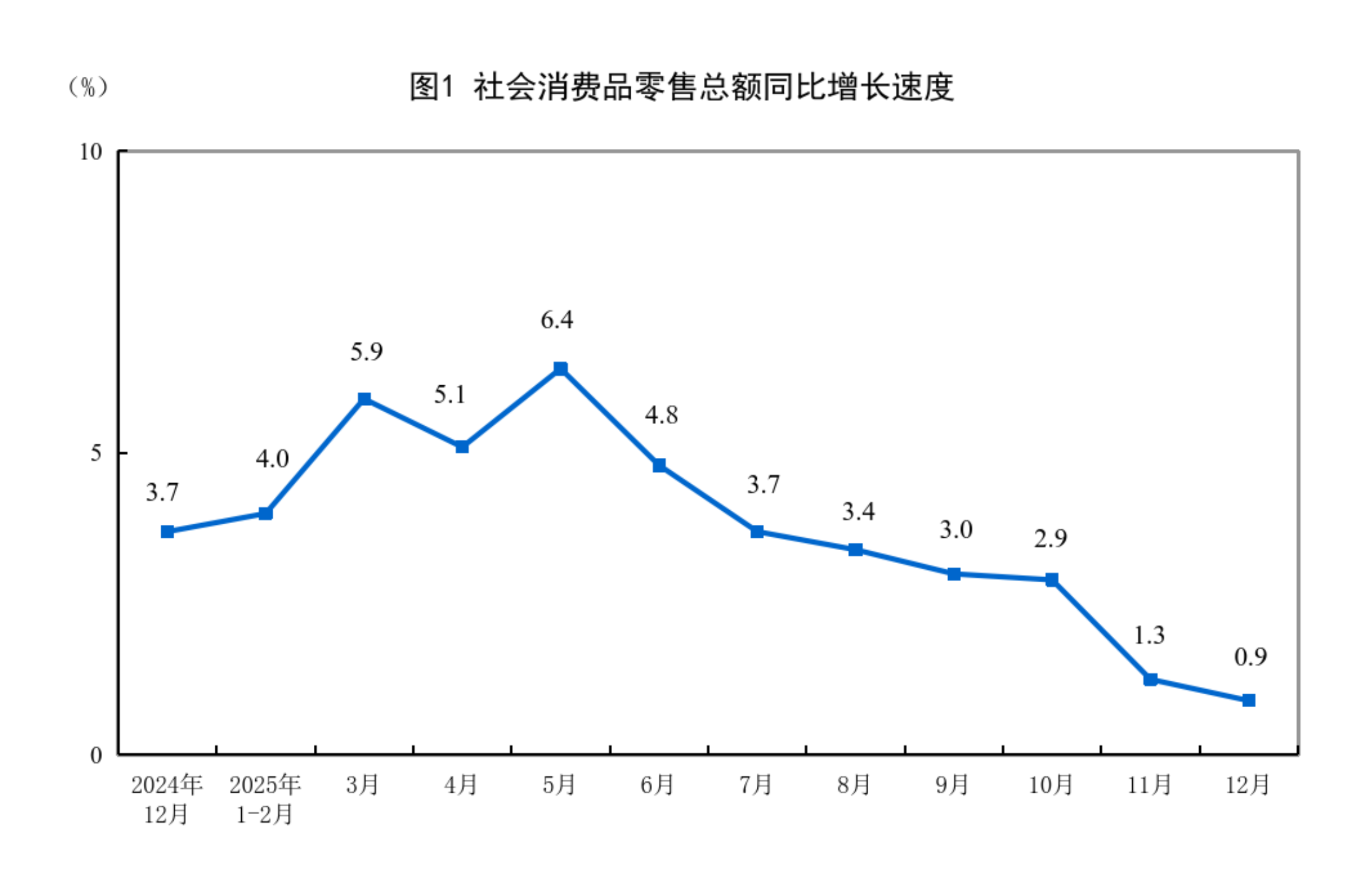
Economic Growth - In Q4 2025, GDP growth was 4.5%, with an annual GDP of 14,018.79 billion yuan, achieving a target growth of around 5%[12] - The contribution to GDP growth from final consumption expenditure was 2.6%, while net exports contributed 1.64%[12] Industrial Production - In December, industrial added value grew by 5.2% year-on-year, with an annual growth of 5.9%[16] - High-tech manufacturing and equipment manufacturing saw added value growth of 9.4% and 9.2%, respectively, exceeding the overall industrial growth by 3.5 and 3.3 percentage points[16] Fixed Asset Investment - National fixed asset investment in 2025 was 485,186 billion yuan, down 3.8% year-on-year, with private investment declining by 6.4%[19] - Infrastructure investment fell by 1.48%, marking the worst performance in a decade, while manufacturing investment saw a slight increase of 0.6%[19] Real Estate Market - Real estate development investment in 2025 decreased by 17.2%, the largest decline since the pandemic, with new construction area down by 20.4%[33] - New residential sales area fell by 8.7%, and sales revenue dropped by 12.6% year-on-year[33] Consumer Spending - In December, retail sales of consumer goods grew by only 0.9%, the lowest monthly increase of the year, with an annual growth of 3.7%[49] - Retail sales excluding automobiles increased by 4.4%, while online retail sales of physical goods rose by 5.2%[49] Price Trends - In December, the Consumer Price Index (CPI) rose by 0.8% year-on-year, while the Producer Price Index (PPI) fell by 2.6% for the year[54] - Food prices significantly contributed to the CPI increase, with fresh fruit prices recovering to a year-on-year growth of 4.4% in December[57]
透过2025年重要经济数据看亮点 新消费增长点持续涌现
Yang Shi Wang· 2026-01-19 09:45
Economic Overview - In 2025, China's GDP reached 140.19 trillion yuan, growing by 5.0% year-on-year at constant prices, achieving the expected target for economic development [1] - Quarterly GDP growth rates were 5.4% in Q1, 5.2% in Q2, 4.8% in Q3, and 4.5% in Q4 [1] Industry Performance - The primary industry added value was 93.35 billion yuan, growing by 3.9%; the secondary industry added value was 499.65 billion yuan, growing by 4.5%; and the tertiary industry added value was 808.88 billion yuan, growing by 5.4% [1] - Industrial production saw a significant increase, with the total industrial added value growing by 5.9%. Key sectors like equipment manufacturing and high-tech manufacturing performed well, with 3D printing equipment, industrial robots, and new energy vehicles seeing production increases of 52.5%, 28%, and 25.1% respectively [1] Consumption Trends - The total retail sales of consumer goods reached 50.12 trillion yuan, marking a 3.7% increase year-on-year, with final consumption expenditure contributing 52% to economic growth, up by 5 percentage points from the previous year [2][4] - Service retail grew by 5.5%, outpacing goods retail by 1.7 percentage points, with significant growth in tourism, transportation, and leisure services [4] - Online retail sales increased by 8.6%, with physical goods online retail growing by 5.2%, accounting for 26.1% of total retail sales [4] Investment Insights - National fixed asset investment (excluding rural households) totaled 48.52 trillion yuan, with manufacturing investment maintaining growth [3] Emerging Consumption Patterns - New consumption trends such as e-commerce, live streaming sales, and online entertainment are driving rapid growth in online consumption [4] - The "silver economy," "ice and snow economy," and "first-release economy" are emerging as new consumption growth points [5]
2025年12月份社会消费品零售总额增长0.9%
Guo Jia Tong Ji Ju· 2026-01-19 02:01
Core Insights - The total retail sales of consumer goods in December reached 45,136 billion yuan, showing a year-on-year growth of 0.9% [7] - Excluding automobiles, the retail sales amounted to 39,654 billion yuan, with a growth of 1.7% [7] - For the year 2025, the total retail sales are projected to be 501,202 billion yuan, representing a growth of 3.7% compared to the previous year [7] Group 1: Retail Sales Overview - In December, urban retail sales were 38,429 billion yuan, increasing by 0.7% year-on-year, while rural retail sales were 6,707 billion yuan, growing by 1.7% [3] - For 2025, urban retail sales are expected to reach 432,972 billion yuan, a growth of 3.6%, and rural retail sales are projected at 68,230 billion yuan, with a growth of 4.1% [3] Group 2: Consumption Type Analysis - In December, the retail sales of goods were 39,398 billion yuan, with a year-on-year increase of 0.7%, while catering revenue was 5,738 billion yuan, growing by 2.2% [4] - For 2025, the retail sales of goods are forecasted to be 443,220 billion yuan, reflecting a growth of 3.8%, and catering revenue is expected to reach 57,982 billion yuan, with a growth of 3.2% [4] Group 3: Retail Formats and Online Sales - In 2025, retail sales from convenience stores, supermarkets, department stores, and specialty stores are projected to grow by 5.5%, 4.3%, 0.1%, and 2.6% respectively, while brand specialty stores are expected to decline by 0.6% [6] - The national online retail sales are anticipated to be 159,722 billion yuan in 2025, marking an 8.6% increase from the previous year, with physical goods online retail sales at 130,923 billion yuan, growing by 5.2% [6]
如何提高居民消费率?
CMS· 2025-12-15 07:34
Consumption Characteristics - China's overall consumption rate (final consumption expenditure/GDP) is significantly lower than that of developed countries, with a ratio of 56.56% compared to over 70% in countries like the US and Japan[10] - The per capita service consumption in China for 2024 is approximately $2,493, which is only about 6% of the US level ($40,088) and 26% of Japan's level ($9,498)[2] - The structure of final consumption shows that the Chinese household consumption rate is around 39.9%, lower than the global average and significantly below countries like India and Brazil[18] Factors Restricting Consumption - The income distribution structure among residents, enterprises, and the government is unbalanced, with residents' income accounting for only about 60% of national income, compared to 84% in the US[31] - Internal income inequality within the resident sector suppresses the purchasing power of lower-income groups, affecting overall consumption capacity[38] - The rigid debt constraints and declining wealth effect limit residents' consumption ability, with household debt to GDP ratio stabilizing around 62%[51] Policy Recommendations - There is potential to enhance consumption policies, focusing on demand-side measures like income increase and burden reduction, as well as supply-side measures such as quality improvement and innovation in consumption scenarios[71] - Increasing service consumption subsidies is crucial, as over 40% of residents' per capita consumption expenditure is on services, which have immediate consumption effects[76] - Encouraging the release of leisure time is essential for boosting service consumption, with proposals for flexible vacation policies and improved work-life balance[77]
国家统计局:今年中国社会消费品零售总额累计增长好于去年
Zhong Guo Xin Wen Wang· 2025-12-15 06:16
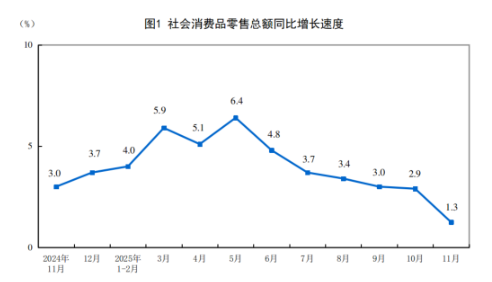
Core Viewpoint - The total retail sales of consumer goods in China showed a cumulative growth better than last year, with a year-on-year increase of 1.3% in November and a cumulative growth of 4% from January to November [1][2]. Group 1: Retail Sales Performance - In November, the total retail sales of consumer goods increased by 1.3% year-on-year, indicating a slight slowdown due to a high base from the previous year [1]. - From January to November, the cumulative retail sales of consumer goods grew by 4%, surpassing both the same period last year and the total growth for the previous year [1]. - The service retail sales from January to November rose by 5.4%, with a continuous increase for three months, indicating a growing share of service consumption in overall consumption [1]. Group 2: New Consumption Trends - New types of consumption, including online and emerging consumption, are developing positively, with online retail sales of physical goods increasing by 5.7% year-on-year, outpacing the overall retail sales growth by 1.7 percentage points [2]. - The share of online retail in total social retail sales reached 25.9%, highlighting the growing importance of digital consumption [2]. - There is a notable increase in demand for digital, green, and health-related consumption, with the retail volume of new energy vehicles in the passenger car market also showing rapid growth [2]. Group 3: Future Outlook - The overall consumption market in November remained stable, with continued expansion in consumption scale [2]. - However, there is a need to enhance residents' consumption capacity and confidence, as well as to strengthen the internal driving force for consumption growth [2]. - Future actions will focus on implementing measures to boost consumption, stabilize employment, promote income growth, and optimize the consumption environment to further release consumption potential [2].
统计局:2025年11月份社会消费品零售总额增长1.3%
Xin Lang Cai Jing· 2025-12-15 02:23
Group 1 - In November, the total retail sales of consumer goods reached 43,898 billion yuan, with a year-on-year growth of 1.3% [1][15] - Excluding automobiles, the retail sales of consumer goods amounted to 39,444 billion yuan, growing by 2.5% [1][15] - From January to November, the total retail sales of consumer goods were 456,067 billion yuan, reflecting a growth of 4.0% [1][15] Group 2 - In November, urban retail sales were 37,684 billion yuan, with a year-on-year increase of 1.0%, while rural retail sales reached 6,214 billion yuan, growing by 2.8% [3][17] - For the period from January to November, urban retail sales totaled 394,544 billion yuan, up by 3.9%, and rural retail sales were 61,523 billion yuan, increasing by 4.4% [3][17] Group 3 - In November, the retail sales of goods were 37,841 billion yuan, with a year-on-year growth of 1.0%, while dining revenue was 6,057 billion yuan, growing by 3.2% [3][17] - From January to November, the retail sales of goods reached 403,822 billion yuan, reflecting a growth of 4.1%, and dining revenue was 52,245 billion yuan, increasing by 3.3% [3][17] Group 4 - For the period from January to November, retail sales in convenience stores, supermarkets, department stores, specialty stores, and brand stores grew by 6.0%, 4.7%, 0.7%, 3.4%, and 0.1% respectively [5][19] - The national online retail sales reached 144,582 billion yuan, with a year-on-year growth of 9.1%, and the physical goods online retail sales were 118,193 billion yuan, increasing by 5.7% [5][19] - The share of physical goods online retail sales in total retail sales of consumer goods was 25.9% [5][19]
Jumia(JMIA) - 2025 Q3 - Earnings Call Presentation
2025-11-12 13:30
Financial Performance - Q3 2025 revenue reached $45.6 million, a 25% year-over-year increase[9] - Q3 2025 GMV totaled $197.2 million, representing a 21% year-over-year growth[9] - Loss before income tax improved to $17.7 million in Q3 2025[7], a 1% year-over-year improvement[9] - Adjusted EBITDA loss was $14.0 million in Q3 2025, compared to $17.0 million in Q3 2024[9, 69] Usage and Customer Metrics - Physical goods orders increased by 34% year-over-year in Q3 2025[7, 20] - Quarterly Active Customers for physical goods grew by 23% year-over-year[7, 17] - Cash burn increased to $15.8 million in Q3 2025, compared to $12.4 million in Q2 2025[7, 9] Regional Performance - Nigeria showed strong momentum, with physical goods orders up 30% and GMV up 43% year-over-year[7] - Egypt's physical goods GMV, excluding corporate sales, grew by 44% year-over-year[25, 26] Future Outlook - The company is on track for targeted full-year 2027 profitability[7] - The company forecasts Loss before Income tax to be between negative $50 million and negative $55 million for full-year 2025[62]

中华全国商业信息中心:前三季度市场销售稳步增长 实物商品网上零售额增速加快
智通财经网· 2025-10-22 11:53
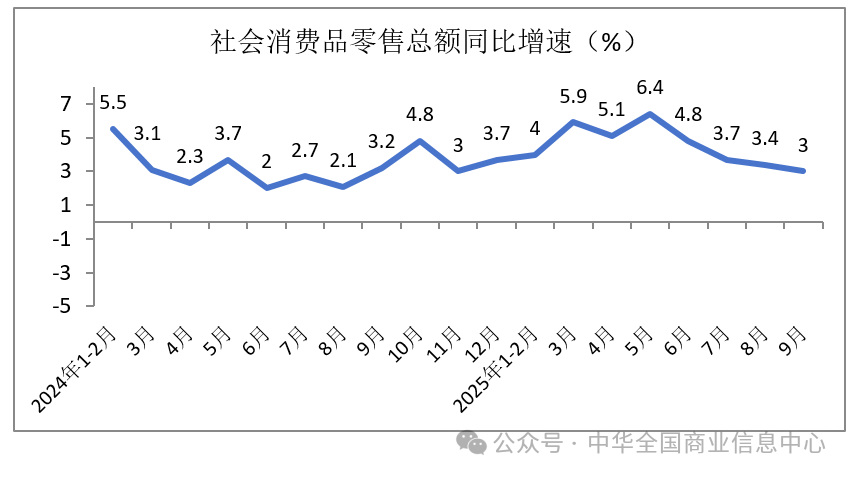
Core Insights - The consumer market in China has shown stable growth in the first three quarters of 2025, with total retail sales of consumer goods reaching 365,877 billion yuan, a year-on-year increase of 4.5%, accelerating by 1.2 percentage points compared to the same period last year and 1.0 percentage point compared to the entire previous year [3][5][9] Group 1: Consumer Spending and Economic Contribution - Final consumption expenditure contributed 53.5% to economic growth, driving GDP growth by 2.8 percentage points, an increase of 9.0 percentage points compared to the previous year [2] - In the third quarter, the contribution rate of final consumption expenditure rose to 56.6%, contributing 2.7 percentage points to GDP growth [2] Group 2: Retail Sales Performance - Retail sales of consumer goods in urban areas reached 316,838 billion yuan, growing by 4.4%, while rural retail sales amounted to 49,039 billion yuan, with a growth rate of 4.6% [5] - The online retail sales of physical goods reached 91,528 billion yuan, increasing by 6.5%, accounting for 25.0% of total retail sales [9] Group 3: Product Categories and Trends - Retail sales of goods totaled 324,888 billion yuan, with a year-on-year growth of 4.6%, and retail sales in limited enterprises increased by 5.1% [7][13] - Basic living goods such as food, clothing, and daily necessities saw retail sales growth of 8.0%, 3.1%, and 7.4% respectively [13] Group 4: Service Consumption Growth - Service retail sales grew by 5.2%, outpacing goods retail sales by 0.6%, with significant growth in cultural, sports, leisure, and travel services [14] - The railway passenger volume reached 3.54 billion, a 6% increase, while box office revenue grew by 20.7% [14] Group 5: Price Trends - The overall price level in the consumer sector remained stable, with the core CPI rising by 0.6% year-on-year, an increase of 0.2 percentage points compared to the first half of the year [17]
商务部最新数据显示:上半年在线餐饮占餐饮收入比重增长1.9个百分点
Jing Ji Ri Bao· 2025-07-21 22:14
Group 1: E-commerce Development in China - In the first half of the year, the contribution rate of online retail sales of physical goods to total social retail sales reached 29.6% [1] - Online dining accounted for a 1.9 percentage point increase in the share of dining revenue [1] - The national online retail sales increased by 8.5% from January to June [1] Group 2: Quality E-commerce and AI Integration - Quality e-commerce initiatives and policies have been effectively implemented, promoting quality products and supporting foreign trade to domestic sales [1] - Key monitored platforms saw significant growth in digital products (9.9%), home appliances (12.7%), and network service consumption (14.6%) [1] - The application of new technologies like artificial intelligence is enhancing the efficiency and innovation of product services across the consumption chain [1] Group 3: Industrial E-commerce Growth - Industrial e-commerce activities have been actively promoting transformation, with over 280 industry matchmaking events held, covering more than 2,200 enterprises [1] - The transaction volume of agricultural products, electronic products, and textile industry e-commerce grew by 17.2%, 7.3%, and 6.2% respectively from January to June [1] Group 4: Silk Road E-commerce Expansion - The number of Silk Road e-commerce partner countries has increased to 36, with new additions including Kenya, Bangladesh, and Egypt [2] - Initiatives like "Silk Road E-commerce Benefits the World" are being advanced to deepen business cooperation with partner countries [2]